Quick Answer
“You’re welcome” is the standard reply to thank you, but native speakers use many alternatives depending on tone and setting.Top alternatives: no problem, my pleasure, anytime, don’t mention it, happy to help.
You’re welcome” is the default response English speakers give after someone says thank you. It signals that you accepted their gratitude and that helping them was not a burden. People use it in daily conversations, at work, in customer service, and in writing such as emails and texts.
Learning alternatives to “you’re welcome” helps you sound more natural and avoid repeating the same phrase in every conversation. It also lets you match your tone to the situation, whether you want to sound casual with friends or professional in a business email. If you also want to express excitement in English or react warmly to someone’s thanks, having a range of phrases makes your responses feel more genuine.
Switching between formal and informal replies shows fluency and emotional intelligence. It tells the listener you understand context, not just vocabulary.
The right tone makes your English sound professional and confident.”
Quick Categories
Formal Alternatives to “You’re Welcome”
- It was my pleasure
- I’m glad I could help
- Not at all
- You’re most welcome
Pro Tip: Use formal alternatives in emails, meetings, and customer service replies to sound polished and respectful.
Casual Alternatives
- No problem
- No worries
- Anytime
- Sure thing
Pro Tip: Save casual alternatives for friends, family, and relaxed conversations, not client-facing messages.
Professional Alternatives
- Happy to help
- Glad I could assist
- Of course
- I’m here if you need anything else
Pro Tip: Professional phrases work best when you also want to keep the door open for future help.
Informal Expressions
- No biggie
- Don’t mention it
- Anytime, friend
- No sweat
Pro Tip: Informal expressions build warmth in personal relationships but can sound unprofessional in writing at work.
“Small phrase changes can completely shift how confident and warm you sound.”
Common Mistakes People Make Using “You’re Welcome”
- Overusing it in every reply, which can sound repetitive and robotic. Example: “Thank you.” “You’re welcome.” “Thanks again.” “You’re welcome.”
- Using casual phrases in formal emails. Example: Writing “no biggie” to a client instead of “happy to help.”
- Sounding sarcastic by accident with flat tone in writing. Example: “You’re welcome.” with no warmth can read as annoyed.
- Skipping a reply altogether, which can seem rude. Example: Someone says “thank you” and you say nothing at all.
- Mixing formal and informal tone in the same message. Example: “It was my pleasure, no biggie at all!”
What Does “You’re Welcome” Mean?
You’re welcome” is a polite response used after someone thanks you. Grammatically, it is a contraction of “you are welcome,” where “welcome” functions as an adjective meaning accepted or invited without obligation.
Example Sentence: “Thanks for helping me move.” “You’re welcome, I was happy to do it.”
When to Use “You’re Welcome”
- After receiving thanks in everyday conversation
- In customer service interactions
- In professional emails when closing a request
- Spoken: casual tone, often shortened to “you’re welcome” or paired with a smile
- Written: slightly more formal, often paired with additional courtesy
Is It Professional or Polite to Say “You’re Welcome”?
You’re welcome” is polite in almost every context, but it is not always the most professional choice. In business settings, phrases like “happy to help” or “of course” often sound more polished and proactive.
Business Example: “Thank you for the quick turnaround.” “Of course, glad I could help before the deadline.”
Polite? Yes Professional? No (in most formal business writing, softer alternatives are preferred)
Pros and Cons of Using “You’re Welcome”
Pros:
- Simple and natural
- Friendly tone
- Common usage
- Easy to understand
Cons:
- Too informal for work
- Overused
- Limited emotional range
- Not suitable for formal writing
“Fluency isn’t about knowing more words, it’s about choosing the right one at the right time.”
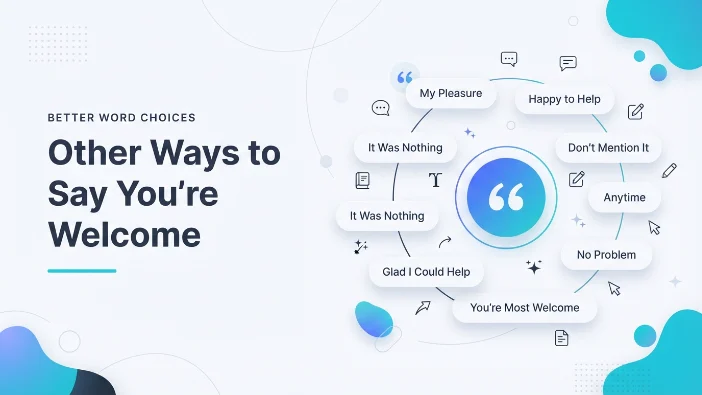
Other Ways to Say You’re Welcome
These alternatives will help you sound more fluent, confident, and natural in different situations. Use them according to tone, context, and audience to express excitement, admiration, or approval when responding to thanks.
Formal Alternatives
1. Phrase: No Problem
Meaning: A relaxed way to say the favor was easy.
Explanation: Shows that helping required little effort.
Example Sentence:
“Thanks for the ride.”
“No problem, I was heading that way anyway.”
Best Use: Friends, casual conversations
Worst Use: Formal emails
Tone: Casual, friendly
Context Variability: Casual, spoken
2. Phrase: My Pleasure
Meaning: Expresses that helping was enjoyable rather than a burden.
Explanation: Common in hospitality, customer service, and professional interactions.
Example Sentence:
“Thank you for your patience.”
“My pleasure. Have a great day!”
Best Use: Customer service, professional settings
Worst Use: Casual text messages
Tone: Warm, professional
Context Variability: Professional, spoken
3. Phrase: Anytime
Meaning: Shows you’re always willing to help again.
Explanation: Creates a friendly, ongoing sense of support.
Example Sentence:
“Thanks for the advice.”
“Anytime—just let me know if you need anything else.”
Best Use: Friends, coworkers
Worst Use: Formal reports
Tone: Casual, reassuring
Context Variability: Casual, professional
4. Phrase: Don’t Mention It
Meaning: Downplays the effort involved in helping.
Explanation: Suggests the favor was too small to deserve thanks.
Example Sentence:
“Thanks for covering my shift.”
“Don’t mention it. Happy to help.”
Best Use: Informal conversations
Worst Use: Client emails
Tone: Humble, casual
Context Variability: Casual, spoken
5. Phrase: Happy to Help
Meaning: Expresses genuine satisfaction in being helpful.
Explanation: One of the most versatile alternatives, suitable for both workplace and everyday conversations.
Example Sentence:
“Thanks for fixing the report.”
“Happy to help. Let me know if anything else comes up.”
Best Use: Workplace, emails
Worst Use: None—highly versatile
Tone: Warm, professional
Context Variability: Professional, casual, spoken
6. Phrase: Of Course
Meaning: Suggests helping was expected and natural.
Explanation: Frequently used in both professional and everyday communication.
Example Sentence:
“Thank you for the update.”
“Of course. I’ll keep you posted.”
Best Use: Business communication
Worst Use: Overly casual chats
Tone: Confident, professional
Context Variability: Professional, spoken
7. Phrase: Not at All
Meaning: A polite way to dismiss someone’s thanks.
Explanation: Especially common in British English and formal conversations.
Example Sentence:
“Thanks for waiting.”
“Not at all. Take your time.”
Best Use: Formal conversations, British English
Worst Use: Casual American conversations
Tone: Polite, formal
Context Variability: Professional, spoken
8. Phrase: Happy to Assist
Meaning: A professional way to acknowledge someone’s gratitude.
Explanation: Frequently used in customer support and business emails.
Example Sentence:
“Thank you for the quick response.”
“Happy to assist. Let me know if you need anything else.”
Best Use: Professional emails, customer service
Worst Use: Casual texting
Tone: Formal, professional
Context Variability: Professional
9. Phrase: Glad to Be of Help
Meaning: Expresses satisfaction in providing assistance.
Explanation: Slightly formal and commonly used in customer support or workplace communication.
Example Sentence:
“Thank you for resolving this quickly.”
“Glad to be of help. Feel free to reach out anytime.”
Best Use: Customer support, business communication
Worst Use: Casual text messages
Tone: Warm, professional
Context Variability: Professional
10. Phrase: I’m Glad I Could Help
Meaning: Shows sincere appreciation for having been useful.
Explanation: Sounds thoughtful and slightly more personal than Happy to Help.
Example Sentence:
“Thanks for explaining the process.”
“I’m glad I could help clarify it.”
Best Use: Mentoring, teaching, workplace conversations
Worst Use: Quick casual replies
Tone: Sincere, supportive
Context Variability: Professional, spoken
Casual Alternatives
11. Phrase: No Worries
Meaning: Reassures someone that helping wasn’t any trouble.
Explanation: Popular in Australian English and casual American conversations.
Example Sentence:
“Sorry for the late reply.”
“No worries at all.”
Best Use: Casual conversations, texting
Worst Use: Formal business emails
Tone: Relaxed, friendly
Context Variability: Casual, spoken
12. Phrase: It’s Nothing
Meaning: Minimizes the effort behind the favor.
Explanation: Common among close friends and family.
Example Sentence:
“Thanks for lending me your notes.”
“It’s nothing. Keep them as long as you need.”
Best Use: Close relationships
Worst Use: Professional settings
Tone: Humble, casual
Context Variability: Casual, spoken
13. Phrase: You Bet
Meaning: An enthusiastic way to respond to thanks.
Explanation: Common in informal American English.
Example Sentence:
“Thanks for the recommendation.”
“You bet. Glad you liked it.”
Best Use: Casual American English
Worst Use: Formal writing
Tone: Energetic, casual
Context Variability: Casual, spoken
14. Phrase: Sure Thing
Meaning: A friendly and upbeat acknowledgment.
Explanation: Common in service settings and casual conversations.
Example Sentence:
“Thanks for the extra napkins.”
“Sure thing. Enjoy your meal!”
Best Use: Service settings, casual conversations
Worst Use: Formal documents
Tone: Upbeat, casual
Context Variability: Casual, spoken
15. Phrase: No Sweat
Meaning: Says the favor required little or no effort.
Explanation: Very informal and often used among friends.
Example Sentence:
“Thanks for helping me carry these boxes.”
“No sweat—that’s what friends are for.”
Best Use: Friends, informal conversations
Worst Use: Workplace emails
Tone: Relaxed, playful
Context Variability: Casual, spoken
16. Phrase: It Was Nothing
Meaning: Downplays the significance of your help.
Explanation: A humble way to accept someone’s thanks.
Example Sentence:
“Thanks for the quick fix.”
“It was nothing. Glad it worked.”
Best Use: Casual conversations
Worst Use: Formal business writing
Tone: Humble, casual
Context Variability: Casual, spoken
17. Phrase: Cheers
Meaning: A brief, informal acknowledgment of thanks.
Explanation: Commonly used in British English instead of You’re welcome.
Example Sentence:
“Thanks for the coffee.”
“Cheers! Enjoy.”
Best Use: British casual English
Worst Use: Formal American business writing
Tone: Friendly, casual
Context Variability: Casual, spoken
18. Phrase: I’ve Got You
Meaning: Reassures someone that you’ll continue to support them.
Explanation: Popular among close friends and teammates.
Example Sentence:
“Thanks for backing me up in the meeting.”
“I’ve got you—always.”
Best Use: Friends, teammates
Worst Use: Formal writing
Tone: Supportive, casual
Context Variability: Casual, spoken
19. Phrase: I’m Here for That
Meaning: A modern way to say you’re happy to help.
Explanation: Frequently used by younger English speakers.
Example Sentence:
“Thanks for organizing the event.”
“I’m here for that—it was fun!”
Best Use: Casual modern conversations
Worst Use: Formal writing
Tone: Enthusiastic, casual
Context Variability: Casual, spoken
20. Phrase: Consider It Done
Meaning: Confirms the task has been completed successfully.
Explanation: Often used after finishing a request or assignment.
Example Sentence:
“Thanks for handling the report.”
“Consider it done. Glad to help.”
Best Use: Workplace, task-based communication
Worst Use: Emotional or personal conversations
Tone: Confident, professional
Context Variability: Professional, spoken
Thoughtful & Sincere Alternatives
21. Phrase: I Appreciate You Saying That
Meaning: Acknowledges someone’s gratitude warmly.
Explanation: Accepts appreciation without dismissing it.
Example Sentence:
“Thank you for your hard work.”
“I appreciate you saying that. It means a lot.”
Best Use: Teamwork, leadership
Worst Use: Very quick casual replies
Tone: Sincere, warm
Context Variability: Professional, spoken
22. Phrase: You’re Most Welcome
Meaning: A gracious, more formal version of You’re welcome.
Explanation: Frequently heard in hospitality and customer service.
Example Sentence:
“Thank you for accommodating us.”
“You’re most welcome. We’re glad you enjoyed your stay.”
Best Use: Hospitality, formal service
Worst Use: Casual texting
Tone: Formal, gracious
Context Variability: Professional, spoken
23. Phrase: Happy to Be Here for You
Meaning: Expresses emotional support along with appreciation.
Explanation: Common among close friends and family.
Example Sentence:
“Thanks for listening to me.”
“Happy to be here for you. Always.”
Best Use: Emotional support, friendships
Worst Use: Business settings
Tone: Caring, warm
Context Variability: Casual, spoken
24. Phrase: Think Nothing of It
Meaning: Encourages the person not to feel indebted.
Explanation: A classic, slightly formal English expression.
Example Sentence:
“Thanks for the ride home.”
“Think nothing of it. Happy to help.”
Best Use: Polite conversations
Worst Use: Modern casual texting
Tone: Formal, gracious
Context Variability: Professional, spoken
25. Phrase: Always Happy to Lend a Hand
Meaning: Shows that helping others is something you gladly do.
Explanation: Common in workplaces and community settings.
Example Sentence:
“Thanks for volunteering again.”
“Always happy to lend a hand.”
Best Use: Community work, teamwork
Worst Use: Very brief casual replies
Tone: Warm, dependable
Context Variability: Professional, casual
26. Phrase: It’s My Job
Meaning: Explains that helping is part of your role.
Explanation: Common in customer service and professional environments.
Example Sentence:
“Thanks for solving my issue so quickly.”
“It’s my job. Glad I could help.”
Best Use: Customer service, workplace
Worst Use: Personal relationships
Tone: Professional, matter-of-fact
Context Variability: Professional, spoken
27. Phrase: Absolutely, Anytime
Meaning: Enthusiastically offers future help as well.
Explanation: Sounds approachable and supportive.
Example Sentence:
“Thanks for reviewing my draft.”
“Absolutely, anytime you need feedback.”
Best Use: Professional collaboration
Worst Use: Highly formal documents
Tone: Confident, warm
Context Variability: Professional, spoken
28. Phrase: Only Glad to Help
Meaning: Emphasizes sincere willingness to assist.
Explanation: A polished and slightly formal expression.
Example Sentence:
“Thank you for mentoring me.”
“Only glad to help. You’re doing great.”
Best Use: Mentorship, professional support
Worst Use: Quick casual conversations
Tone: Sincere, formal
Context Variability: Professional, spoken
29. Phrase: It Was the Least I Could Do
Meaning: Suggests your help was modest compared to what the person deserved.
Explanation: A humble response after doing a meaningful favor.
Example Sentence:
“Thank you for staying late to help.”
“It was the least I could do.”
Best Use: Sincere, heartfelt situations
Worst Use: Small everyday favors
Tone: Humble, warm
Context Variability: Professional, spoken
30. Phrase: You Don’t Need to Thank Me
Meaning: Politely tells someone their gratitude isn’t necessary.
Explanation: Can sound caring and reassuring when said sincerely.
Example Sentence:
“Thank you so much for this.”
“You don’t need to thank me, really.”
Best Use: Close relationships
Worst Use: Formal business replies
Tone: Humble, personal
Context Variability: Casual, spoken
Choosing the right phrase for the moment is what separates good English from fluent English.
Quiz: Test Your Knowledge
1. Which phrase is best for a formal business email?
A) No biggie
B) Happy to assist
C) No sweat
Answer: B) Happy to assist It’s professional, courteous, and well-suited for business communication.
2. Which phrase is the most casual when talking with friends?
A) It’s my job
B) No worries
C) You’re most welcome
Answer: B) No worries This relaxed expression is commonly used in everyday conversations with friends and family.
3. Which phrase works best in hospitality or customer service?
A) My pleasure
B) I’ve got you
C) Cheers
Answer: A) My pleasure A polished and welcoming response that’s widely used in customer-facing roles.
4. Which phrase should you avoid in a professional client email?
A) Of course
B) No biggie
C) Happy to help
Answer: B) No biggie Its informal tone makes it unsuitable for professional business communication.
Choosing the right response to “thank you” helps you sound more natural, professional, and confident in every conversation.
Comparison Table: Top Alternatives
| Phrase | Tone | Best Use |
|---|---|---|
| No problem | Casual | Friends, everyday talk |
| My pleasure | Formal, warm | Customer service |
| Anytime | Casual, reassuring | Friends, colleagues |
| Don’t mention it | Casual, humble | Informal conversation |
| Happy to help | Professional, warm | Workplace, email |
| Of course | Professional, confident | Business communication |
| Not at all | Formal, polite | British English, formal talk |
| No worries | Relaxed, friendly | Texts, casual chats |
| I’m glad I could help | Sincere, professional | Mentoring, teaching |
| Happy to assist | Formal, professional | Professional emails |
FAQs
What can I say instead of “you’re welcome” in a formal email?
Use phrases like “happy to assist,” “glad I could help,” or “of course” to sound professional and polished.
Is “no problem” rude to say instead of “you’re welcome”?
No, “no problem” is a common and accepted casual alternative, though it should be avoided in very formal writing.
What is a British English alternative to “you’re welcome”?
“Not at all” and “cheers” are common British English alternatives.
Can “you’re welcome” sound sarcastic?
Yes, if the tone is flat or delayed, it can sound sarcastic, especially in text without emojis or warmth.
What is the most professional way to reply to thank you?
“Happy to assist” or “glad I could help” are considered the most professional alternatives.
Conclusion
Learning different other ways to say “you’re welcome” helps you sound more fluent, natural, and confident in both spoken and written English. Instead of repeating the same phrase, you can match your tone to the situation, whether formal, professional, or casual.
Practice these alternatives daily in real conversations, emails, and messages. Paying attention to tone and context will help your English sound more authentic and appropriate, no matter who you’re speaking to.
Read More Related Articles:
- Other Ways to Say “This Shows That” | Express Your Ideas with Confidence In 2026
- Other Ways to Say “Which” in English | Beyond the Common Choices In 2026
- Other Ways to Say Also in an Essay | Make Your Writing Shine In 2026

Henry Walker is an American writer and blogger with a keen interest in communication, language and digital content. At TextsResponse.com, he creates informative and reader-focused resources designed to help people communicate with clarity, confidence and authenticity.