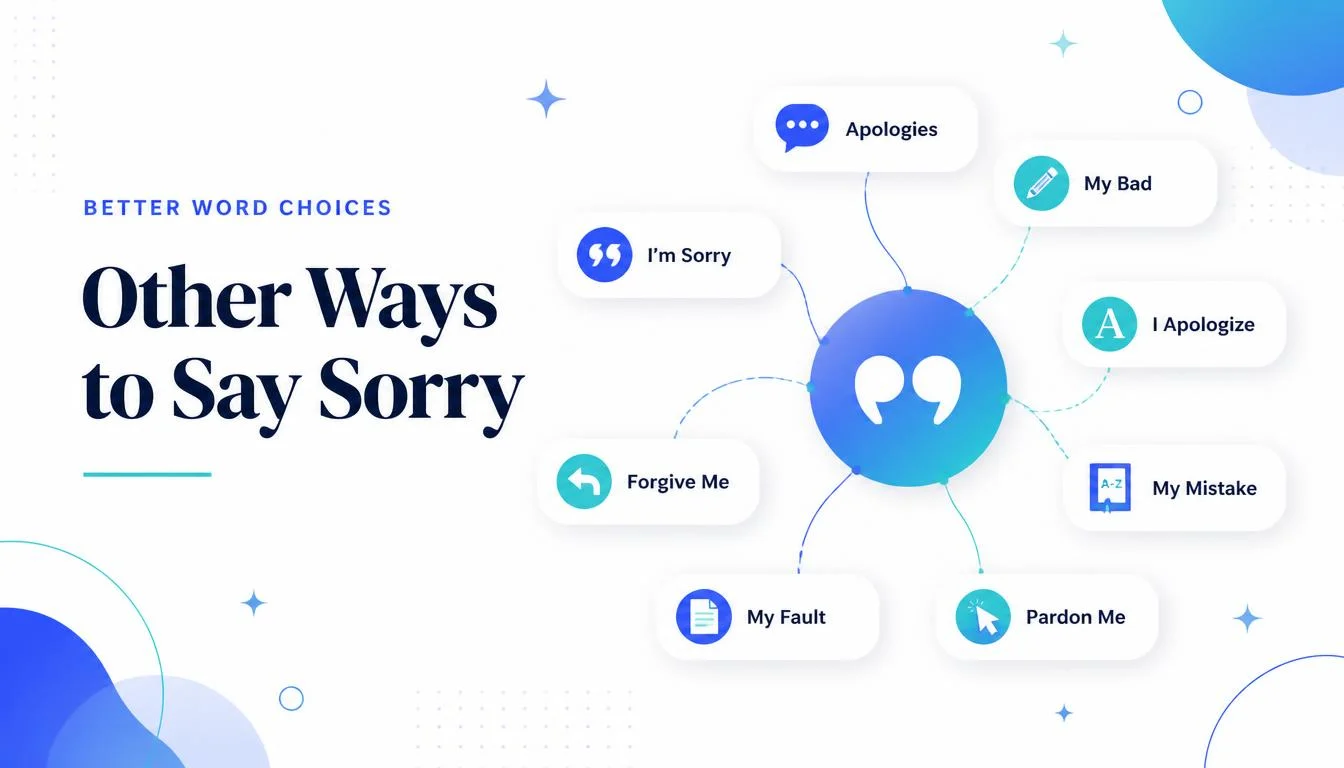
Quick Answer
Other ways to say yes include absolutely, certainly, definitely, of course, indeed, agreed, and certainly.
Finding other ways to say yes can help you sound more natural, confident, and expressive in English. Instead of repeating “yes” in every conversation, you can choose alternatives that match the situation and tone.
Whether you are agreeing with someone, confirming information, accepting an offer, or responding professionally, learning other ways to say yes gives you more flexibility in both spoken and written English.
Quick Categories
Formal alternatives to “Sorry”
- I sincerely apologize
- My deepest apologies
- Please accept my apologies
- I beg your pardon
Pro Tip: Use formal alternatives in emails, official letters, or when addressing someone with authority. They signal respect and seriousness.
Casual alternatives
- My bad
- Oops, my mistake
- My fault
- That was my mistake
Pro Tip: Save casual alternatives for friends, family, or relaxed conversations. Using them at work can seem unprofessional.
Professional alternatives
- I apologize for the inconvenience
- I apologize for any trouble caused
- I take full responsibility
- I apologize for the delay
Pro Tip: Professional alternatives work best in customer service, business emails, and workplace communication where clarity and accountability matter.
Informal expressions
- Excuse me
- Forgive me
- I didn’t mean to do that
- I hate that this happened
Pro Tip: Informal expressions suit everyday spoken English but should be paired with a sincere tone to avoid sounding dismissive.
“Tone is not decoration, it’s the message itself.”
Common Mistakes Section
- Overusing “sorry” without context
Mistake: “Sorry sorry sorry, I didn’t see your message.”
Fix: Use one clear apology instead of repeating the word. - Using casual phrases in formal writing
Mistake: “My bad for the late report.”
Fix: “I apologize for the delay in submitting the report.” - Apologizing without taking responsibility
Mistake: “Sorry you feel that way.”
Fix: “I’m sorry for how my words affected you. - Mixing formal and informal tone in one sentence
Mistake: “I sincerely apologize, my bad.”
Fix: Choose one tone and stay consistent. - Skipping the reason for the apology
Mistake: “Sorry.”
Fix: “I apologize for missing the deadline.”
What Does “Sorry” Mean?
“Sorry” is an adjective used to express regret, sympathy, or an apology for a mistake, inconvenience, or unfortunate situation. Grammatically, it is often followed by “for” plus a noun or gerund, or “about” plus a noun.
Example: I’m sorry for the confusion earlier today.
When to Use “Sorry”
- Apologizing for a mistake or delay
- Expressing sympathy for someone’s misfortune
- Interrupting or getting someone’s attention
- Declining an invitation politely
Spoken vs Written: In speech, “sorry” is short and immediate. In writing, especially professional writing, alternatives to sorry like “I apologize” often sound more polished.
Formal vs Informal: “Sorry” works in both settings, but formal writing usually pairs it with more specific, structured phrasing.
Is It Professional or Polite to Say “Sorry”?
Sorry” is polite in almost every context, but it is not always the most professional choice for business communication, where accountability and clarity matter more.
Business example: “I’m sorry, the shipment was delayed” sounds less formal than “I apologize for the delay in your shipment.”
Polite? Yes
Professional? No, in most formal business contexts
Pros and Cons of Using “Sorry”
Pros
- Simple and natural
- Friendly tone
- Common usage
- Easy to understand
Cons
- Too informal for work
- Overused
- Limited emotional range
- Not suitable for formal writing
Fluency isn’t about knowing more words, it’s about knowing which word fits the moment.
Other Ways to Say “Sorry” (With Examples)1. I Apologize
Meaning: A direct statement of regret.
Explanation: Slightly more formal than “sorry” and widely accepted in speech and writing.
Example Sentence: I apologize for the confusion in my last email.
Best Use: Emails, meetings
Worst Use: Casual chats
Tone: Formal, respectful
Context Variability: Professional, written
2. My Apologies
Meaning: A brief, formal way to say sorry.
Explanation: Common in business writing and polite conversation.
Example Sentence: My apologies for the late reply.
Best Use: Business emails
Worst Use: Close friendships
Tone: Polished, brief
Context Variability: Professional, spoken
3. Please Accept My Apologies
Meaning: A formal request for forgiveness.
Explanation: Used when addressing someone of higher status or in official matters.
Example Sentence: Please accept my apologies for the scheduling error.
Best Use: Official letters
Worst Use: Everyday talk
Tone: Formal, respectful
Context Variability: Professional, written
4. I Sincerely Apologize
Meaning: A heartfelt, formal apology.
Explanation: Adds emotional weight to a formal statement.
Example Sentence: I sincerely apologize for the inconvenience this caused you.
Best Use: Serious mistakes
Worst Use: Minor errors
Tone: Serious, sincere
Context Variability: Professional, spoken
5. My Deepest Apologies
Meaning: An intense expression of regret.
Explanation: Reserved for significant errors or emotional situations.
Example Sentence: My deepest apologies for missing your event.
Best Use: Major mistakes
Worst Use: Small talk
Tone: Solemn, formal
Context Variability: Formal, written
6. I Owe You an Apology
Meaning: Acknowledging a debt of regret to someone.
Explanation: Suggests personal accountability and reflection.
Example Sentence: I owe you an apology for how I reacted yesterday.
Best Use: Personal conflicts
Worst Use: Business emails
Tone: Honest, reflective
Context Variability: Spoken, personal
7. I Regret That
Meaning: Expressing sorrow over an outcome.
Explanation: Common in formal or written statements.
Example Sentence: I regret that the meeting was cancelled at short notice.
Best Use: Formal statements
Worst Use: Casual talk
Tone: Formal, neutral
Context Variability: Professional, written
8. I Regret Any Inconvenience Caused
Meaning: A formal acknowledgment of disruption.
Explanation: Frequently used in customer service and official notices.
Example Sentence: We regret any inconvenience caused by the delay.
Best Use: Customer service
Worst Use: Personal apologies
Tone: Formal, corporate
Context Variability: Professional, written
9. Please Forgive Me
Meaning: A request for pardon.
Explanation: More emotional and personal than a standard apology.
Example Sentence: Please forgive me for forgetting your birthday.
Best Use: Personal relationships
Worst Use: Workplace emails
Tone: Emotional, sincere
Context Variability: Personal, spoken
10. Forgive Me
Meaning: A short request for pardon.
Explanation: Slightly dramatic and used for emphasis.
Example Sentence: Forgive me, I didn’t realize you were waiting.
Best Use: Spoken apologies
Worst Use: Formal writing
Tone: Warm, direct
Context Variability: Spoken, personal
11. My Bad
Meaning: A casual way to admit fault.
Explanation: Very informal and common among peers.
Example Sentence: My bad, I forgot to send the file.
Best Use: Friends, casual chats
Worst Use: Professional settings
Tone: Relaxed, casual
Context Variability: Casual, spoken
12. Oops, My Mistake
Meaning: A light acknowledgment of a small error.
Explanation: Used for minor, low-stakes mistakes.
Example Sentence: Oops, my mistake, I sent the wrong link.
Best Use: Minor errors
Worst Use: Serious situations
Tone: Playful, light
Context Variability: Casual, spoken
13. My Fault
Meaning: A direct admission of responsibility.
Explanation: Short and used in everyday speech.
Example Sentence: My fault, I should have checked the schedule.
Best Use: Casual conversation
Worst Use: Formal writing
Tone: Honest, casual
Context Variability: Casual, spoken
14. I Take Full Responsibility
Meaning: A statement of ownership over a mistake.
Explanation: Common in professional and leadership contexts.
Example Sentence: I take full responsibility for the missed deadline.
Best Use: Workplace accountability
Worst Use: Minor slip-ups
Tone: Confident, professional
Context Variability: Professional, spoken
15. I Didn’t Mean to Do That
Meaning: Clarifying that the action was unintentional.
Explanation: Often paired with another apology phrase.
Example Sentence: I didn’t mean to do that, please forgive me.
Best Use: Clarifying intent
Worst Use: Formal writing
Tone: Apologetic, honest
Context Variability: Spoken, personal
16. I Feel Terrible About This
Meaning: Expressing strong emotional regret.
Explanation: Shows depth of feeling behind the apology.
Example Sentence: I feel terrible about this; it was completely avoidable.
Best Use: Personal apologies
Worst Use: Brief emails
Tone: Emotional, sincere
Context Variability: Personal, spoken
17.
Mini Quiz / Self-Check
Mini Quiz / Self-Check
1. Which phrase is most appropriate in a formal business email?
a) My bad
b) I apologize for the inconvenience
c) Oops, my mistake
2. Which alternative best suits a casual conversation with a friend?
a) I beg your pardon
b) My apologies for any confusion
c) My fault
3. True or False: “I take full responsibility” is a good phrase for workplace accountability.
Answer: True
4. Which phrase adds an action-oriented solution to an apology?
a) I feel terrible about this
b) Let me make it right
c) Excuse me
Answers: 1-b, 2-c, 3-True, 4-b
Comparison Table: Top Alternatives
| Phrase | Tone | Best Use |
|---|---|---|
| I apologize | Formal, respectful | Emails, meetings |
| My apologies | Polished, brief | Business emails |
| I sincerely apologize | Serious, sincere | Serious mistakes |
| My deepest apologies | Solemn, formal | Major mistakes |
| I take full responsibility | Confident, professional | Workplace accountability |
| My bad | Relaxed, casual | Friends, casual chats |
| Oops, my mistake | Playful, light | Minor errors |
| I apologize for the inconvenience | Formal, polite | Customer support |
| Please forgive me | Emotional, sincere | Personal relationships |
| Let me make it right | Proactive, sincere | Problem-solving apologies |
FAQs
1. What is a more professional way to say sorry?
I apologize for the inconvenience” or “I take full responsibility” are more professional alternatives to sorry in workplace communication.
2. What is a casual way to say sorry?
“My bad” and “Oops, my mistake” are common casual alternatives used among friends.
3. Is it rude to overuse “sorry” in English?
Overusing “sorry” can weaken its impact and make apologies feel automatic rather than sincere.
4. What are formal alternatives to “sorry” for emails?
“Please accept my apologies” and “I sincerely apologize” work well in formal, written English.
5. How can I sound more sincere when apologizing?
Pair your apology with a specific reason and, when possible, a solution, such as “Let me make it right.”
Conclusion
Learning other ways to say sorry gives you the flexibility to match your tone to any situation, whether formal, professional, or casual. Instead of relying on one word, using varied apology phrases makes your English sound more natural, confident, and sincere.
Practice these alternatives daily in real conversations and writing. Pay attention to tone, audience, and context each time you apologize, and over time, choosing the right phrase will become second nature.
Read More Related Articles:
- Other Ways to Say “From” in a Letter | For a More Professional Sign-Off In 2026
- Other Ways to Say Be Safe | Upgrade Your Farewells In 2026
- Other Ways to Say Feel Free | Formal Writing and Business Communication In 2026

Daniel Murphy is a professional writer and blogger specializing in digital communication and messaging trends. As a contributor to TextsResponse.com, he creates reader-focused content designed to help people find the right words at the right time.