Quick Answer:
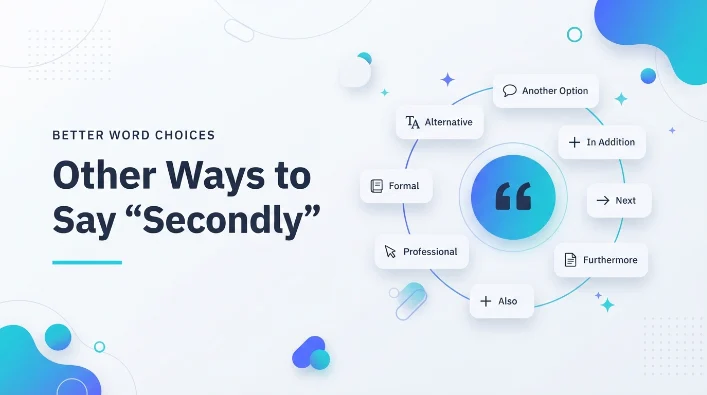
Looking for alternatives to “secondly”? Try next, furthermore, moreover, in addition, or subsequently. These synonyms work across formal writing, professional emails, and everyday conversation to help you express your second point more naturally.
The word “secondly” is a common transition adverb used to introduce the second point, reason, or step in a sequence. You’ve likely used it countless times when listing arguments, explaining processes, or structuring presentations. While it gets the job done, relying on it too often can make your English sound repetitive and uninspired.
Learning alternatives to “secondly” is one of the quickest ways to elevate your fluency. Whether you are writing a business report, delivering a presentation, or simply having a conversation, varying your transition words makes you sound more polished and confident. It also helps you express excitement in English by keeping your listener engaged with fresh, dynamic language.
“The right transition word at the right moment can transform a clumsy sentence into a confident statement.”
Quick Categories
Formal Alternatives to “Secondly”
- Furthermore
- Moreover
- Subsequently
- In the second place
- Additionally
- A further consideration is
Casual Alternatives
- Next
- Then
- After that
- Also
- Plus
Professional Alternatives
- In addition
- Another key point
- Following this
- Building on that
- Equally important
Informal Expressions
- On top of that
- What’s more
- Moving on
- Likewise
- Not only that
What Does “Secondly” Mean?
Secondly is an adverb that means “in the second place” or “as a second point.” It is used to introduce the second item in a sequence of ideas, arguments, steps, or reasons.
Grammar note: “Secondly” is a conjunctive adverb it connects two clauses or sentences and shows the relationship between them. It typically appears at the beginning of a sentence or clause, followed by a comma.
Example sentence: “Firstly, we need to review the budget; secondly, we must allocate resources to each department.”
When to Use “Secondly”
Use “secondly” when you are:
- Presenting a numbered list of arguments or reasons
- Explaining a step-by-step process
- Structuring a speech or presentation
- Writing formal essays or academic papers
- Organizing ideas in professional correspondence
Spoken vs Written: “Secondly” appears more often in formal writing than in casual speech. In conversation, native speakers usually prefer simpler transitions like “next” or “then.”
Formal vs Informal: “Secondly” leans formal. While acceptable in academic and professional contexts, it can feel stiff in everyday conversation.
“Great communicators don’t just know words they know when to use them.”
Is It Professional or Polite to Say “Secondly”?
Polite? ✔️ Yes it is neutral and courteous.
Professional? ❌ Not in most cases while not incorrect, “secondly” can sound dated and overly mechanical in modern business communication. Professionals today prefer smoother, more natural transitions like “furthermore” or “in addition.”
Business-style example: “Our primary concern is customer satisfaction. Furthermore, we must ensure our team has the resources to deliver on that promise.”
Pros and Cons of Using “Secondly”
Pros
- Simple and easy to understand
- Clearly signals the second point
- Commonly used and widely accepted
- Works in both spoken and written English
Cons
- Sounds too formal for casual conversation
- Can feel repetitive when overused
- Lacks nuance and emotional range
- Not suitable for creative or informal writing
Other Ways to Say “Secondly” (With Examples)
These 30 alternatives will help you sound more fluent, confident, and natural in different situations. Use them according to tone, context, and audience to express your second point with precision.
1. Phrase: Next
Meaning: Immediately following in order or sequence.
Explanation: A simple, strong alternative that works in almost any context.
Example Sentence: “First, gather all the materials. Next, assemble the components according to the manual.”
Best Use: Instructions
Worst Use: Formal academic essays
Tone: Neutral, clear
Context Variability: Casual: “Next, we went to the store.” / Professional: “Next, I will address our quarterly targets.”
2. Phrase: Furthermore
Meaning: In addition to what has just been stated.
Explanation: Adds weight to your second point, implying it strengthens the first.
Example Sentence: “The proposal is cost-effective. Furthermore, it requires minimal training for staff.”
Best Use: Persuasive writing
Worst Use: Casual conversation
Tone: Formal, persuasive
Context Variability: Professional: “Furthermore, the data supports this conclusion.” / Formal: “Furthermore, we must consider the ethical implications.”
3. Phrase: Moreover
Meaning: As an additional and important point.
Explanation: Similar to “furthermore” but often carries a slightly stronger sense of adding significant information.
Example Sentence: “The new software increases efficiency. Moreover, it reduces operational costs by 15%.”
Best Use: Academic writing
Worst Use: Text messages
Tone: Formal, emphatic
Context Variability: Professional: “Moreover, this strategy aligns with our long-term goals.” / Formal: “Moreover, the evidence is overwhelming.”
4. Phrase: Subsequently
Meaning: After a particular thing has happened; afterward.
Explanation: Emphasizes a time-based sequence, ideal for describing events that follow one another.
Example Sentence: “The committee approved the proposal. Subsequently, the implementation team began work.”
Best Use: Chronological narratives
Worst Use: Listing unrelated points
Tone: Formal, sequential
Context Variability: Professional: “Subsequently, we revised our strategy.” / Formal: “The data was collected and subsequently analyzed.”
5. Phrase: In addition
Meaning: As an extra point or factor.
Explanation: A neutral, professional way to introduce another item to your list.
Example Sentence: “We need to increase our marketing budget. In addition, we should hire a social media specialist.”
Best Use: Business communication
Worst Use: Very informal settings
Tone: Professional, neutral
Context Variability: Professional: “In addition, we offer free shipping.” / Casual: “In addition, I brought snacks.”
6. Phrase: Additionally
Meaning: As a further point; also.
Explanation: A versatile alternative that fits almost any context.
Example Sentence: “The course covers basic grammar. Additionally, it includes advanced writing techniques.”
Best Use: Almost any context
Worst Use: Overusing in a single paragraph
Tone: Neutral, professional
Context Variability: Professional: “Additionally, we provide ongoing support.” / Casual: “Additionally, I think we should leave early.”
7. Phrase: Then
Meaning: After that; next in order.
Explanation: One of the simplest and most natural alternatives.
Example Sentence: “Press the power button. Then, wait for the system to boot up.”
Best Use: Step-by-step instructions
Worst Use: Formal academic papers
Tone: Casual, straightforward
Context Variability: Casual: “We had dinner, then we went to the movies.” / Professional: “Review the document, then sign it.”
8. Phrase: Following that
Meaning: Coming immediately after in time or order.
Explanation: Emphasizes the direct sequence between two points.
Example Sentence: “We will finalize the design. Following that, we will begin production.”
Best Use: Project timelines
Worst Use: Quick, casual lists
Tone: Professional, sequential
Context Variability: Professional: “Following that, we’ll conduct user testing.” / Formal: “Following that, a new phase will commence.”
9. Phrase: In the second place
Meaning: As the second item or point.
Explanation: A more formal version of “secondly” that sounds slightly more deliberate.
Example Sentence: “In the first place, we lack funding. In the second place, we don’t have the right team.”
Best Use: Formal arguments
Worst Use: Everyday conversation
Tone: Formal, structured
Context Variability: Formal: “In the second place, the evidence is inconclusive.” / Professional: “In the second place, we must consider logistics.”
10. Phrase: Another point is
Meaning: Introduces an additional point or consideration.
Explanation: A clear, straightforward way to add to your list.
Example Sentence: “Another point is that remote work improves employee satisfaction.”
Best Use: Meetings and discussions
Worst Use: Very formal writing
Tone: Conversational, clear
Context Variability: Professional: “Another point is our budget constraints.” / Casual: “Another point is that I don’t like sushi.”
11. Phrase: A further consideration is
Meaning: Introduces an additional factor to think about.
Explanation: A polished, thoughtful way to add a second point.
Example Sentence: “A further consideration is the environmental impact of our packaging.”
Best Use: Reports and proposals
Worst Use: Casual chats
Tone: Formal, analytical
Context Variability: Formal: “A further consideration is long-term sustainability.” / Professional: “A further consideration is staff training.”
12. Phrase: Equally important
Meaning: Indicates that the second point carries the same weight as the first.
Explanation: Perfect when you want to emphasize that your second point is just as significant.
Example Sentence: “We need to improve our product quality. Equally important, we must enhance customer service.”
Best Use: Persuasive arguments
Worst Use: Listing trivial points
Tone: Emphatic, professional
Context Variability: Professional: “Equally important is our commitment to diversity.” / Formal: “Equally important, the methodology must be sound.”
13. Phrase: Building on that
Meaning: Adding to or expanding upon the previous point.
Explanation: Creates a sense of progression and development in your argument.
Example Sentence: “We have a strong brand identity. Building on that, we should launch a new marketing campaign.”
Best Use: Strategic discussions
Worst Use: Simple lists
Tone: Dynamic, professional
Context Variability: Professional: “Building on that, let’s explore new markets.” / Casual: “Building on that, I think we should try something new.”
14. Phrase: Following this
Meaning: Coming after this point in the sequence.
Explanation: A smooth, professional transition for structured writing.
Example Sentence: “We will analyze the data. Following this, we will draft the report.”
Best Use: Process descriptions
Worst Use: Quick, informal notes
Tone: Formal, sequential
Context Variability: Formal: “Following this, the results will be published.” / Professional: “Following this, we’ll schedule a review.”
15. Phrase: Also
Meaning: In addition; too.
Explanation: One of the most common and versatile alternatives.
Example Sentence: “We need to hire a developer. Also, we should upgrade our servers.”
Best Use: Everyday conversation
Worst Use: Formal academic writing
Tone: Casual, simple
Context Variability: Casual: “I’m tired. Also, I’m hungry.” / Professional: “Also, please review the attached document.”
16. Phrase: Plus
Meaning: As an additional point; also.
Explanation: Informal and conversational, great for spoken English.
Example Sentence: “The hotel has a pool. Plus, it offers free breakfast.”
Best Use: Casual conversation
Worst Use: Business reports
Tone: Informal, friendly
Context Variability: Casual: “I like this car. Plus, it’s affordable.” / Professional: Avoid in formal writing.
“Alternatives to ‘secondly’ are not just synonyms they are tools for better communication.”
17. Phrase: On top of that
Meaning: In addition to everything already mentioned.
Explanation: An informal, emphatic way to add another point.
Example Sentence: “The project is behind schedule. On top of that, we’ve exceeded our budget.”
Best Use: Informal spoken English
Worst Use: Formal writing
Tone: Informal, emphatic
Context Variability: Casual: “On top of that, it started raining.” / Professional: Avoid.
18. Phrase: What’s more
Meaning: As an additional and often surprising point.
Explanation: Adds a layer of emphasis, often introducing information that strengthens your case.
Example Sentence: “The restaurant has excellent food. What’s more, the service is outstanding.”
Best Use: Persuasive speech
Worst Use: Academic papers
Tone: Conversational, persuasive
Context Variability: Casual: “What’s more, they gave us a discount.” / Professional: “What’s more, our competitors are struggling.”
19. Phrase: Moving on
Meaning: Transitioning to the next point.
Explanation: A natural way to shift focus, especially in presentations.
Example Sentence: “We’ve covered the budget. Moving on, let’s discuss the timeline.”
Best Use: Presentations and meetings
Worst Use: Formal essays
Tone: Professional, conversational
Context Variability: Professional: “Moving on, I’d like to introduce our new strategy.” / Casual: “Moving on, what’s for lunch?”
20. Phrase: Likewise
Meaning: In a similar way; also.
Explanation: Works well when your second point is similar to or supports the first.
Example Sentence: “We need to increase sales. Likewise, we must improve customer retention.”
Best Use: Comparative arguments
Worst Use: When points are unrelated
Tone: Formal, comparative
Context Variability: Formal: “Likewise, the second experiment yielded similar results.” / Professional: “Likewise, our competitors are facing the same challenges.”
21. Phrase: Not only that
Meaning: In addition to what was just mentioned.
Explanation: An informal way to add a second, often surprising, point.
Example Sentence: “The movie was funny. Not only that, it was also surprisingly touching.”
Best Use: Informal storytelling
Worst Use: Formal documents
Tone: Informal, enthusiastic
Context Variability: Casual: “Not only that, but he also paid for dinner.” / Professional: Avoid.
22. Phrase: After that
Meaning: Following that in time or order.
Explanation: A simple, clear transition for describing sequences.
Example Sentence: “We’ll finish the prototype. After that, we’ll test it with users.”
Best Use: Step-by-step explanations
Worst Use: Formal essays
Tone: Neutral, clear
Context Variability: Casual: “We ate lunch. After that, we went for a walk.” / Professional: “After that, we’ll review the findings.”
23. Phrase: A second point is
Meaning: Introduces the second point in a sequence.
Explanation: A direct and unambiguous alternative.
Example Sentence: “A second point is the importance of employee well-being.”
Best Use: Structured arguments
Worst Use: Creative writing
Tone: Formal, clear
Context Variability: Formal: “A second point is the methodology’s reliability.” / Professional: “A second point is our pricing strategy.”
24. Phrase: Another key aspect
Meaning: Introduces another important element.
Explanation: Emphasizes that the second point is significant.
Example Sentence: “Another key aspect is the user experience design.”
Best Use: Project reviews
Worst Use: Casual conversation
Tone: Professional, analytical
Context Variability: Professional: “Another key aspect is supply chain management.” / Formal: “Another key aspect is the theoretical framework.”
25. Phrase: In turn
Meaning: As a result or consequence; in the next place.
Explanation: Suggests a causal or logical sequence between points.
Example Sentence: “We invested in new technology. In turn, productivity increased significantly.”
Best Use: Cause-and-effect explanations
Worst Use: Simple lists
Tone: Formal, logical
Context Variability: Formal: “This led to higher costs, which in turn affected pricing.” / Professional: “In turn, this improved our reputation.”
26. Phrase: From there
Meaning: Moving forward from that point.
Explanation: A conversational way to indicate the next step.
Example Sentence: “We’ll establish our brand presence. From there, we can expand into new markets.”
Best Use: Strategic planning
Worst Use: Academic writing
Tone: Conversational, strategic
Context Variability: Professional: “From there, we’ll scale our operations.” / Casual: “From there, we drove to the beach.”
27. Phrase: Besides
Meaning: In addition to; as well as.
Explanation: Often used to add a point that reinforces or supports the previous one.
Example Sentence: “We don’t have the budget. Besides, the timing isn’t right.”
Best Use: Casual and semi-formal contexts
Worst Use: Very formal writing
Tone: Neutral, conversational
Context Variability: Casual: “Besides, I don’t even like coffee.” / Professional: “Besides, we have other priorities.”
28. Phrase: In continuation
Meaning: Continuing with the next point.
Explanation: A formal way to indicate that you are extending your argument.
Example Sentence: “In continuation of our discussion, let’s examine the financial implications.”
Best Use: Formal meetings and documents
Worst Use: Everyday speech
Tone: Formal, structured
Context Variability: Formal: “In continuation, we present the following findings.” / Professional: “In continuation, I’d like to add another perspective.”
29. Phrase: Later
Meaning: At a subsequent time.
Explanation: Emphasizes the timing rather than the order of points.
Example Sentence: “We’ll address the budget now. Later, we’ll discuss resource allocation.”
Best Use: Time-based sequences
Worst Use: Formal lists
Tone: Casual, clear
Context Variability: Casual: “We’ll have lunch now. Later, we’ll go to the museum.” / Professional: “Later, we’ll review the proposals.”
30. Phrase: Thereafter
Meaning: After that time; from that point onward.
Explanation: A formal, somewhat literary alternative for describing what follows.
Example Sentence: “The contract was signed in January. Thereafter, construction began immediately.”
Best Use: Legal and formal documents
Worst Use: Everyday conversation
Tone: Formal, legal
Context Variability: Formal: “Thereafter, the company experienced steady growth.” / Professional: “Thereafter, we implemented the new policy.”
“Fluency isn’t about knowing more words it’s about knowing which word fits the moment.”
Common Mistakes to Avoid
1. Using “secondly” without a “firstly”
Mistake: “Secondly, we need to improve our website.” (with no first point mentioned)
Correction: Always pair “secondly” with a preceding first point. If you haven’t used “firstly,” use a different transition like “in addition” or “furthermore.”
2. Overusing “secondly” in a single piece of writing
Mistake: “Firstly… secondly… thirdly… fourthly…” this becomes monotonous.
Correction: Vary your transitions. Use “next,” “in addition,” and “finally” to keep your writing engaging.
3. Using “subsequently” for simultaneous events
Mistake: “The team discussed the issue and subsequently made a decision at the same meeting.”
Correction: “Subsequently” implies a time gap. Use “then” or “also” for simultaneous actions.
4. Using “secondly” in casual conversation
Mistake: “I want pizza. Secondly, I want ice cream.”
Correction: In casual speech, use “next,” “then,” or “also.” “Secondly” sounds overly formal.
5. Forgetting the comma after “secondly”
Mistake: “Secondly we should consider the cost.”
Correction: “Secondly, we should consider the cost.” Always use a comma after introductory transition words.
Mini Quiz / Self-Check
1. Which alternative is best for a formal business report?
- A) Plus
- B) Moreover
- C) On top of that
Answer: B) Moreover it’s formal and professional.
2. You’re giving a casual presentation to colleagues. Which transition sounds most natural?
- A) In the second place
- B) Subsequently
- C) Next
Answer: C) Next it’s clear, natural, and professional enough for most workplace settings.
3. Which phrase emphasizes that your second point is just as important as the first?
- A) Furthermore
- B) Equally important
- C) After that
Answer: B) Equally important it explicitly signals equal significance.
4. You’re writing an academic paper. Which alternative should you avoid?
- A) Moreover
- B) Additionally
- C) What’s more
Answer: C) What’s more it’s too informal for academic writing.
Comparison Table: Top 10 Alternatives
| Phrase | Tone | Best Use |
|---|---|---|
| Next | Neutral | Instructions and step-by-step guides |
| Furthermore | Formal | Persuasive and academic writing |
| Moreover | Formal | Adding significant supporting points |
| Subsequently | Formal | Chronological sequences |
| In addition | Professional | Business communication |
| Additionally | Neutral | Almost any professional context |
| Then | Casual | Everyday conversation and simple instructions |
| Equally important | Emphatic | Emphasizing equal significance |
| Building on that | Professional | Strategic discussions and presentations |
| Likewise | Formal | Comparative arguments |
FAQs
1. Is “secondly” grammatically correct?
Yes, “secondly” is grammatically correct. It is an adverb used to introduce the second point in a sequence. However, many style guides suggest using “second” instead of “secondly” in formal writing because the “-ly” ending is unnecessary.
2. What is the best formal alternative to “secondly”?
“Furthermore” and “moreover” are excellent formal alternatives. They add weight to your argument and sound polished in academic and professional writing.
3. Can I use “secondly” in a professional email?
Yes, but it can sound a bit stiff. For modern professional emails, consider using “in addition,” “next,” or “additionally” instead. These sound more natural and conversational while remaining professional.
4. What is the difference between “secondly” and “subsequently”?
“Secondly” introduces the second point in a list or argument. “Subsequently” means “afterward” and emphasizes a time-based sequence. Use “subsequently” when describing events that happen one after another.
5. Is it okay to use “secondly” in IELTS or TOEFL writing?
Yes, but using it sparingly is better. Examiners look for a range of vocabulary. Using varied transitions like “furthermore,” “moreover,” and “in addition” will help you score higher on lexical resource.
Conclusion
Learning alternatives to “secondly” is a small change that makes a big difference in your English fluency. Whether you are writing a formal report, delivering a presentation, or having a casual conversation, choosing the right transition word helps you sound more confident, professional, and engaging. The key is not just knowing the alternatives but understanding when and how to use them.
Start by replacing “secondly” with one new alternative each day. Practice using it in emails, conversations, and writing. Over time, these alternatives will become second nature, and your English will feel more dynamic and expressive. Remember: the right tone makes your English sound professional and confident.
Read More Related Articles:
- Other Ways to Say I Hope All Is Well | Make a Better First Impression In 2026
- Other Ways to Say Circle Back | Improve Your Workplace Communication In 2026
- Other Ways to Say Welcome to the Team | Warm First Impression In 2026

Daniel Murphy is a professional writer and blogger specializing in digital communication and messaging trends. As a contributor to TextsResponse.com, he creates reader-focused content designed to help people find the right words at the right time.