Quick Answer
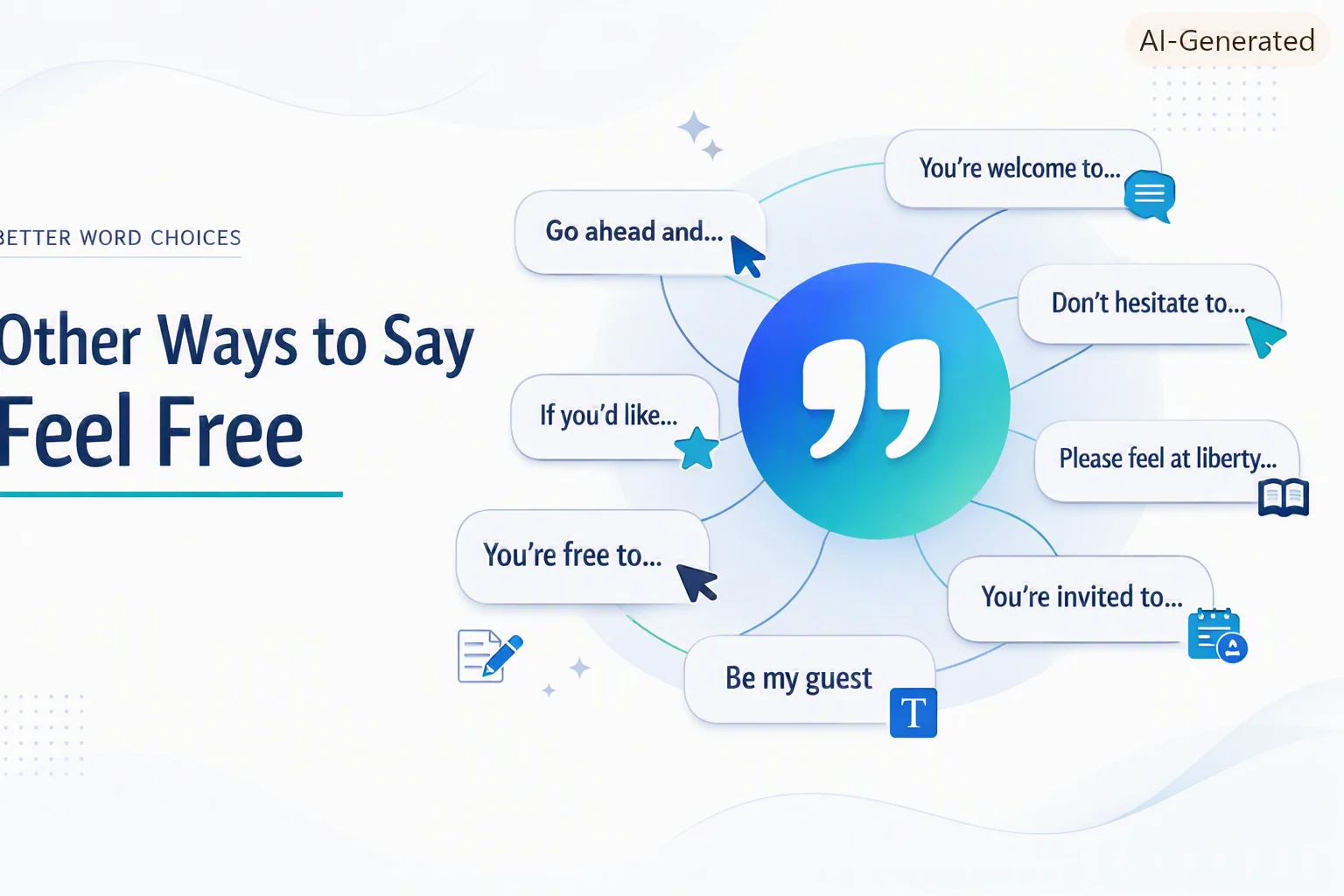
Feel free is a friendly, inviting phrase used to give someone permission or encouragement to do something without worry. It works in casual chats, emails, and even some professional settings, though tone matters.Top alternatives: don’t hesitate to, you’re welcome to, please go ahead and, you’re invited to, I encourage you to
Feel free is one of the most common invitation phrases in English. People use it to give permission, remove hesitation, or make someone feel comfortable taking an action, whether that’s asking a question, sharing an opinion, or using something that belongs to someone else.
You’ll hear it in offices, classrooms, customer service replies, and everyday conversations. It softens a request and signals openness, which is why it shows up so often in emails like “feel free to reach out” or “feel free to share your thoughts.”
Learning alternatives to feel free helps you avoid repetition and match your tone to the situation. Whether you want to sound more formal, more casual, or simply express excitement in English while inviting someone to act, having a range of phrases makes your communication sound natural and confident.
Repeating the same phrase too often makes your English sound flat. Variety is what makes you sound fluent.”
Quick Categories
Formal alternatives to “Feel Free”
- You are welcome to
- Please do not hesitate to
- I would encourage you to
- You have my permission to
Pro Tip: Use formal alternatives in emails, reports, and official communication to sound polished and respectful.
Casual alternatives
- Go right ahead and
- No need to ask twice
- You can always
- Don’t be shy about
Pro Tip: Save casual alternatives for friends, close colleagues, or informal chats where a relaxed tone fits naturally.
Professional alternatives
- I invite you to
- Please go ahead and
- You’re welcome to
- Consider yourself free to
Pro Tip: Professional alternatives work best when you want to sound approachable without losing credibility at work.
Informal expressions
- Take your time and
- Please don’t hold back
- It’s totally okay to
- You shouldn’t hesitate to
Pro Tip: Informal expressions are great for spoken English, but double-check them before using in formal written documents.
Common Mistakes Section
- Overusing it in every sentence – Repeating “feel free” too often makes writing sound repetitive. Example: “Feel free to ask, and feel free to call, and feel free to email me.”
- Using it in overly formal legal or academic writing – It can sound too casual for strict formal contexts. Example: “Feel free to submit your legal objection” sounds better as “You are permitted to submit your objection.”
- Pairing it with commands instead of invitations – This creates an awkward contradiction. Example: “Feel free to submit the report by 5 PM” should be “Please submit the report by 5 PM.”
- Forgetting the “to” before the verb – A common grammar slip for learners. Example: Incorrect: “Feel free ask me.” Correct: “Feel free to ask me.”
- Using it sarcastically without context – Native speakers sometimes use it ironically, which can confuse learners. Example: “Oh, feel free to take all the credit” can sound sarcastic depending on tone.
What Does “Feel Free” Mean?
Feel free means to have permission or encouragement to do something without hesitation or worry about causing inconvenience.
Grammar note: It is followed by an infinitive verb using “to” (feel free to ask, feel free to join).
Example Sentence: “Feel free to contact me if you have any questions.”
When to Use “Feel Free”
- When offering help or availability
- When giving permission for someone to act
- When encouraging questions or feedback
- Spoken: Common in daily conversation and casual meetings
- Written: Common in emails, customer support, and informal messages
- Formal: Acceptable in polite business emails
- Informal: Very common among friends, coworkers, and classmates
Is It Professional or Polite to Say “Feel Free”?
Feel free is polite and friendly, but its professionalism depends on context. In everyday business emails, it sounds warm and approachable. In highly formal documents, contracts, or academic writing, it can sound too casual.
Business example: “Feel free to schedule a call at your convenience.”
Polite? ✔️ Yes Professional? ❌ No (in most formal or legal writing)
Pros and Cons of Using “Feel Free”
Pros:
- Simple and natural
- Friendly tone
- Common usage
- Easy to understand
Cons:
- Too informal for work
- Overused
- Limited emotional range
- Not suitable for formal writing
The right tone makes your English sound professional and confident.”
Other Ways to Say Feel Free
These alternatives will help you sound more fluent, confident, and natural in different situations. Use them according to tone, context, and audience to express excitement, admiration, or approval while inviting someone to act.
1. Phrase: Don’t Hesitate To
Meaning: Encourages someone to act without worry.
Explanation: A polite way to remove hesitation, commonly used in formal and semi-formal communication.
Example Sentence: “Don’t hesitate to reach out if you need support.”
Best Use: Emails, customer service
Worst Use: Casual texting
Tone: Polite, encouraging
Context Variability: Professional, spoken
2. Phrase: You’re Welcome To
Meaning: Gives permission in a warm and welcoming way.
Explanation: Suggests genuine openness and willingness for someone to take action.
Example Sentence: “You’re welcome to join us for lunch.”
Best Use: Social invitations
Worst Use: Legal documents
Tone: Warm, inviting
Context Variability: Casual, professional
3. Phrase: Please Go Ahead and
Meaning: Grants permission to proceed with an action.
Explanation: A clear, action-oriented alternative suitable for professional settings.
Example Sentence: “Please go ahead and submit your application.”
Best Use: Instructions, workplace
Worst Use: Casual friendly chats
Tone: Direct, professional
Context Variability: Professional, spoken
4. Phrase: You Have My Permission To
Meaning: Explicitly grants authorization.
Explanation: Best used when approval or authority is required.
Example Sentence: “You have my permission to use the company logo.”
Best Use: Formal approvals
Worst Use: Everyday small talk
Tone: Formal, authoritative
Context Variability: Professional
5. Phrase: There’s No Need to Hold Back
Meaning: Encourages someone to express themselves openly.
Explanation: Reassures the listener that they shouldn’t hesitate to speak or act.
Example Sentence: “There’s no need to hold back your opinion in this meeting.”
Best Use: Discussions, feedback sessions
Worst Use: Formal writing
Tone: Reassuring, open
Context Variability: Spoken, casual
6. Phrase: You’re More Than Welcome To
Meaning: Emphasizes enthusiastic permission.
Explanation: Adds warmth and genuine encouragement to an invitation.
Example Sentence: “You’re more than welcome to bring a guest.”
Best Use: Invitations
Worst Use: Legal notices
Tone: Enthusiastic, friendly
Context Variability: Casual, professional
7. Phrase: It’s Perfectly Fine To
Meaning: Reassures someone that an action is acceptable.
Explanation: Helps remove doubt or hesitation.
Example Sentence: “It’s perfectly fine to ask questions during the presentation.”
Best Use: Classrooms, meetings
Worst Use: Strict formal writing
Tone: Reassuring, calm
Context Variability: Spoken, professional
8. Phrase: Go Right Ahead and
Meaning: Encourages someone to take immediate action.
Explanation: A casual, energetic way to give permission.
Example Sentence: “Go right ahead and grab a seat.”
Best Use: Casual conversation
Worst Use: Formal emails
Tone: Casual, direct
Context Variability: Casual, spoken
9. Phrase: Please Don’t Think Twice About
Meaning: Encourages confidence in taking action.
Explanation: Removes doubt and reassures the other person.
Example Sentence: “Please don’t think twice about calling us anytime.”
Best Use: Customer support
Worst Use: Legal writing
Tone: Warm, supportive
Context Variability: Professional, spoken
10. Phrase: You Can Always
Meaning: Highlights that an option is always available.
Explanation: Suggests reliability and openness.
Example Sentence: “You can always email me directly.”
Best Use: Ongoing offers
Worst Use: One-time formal permissions
Tone: Reliable, friendly
Context Variability: Casual, professional
11. Phrase: It Would Be My Pleasure If You
Meaning: Expresses delight in offering permission or an invitation.
Explanation: Adds warmth and courtesy to the message.
Example Sentence: “It would be my pleasure if you joined our team meeting.”
Best Use: Formal invitations
Worst Use: Casual texting
Tone: Polite, gracious
Context Variability: Professional
12. Phrase: I Encourage You To
Meaning: Motivates someone to take action.
Explanation: Frequently used in professional, educational, and advisory settings.
Example Sentence: “I encourage you to share your feedback.”
Best Use: Professional advice
Worst Use: Informal chats
Tone: Motivating, formal
Context Variability: Professional
13. Phrase: Please Feel Comfortable To
Meaning: Invites someone to act without feeling uncomfortable.
Explanation: Focuses on creating emotional comfort and openness.
Example Sentence: “Please feel comfortable to speak up anytime.”
Best Use: Supportive settings
Worst Use: Strict formal contexts
Tone: Gentle, supportive
Context Variability: Spoken, professional
14. Phrase: You’re Invited To
Meaning: Formally welcomes someone to participate.
Explanation: Commonly used for events, presentations, and invitations.
Example Sentence: “You’re invited to ask any questions after the talk.”
Best Use: Events, presentations
Worst Use: Everyday small requests
Tone: Formal, welcoming
Context Variability: Professional
15. Phrase: Don’t Be Shy About
Meaning: Encourages confidence and participation.
Explanation: Helps remove embarrassment or hesitation.
Example Sentence: “Don’t be shy about asking for help.”
Best Use: Encouragement
Worst Use: Formal documents
Tone: Friendly, encouraging
Context Variability: Casual, spoken
16. Phrase: It’s Totally Okay To
Meaning: Reassures someone that an action is acceptable.
Explanation: A relaxed, modern way to give permission.
Example Sentence: “It’s totally okay to disagree with me.”
Best Use: Casual discussions
Worst Use: Business proposals
Tone: Relaxed, reassuring
Context Variability: Casual, spoken
17. Phrase: Please Don’t Hold Back
Meaning: Encourages complete honesty or participation.
Explanation: Commonly used when requesting feedback or suggestions.
Example Sentence: “Please don’t hold back your suggestions.”
Best Use: Feedback sessions
Worst Use: Formal legal notices
Tone: Direct, encouraging
Context Variability: Professional, spoken
18. Phrase: You’re Free To
Meaning: States that an action is permitted without restriction.
Explanation: A simple, neutral expression suitable for many situations.
Example Sentence: “You’re free to leave whenever you like.”
Best Use: General permission
Worst Use: Highly formal contracts
Tone: Neutral, open
Context Variability: Casual, professional
19. Phrase: I Welcome You To
Meaning: Formally encourages someone to take part.
Explanation: Often used in speeches, presentations, and professional writing.
Example Sentence: “I welcome you to explore our new services.”
Best Use: Formal writing, presentations
Worst Use: Casual texting
Tone: Formal, gracious
Context Variability: Professional
20. Phrase: Consider Yourself Free To
Meaning: Gives personal permission in a friendly way.
Explanation: Slightly more expressive than simply saying “you’re free to.
Example Sentence: “Consider yourself free to explore the office.”
Best Use: Onboarding, casual permission
Worst Use: Strict legal writing
Tone: Friendly, open
Context Variability: Casual, professional
21. Phrase: No Need to Ask Twice, Just
Meaning: Encourages immediate and confident action.
Explanation: A casual, energetic invitation to proceed.
Example Sentence: “No need to ask twice, just take a copy.”
Best Use: Informal offers
Worst Use: Business emails
Tone: Casual, energetic
Context Variability: Casual, spoken
22. Phrase: Take the Liberty To
Meaning: Grants permission to act independently.
Explanation: Slightly formal and often used in professional collaboration.
Example Sentence: “Please take the liberty to edit the draft as needed.”
Best Use: Professional collaboration
Worst Use: Casual conversation
Tone: Formal, trusting
Context Variability: Professional
23. Phrase: Please Make Yourself Comfortable and
Meaning: Invites someone to relax before taking an action.
Explanation: Common in hospitality and welcoming environments.
Example Sentence: “Please make yourself comfortable and help yourself to refreshments.”
Best Use: Hosting, guests
Worst Use: Formal reports
Tone: Warm, hospitable
Context Variability: Spoken, casual
24. Phrase: You Shouldn’t Hesitate To
Meaning: Encourages someone to act confidently without delay.
Explanation: A reassuring and slightly formal alternative.
Example Sentence: “You shouldn’t hesitate to raise concerns.”
Best Use: Professional guidance
Worst Use: Casual banter
Tone: Reassuring, formal
Context Variability: Professional
25. Phrase: It’s Absolutely Fine If You
Meaning: Strongly reassures that an action is acceptable.
Explanation: Adds extra emphasis to reassure the other person.
Example Sentence: “It’s absolutely fine if you need more time.”
Best Use: Supportive conversations
Worst Use: Legal writing
Tone: Reassuring, warm
Context Variability: Spoken, casual
26. Phrase: Please Don’t Be Afraid To
Meaning: Removes fear or hesitation from taking action.
Explanation: Especially useful when someone feels nervous or uncertain.
Example Sentence: “Please don’t be afraid to ask for clarification.”
Best Use: Mentoring, teaching
Worst Use: Strict formal notices
Tone: Supportive, gentle
Context Variability: Spoken, professional
27. Phrase: I Invite You To
Meaning: Formally opens an opportunity for participation.
Explanation: Common in professional meetings, presentations, and ceremonies.
Example Sentence: “I invite you to share your thoughts during the discussion.”
Best Use: Formal meetings
Worst Use: Casual texting
Tone: Formal, respectful
Context Variability: Professional
28. Phrase: You’re Allowed To
Meaning: Clearly states that permission has been granted.
Explanation: A straightforward and neutral expression.
Example Sentence: “You’re allowed to bring one guest.”
Best Use: Rules, general permission
Worst Use: Warm personal invitations
Tone: Neutral, clear
Context Variability: Casual, professional
29. Phrase: Rest Assured You Can
Meaning: Reassures someone that they have permission or support.
Explanation: Builds confidence and trust while granting permission.
Example Sentence: “Rest assured you can contact our team anytime.”
Best Use: Customer service
Worst Use: Casual small talk
Tone: Confident, reassuring
Context Variability: Professional
30. Phrase: Please Help Yourself To
Meaning: Invites someone to freely take or use something.
Explanation: Commonly used when offering food, drinks, or shared resources.
Example Sentence: “Please help yourself to any of the handouts.”
Best Use: Hosting, sharing resources
Worst Use: Formal legal permissions
Tone: Generous, welcoming
Context Variability: Casual, spoken
“Choosing the right alternative shows your listener you understand both language and tone.”
Mini Quiz / Self-Check
1. Which phrase is the most formal?
A) Go right ahead and
B) You have my permission to
C) No need to ask twice, just
Answer: B
2. Which phrase fits a warm, hospitality context best?
A) Please make yourself comfortable and
B) Take the liberty to
C) You’re allowed to
Answer: A
3. Which alternative would sound odd in a strict legal document?
A) You are permitted to
B) Feel free to
C) You shall be authorized to
Answer: B
4. Which phrase best encourages someone who seems nervous?
A) Please don’t be afraid to
B) Rest assured you can
C) You’re invited to
Answer: A
“Confidence in English comes from knowing which words fit which moment.”
Comparison Table: Top Alternatives
| Phrase | Tone | Best Use |
|---|---|---|
| Don’t hesitate to | Polite, encouraging | Emails, customer service |
| You’re welcome to | Warm, inviting | Social invitations |
| Please go ahead and | Direct, professional | Instructions, workplace |
| You have my permission to | Formal, authoritative | Formal approvals |
| You’re more than welcome to | Enthusiastic, friendly | Invitations |
| I encourage you to | Motivating, formal | Professional advice |
| You’re invited to | Formal, welcoming | Events, presentations |
| It’s totally okay to | Relaxed, reassuring | Casual discussions |
| You’re free to | Neutral, open | General permission |
| Rest assured you can | Confident, reassuring | Customer service |
FAQs
Is “feel free” too casual for a business email?
It is generally acceptable in business emails but can sound casual in very formal or legal correspondence, where “you are welcome to” is safer.
What is the most professional alternative to “feel free”?
“You have my permission to” or “I invite you to” are among the most professional alternatives to feel free.
Can I use “feel free” with strangers?
Yes, it is polite and commonly used even with people you don’t know well, especially in customer service or hospitality settings.
What’s a good alternative to “feel free” for spoken English?
Go right ahead and” or “don’t be shy about” work well in natural spoken conversation.
Does “feel free” always need “to” after it?
Yes, “feel free” is almost always followed by an infinitive verb using “to,” such as “feel free to ask.”
Conclusion
Learning other ways to say feel free helps you sound more fluent, confident, and adaptable across different settings, from casual chats to formal business writing. Each alternative carries its own tone, so choosing the right one strengthens both your spoken and written English.
Practice using a few new alternatives every day, and pay attention to tone before you speak or write. Over time, this awareness will make your English sound natural, professional, and genuinely confident in any situation.
Read More Related Articles:
- Other Ways to Say “This Shows That” | Express Your Ideas with Confidence In 2026
- Other Ways to Say “Which” in English | Beyond the Common Choices In 2026
- Other Ways to Say Also in an Essay | Make Your Writing Shine In 2026

Daniel Murphy is a professional writer and blogger specializing in digital communication and messaging trends. As a contributor to TextsResponse.com, he creates reader-focused content designed to help people find the right words at the right time.