Quick Answer
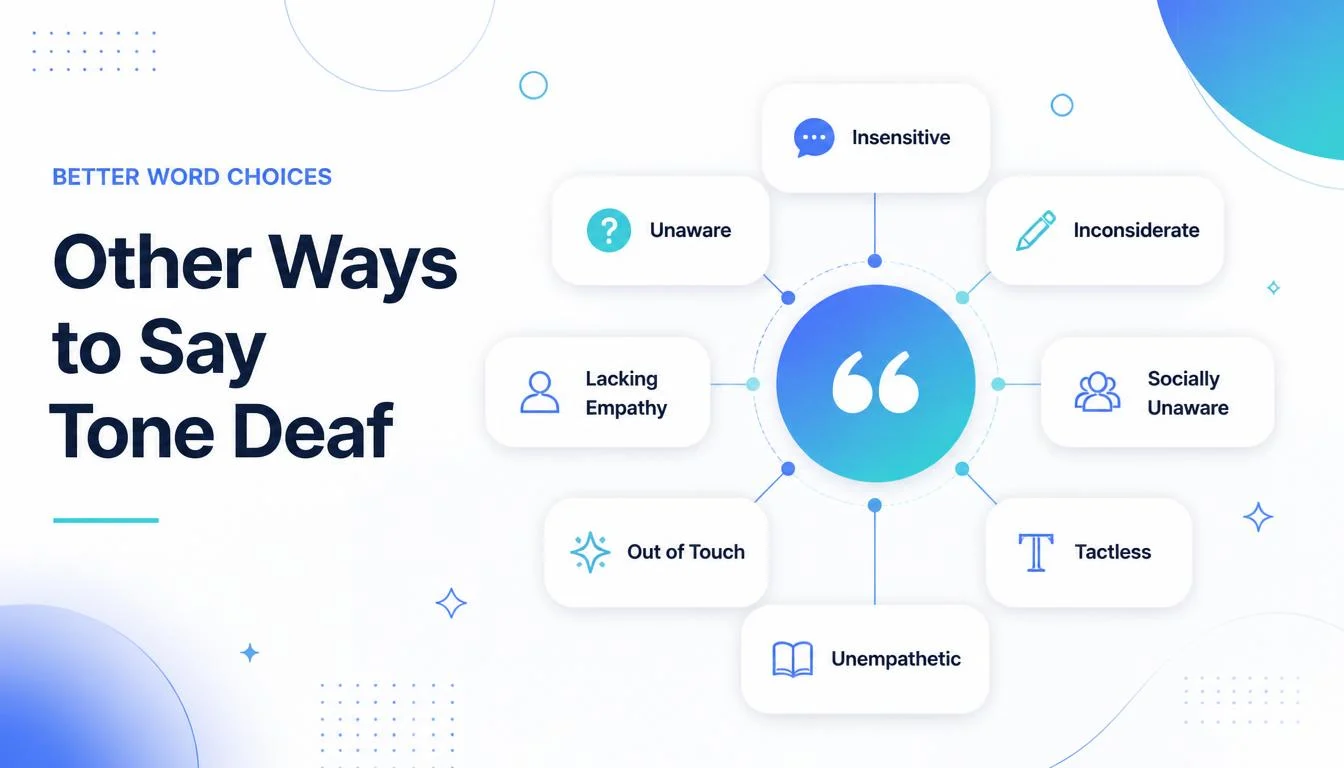
Other ways to say tone deaf include insensitive, unaware, out of touch, inconsiderate, and lacking awareness. The best alternative depends on whether you want to sound polite, neutral, or direct.
Learning other ways to say tone deaf can help you express concerns about insensitive comments, inappropriate behavior, or a lack of understanding more clearly. The phrase “tone deaf” is often used when someone fails to recognize the feelings, needs, or circumstances of others, especially in a sensitive situation.
Whether you are writing professionally, discussing social issues, or having an everyday conversation, choosing the right alternative can make your message more respectful and precise. Words such as “insensitive,” “out of touch,” and “inconsiderate” offer different shades of meaning, allowing you to communicate your point without sounding unnecessarily harsh.
Quick Categories: Alternatives by Tone and Context
Choosing among the alternatives depends on whether you are writing a professional email, discussing a public statement, or having a casual conversation.
Formal alternatives to “tone deaf”
- Lacking sensitivity: Failing to consider other people’s feelings or circumstances.
- Insufficiently considerate: Not giving enough thought to others’ needs.
- Unresponsive to social concerns: Failing to acknowledge important social issues.
- Demonstrating a lack of awareness: Not recognizing the implications of a situation.
Pro Tip: Use precise, neutral expressions in academic writing, reports, and formal criticism. Describe the behavior rather than labeling the person.
Casual alternatives
- Out of touch: Not understanding people’s current experiences or concerns.
- Insensitive: Not considering other people’s feelings.
- Missing the point: Failing to understand what matters in a conversation.
- Not reading the room: Failing to recognize the mood or atmosphere.
Pro Tip: These expressions work well in everyday conversations. Use them carefully when discussing sensitive personal matters.
Professional alternatives
- Lacking emotional intelligence: Struggling to recognize or manage emotions effectively.
- Unaware of stakeholder concerns: Overlooking the needs or expectations of affected people.
- Demonstrating poor judgment: Making an inappropriate decision in a particular situation.
- Insufficiently empathetic: Not adequately considering other people’s perspectives.
Pro Tip: In the workplace, explain the specific impact of a statement or decision. This makes your feedback more constructive and actionable.
Informal expressions
- Socially unaware: Not recognizing social expectations or interpersonal cues.
- Clueless about the situation: Not understanding what is happening or why it matters.
- Completely missing the mood: Failing to notice the emotional atmosphere.
- Insensitive to the moment: Failing to appreciate what the situation requires.
Pro Tip: Informal expressions are useful with friends and colleagues you know well. Avoid using them to embarrass someone in public.
Common Mistakes When Using “Tone Deaf”
Even advanced English learners can misuse this expression. These five mistakes can make your communication less accurate or less considerate.
1. Confusing musical ability with social sensitivity
The phrase has a literal musical meaning and a figurative social meaning.
Incorrect: “She cannot sing in tune, so her comments about the layoffs were tone deaf.”
Better: “She struggles to sing in tune, but her comments about the layoffs were also insensitive.”
The two meanings describe different things. A person can lack musical pitch accuracy without lacking empathy.
2. Using it as a general synonym for being wrong
Not every mistake demonstrates insensitivity. Someone can make an incorrect statement without ignoring other people’s feelings.
Incorrect: “Your calculation is tone deaf.”
Better: “Your calculation is inaccurate.”
Use the expression when the issue concerns awareness, sensitivity, or social context, not merely factual correctness.
3. Labeling the person instead of the behavior
Personal labels can make criticism sound unnecessarily hostile.
Less effective: “You are tone deaf.”
Better: “That comment may come across as insensitive to people affected by the situation.”
The second version identifies the problem without making a sweeping judgment about someone’s character.
4. Using it in overly formal writing
Although the expression appears in journalism and professional commentary, it can sound judgmental in official documents.
Less suitable: “The department’s tone deaf response damaged employee confidence.”
Better: “The department’s response failed to address employees’ concerns.”
The alternative sounds more objective and focuses on the actual communication problem.
5. Assuming it always means a lack of empathy
Sometimes a person understands others’ feelings but misjudges the appropriate response. In other cases, the problem is a lack of information or awareness.
Less accurate: “He disagreed with my proposal, so he was tone deaf.”
Better: “He misunderstood the concerns behind my proposal.”
Disagreement alone does not demonstrate insensitivity. Consider the situation before choosing the expression.
“Strong criticism becomes more useful when it identifies a specific behavior instead of attacking a person’s character.”
What Does “Tone Deaf” Mean?
Tone deaf has two main meanings in English.
- Literal meaning: Unable to distinguish musical pitches accurately or recognize differences between notes.
- Figurative meaning: Failing to recognize the emotional, social, or cultural implications of words, actions, or decisions.
In everyday communication, the figurative meaning is common. People may describe a comment, advertisement, public statement, or workplace decision as tone deaf when it appears disconnected from the concerns of others.
Grammar explanation
“Tone deaf” is an adjective phrase. It commonly appears after linking verbs such as be and seem, or before a noun.
Examples:
- After a linking verb: “The response seemed tone deaf.”
- Before a noun: “The company issued a tone deaf statement.”
In figurative use, the expression is often critical. In musical contexts, it describes a specific difficulty and should not automatically be treated as a judgment about someone’s personality.
Example sentence: “The executive’s celebratory message seemed tone deaf while employees were worried about losing their jobs.”
When to Use “Tone Deaf”
The expression can be useful when you want to describe a mismatch between a message and the circumstances in which it appears.
Common contexts include:
- Workplace communication: A manager ignores employee concerns while announcing an unrelated success.
- Public relations: A company responds insensitively to a serious incident.
- Social media: Someone makes a joke that overlooks another person’s hardship.
- Politics and public debate: A public figure makes a statement that seems disconnected from people’s experiences.
- Personal relationships: A friend responds casually when someone shares distressing news.
- Cultural discussions: A message overlooks important cultural sensitivities.
- Music education: Someone struggles to identify or reproduce musical pitches accurately.
Spoken versus written use
Spoken English: The expression can be direct and conversational.
Example: “That joke was a little tone deaf given what everyone is going through.”
Written English: It appears in opinion articles, reviews, workplace commentary, and social analysis.
Example: “The announcement was criticized for appearing insensitive to employees facing financial uncertainty.”
Formal versus informal use
In casual conversations, tone deaf can be a concise way to express disapproval. In formal communication, phrases such as insufficiently sensitive, unresponsive to employee concerns, or poorly judged may be more precise.
The right choice depends on your purpose. If you want to criticize a decision, describe its impact. If you want to explain a misunderstanding, identify what was overlooked.
Is It Professional or Polite to Say “Tone Deaf”?
The expression can be professional in some contexts, but it is not always polite. It carries a critical tone and may sound accusatory when used directly about a colleague, manager, or client.
Politeness versus professionalism
- Politeness: Consider whether the expression might embarrass or offend the person receiving your feedback.
- Professionalism: Focus on evidence, impact, and specific improvements.
- Constructive feedback: Explain what was overlooked and how the message could be improved.
Business style example
Direct version: “The announcement was tone deaf because it ignored employees’ concerns about workload.”
More diplomatic version: “The announcement may not have fully addressed employees’ concerns about workload. Acknowledging those concerns could make the message more effective.”
The diplomatic version preserves the criticism while offering a constructive path forward.
- Polite? ✔️ Yes, when used thoughtfully and with a clear explanation.
- Professional? ❌ Not in every situation, particularly when directed at an individual without supporting context.
For workplace discussions, professional reaction phrases such as poorly judged, insufficiently sensitive, and out of step with employee concerns can communicate the issue without unnecessarily escalating the conversation.
Pros and Cons of Using “Tone Deaf”
Understanding the strengths and limitations of this expression helps you decide when to use it and when to choose an alternative.
Pros
- Simple and natural: It communicates a recognizable kind of social or emotional mismatch.
- Friendly tone in some contexts: Among familiar speakers, it can provide concise criticism without a lengthy explanation.
- Common usage: Many English speakers understand its figurative meaning.
- Easy to understand: It can summarize why a comment or decision seems inappropriate in context.
Cons
- Too informal for some workplaces: It may sound judgmental in formal reports or sensitive correspondence.
- Can be overused: Repeated use may replace more precise descriptions of the actual problem.
- Limited emotional range: It does not distinguish clearly between carelessness, ignorance, poor judgment, and a lack of empathy.
- Not suitable for every formal document: Objective reports usually benefit from describing specific actions and their consequences.
A useful rule is to use the expression when it accurately captures the problem. Choose a more precise alternative when the audience needs to understand exactly what went wrong.
Other Ways to Say “Tone Deaf” With Examples
These 30 alternatives will help you sound more fluent, confident, and natural in different situations.
Use them according to tone, context, and audience to express criticism accurately and respectfully. Some describe a lack of empathy, while others focus on poor judgment, social awareness, or misunderstanding.
1. Insensitive
Meaning: Not showing enough consideration for other people’s feelings.
Explanation: This is one of the closest alternatives when a remark or action disregards someone’s emotional experience.
Example Sentence: “The comment about her financial situation was insensitive.”
Best Use: Personal feedback
Worst Use: Neutral disagreement
Tone: Direct, critical, clear
Context Variability: Casual: “That was insensitive.” Professional: “The response may have been insensitive to affected employees.” Spoken: “I thought his remark was insensitive.”
2. Out of Touch
Meaning: Not understanding people’s current experiences, needs, or concerns.
Explanation: This phrase often describes leaders, organizations, or public figures who seem disconnected from the people they serve.
Example Sentence: “The company’s decision seemed out of touch with the challenges facing its employees.”
Best Use: Public criticism
Worst Use: Technical reporting
Tone: Conversational, critical, evaluative
Context Variability: Casual: “That idea is out of touch.” Professional: “The proposal appears out of touch with employee expectations.” Spoken: “He seems out of touch with what people need.”
3. Lacking Empathy
Meaning: Not adequately understanding or considering another person’s feelings.
Explanation: This phrase emphasizes a failure to appreciate someone else’s emotional experience.
Example Sentence: “The manager’s response appeared to lack empathy for employees affected by the changes.”
Best Use: Emotional feedback
Worst Use: Unsupported accusations
Tone: Serious, analytical, critical
Context Variability: Casual: “That response lacked empathy.” Professional: “The communication could demonstrate greater empathy.” Spoken: “It sounded like she lacked empathy.”
4. Socially Unaware
Meaning: Not recognizing social expectations, cues, or sensitivities.
Explanation: Use this phrase when someone fails to understand how a comment or action may be received.
Example Sentence: “His socially unaware remark made the discussion uncomfortable.”
Best Use: Social situations
Worst Use: Formal evaluations
Tone: Descriptive, direct, mildly critical
Context Variability: Casual: “That was socially unaware.” Professional: “The comment showed limited awareness of the audience.” Spoken: “He can be socially unaware sometimes.”
5. Inconsiderate
Meaning: Failing to think about other people’s needs or feelings.
Explanation: This alternative works well when an action appears thoughtless or disregards the effect on others.
Example Sentence: “Announcing the schedule change without warning was inconsiderate.”
Best Use: Everyday criticism
Worst Use: Neutral analysis
Tone: Direct, personal, critical
Context Variability: Casual: “That was inconsiderate.” Professional: “The lack of notice may have been inconsiderate to staff.” Spoken: “I thought it was inconsiderate not to tell anyone.”
6. Insensitive to the Situation
Meaning: Failing to recognize the importance or emotional nature of particular circumstances.
Explanation: This phrase is useful when the timing or context makes a statement inappropriate.
Example Sentence: “Making jokes during the serious discussion was insensitive to the situation.”
Best Use: Sensitive discussions
Worst Use: Routine praise
Tone: Careful, explanatory, critical
Context Variability: Casual: “That joke was insensitive to the situation.” Professional: “The response did not adequately account for the circumstances.” Spoken: “It felt insensitive to what everyone was experiencing.”
7. Poorly Judged
Meaning: Showing a lack of sound judgment in a particular situation.
Explanation: This expression criticizes a decision or remark without necessarily suggesting that the person lacks empathy.
Example Sentence: “The celebratory announcement was poorly judged given the recent layoffs.”
Best Use: Business feedback
Worst Use: Personal reassurance
Tone: Formal, measured, evaluative
Context Variability: Casual: “That was a poorly judged comment.” Professional: “The timing of the announcement was poorly judged.” Spoken: “I think that response was poorly judged.”
8. Unaware of Social Cues
Meaning: Not recognizing signals that indicate how people feel or expect others to behave.
Explanation: Use this phrase when someone misses a social signal, such as discomfort, sadness, or a desire to change the subject.
Example Sentence: “He seemed unaware of social cues when he continued joking after everyone became uncomfortable.”
Best Use: Interpersonal feedback
Worst Use: Formal reports
Tone: Descriptive, neutral, corrective
Context Variability: Casual: “She missed the social cues.” Professional: “The response did not reflect the audience’s reaction.” Spoken: “He was unaware that people wanted to end the conversation.”
9. Disconnected From Reality
Meaning: Failing to recognize the practical circumstances or experiences of others.
Explanation: This stronger phrase often criticizes statements or decisions that ignore everyday realities.
Example Sentence: “The proposed budget seemed disconnected from the financial pressures facing local families.”
Best Use: Public policy
Worst Use: Gentle feedback
Tone: Strong, critical, emphatic
Context Variability: Casual: “That idea is disconnected from reality.” Professional: “The proposal does not adequately reflect current operating conditions.” Spoken: “That suggestion feels disconnected from what people are dealing with.”
10. Lacking Sensitivity
Meaning: Not showing enough awareness of a subject’s emotional or social importance.
Explanation: This is a measured alternative suitable for formal discussions of communication and behavior.
Example Sentence: “The campaign was criticized for lacking sensitivity toward affected communities.”
Best Use: Formal criticism
Worst Use: Casual banter
Tone: Formal, objective, restrained
Context Variability: Casual: “That lacked sensitivity.” Professional: “The campaign could demonstrate greater sensitivity to community concerns.” Spoken: “I felt the comment lacked sensitivity.”
11. Inappropriate
Meaning: Not suitable for a particular situation or audience.
Explanation: This broad alternative focuses on whether something fits the context rather than on the speaker’s personality.
Example Sentence: “The joke was inappropriate during a meeting about workplace harassment.”
Best Use: Workplace conduct
Worst Use: Minor preferences
Tone: Neutral, corrective, firm
Context Variability: Casual: “That joke was inappropriate.” Professional: “The remark was inappropriate for the meeting.” Spoken: “I do not think that was appropriate to say.”
12. Insufficiently Considerate
Meaning: Not showing enough thought for other people’s feelings or circumstances.
Explanation: This formal expression works well when you want to criticize conduct without using emotionally charged language.
Example Sentence: “The revised policy was insufficiently considerate of employees with caregiving responsibilities.”
Best Use: Formal feedback
Worst Use: Casual conversation
Tone: Formal, diplomatic, evaluative
Context Variability: Casual: “That was not very considerate.” Professional: “The policy could be more considerate of employees’ circumstances.” Spoken: “I do not think we considered everyone’s needs.”
13. Emotionally Unaware
Meaning: Not recognizing the emotional impact of words or actions.
Explanation: This phrase highlights a failure to notice feelings or emotional context.
Example Sentence: “His response seemed emotionally unaware of how upsetting the news had been.”
Best Use: Personal discussions
Worst Use: Technical documents
Tone: Reflective, critical, explanatory
Context Variability: Casual: “That response felt emotionally unaware.” Professional: “The message did not adequately acknowledge employees’ concerns.” Spoken: “He did not seem aware of how upset she was.”
14. Out of Step With Public Sentiment
Meaning: Not aligned with what a community or audience currently feels or believes.
Explanation: This expression is especially useful when evaluating public statements, campaigns, or organizational decisions.
Example Sentence: “The advertisement was out of step with public sentiment following the disaster.”
Best Use: Public relations
Worst Use: Private disputes
Tone: Formal, analytical, critical
Context Variability: Casual: “That message is out of step with how people feel.” Professional: “The campaign appears out of step with public sentiment.” Spoken: “The announcement did not reflect the public mood.”
15. Missing the Point
Meaning: Failing to understand the main issue or concern.
Explanation: This alternative works when a response focuses on the wrong subject or overlooks what matters most.
Example Sentence: “By discussing profits instead of employee safety, the presentation missed the point.”
Best Use: Group discussions
Worst Use: Sensitive apologies
Tone: Conversational, direct, corrective
Context Variability: Casual: “You are missing the point.” Professional: “The response does not address the central concern.” Spoken: “I think we are missing the point here.”
16. Not Reading the Room
Meaning: Failing to recognize the mood, attitudes, or expectations of people present.
Explanation: This common idiom is useful when someone speaks or acts without noticing how others are reacting.
Example Sentence: “He was not reading the room when he celebrated his promotion during the team’s difficult week.”
Best Use: Group settings
Worst Use: Formal reports
Tone: Informal, vivid, critical
Context Variability: Casual: “You need to read the room.” Professional: “The speaker did not adequately respond to the audience’s mood.” Spoken: “She was not reading the room at all.”
17. Culturally Insensitive
Meaning: Failing to respect or recognize cultural differences and sensitivities.
Explanation: Use this phrase when a statement, image, or action overlooks a cultural practice or risks offending a community.
Example Sentence: “The advertisement was criticized for using culturally insensitive imagery.”
Best Use: Cultural discussions
Worst Use: Unrelated errors
Tone: Serious, precise, critical
Context Variability: Casual: “That joke was culturally insensitive.” Professional: “The material should be reviewed for cultural sensitivity.” Spoken: “I think that comment overlooked important cultural differences.”
18. Unempathetic
Meaning: Not demonstrating understanding or concern for another person’s feelings.
Explanation: This adjective describes a response that appears emotionally unsupportive, although it can sound more judgmental than describing the behavior directly.
Example Sentence: “The reply seemed unempathetic toward customers who had lost access to their accounts.”
Best Use: Feedback discussions
Worst Use: Neutral disagreement
Tone: Direct, serious, critical
Context Variability: Casual: “That sounded unempathetic.” Professional: “The response could better acknowledge customers’ difficulties.” Spoken: “His answer came across as unempathetic.”
19. Thoughtless
Meaning: Done without sufficient consideration for the consequences or feelings involved.
Explanation: This alternative is useful for careless remarks or actions that cause unnecessary discomfort.
Example Sentence: “The thoughtless announcement ignored how anxious employees were about their jobs.”
Best Use: Everyday feedback
Worst Use: Formal assessments
Tone: Direct, personal, disapproving
Context Variability: Casual: “That was thoughtless.” Professional: “The communication did not sufficiently consider employees’ concerns.” Spoken: “I think that was a thoughtless thing to say.”
20. Tone Insensitive
Meaning: Failing to use language or a communication style appropriate to the situation.
Explanation: This expression focuses specifically on how a message sounds or feels to its audience. In many contexts, insensitive in tone is the more natural wording.
Example Sentence: “The email was insensitive in tone and did not acknowledge the team’s recent difficulties.”
Best Use: Writing feedback
Worst Use: Musical ability
Tone: Analytical, formal, corrective
Context Variability: Casual: “That message sounded insensitive.” Professional: “The email’s tone may be perceived as insensitive.” Spoken: “The way he said it felt inappropriate for the moment.”
21. Disregarding Others’ Feelings
Meaning: Acting or speaking without adequately considering other people’s emotions.
Explanation: This phrase explicitly identifies the behavior behind a socially insensitive response.
Example Sentence: “The announcement seemed to disregard the feelings of employees who had recently been made redundant.”
Best Use: Behavior feedback
Worst Use: Light conversation
Tone: Serious, descriptive, critical
Context Variability: Casual: “You are disregarding how people feel.” Professional: “The message appears to overlook employees’ emotional concerns.” Spoken: “It felt as though nobody considered their feelings.”
22. Unmindful of Others
Meaning: Not paying sufficient attention to other people’s needs, feelings, or circumstances.
Explanation: This expression is useful when someone overlooks the effect of their conduct on others.
Example Sentence: “The decision seemed unmindful of the pressures facing frontline staff.”
Best Use: Formal commentary
Worst Use: Casual praise
Tone: Formal, measured, critical
Context Variability: Casual: “That was not very thoughtful of others.” Professional: “The decision did not adequately consider staff circumstances.” Spoken: “It seemed unmindful of what the team was going through.”
23. Socially Insensitive
Meaning: Not adequately recognizing the social implications of words or actions.
Explanation: This alternative works when the problem involves social expectations, group experiences, or public concerns.
Example Sentence: “The public statement was socially insensitive because it dismissed concerns raised by the affected community.”
Best Use: Public commentary
Worst Use: Simple corrections
Tone: Formal, critical, explanatory
Context Variability: Casual: “That was socially insensitive.” Professional: “The statement may be perceived as socially insensitive.” Spoken: “That remark did not take the wider situation into account.”
24. Lacking Emotional Intelligence
Meaning: Showing difficulty recognizing, understanding, or responding appropriately to emotions.
Explanation: This broader phrase may describe a pattern of communication rather than one isolated remark, so avoid making unsupported judgments about individuals.
Example Sentence: “The supervisor’s response suggested a need for greater emotional intelligence in difficult conversations.”
Best Use: Leadership development
Worst Use: Casual accusations
Tone: Analytical, professional, evaluative
Context Variability: Casual: “That response lacked emotional awareness.” Professional: “The situation called for greater emotional intelligence.” Spoken: “A little more awareness of people’s feelings would have helped.”
25. Inattentive to Context
Meaning: Failing to consider the circumstances surrounding an event or conversation.
Explanation: This precise alternative is useful when the problem stems from ignoring timing, background, or relevant details.
Example Sentence: “The marketing message was inattentive to context because it launched during a community crisis.”
Best Use: Editorial review
Worst Use: Personal praise
Tone: Formal, analytical, precise
Context Variability: Casual: “That ignored the context.” Professional: “The communication was insufficiently attentive to the circumstances.” Spoken: “They did not consider what was happening at the time.”
26. Disconnected From People’s Experiences
Meaning: Failing to understand the realities or challenges that others face.
Explanation: This phrase emphasizes a gap between someone’s message and the lived experiences of the audience.
Example Sentence: “The proposal felt disconnected from the experiences of families struggling with rising costs.”
Best Use: Social commentary
Worst Use: Routine requests
Tone: Empathetic, analytical, critical
Context Variability: Casual: “That does not reflect what people are experiencing.” Professional: “The proposal does not adequately account for customers’ circumstances.” Spoken: “It feels disconnected from what people are actually dealing with.”
27. Insensitive to Cultural Context
Meaning: Failing to account for cultural factors that affect how a message is understood.
Explanation: Use this phrase when a communication overlooks traditions, cultural meanings, or differences in social expectations.
Example Sentence: “The campaign was insensitive to cultural context and required further review.”
Best Use: International communication
Worst Use: Simple mistakes
Tone: Formal, specific, constructive
Context Variability: Casual: “That missed the cultural context.” Professional: “The material should be assessed for cultural appropriateness.” Spoken: “We need to consider how different audiences might interpret this.”
28. Poorly Timed
Meaning: Happening at a moment when it is unlikely to be appropriate or well received.
Explanation: Sometimes the main problem is not what someone says but when they say it.
Example Sentence: “The announcement of the company’s luxury retreat was poorly timed while staff were facing pay cuts.”
Best Use: Communication planning
Worst Use: Factual errors
Tone: Neutral, measured, evaluative
Context Variability: Casual: “That was badly timed.” Professional: “The announcement was poorly timed given current employee concerns.” Spoken: “I do not think this was the right moment to share that news.”
29. Unresponsive to Concerns
Meaning: Failing to acknowledge or address issues raised by other people.
Explanation: This professional alternative focuses on a specific communication failure rather than a person’s general sensitivity.
Example Sentence: “The company’s statement was unresponsive to customers’ concerns about the data breach.”
Best Use: Customer relations
Worst Use: Unrelated feedback
Tone: Professional, objective, firm
Context Variability: Casual: “They did not address what people were worried about.” Professional: “The response was unresponsive to the concerns raised.” Spoken: “They never really answered the questions people had.”
30. Lacking Awareness of the Impact
Meaning: Not recognizing how one’s actions or words affect others.
Explanation: This flexible phrase is useful in workplace feedback, formal reports, and conversations about unintended consequences.
Example Sentence: “The presenter appeared unaware of the impact his remarks had on employees who had experienced discrimination.”
Best Use: Constructive feedback
Worst Use: Lighthearted banter
Tone: Diplomatic, reflective, precise
Context Variability: Casual: “You may not realize how that affects people.” Professional: “The communication did not fully account for its potential impact.” Spoken: “I do not think she realized how her words would affect the team.”
“The most effective alternative is the one that explains exactly what was overlooked.”
Comparison Table: Top 10 Alternatives
Use this table to quickly compare the most useful alternatives to tone deaf and choose the right expression.
| Phrase | Tone | Best Use |
|---|---|---|
| Insensitive | Direct, critical | Personal feedback |
| Out of touch | Conversational, critical | Public commentary |
| Lacking empathy | Serious, reflective | Emotional situations |
| Inconsiderate | Direct, personal | Everyday interactions |
| Poorly judged | Formal, measured | Business decisions |
| Socially unaware | Descriptive, critical | Social situations |
| Inappropriate | Neutral, firm | Workplace conduct |
| Not reading the room | Informal, vivid | Group conversations |
| Culturally insensitive | Serious, precise | Cultural discussions |
| Unresponsive to concerns | Professional, objective | Business communication |
Mini Quiz: Test Your Understanding
Check your understanding of the alternatives and their appropriate contexts.
1. A manager announces a luxury office renovation while employees are worried about layoffs. Which phrase fits best?Poorly timedMusically inaccurateEntirely unrelated
2. You are writing a formal report about a company that ignored customer complaints. Which phrase is most suitable?Clueless about everythingUnresponsive to concernsNot reading the room
3. A friend continues making jokes after noticing that everyone is upset. Which expression sounds most natural in casual conversation?Not reading the roomInsufficiently considerate of stakeholdersInattentive to context
4. Someone gives an incorrect answer to a mathematics problem. Is tone deaf the best description?Yes, every mistake is tone deafNo, inaccurate is more preciseYes, because it means incorrect
FAQs
1. What are the best alternatives to tone deaf?
The best general alternatives are insensitive, out of touch, lacking empathy, inconsiderate, and socially unaware. Choose one based on whether you want to emphasize feelings, awareness, or behavior.
2. What is a professional way to say tone deaf?
Use expressions such as poorly judged, insufficiently sensitive, or unresponsive to employee concerns. These phrases communicate criticism more objectively in workplace discussions.
3. Is tone deaf rude to say?
It can be. The phrase may sound judgmental, particularly when directed at an individual. Describing a specific remark or decision as insensitive is often more constructive.
4. What is the difference between tone deaf and insensitive?
Tone deaf often describes a failure to recognize the broader emotional or social context. Insensitive more directly describes a lack of consideration for other people’s feelings. Their meanings overlap, but they are not always interchangeable.
5. Can tone dceaf be used in formal writing?
Yes, especially in opinion articles, media commentary, and social analysis. However, formal reports and professional correspondence often benefit from more precise wording, such as inappropriate, poorly judged, or unresponsive to concerns.
Conclusion
Learning other ways to say tone deaf helps you express criticism with greater accuracy, confidence, and professionalism. Words such as insensitive, lacking empathy, out of touch, and poorly judged allow you to distinguish between emotional insensitivity, limited awareness, and inappropriate decisions.
The best choice depends on your audience, purpose, and relationship with the person involved. In professional communication, focus on specific behavior and its impact rather than making personal judgments. In casual conversations, familiar expressions can sound natural, provided you use them thoughtfully.
Make daily practice part of your English learning routine. Try writing one sentence with a formal alternative and another with a casual expression. Over time, you will become more confident in choosing language that communicates your meaning without creating unnecessary tension.
Read More Related Articles:
- Other Ways to Say You’re Beautiful | Beyond the Ordinary Compliment In 2026
- Other Ways to Say I Love You in Spanish | Beyond the Usual Phrase In 2026
- Other Ways to Say I Love You in Other Languages | Beyond the Classic Three Words In 2026

Henry Walker is an American writer and blogger with a keen interest in communication, language and digital content. At TextsResponse.com, he creates informative and reader-focused resources designed to help people communicate with clarity, confidence and authenticity.