Quick Answer
Looking for another way to say example in English? The most natural alternatives are instance, illustration, case, sample, and specimen. Each one shifts the tone slightly, so choosing the right one makes your writing and speech sound more precise and professional.Top 5 alternatives: instance, illustration, case, sample, specimen
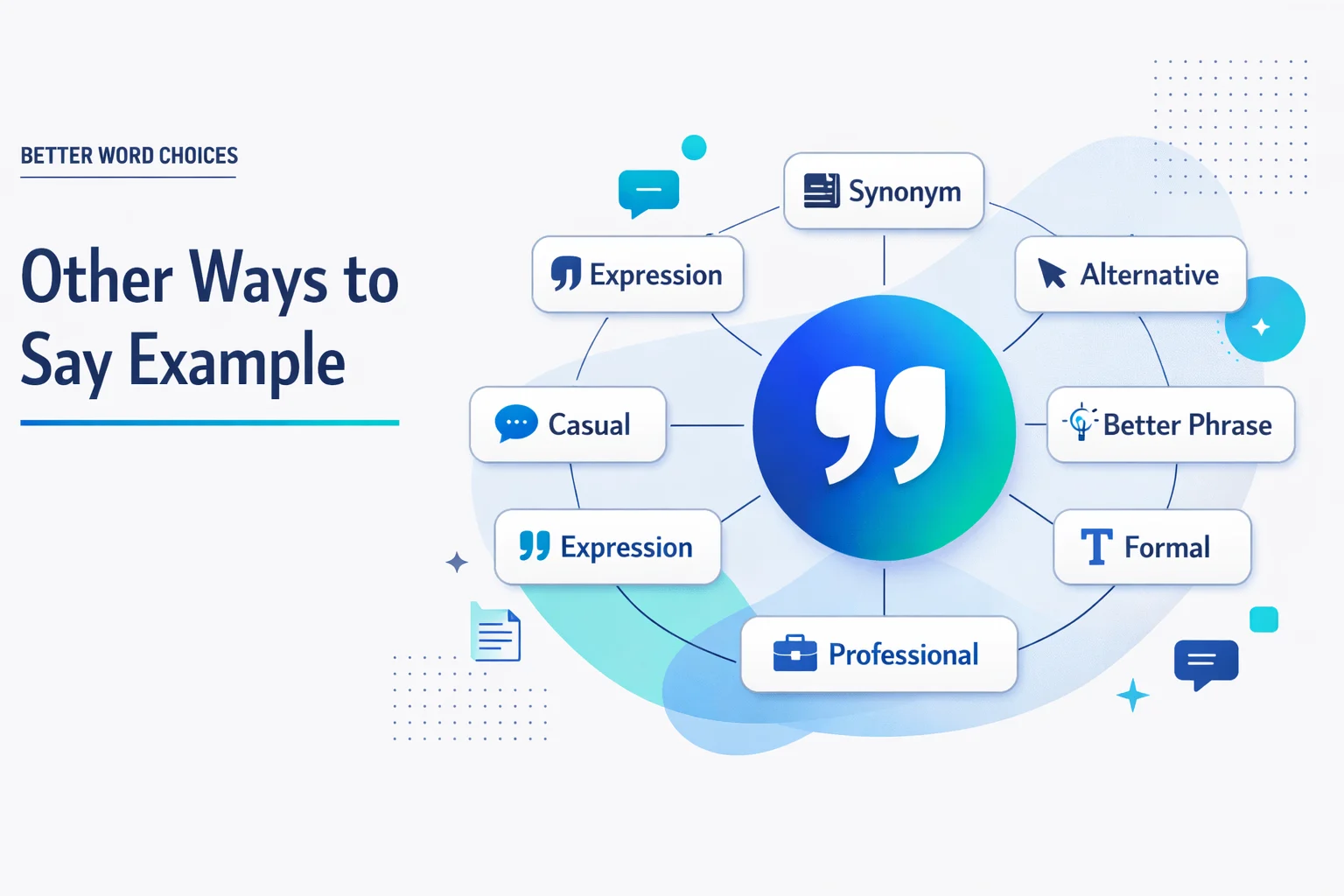
Searching for Other Ways to Say Example can make your writing sound more polished, engaging, and professional. Whether you’re writing an academic essay, business report, presentation, or casual blog post, using a variety of synonyms helps avoid repetition and improves readability. In this guide, you’ll discover 30 excellent alternatives to example, along with their meanings, explanations, example sentences, and the best situations in which to use each one.
The word example is one of the most commonly used words in English. People use it to point to a specific case that supports an idea, proves a point, or clarifies a concept. You will hear it in classrooms, meetings, essays, and everyday conversation.
Whether you are writing a formal report or chatting casually with a friend, knowing which synonym fits the moment builds confidence and keeps your language natural.
“The right word for the right moment is what separates good English from great English.”
Quick Categories
Formal alternatives to “Example”
- Instance
- Illustration
- Case in point
- Exemplar
Pro Tip: Use “instance” and “exemplar” in academic writing or formal reports where precision matters more than casual tone.
Casual alternatives
- Sample
- Case
- Like
- Say
Pro Tip: In spoken conversation, “like” or “say” (“Say you wanted to save money…”) sound far more natural than “example.
Professional alternatives
- Case study
- Benchmark
- Reference point
- Model
Pro Tip: In business settings, “case study” adds credibility because it implies real, documented evidence.
Informal expressions
- For instance
- Take this
- Picture this
- Here’s one
Pro Tip: Informal expressions work best in spoken English or casual writing like blogs and social posts, not formal reports.
“Formal or informal, tone is the invisible signal that tells your listener how to take you seriously.”
Common Mistakes Section
- Overusing “example” repeatedly in one paragraph. Mistake: “This is an example. Another example is this. One more example would be…”
- Using “instance” in casual speech, which sounds stiff. Mistake: “For instance, wanna grab coffee?”
- Confusing “sample” with “example” in statistics contexts. Mistake: “The example size was too small for the survey.” (should be “sample size”)
- Using “specimen” for people, which can sound rude or clinical. Mistake: “He is a fine specimen of a manager.” (sounds awkward, not a compliment)
- Mixing “e.g.” and “for example” incorrectly in the same sentence. Mistake: “For example, e.g., cats and dogs are pets.”
What Does “Example” Mean?
Example (noun) refers to a specific case, item, or instance that represents or illustrates a general rule, pattern, or category.
Grammar note: “Example” is a countable noun. It is often followed by “of” (example of something) and commonly appears in the phrase “for example.
Example sentence: “An apple is an example of a fruit.”
When to Use “Example”
- To clarify a general statement with a specific case
- To support an argument with evidence
- To teach a concept through demonstration
- To compare abstract ideas with real situations
Spoken vs Written
- Spoken: “Like, for example, when you’re running late…”
- Written: “For example, the data shows a clear upward trend.”
Formal vs Informal
- Formal: “This case exemplifies the broader issue at hand.”
- Informal: “Here’s an example of what I mean.”
Is It Professional or Polite to Say “Example”?
Example” is a neutral word, both polite and generally professional. However, in highly formal writing, using varied synonyms like “instance” or “illustration” can sound more polished.
Business example: “Let me give you an example of how this strategy improved our sales last quarter.”
Polite? ✔️ Yes Professional? ✔️ Yes (in most contexts)
Pros and Cons of Using “Example”
Pros:
- Simple and natural
- Friendly tone
- Common usage
- Easy to understand
Cons:
- Too repetitive if overused
- Sounds generic in formal writing
- Limited variation in tone
- Can weaken persuasive writing if used too often
“Repetition dulls language. Variety sharpens it.”
Other Ways to Say “Example”
These alternatives will help you sound more fluent, confident, and natural in different situations. Use them according to tone, context, and audience to express excitement, admiration, or approval when introducing supporting evidence.
1. Instance
Meaning: A single occurrence or example of something.
Explanation: Used to point to one specific case within a broader pattern or discussion.
Example Sentence: This is a clear instance of poor planning.
Best Use: Academic writing, research papers
Worst Use: Casual conversations
Tone: Formal, precise
Context Variability: Professional, written
2. Illustration
Meaning: An example that helps explain or clarify an idea.
Explanation: Frequently used to make abstract or complex concepts easier to understand.
Example Sentence: The chart provides a clear illustration of the trend.
Best Use: Teaching, presentations, reports
Worst Use: Quick casual chats
Tone: Clear, descriptive
Context Variability: Professional, spoken, written
3. Case
Meaning: A particular situation, event, or example.
Explanation: A versatile word commonly used in legal, medical, academic, and everyday contexts.
Example Sentence: In this case, the results were surprising.
Best Use: Reports, discussions, case analyses
Worst Use: Creative or poetic writing
Tone: Neutral, direct
Context Variability: Casual, professional
4. Sample
Meaning: A small portion that represents a larger group.
Explanation: Often used in research, testing, surveys, and product demonstrations.
Example Sentence: Here’s a sample of our new design.
Best Use: Research, marketing, product testing
Worst Use: Emotional or personal topics
Tone: Practical, factual
Context Variability: Professional, casual
5. Specimen
Meaning: A representative item collected for examination or study.
Explanation: Commonly used in scientific, biological, and medical contexts.
Example Sentence: The laboratory collected a specimen for testing.
Best Use: Scientific and medical writing
Worst Use: Casual descriptions of people
Tone: Technical, formal
Context Variability: Professional
6. Exemplar
Meaning: A perfect or outstanding example of something.
Explanation: Refers to someone or something that represents excellence.
Example Sentence: She is an exemplar of effective leadership.
Best Use: Formal praise, professional writing
Worst Use: Everyday conversation
Tone: Formal, admiring
Context Variability: Professional, written
7. Model
Meaning: An example or standard worthy of imitation.
Explanation: Suggests an ideal pattern that others can follow.
Example Sentence: This report serves as a model for future submissions.
Best Use: Workplace feedback, education
Worst Use: Casual small talk
Tone: Professional, approving
Context Variability: Professional
8. Demonstration
Meaning: A practical display showing how something works.
Explanation: Often involves explaining or proving a concept through action.
Example Sentence: The teacher gave a demonstration of the experiment.
Best Use: Training sessions, teaching
Worst Use: Formal essays
Tone: Instructive, clear
Context Variability: Professional, spoken
9. Precedent
Meaning: An earlier example that serves as a guide for future decisions.
Explanation: Frequently used in legal, policy, and organizational contexts.
Example Sentence: This ruling sets an important precedent for future cases.
Best Use: Legal writing, policy documents
Worst Use: Casual conversation
Tone: Formal, authoritative
Context Variability: Professional
10. Case in Point
Meaning: A specific example that proves a broader statement.
Explanation: Strengthens an argument by providing direct evidence.
Example Sentence: Our recent product launch is a case in point.
Best Use: Presentations, debates, persuasive writing
Worst Use: Technical documentation
Tone: Confident, persuasive
Context Variability: Professional, spoken
11. For Instance
Meaning: Introduces a specific example.
Explanation: A common and slightly formal alternative to for example.
Example Sentence: Some fruits, for instance apples and pears, are rich in fiber.
Best Use: Essays, speeches
Worst Use: Casual texting
Tone: Formal, explanatory
Context Variability: Written, spoken
12. Case Study
Meaning: A detailed examination of a real-world example.
Explanation: Used to analyze specific situations in depth.
Example Sentence: The presentation included a case study on customer retention.
Best Use: Business reports, academic research
Worst Use: Casual conversation
Tone: Analytical, formal
Context Variability: Professional
13. Prototype
Meaning: An early version used to test or develop an idea.
Explanation: Common in product development, engineering, and design.
Example Sentence: This is the first prototype of the new application.
Best Use: Product design, engineering
Worst Use: General conversation
Tone: Technical, forward-looking
Context Variability: Professional
14. Template
Meaning: A reusable format or example.
Explanation: Provides a structured model for creating similar work.
Example Sentence: Use this email as a template for future replies.
Best Use: Workplace communication
Worst Use: Storytelling
Tone: Practical, structured
Context Variability: Professional
15. Paradigm
Meaning: A typical pattern or model.
Explanation: Common in academic, philosophical, and theoretical discussions.
Example Sentence: This company is a paradigm of innovation.
Best Use: Academic essays, research
Worst Use: Casual conversations
Tone: Intellectual, formal
Context Variability: Professional, written
16. Archetype
Meaning: A perfect or classic example of a particular type.
Explanation: Frequently used in literature, psychology, and storytelling.
Example Sentence: The hero is an archetype found in many cultures.
Best Use: Literary analysis
Worst Use: Business meetings
Tone: Thoughtful, descriptive
Context Variability: Written
17. Showcase
Meaning: A display that highlights something as an excellent example.
Explanation: Emphasizes quality or achievement.
Example Sentence: The event will showcase local talent.
Best Use: Marketing, events
Worst Use: Technical writing
Tone: Promotional, positive
Context Variability: Professional, casual
18. Representation
Meaning: Something that stands for or reflects a larger idea.
Explanation: Often used in reports, analysis, and presentations.
Example Sentence: This graph is a representation of monthly sales.
Best Use: Reports, presentations
Worst Use: Everyday conversation
Tone: Analytical, neutral
Context Variability: Professional
19. Token
Meaning: A symbolic example or gesture.
Explanation: Commonly used when referring to appreciation or recognition.
Example Sentence: Please accept this gift as a token of our appreciation.
Best Use: Formal messages
Worst Use: Technical explanations
Tone: Polite, symbolic
Context Variability: Professional, written
20. Exhibit
Meaning: An item presented as evidence or proof.
Explanation: Frequently used in legal proceedings and formal presentations.
Example Sentence: Exhibit A contains the signed agreement.
Best Use: Legal documents, formal presentations
Worst Use: Casual conversations
Tone: Formal, evidential
Context Variability: Professional
21. Scenario
Meaning: A possible situation used for explanation or planning.
Explanation: Often presents a hypothetical example.
Example Sentence: Let’s consider a scenario where sales decrease by 10 percent.
Best Use: Planning sessions, training
Worst Use: Casual storytelling
Tone: Analytical, hypothetical
Context Variability: Professional, spoken
22. Benchmark
Meaning: A standard used for comparison.
Explanation: Represents a point of reference for measuring quality or performance.
Example Sentence: This product sets the benchmark for quality.
Best Use: Business analysis, performance reviews
Worst Use: Casual conversation
Tone: Professional, comparative
Context Variability: Professional
23. Reference Point
Meaning: A standard used for comparison or understanding.
Explanation: Helps explain or evaluate another idea or situation.
Example Sentence: Use last year’s report as a reference point.
Best Use: Planning, analysis
Worst Use: Emotional discussions
Tone: Practical, neutral
Context Variability: Professional
24. Epitome
Meaning: A perfect example of a particular quality.
Explanation: Used to emphasize excellence or an ideal standard.
Example Sentence: Her work ethic is the epitome of dedication.
Best Use: Formal compliments, descriptive writing
Worst Use: Casual jokes
Tone: Elevated, admiring
Context Variability: Professional, written
25. Embodiment
Meaning: A person or thing that perfectly represents an idea or quality.
Explanation: Often used for strong descriptive emphasis.
Example Sentence: He is the embodiment of patience.
Best Use: Formal writing, speeches
Worst Use: Everyday conversation
Tone: Literary, formal
Context Variability: Written
26. Analogy
Meaning: A comparison used to explain an idea through similarity.
Explanation: Helps readers understand unfamiliar concepts by relating them to familiar ones.
Example Sentence: Think of the brain as a computer, to use an analogy.
Best Use: Teaching, presentations
Worst Use: Legal documents
Tone: Explanatory, creative
Context Variability: Professional, spoken
27. Snapshot
Meaning: A brief overview or example of a situation.
Explanation: Provides a quick picture rather than a complete analysis.
Example Sentence: This report gives a snapshot of last quarter’s performance.
Best Use: Executive summaries, updates
Worst Use: Detailed research analysis
Tone: Concise, practical
Context Variability: Professional, casual
28. To Illustrate
Meaning: Introduces an example that clarifies a point.
Explanation: A formal transition phrase commonly used in essays and presentations.
Example Sentence: To illustrate, consider how prices changed last year.
Best Use: Essays, speeches, presentations
Worst Use: Text messaging
Tone: Formal, explanatory
Context Variability: Written, spoken
29. Typical Case
Meaning: A common or representative example.
Explanation: Indicates that the example reflects a usual situation.
Example Sentence: This is a typical case of workplace miscommunication.
Best Use: Workplace discussions, reports
Worst Use: Creative writing
Tone: Neutral, descriptive
Context Variability: Professional, spoken
30. Sample Case
Meaning: A representative case selected for study or explanation.
Explanation: Frequently used in research, education, and training materials.
Example Sentence: We reviewed a sample case to better understand the process.
Best Use: Research, training, education
Worst Use: Casual conversation
Tone: Practical, formal
Context Variability: Professional
“Every strong argument needs a strong example to stand on.”
Mini Quiz / Self-Check
- Which word fits best in a legal document? a) Sample b) Exhibit c) Snapshot
- Which phrase is most natural in casual spoken English? a) Case in point b) For instance c) The embodiment of
- Which word is commonly used in scientific research? a) Specimen b) Token c) Showcase
- Which phrase best introduces a hypothetical situation? a) Scenario b) Exemplar c) Precedent
Answers: 1-b, 2-a, 3-a, 4-a
Comparison Table: Top Alternatives
| Phrase | Tone | Best Use |
|---|---|---|
| Instance | Formal, precise | Academic writing |
| Illustration | Descriptive, clear | Teaching, presentations |
| Case | Neutral, direct | Discussions, reports |
| Sample | Practical, factual | Research, marketing |
| Specimen | Technical, formal | Scientific writing |
| Exemplar | Elevated, admiring | Formal praise |
| Case Study | Analytical, formal | Business reports |
| Benchmark | Comparative, formal | Performance reviews |
| Scenario | Analytical, hypothetical | Planning, training |
| Case in Point | Confident, direct | Arguments, debates |
FAQs
1. What is another word for example in formal writing?
“Instance,” “illustration,” and “exemplar” are strong formal alternatives.
2. Is “for instance” the same as “for example”?
Yes, they are interchangeable, though “for instance” sounds slightly more formal.
3. What is a professional way to say example in a business report?
Use “case study,” “benchmark,” or “reference point” for a professional tone.
4. Can “sample” and “example” be used interchangeably?
Not always. “Sample” often implies a portion of a larger set, while “example” simply illustrates a point.
5. What is a casual way to introduce an example in conversation?
Try phrases like “here’s one,” “take this,” or “say.”
Conclusion
Learning alternatives to example gives your English more range and precision. Instead of repeating the same word, you can choose from formal options like “instance” and “exemplar,” professional terms like “case study” and “benchmark,” or casual phrases like “take this” and “say.”
Practice using these alternatives daily in your writing and conversations. Pay close attention to tone, since the right word choice not only avoids repetition but also strengthens how clearly and confidently you communicate.
Read More Related Articles:
- Other Ways to Say “First of All” | Make You Sound More Fluent In 2026
- Other Ways to Say That Being Said | Smarter & More Fluent Alternatives In 2026
- Other Ways to Say “In This Article” | That Instantly Elevate Your Writing In 2026

Henry Walker is an American writer and blogger with a keen interest in communication, language and digital content. At TextsResponse.com, he creates informative and reader-focused resources designed to help people communicate with clarity, confidence and authenticity.