Quick Answer
Looking for other ways to say “in summary”? The most natural alternatives are to sum up, in conclusion, in short, in a nutshell, and long story short. Each one shifts the tone slightly, so picking the right phrase depends on whether you are writing a formal report or chatting with a colleague.Top 5 Alternatives: to sum up, in conclusion, in short, in a nutshell, long story short
In summary” is one of the most common transition phrases in English. People use it to signal that they are about to close out a point, a report, an email, or a conversation with the main takeaway. It tells the listener or reader: “Here is the short version of everything I just said.”
Because it appears so often in essays, meetings, and presentations, relying on the same phrase every time can make your writing sound repetitive. Learning alternatives to “in summary” helps you sound more fluent and adds variety to both spoken and written English. It also allows you to match your tone more precisely, whether you need something formal for a business report or something relaxed for a casual chat.
Beyond variety, expanding your vocabulary here also helps you express excitement in English when a conclusion is genuinely positive, or stay neutral and professional when it is not. Small word choices like this often separate confident English speakers from beginners.
The right tone makes your English sound professional and confident.
Quick Categories
Formal Alternatives to “In Summary”
- In conclusion
- To conclude
- To summarize
- In the final analysis
Pro Tip: Save formal alternatives for reports, essays, and presentations where a polished tone matters most.
Casual Alternatives
- Long story short
- In a nutshell
- Bottom line
- All in all
Pro Tip: Casual alternatives work well in texts, emails to friends, or informal team chats, but avoid them in client-facing documents.
Professional Alternatives
- To recap
- In closing
- Taking everything into account
- Overall
Pro Tip: Professional alternatives strike a balance between friendly and formal, making them ideal for meetings and workplace emails.
Informal Expressions
- Basically
- Anyway, long story short
- So yeah, that’s pretty much it
- To wrap it up
Pro Tip: Informal expressions are best used in speech, not in written business communication, since they can sound too relaxed on paper.
Common Mistakes People Make Using “In Summary”
- Overusing it in the middle of a paragraph. Incorrect: “In summary, the results were positive, but in summary, we still need more data.”
- Using it without actually summarizing anything new. Incorrect: “In summary, as I said before, it was good.”
- Starting every conclusion the same way in longer documents. Incorrect: Repeating “in summary” at the end of every section of a ten-page report.
- Confusing it with an introduction phrase. Incorrect: “In summary, let me explain what happened.”
- Using overly casual alternatives in formal writing. Incorrect: “Long story short, the merger failed,” in a formal shareholder report.
What Does “In Summary” Mean?
“In summary” is a transitional phrase used to introduce a brief restatement of the main points that were just discussed. Grammatically, it functions as an introductory phrase and is usually followed by a comma.
Example Sentence: “In summary, the campaign increased engagement but did not meet the sales target.”
When to Use “In Summary”
- At the end of a report, essay, or presentation
- Before closing an email that covered multiple points
- When wrapping up a meeting or discussion
- In academic writing to restate key findings
Spoken vs Written: In spoken English, people often prefer shorter alternatives like “so basically” or “long story short.” In written English, “in summary,” “in conclusion,” and “to summarize” are more common.
Formal vs Informal: Formal writing favors “in conclusion” or “to summarize,” while informal speech favors “bottom line” or “in a nutshell.
Is It Professional or Polite to Say “In Summary”?
In summary” is both polite and professional in almost every context. It is neutral, respectful, and widely accepted in business communication.
Business Example: “In summary, the Q3 report shows a 12% increase in revenue and a slight drop in customer churn.”
Polite? ✔️ Yes Professional? ✔️ Yes
Professional reaction phrases like this build trust because they sound clear and confident.”
Pros and Cons of Using “In Summary”
Pros:
- Simple and natural
- Universally understood
- Common usage in both speech and writing
- Easy to understand for non-native speakers
Cons:
- Can feel repetitive if overused
- Sounds slightly generic in creative writing
- Limited emotional range
- Not ideal for casual conversations among friends
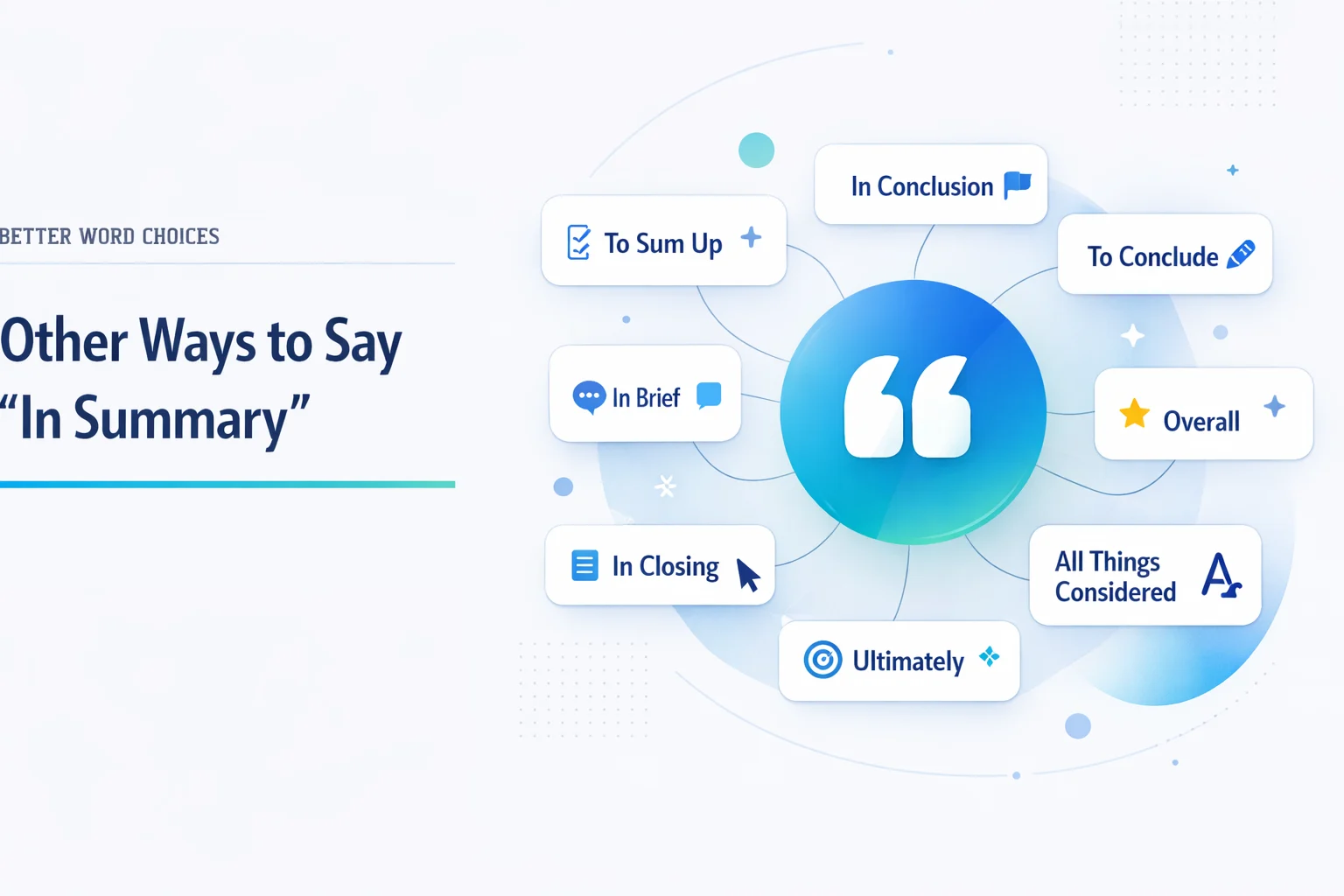
Other Ways to Say “In Summary”
These alternatives will help you sound more fluent, confident, and natural in different situations. Use them according to tone, context, and audience to express excitement, admiration, or simple clarity when closing a point.
1. To Sum Up
Meaning: Gives a brief final statement of the main points.
Explanation: A slightly more active alternative to in summary, commonly used to conclude presentations and discussions.
Example Sentence: To sum up, the team exceeded every goal this quarter.
Best Use: Presentations, speeches
Worst Use: Casual text messages
Tone: Formal, clear
Context Variability: Professional, spoken
2. In Conclusion
Meaning: Introduces the final point or overall judgment.
Explanation: One of the most common and widely accepted phrases for ending formal writing.
Example Sentence: In conclusion, the experiment supports our original hypothesis.
Best Use: Essays, reports
Worst Use: Casual conversations
Tone: Formal, academic
Context Variability: Formal, written
3. To Conclude
Meaning: Signals the final statement of a discussion or piece of writing.
Explanation: A polished and slightly more formal alternative to in conclusion.
Example Sentence: To conclude, the proposal offers strong long-term value.
Best Use: Academic writing
Worst Use: Everyday speech
Tone: Formal, precise
Context Variability: Professional, written
4. To Summarize
Meaning: Restates the main ideas briefly.
Explanation: Frequently used in business writing, reports, and presentations.
Example Sentence: To summarize, our budget needs a 10% increase next year.
Best Use: Business reports
Worst Use: Casual conversation
Tone: Formal, neutral
Context Variability: Professional, written
5. In Short
Meaning: States the main point briefly.
Explanation: A concise phrase that works in both formal and informal communication.
Example Sentence: In short, the plan needs more testing before launch.
Best Use: Emails, meetings
Worst Use: Long academic essays
Tone: Neutral, direct
Context Variability: Casual, professional
6. In Brief
Meaning: Summarizes information concisely.
Explanation: A slightly more formal alternative to in short.
Example Sentence: In brief, the merger was approved by both boards.
Best Use: News reports
Worst Use: Informal conversations
Tone: Formal, concise
Context Variability: Professional, written
7. In a Nutshell
Meaning: Explains something using very few words.
Explanation: A friendly idiom that makes summaries feel conversational.
Example Sentence: In a nutshell, the trip was amazing but exhausting.
Best Use: Casual conversation
Worst Use: Formal reports
Tone: Friendly, casual
Context Variability: Casual, spoken
8. Long Story Short
Meaning: Skips unnecessary details to give the final outcome.
Explanation: A common phrase in storytelling and everyday conversations.
Example Sentence: Long story short, we missed the flight.
Best Use: Storytelling, text messages
Worst Use: Business writing
Tone: Informal, relaxed
Context Variability: Casual, spoken
9. All in All
Meaning: Considers everything overall.
Explanation: Combines multiple points into one final judgment.
Example Sentence: All in all, the event was a success.
Best Use: Reviews, feedback
Worst Use: Technical reports
Tone: Neutral, reflective
Context Variability: Casual, professional
10. To Recap
Meaning: Briefly reviews what has already been discussed.
Explanation: Frequently used in meetings, presentations, and discussions.
Example Sentence: To recap, we agreed on three next steps.
Best Use: Meetings, conference calls
Worst Use: Formal essays
Tone: Professional, clear
Context Variability: Professional, spoken
11. In Closing
Meaning: Introduces the final remarks of a speech or letter.
Explanation: A respectful phrase commonly used in formal speaking and writing.
Example Sentence: In closing, I want to thank everyone for their hard work.
Best Use: Speeches, letters
Worst Use: Casual texting
Tone: Formal, respectful
Context Variability: Professional, spoken
12. Ultimately
Meaning: Highlights the final or most important outcome.
Explanation: Emphasizes the key takeaway after considering all factors.
Example Sentence: Ultimately, the decision depends on the budget.
Best Use: Discussions, essays
Worst Use: Short casual notes
Tone: Formal, decisive
Context Variability: Professional, written
13. In Essence
Meaning: Expresses the core or fundamental idea.
Explanation: Focuses on the most important meaning of a topic.
Example Sentence: In essence, the plan is about cutting costs.
Best Use: Explanations, analysis
Worst Use: Casual small talk
Tone: Formal, thoughtful
Context Variability: Professional, written
14. Briefly
Meaning: Explains something in a short and concise way.
Explanation: Signals that only the key points will be covered.
Example Sentence: Briefly, the update improves speed and security.
Best Use: Quick updates
Worst Use: Detailed reports
Tone: Neutral, efficient
Context Variability: Professional, spoken
15. In the End
Meaning: Describes the final result after everything has been considered.
Explanation: Common in storytelling and reflective writing.
Example Sentence: In the end, both teams agreed on the terms.
Best Use: Stories, reflections
Worst Use: Technical writing
Tone: Reflective, neutral
Context Variability: Casual, written
16. Taking Everything into Account
Meaning: Considers all relevant factors before reaching a conclusion.
Explanation: Useful when weighing multiple points or perspectives.
Example Sentence: Taking everything into account, the offer seems fair.
Best Use: Decisions, negotiations
Worst Use: Casual conversations
Tone: Formal, careful
Context Variability: Professional, written
17. Bottom Line
Meaning: States the most important final point.
Explanation: A popular business expression for the key takeaway.
Example Sentence: Bottom line, we need more funding by March.
Best Use: Business meetings
Worst Use: Academic essays
Tone: Direct, casual-professional
Context Variability: Professional, spoken
18. In the Final Analysis
Meaning: Gives a conclusion after careful consideration.
Explanation: Common in analytical and academic writing.
Example Sentence: In the final analysis, the strategy paid off.
Best Use: Academic papers
Worst Use: Everyday speech
Tone: Formal, analytical
Context Variability: Professional, written
19. To Put It Briefly
Meaning: Explains something using only the essential points.
Explanation: A formal alternative to in short.
Example Sentence: To put it briefly, the project is behind schedule.
Best Use: Updates, summaries
Worst Use: Storytelling
Tone: Neutral, formal
Context Variability: Professional, spoken
20. In Sum
Meaning: States the final conclusion in a concise way.
Explanation: Frequently used in academic and analytical writing.
Example Sentence: In sum, the data supports our approach.
Best Use: Research papers
Worst Use: Informal speech
Tone: Formal, academic
Context Variability: Professional, written
21. On the Whole
Meaning: Considers the overall situation rather than individual details.
Explanation: Useful when giving a balanced general impression.
Example Sentence: On the whole, the feedback was positive.
Best Use: Reviews, evaluations
Worst Use: Technical instructions
Tone: Neutral, balanced
Context Variability: Casual, professional
22. Overall
Meaning: Considers everything as a whole.
Explanation: One of the most versatile summary expressions in English.
Example Sentence: Overall, the launch went smoothly.
Best Use: Almost any context
Worst Use: Highly formal legal writing
Tone: Neutral, versatile
Context Variability: Casual, professional, spoken
23. In Review
Meaning: Looks back over what has already been discussed.
Explanation: Common in structured reports and presentations.
Example Sentence: In review, three main risks were identified.
Best Use: Reports, presentations
Worst Use: Casual conversation
Tone: Formal, structured
Context Variability: Professional, written
24. To Wrap Things Up
Meaning: Brings a discussion or activity to a close.
Explanation: A friendly and professional way to signal the ending.
Example Sentence: To wrap things up, let’s confirm next week’s deadline.
Best Use: Meetings, conference calls
Worst Use: Formal essays
Tone: Friendly, professional
Context Variability: Professional, spoken
25. Basically
Meaning: Explains the main idea in simple terms.
Explanation: Very common in everyday spoken English.
Example Sentence: Basically, we ran out of time.
Best Use: Casual speech
Worst Use: Formal writing
Tone: Informal, simple
Context Variability: Casual, spoken
26. So Yeah, That’s Pretty Much It
Meaning: Ends a conversation or explanation informally.
Explanation: Common among friends and in relaxed discussions.
Example Sentence: So yeah, that’s pretty much it for the update.
Best Use: Friendly conversations
Worst Use: Professional emails
Tone: Informal, relaxed
Context Variability: Casual, spoken
27. To Bring This to a Close
Meaning: Formally ends a discussion or presentation.
Explanation: Sounds polished and intentional in professional settings.
Example Sentence: To bring this to a close, thank you all for attending.
Best Use: Speeches, presentations
Worst Use: Text messages
Tone: Formal, polished
Context Variability: Professional, spoken
28. Summing Up
Meaning: Gives a brief final overview.
Explanation: A slightly softer alternative to to sum up.
Example Sentence: Summing up, the numbers look promising.
Best Use: Presentations, discussions
Worst Use: Casual texting
Tone: Neutral, professional
Context Variability: Professional, spoken
29. In Closing Remarks
Meaning: Introduces the final section of a speech.
Explanation: Commonly used during formal ceremonies and public speaking.
Example Sentence: In closing remarks, the director praised the team’s effort.
Best Use: Ceremonies, speeches
Worst Use: Everyday writing
Tone: Formal, ceremonial
Context Variability: Professional, spoken
30. Wrapping Things Up
Meaning: Casually signals the end of a discussion.
Explanation: A relaxed version of to wrap things up that suits informal meetings.
Example Sentence: Wrapping things up, we’ll follow up by email.
Best Use: Informal meetings
Worst Use: Academic essays
Tone: Friendly, casual-professional
Context Variability: Casual, professional, spoken
Learning alternatives to common phrases is one of the fastest ways to sound more fluent.
Mini Quiz: Test Your Understanding
1. Which phrase is most appropriate for a formal academic paper?
A) In the Final Analysis
B) Basically
C) Bottom Line
Correct Answer: A) In the Final Analysis
2. Which alternative works best in a casual conversation with a friend?
A) In Closing Remarks
B) In a Nutshell
C) In Sum
D) Taking Everything into Account
Correct Answer: B) In a Nutshell
3. Which phrase would sound out of place in a business email?
A) To Recap
B) So Yeah, That’s Pretty Much It
C) In Short
D) Overall
Correct Answer: B) So Yeah, That’s Pretty Much It
4. True or False
“In Summary” can be used in both written and spoken English.
Correct Answer: True
Comparison Table: Top Alternatives to “In Summary”
| Phrase | Tone | Best Use |
|---|---|---|
| To sum up | Formal | Presentations |
| In conclusion | Formal | Essays |
| To summarize | Formal | Business reports |
| In short | Neutral | Emails |
| In a nutshell | Casual | Conversations |
| Long story short | Informal | Storytelling |
| Bottom line | Direct | Business meetings |
| Overall | Versatile | Almost any context |
| To recap | Professional | Meetings |
| In the final analysis | Formal | Academic papers |
FAQs
1. What is the most common way to say “in summary”?
“To sum up” and “in conclusion” are the most widely used alternatives in both writing and speech.
2. Is “in a nutshell” formal or informal?
“In a nutshell” is informal and works best in casual conversations rather than formal writing.
3. Can I use “bottom line” in a business email?
Yes, “bottom line” is common in professional settings, especially when speaking directly and efficiently.
4. What is a good academic alternative to “in summary”?
“In the final analysis” and “in sum” both sound polished and fit academic or research writing well.
5. How can I avoid repeating “in summary” in long documents?
Rotate between formal alternatives like “to summarize,” “overall,” and “in conclusion” depending on the section.
Conclusion
Mastering alternatives to “in summary” makes your English sound more natural, confident, and varied across different situations. Whether you are closing a formal report with “to summarize” or ending a casual chat with “long story short,” matching tone to context is what separates fluent speakers from beginners.
Practice using a few of these phrases daily in your writing and conversations. Over time, you will naturally choose the right closing phrase without even thinking about it, and your English will sound noticeably more professional and polished.
Want more phrase variety? Check out our related guide on professional English communication and other “Other Ways to Say” articles for everyday expressions.
Read More Related Articles:
- Other Ways to Say Additionally | Make Your Writing More Polished In 2026
- Other Ways to Say Conclusion | End Any Piece with Confidence In 2026
- Other Ways to Say “Similarly” | Smart Synonyms You’ll Use Every Day In 2026

Henry Walker is an American writer and blogger with a keen interest in communication, language and digital content. At TextsResponse.com, he creates informative and reader-focused resources designed to help people communicate with clarity, confidence and authenticity.