Quick Answer
If you want other ways to say conclusion, you can use words and phrases that signal you are wrapping up your thoughts, summarizing key points, or closing a discussion. The top five alternatives are: to sum up, in summary, to wrap up, in closing, and ultimately.
The word conclusion is one of the most commonly used words in both spoken and written English. It signals the end of an idea, an essay, a speech, or a business report. People rely on it constantly, but repeating the same word again and again can make your writing sound flat and repetitive.
Learning alternatives to conclusion helps you sound more polished, natural, and confident, whether you are writing an academic paper, closing a presentation, or wrapping up an email. Choosing the right closing phrase also helps you express excitement in English when the outcome is positive, or stay neutral and formal when the tone needs to be professional.
This guide gives you a complete list of alternatives, organized by tone and context, along with examples, usage tips, and a quick self-check quiz.
The right tone makes your English sound professional and confident.
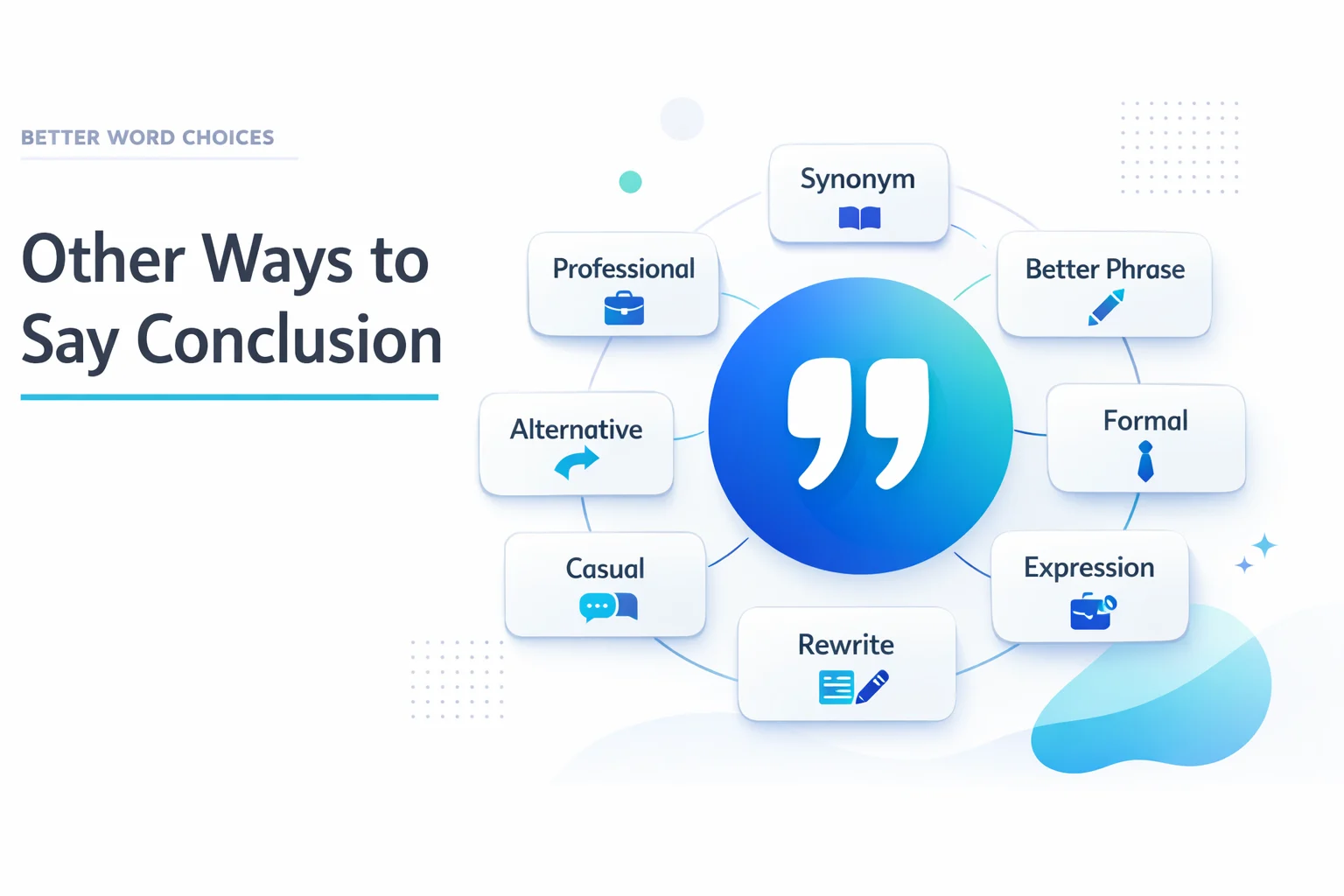
Quick Categories
Formal alternatives to “conclusion”
- To conclude
- In summary
- Ultimately
- On the whole
Pro Tip: Use formal alternatives in essays, research papers, and official reports where a professional tone is expected.
Casual alternatives
- To wrap up
- In a nutshell
- Bottom line
- Long story short
Pro Tip: Save casual alternatives for conversations with friends, colleagues you know well, or informal writing like blog posts.
Professional alternatives
- In closing
- Taking everything into account
- To summarize
- Final thoughts
Pro Tip: In business emails and meetings, professional alternatives keep your message clear without sounding too stiff or too relaxed.
Informal expressions
- At the end of the day
- Long story short
- To put it simply
- In a word
Pro Tip: Informal expressions work well in spoken English, but avoid them in formal written documents.
Small word choices make a big difference in how confident you sound.
Common Mistakes
- Overusing “in conclusion” in every paragraph. Example: Writing “In conclusion” three times in one short essay makes the writing repetitive.
- Using casual phrases in formal writing. Example: Writing “long story short” in a university thesis sounds unprofessional.
- Starting a conclusion with “so” in academic writing. Example: “So, in conclusion, the results show…” is too informal for a research paper.
- Repeating the same alternative throughout a document. Example: Using “to sum up” five times in one report reduces its impact.
- Confusing “conclusion” with “introduction” in structure. Example: Placing a closing phrase like “in closing” at the start of a paragraph confuses the reader.
What Does “Conclusion” Mean?
Conclusion is a noun that refers to the final part of something, such as a speech, essay, meeting, or argument, where the main points are summarized or a final decision is reached.
Grammar note: “Conclusion” is often used with prepositions like “in conclusion,” “at the conclusion of,” or “draw a conclusion.”
Example sentence: In conclusion, the team successfully completed the project ahead of schedule.
When to Use “Conclusion”
- Ending an academic essay or research paper
- Closing a business presentation or report
- Summarizing key points in a speech
- Wrapping up a formal letter or email
Spoken vs Written: In spoken English, people often prefer shorter alternatives like “so” or “to wrap up.” In written English, “in conclusion” or “to conclude” remains common in formal documents.
Formal vs Informal: Formal settings call for words like “ultimately” or “in summary,” while informal settings allow for phrases like “bottom line” or “long story short.
Is It Professional or Polite to Say “Conclusion”?
Conclusion” itself is both polite and professional, making it a safe choice in almost any setting.
Business example: In conclusion, we recommend moving forward with the proposed marketing strategy.
Polite? Yes Professional? Yes
Pros and Cons of Using “Conclusion”
Pros:
- Clear and widely understood
- Works in both spoken and written English
- Appropriate for formal and academic contexts
- Signals structure and organization
Cons:
- Can sound repetitive if overused
- May feel too formal for casual conversation
- Limited emotional or stylistic variation
- Common in essays, which can make writing predictable
“Variety in vocabulary keeps your reader engaged from start to finish.”
Other Ways to Say Conclusion
These alternatives will help you sound more fluent, confident, and natural in different situations. Use them according to tone, context, and audience to express excitement, admiration, or approval, or simply to keep your writing clear and professional.
1. To Sum Up
Meaning: A way to briefly restate the main points.
Explanation: Commonly used before giving a short summary or conclusion.
Example Sentence: To sum up, the campaign increased sales by twenty percent.
Best Use: Presentations, reports
Worst Use: Casual chats
Tone: Neutral, clear, professional
Context Variability: Professional, spoken
2. In Summary
Meaning: Introduces a condensed version of what has been discussed.
Explanation: A formal transition commonly used to conclude reports, essays, and research papers.
Example Sentence: In summary, our findings support the original hypothesis.
Best Use: Academic writing
Worst Use: Texting friends
Tone: Formal, precise, professional
Context Variability: Professional, written
3. To Wrap Up
Meaning: To bring a discussion or activity to an end.
Explanation: A friendly and conversational way to signal that you’re finishing.
Example Sentence: To wrap up, let’s review the action items from today’s meeting.
Best Use: Meetings, chats
Worst Use: Formal essays
Tone: Friendly, casual, direct
Context Variability: Casual, spoken
4. All Things Considered
Meaning: After thinking about every important factor.
Explanation: Used to present a balanced conclusion after weighing multiple points.
Example Sentence: All things considered, the project was a success.
Best Use: Discussions, reviews
Worst Use: Quick notes
Tone: Thoughtful, balanced, formal
Context Variability: Professional, written
5. In Closing
Meaning: Introduces the final remarks.
Explanation: A formal closing phrase commonly used in speeches, presentations, and letters.
Example Sentence: In closing, I would like to thank everyone for their hard work.
Best Use: Speeches, letters
Worst Use: Casual texts
Tone: Formal, respectful, polished
Context Variability: Professional, spoken
6. To Conclude
Meaning: To bring an argument or discussion to an end.
Explanation: A direct and formal transition used in academic and professional writing.
Example Sentence: To conclude, the evidence strongly supports our proposal.
Best Use: Essays, reports
Worst Use: Casual talk
Tone: Formal, academic, clear
Context Variability: Professional, written
7. Taking Everything into Account
Meaning: After considering all relevant factors.
Explanation: Suggests a careful and balanced final judgment.
Example Sentence: Taking everything into account, we decided to delay the launch.
Best Use: Business decisions
Worst Use: Short messages
Tone: Formal, careful, professional
Context Variability: Professional, written
8. In a Nutshell
Meaning: A brief and simple summary.
Explanation: A popular expression for explaining something quickly and clearly.
Example Sentence: In a nutshell, the plan worked better than expected.
Best Use: Casual talks
Worst Use: Formal reports
Tone: Casual, simple, friendly
Context Variability: Casual, spoken
9. Overall
Meaning: Considering everything as a whole.
Explanation: A short, versatile word used to summarize an overall impression.
Example Sentence: Overall, the event was well organized and successful.
Best Use: Reviews, feedback
Worst Use: Long formal essays
Tone: Neutral, simple, clear
Context Variability: Professional, casual
10. To Bring This to a Close
Meaning: To formally end a discussion or presentation.
Explanation: Often used in speeches, meetings, and presentations.
Example Sentence: To bring this to a close, let’s recap our main goals.
Best Use: Presentations
Worst Use: Informal chats
Tone: Formal, structured, polished
Context Variability: Professional, spoken
11. In the End
Meaning: After everything has happened or been considered.
Explanation: Introduces the final outcome or conclusion naturally.
Example Sentence: In the end, both teams agreed on a fair solution.
Best Use: Storytelling, discussions
Worst Use: Technical reports
Tone: Reflective, natural, neutral
Context Variability: Casual, spoken
12. Ultimately
Meaning: In the final analysis or result.
Explanation: Signals the most important final conclusion.
Example Sentence: Ultimately, the client chose the more affordable option.
Best Use: Formal writing
Worst Use: Casual texts
Tone: Formal, decisive, clear
Context Variability: Professional, written
13. As a Final Point
Meaning: Introduces the last idea in a discussion or list.
Explanation: Frequently used in structured speeches and essays.
Example Sentence: As a final point, I want to emphasize the importance of teamwork.
Best Use: Speeches, essays
Worst Use: Casual conversation
Tone: Formal, structured, clear
Context Variability: Professional, spoken
14. To Summarize
Meaning: To briefly restate the main points.
Explanation: A standard transition in academic and professional writing.
Example Sentence: To summarize, the report highlights three major risks.
Best Use: Reports, essays
Worst Use: Casual chats
Tone: Formal, precise, professional
Context Variability: Professional, written
15. In Brief
Meaning: A quick summary.
Explanation: Useful when time or space is limited.
Example Sentence: In brief, the strategy needs a few small adjustments.
Best Use: Quick updates
Worst Use: Detailed essays
Tone: Concise, neutral, clear
Context Variability: Professional, spoken
16. Final Thoughts
Meaning: The last opinions or reflections on a topic.
Explanation: Frequently used at the end of blogs, articles, and reviews.
Example Sentence: Final thoughts: this product is worth the investment.
Best Use: Blogs, reviews
Worst Use: Academic essays
Tone: Reflective, friendly, conversational
Context Variability: Casual, written
17. All in All
Meaning: Considering everything together.
Explanation: A friendly expression for giving an overall impression.
Example Sentence: All in all, it was a productive week.
Best Use: Casual reviews
Worst Use: Formal reports
Tone: Friendly, casual, simple
Context Variability: Casual, spoken
18. In Essence
Meaning: Refers to the most important or fundamental idea.
Explanation: Highlights the core message of a discussion.
Example Sentence: In essence, the plan focuses on reducing costs.
Best Use: Analysis, discussions
Worst Use: Casual texts
Tone: Thoughtful, formal, precise
Context Variability: Professional, written
19. To Finish Up
Meaning: To complete or end something.
Explanation: A relaxed transition commonly used in meetings and conversations.
Example Sentence: To finish up, let’s confirm next week’s schedule.
Best Use: Meetings, casual talks
Worst Use: Academic writing
Tone: Casual, friendly, direct
Context Variability: Casual, spoken
20. At the End of the Day
Meaning: When everything has been considered.
Explanation: A popular idiom used to express the final truth or most important conclusion.
Example Sentence: At the end of the day, customer satisfaction matters most.
Best Use: Conversations, casual talks
Worst Use: Formal essays
Tone: Casual, idiomatic, relatable
Context Variability: Casual, spoken
21. In Short
Meaning: A brief way of expressing the main idea.
Explanation: Ideal for concise summaries.
Example Sentence: In short, the plan needs more funding to succeed.
Best Use: Quick summaries
Worst Use: Detailed reports
Tone: Concise, clear, neutral
Context Variability: Professional, spoken
22. Bottom Line
Meaning: The most important point or final result.
Explanation: Widely used in business and everyday conversation.
Example Sentence: Bottom line, we need to cut expenses this quarter.
Best Use: Business talks
Worst Use: Formal essays
Tone: Direct, casual, practical
Context Variability: Casual, professional
23. Wrapping Things Up
Meaning: Bringing a discussion or activity to an end.
Explanation: A friendly transition commonly used in meetings and presentations.
Example Sentence: Wrapping things up, thank you all for attending today.
Best Use: Meetings, presentations
Worst Use: Academic writing
Tone: Friendly, casual, warm
Context Variability: Casual, spoken
24. To Put It Simply
Meaning: To explain something in an easy-to-understand way.
Explanation: Helps simplify complex ideas before concluding.
Example Sentence: To put it simply, the new system saves time and money.
Best Use: Explanations
Worst Use: Formal essays
Tone: Clear, simple, friendly
Context Variability: Casual, spoken
25. In a Word
Meaning: Summarizes something using one key idea.
Explanation: A brief and impactful way to conclude a statement.
Example Sentence: In a word, the launch was a success.
Best Use: Casual summaries
Worst Use: Long reports
Tone: Concise, casual, direct
Context Variability: Casual, spoken
26. On the Whole
Meaning: Considering everything in general.
Explanation: A balanced expression commonly used in formal summaries.
Example Sentence: On the whole, the results were positive.
Best Use: Reports, reviews
Worst Use: Casual chats
Tone: Formal, balanced, neutral
Context Variability: Professional, written
27. To Close
Meaning: To formally end a speech, letter, or discussion.
Explanation: A concise and professional closing transition.
Example Sentence: To close, I want to thank our sponsors for their support.
Best Use: Speeches, letters
Worst Use: Casual texts
Tone: Formal, respectful, brief
Context Variability: Professional, spoken
28. Long Story Short
Meaning: A quick summary of a longer explanation.
Explanation: A popular informal phrase used in storytelling.
Example Sentence: Long story short, we missed the flight but caught the next one.
Best Use: Storytelling, casual conversations
Worst Use: Business reports
Tone: Casual, relatable, informal
Context Variability: Casual, spoken
29. Final Word
Meaning: The last statement or final decision on a matter.
Explanation: Often signals authority or a definitive conclusion.
Example Sentence: My final word is that we should proceed with the plan.
Best Use: Decisions, debates
Worst Use: Casual updates
Tone: Firm, formal, decisive
Context Variability: Professional, spoken
30. In Closing Remarks
Meaning: Refers to the final section of a speech or presentation.
Explanation: Commonly used in formal public speaking to introduce concluding comments.
Example Sentence: In closing remarks, the CEO thanked the entire team.
Best Use: Formal speeches
Worst Use: Casual conversation
Tone: Formal, polished, respectful
Context Variability: Professional, spoken
“Choosing the right closing phrase shows confidence and control over your message.”
Mini Quiz / Self-Check
1. Which phrase is most appropriate for a formal research paper?
A) Bottom line
B) To conclude
C) Long story short
Correct Answer: B) To conclude
2. Which alternative fits best in a casual conversation with a friend?
A) In essence
B) At the end of the day
C) On the whole
Correct Answer: B) At the end of the day
3. Which phrase would you use in the closing remarks of an official speech?
A) In a word
B) In closing
C) To wrap up
Correct Answer: B) In closing
4. True or False
Statement: “Long story short” is suitable for a formal business report.
Correct Answer: False
“Matching tone to context is the real secret to fluent English.”
Comparison Table: Top Alternatives
| Phrase | Tone | Best Use |
|---|---|---|
| To sum up | Neutral, professional | Presentations, reports |
| In summary | Formal, precise | Academic writing |
| To wrap up | Friendly, casual | Meetings, chats |
| In closing | Formal, respectful | Speeches, letters |
| To conclude | Formal, academic | Essays, reports |
| In a nutshell | Casual, simple | Casual talks |
| Ultimately | Formal, decisive | Formal writing |
| To summarize | Formal, precise | Reports, essays |
| Bottom line | Direct, practical | Business talks |
| At the end of the day | Casual, idiomatic | Conversations |
FAQs
What is the most professional way to say “conclusion”?
In closing” and “to conclude” are among the most professional alternatives to conclusion for formal writing and speeches.
What is a casual synonym for “conclusion”?
“Bottom line” and “in a nutshell” are common informal expressions in English for everyday conversation.
Can I use “in conclusion” in a business email?
Yes, but professional reaction phrases like “in summary” or “to summarize” often sound smoother in email writing.
What are other ways to say “conclusion” in an essay?
Academic essays commonly use “to conclude,” “in summary,” or “ultimately” as strong alternatives to conclusion.
Is “long story short” formal or informal? “
Long story short” is an informal expression in English, best suited for spoken conversation rather than formal writing.
Conclusion
Learning multiple alternatives to conclusion allows you to communicate with greater precision, variety, and confidence across different situations, from academic essays to casual conversations. Instead of repeating the same closing word, you can now choose a phrase that matches your tone, audience, and purpose.
Practice using these alternatives daily in your writing and speech to strengthen your fluency. Paying attention to tone awareness, whether formal, professional, casual, or informal, will help your English sound natural and polished in every context.

Daniel Murphy is a professional writer and blogger specializing in digital communication and messaging trends. As a contributor to TextsResponse.com, he creates reader-focused content designed to help people find the right words at the right time.