Quick Answer
If you want quick alternatives to I agree, you can say: absolutely, that makes sense, I’m on board, fair enough, or you’re right. Each phrase carries a slightly different tone, so choosing the right one depends on whether you are speaking casually, professionally, or in writing.
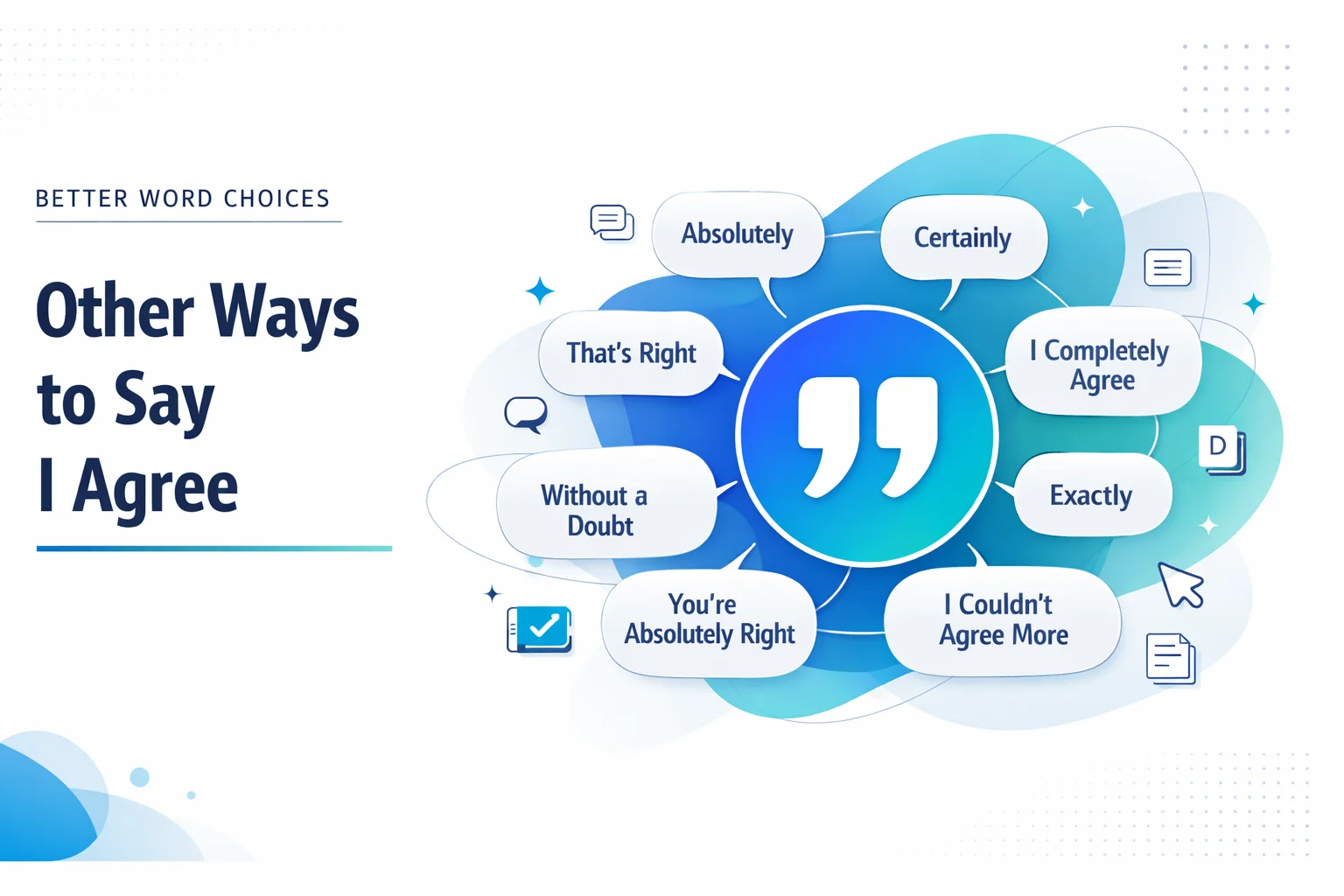
Finding Other Ways to Say I Agree can make your conversations and writing sound more natural, confident, and engaging. Whether you’re participating in a business meeting, writing an email, joining a classroom discussion, or chatting with friends, using a variety of agreement phrases helps you express support in the right tone for every situation. In this guide, you’ll discover the best alternatives to “I agree”, along with their meanings, examples, and the contexts where they work best.
I agree is one of the most common phrases in English. People use it to confirm agreement with an idea, an opinion, a plan, or a statement someone else has made. It shows up in meetings, emails, casual chats, debates, and everyday conversations.
This is also useful when you want to express excitement in English about an idea you support, or when you need a more measured, professional way to confirm agreement at work. Below, you will find formal, casual, professional, and informal options, along with clear examples for each.
“The right tone makes your English sound professional and confident.”
Quick Categories
Formal Alternatives to “I Agree”
- I concur
- I am in agreement
- That is a valid point
- I share that view
Pro Tip: Use formal alternatives in written reports, academic writing, and official emails where a professional tone matters.
Casual Alternatives
- Totally
- For sure
- Same here
- Sounds good to me
Pro Tip: Save casual alternatives for friends, family, or relaxed conversations, not for business emails.
Professional Alternatives
- I’m on board with that
- That aligns with my thinking
- I support this approach
- That makes sense to me
Pro Tip: In meetings, pairing a professional alternative with a short reason (“That makes sense to me because…”) builds credibility.
Informal Expressions
- Yeah, definitely
- I’m with you on that
- No argument here
- Right on
Pro Tip: Informal expressions work well in texts and spoken conversation, but avoid them in formal writing.
Small changes in wording can completely shift how confident and natural you sound.”
Common Mistakes
- Overusing “I agree” repeatedly in the same conversation. Example: “I agree. I agree. I agree with that too.”
- Using casual phrases in formal emails. Example: “Yeah, totally agree with the new policy.” (in a business email)
- Forgetting to add a reason after agreeing. Example: “I agree.” (with no explanation, sounding flat)
- Mixing formal and informal tone in one sentence. Example: “I concur, that’s totally cool with me.”
- Using “I agree” when a stronger or weaker word fits better. Example: Saying “I agree” when you actually mean “I strongly support this.
What Does “I Agree” Mean?
I agree means you share the same opinion, idea, or decision as someone else. It is a simple subject-verb structure: “I” (subject) + “agree” (verb), often followed by “with” plus a noun or pronoun.
Example Sentence: I agree with your plan to launch the product next month.
When to Use “I Agree”
- Confirming a shared opinion in a discussion
- Approving a suggestion or plan
- Responding to someone’s statement in writing
- Supporting a decision in a meeting
Spoken vs Written
- Spoken: Often shortened or paired with tone, such as “I agree, definitely.”
- Written: Usually followed by a reason for clarity, such as “I agree, as this approach saves time.”
Formal vs Informal
- Formal: “I agree with the committee’s recommendation.”
- Informal: “Yeah, I agree, let’s do that.”
Is It Professional or Polite to Say “I Agree”?
I agree is polite and works in almost any setting, but it is not always the most professional-sounding choice on its own, especially without supporting reasoning.
Business Example: “I agree with the proposed timeline, and I believe it also gives the team enough room for testing.”
Polite? Yes Professional? No (in most cases, unless followed by a reason)
Pros and Cons of Using “I Agree”
Pros
- Simple and natural
- Friendly tone
- Common usage
- Easy to understand
Cons
- Too informal for work
- Overused
- Limited emotional range
- Not suitable for formal writing
Other Ways to Say I Agree
These alternatives will help you sound more fluent, confident, and natural in different situations.
Use them according to tone, context, and audience to express excitement, admiration, or approval.
1. I Concur
Meaning: A formal way to express agreement.
Explanation: Commonly used in academic, legal, and professional settings to indicate that you fully agree with a statement or conclusion.
Example Sentence: I concur with the findings presented in this report.
Best Use: Reports, legal documents, formal writing
Worst Use: Casual conversations
Tone: Formal, precise, respectful
Context Variability: Professional, written
2. Absolutely
Meaning: Expresses complete and enthusiastic agreement.
Explanation: Shows strong confidence and wholehearted support for an idea or opinion.
Example Sentence: Absolutely, that’s the best way forward.
Best Use: Casual conversations, spoken English
Worst Use: Legal or highly formal documents
Tone: Enthusiastic, confident, warm
Context Variability: Casual, spoken
3. That Makes Sense to Me
Meaning: You understand and agree with the reasoning.
Explanation: Indicates thoughtful agreement after considering the explanation or evidence.
Example Sentence: That makes sense to me, especially given the budget limitations.
Best Use: Meetings, workplace discussions
Worst Use: Very casual text messages
Tone: Thoughtful, professional, calm
Context Variability: Professional, spoken
4. I’m On Board
Meaning: You fully support a plan or decision.
Explanation: Suggests commitment and willingness to participate, not just agreement.
Example Sentence: I’m on board with the new marketing strategy.
Best Use: Team projects, workplace collaboration
Worst Use: Academic essays
Tone: Supportive, collaborative, energetic
Context Variability: Professional, spoken
5. Fair Enough
Meaning: You accept another person’s point, even if you’re not completely convinced.
Explanation: Often used after considering someone else’s reasoning.
Example Sentence: Fair enough, I understand why you’d choose that option.
Best Use: Friendly debates, casual discussions
Worst Use: Formal reports
Tone: Relaxed, open-minded, neutral
Context Variability: Casual, spoken
6. You’re Right
Meaning: Confirms that someone else’s statement is correct.
Explanation: A straightforward way to acknowledge another person’s accuracy.
Example Sentence: You’re right, we should test this before launching.
Best Use: Everyday conversations
Worst Use: Highly formal writing
Tone: Honest, direct, warm
Context Variability: Casual, professional
7. I Share That View
Meaning: You have the same opinion as someone else.
Explanation: A polished phrase often used in formal discussions, interviews, and panels.
Example Sentence: I share that view regarding the company’s future direction.
Best Use: Interviews, panel discussions
Worst Use: Texting friends
Tone: Formal, composed, respectful
Context Variability: Professional
8. Totally
Meaning: Expresses complete agreement in an informal way.
Explanation: A common phrase in casual spoken English.
Example Sentence: Totally, that movie was amazing.
Best Use: Friends, casual conversations
Worst Use: Business meetings
Tone: Casual, energetic, friendly
Context Variability: Casual, spoken
9. That’s a Valid Point
Meaning: Acknowledges that someone has made a reasonable argument.
Explanation: Shows respect for another person’s perspective, even if further discussion may follow.
Example Sentence: That’s a valid point, and it changes how I see this.
Best Use: Debates, workplace discussions
Worst Use: Very casual conversations
Tone: Analytical, respectful, calm
Context Variability: Professional, spoken
10. Same Here
Meaning: You share the same opinion or feeling.
Explanation: A brief and natural response in everyday conversations.
Example Sentence: Same here, I’d rather work remotely too.
Best Use: Casual conversations
Worst Use: Formal emails
Tone: Casual, friendly, brief
Context Variability: Casual, spoken
11. I Couldn’t Agree More
Meaning: Expresses complete agreement.
Explanation: Used when you strongly support someone else’s opinion.
Example Sentence: I couldn’t agree more with your assessment.
Best Use: Strong expressions of support
Worst Use: Situations involving only partial agreement
Tone: Enthusiastic, sincere, strong
Context Variability: Professional, spoken
12. Sounds Good to Me
Meaning: Indicates approval of a suggestion or plan.
Explanation: A friendly way to confirm agreement.
Example Sentence: Sounds good to me, let’s meet at noon.
Best Use: Planning, casual conversations
Worst Use: Formal writing
Tone: Relaxed, easygoing, friendly
Context Variability: Casual, spoken
13. I’m With You on That
Meaning: You support the same opinion or viewpoint.
Explanation: Shows agreement while expressing solidarity.
Example Sentence: I’m with you on that, the deadline is unrealistic.
Best Use: Team discussions
Worst Use: Formal reports
Tone: Supportive, warm, informal
Context Variability: Casual, professional
14. That Aligns with My Thinking
Meaning: Your opinion matches the idea being discussed.
Explanation: A professional phrase commonly used in workplace communication.
Example Sentence: That aligns with my thinking on the project timeline.
Best Use: Meetings, business emails
Worst Use: Casual conversations
Tone: Professional, measured, clear
Context Variability: Professional
15. Right On
Meaning: An enthusiastic expression of agreement.
Explanation: Frequently used in relaxed and friendly conversations.
Example Sentence: Right on, that’s exactly what I was thinking.
Best Use: Informal conversations
Worst Use: Professional writing
Tone: Casual, upbeat, informal
Context Variability: Casual, spoken
16. No Argument Here
Meaning: You have no reason to disagree.
Explanation: Suggests easy and complete agreement.
Example Sentence: No argument here, your plan sounds solid.
Best Use: Informal discussions
Worst Use: Formal documents
Tone: Relaxed, agreeable, casual
Context Variability: Casual, spoken
17. I Support This Approach
Meaning: You approve of a particular method or strategy.
Explanation: Frequently used in workplace and project discussions.
Example Sentence: I support this approach for handling customer feedback.
Best Use: Workplace decisions
Worst Use: Casual conversations
Tone: Professional, confident, formal
Context Variability: Professional
18. Exactly
Meaning: Strongly confirms that someone is correct.
Explanation: A concise way to emphasize complete agreement.
Example Sentence: Exactly, that’s the point I was trying to make.
Best Use: Conversations
Worst Use: Very formal writing
Tone: Confident, direct, energetic
Context Variability: Casual, spoken
19. I Am in Agreement
Meaning: A formal statement expressing shared opinion.
Explanation: Often used in legal, academic, and business contexts.
Example Sentence: I am in agreement with the terms outlined in the contract.
Best Use: Contracts, formal writing
Worst Use: Everyday conversations
Tone: Formal, official, precise
Context Variability: Professional
20. That Works for Me
Meaning: You accept a suggestion or arrangement.
Explanation: Common when confirming schedules or plans.
Example Sentence: That works for me, let’s schedule it for Friday.
Best Use: Planning, scheduling
Worst Use: Formal essays
Tone: Practical, easygoing, neutral
Context Variability: Casual, professional
21. I Second That
Meaning: You formally support another person’s proposal.
Explanation: Commonly used during meetings, votes, and group decisions.
Example Sentence: I second that, we should move forward with the plan.
Best Use: Meetings, voting situations
Worst Use: Everyday small talk
Tone: Formal, supportive, decisive
Context Variability: Professional
22. True That
Meaning: Confirms that something is true.
Explanation: A casual expression of agreement popular in everyday speech.
Example Sentence: True that, the traffic was terrible today.
Best Use: Casual conversations
Worst Use: Business settings
Tone: Informal, relaxed, friendly
Context Variability: Casual, spoken
23. I Feel the Same Way
Meaning: Your feelings or opinions match someone else’s.
Explanation: Adds a personal and emotional element to agreement.
Example Sentence: I feel the same way about working from home.
Best Use: Personal conversations
Worst Use: Legal or technical writing
Tone: Warm, sincere, personal
Context Variability: Casual, spoken
24. That’s How I See It Too
Meaning: You share the same perspective.
Explanation: A reflective way to express agreement.
Example Sentence: That’s how I see it too, the risk seems manageable.
Best Use: Discussions, debates
Worst Use: Very casual texting
Tone: Thoughtful, calm, sincere
Context Variability: Professional, spoken
25. Yeah, Definitely
Meaning: Expresses strong agreement in an informal way.
Explanation: A common phrase in everyday spoken English.
Example Sentence: Yeah, definitely, we should try that restaurant.
Best Use: Casual conversations
Worst Use: Professional emails
Tone: Casual, confident, friendly
Context Variability: Casual, spoken
26. I Stand by That
Meaning: You firmly support your opinion or decision.
Explanation: Expresses confidence and commitment to your viewpoint.
Example Sentence: I stand by that decision, even with the criticism.
Best Use: Debates, defending opinions
Worst Use: Light casual conversations
Tone: Firm, confident, serious
Context Variability: Professional, spoken
27. That Resonates with Me
Meaning: An idea feels personally meaningful or true.
Explanation: Often used when discussing values, experiences, or emotions.
Example Sentence: That resonates with me, especially the part about work-life balance.
Best Use: Personal and reflective discussions
Worst Use: Technical reports
Tone: Reflective, warm, sincere
Context Variability: Casual, professional
28. I’m Fully in Favor of That
Meaning: You strongly support a proposal or decision.
Explanation: Indicates enthusiastic approval in formal discussions.
Example Sentence: I’m fully in favor of that proposal for remote work.
Best Use: Meetings, proposals, voting
Worst Use: Casual conversations
Tone: Formal, decisive, confident
Context Variability: Professional
29. Yep, Agreed
Meaning: A brief and informal confirmation of agreement.
Explanation: Frequently used in text messages and casual chats.
Example Sentence: Yep, agreed, let’s move the meeting to Monday.
Best Use: Texting, informal conversations
Worst Use: Formal writing
Tone: Brief, casual, friendly
Context Variability: Casual, spoken
30. I’m Inclined to Agree
Meaning: You generally agree but remain open to additional information.
Explanation: Expresses cautious agreement while acknowledging there may be more to consider.
Example Sentence: I’m inclined to agree, although I’d like to see more data first.
Best Use: Professional discussions, careful analysis
Worst Use: Quick casual replies
Tone: Thoughtful, cautious, professional
Context Variability: Professional, written
“Choosing the right synonym is not about sounding smart, it’s about sounding clear.”
Mini Quiz
1. Which phrase is most appropriate for a formal business report?
A) Totally
B) I concur
C) True that
Correct Answer: B) I concur
2. Which phrase fits best in a casual conversation with a friend about weekend plans?
A) I am in agreement
B) Sounds good to me
C) I second that
Correct Answer: B) Sounds good to me
3. Which phrase expresses agreement with slight hesitation?
A) I’m inclined to agree
B) Exactly
C) Right on
Correct Answer: A) I’m inclined to agree
4. Which phrase sounds most professional in a team meeting?
A) Yeah, definitely
B) That aligns with my thinking
C) True that
Correct Answer: B) That aligns with my thinking
Fluency grows when you learn to match your words to the moment.
Comparison Table: Top Alternatives
| Phrase | Tone | Best Use |
|---|---|---|
| I concur | Formal | Reports, legal writing |
| Absolutely | Enthusiastic | Casual, spoken |
| That makes sense to me | Thoughtful | Meetings |
| I’m on board | Supportive | Teamwork |
| Fair enough | Neutral | Casual debates |
| You’re right | Direct | Conversations |
| I share that view | Formal | Interviews |
| I couldn’t agree more | Strong | Professional, spoken |
| I second that | Decisive | Meetings, votes |
| That aligns with my thinking | Professional | Workplace emails |
Your choice of words shapes how people perceive your confidence.
FAQs
What is another professional way to say I agree?
You can say “I’m on board,” “that aligns with my thinking,” or “I support this approach” in professional settings.
What is a formal alternative to I agree?
Formal alternatives to I agree include “I concur,” “I am in agreement,” and “I share that view.”
How do you express strong agreement in English?
You can express strong agreement using phrases like “I couldn’t agree more” or “I’m fully in favor of that.
Is it okay to say I agree in a business email?
Yes, but it is more professional to add a reason, such as “I agree with this plan because it fits our timeline.”
What are casual ways to say I agree?
Casual alternatives include “totally,” “same here,” “sounds good to me,” and “true that.”
Conclusion
Learning different alternatives to I agree helps you sound more natural, confident, and fluent in both spoken and written English. Instead of repeating the same phrase, you can choose words that match the tone of the situation, whether formal, professional, or casual.
Try to practice a few new expressions every day, paying close attention to tone and context. Over time, this awareness will make your communication clearer, more professional, and more engaging in every conversation.
For more expressions, check out other other ways to say guides and a complete professional English communication guide to keep improving your fluency.
If you found these alternatives helpful, try using three new phrases from this list in your conversations this week.
Read More Related Articles:
- Other Ways to Say “The Author Says” | Like a Skilled Academic Writer In 2026
- Other Ways to Say “In Summary” | Clearer and Stronger Conclusions In 2026
- Other Ways to Say “Similarly” | Smart Synonyms You’ll Use Every Day In 2026

Daniel Murphy is a professional writer and blogger specializing in digital communication and messaging trends. As a contributor to TextsResponse.com, he creates reader-focused content designed to help people find the right words at the right time.