Quick Answer 🔥
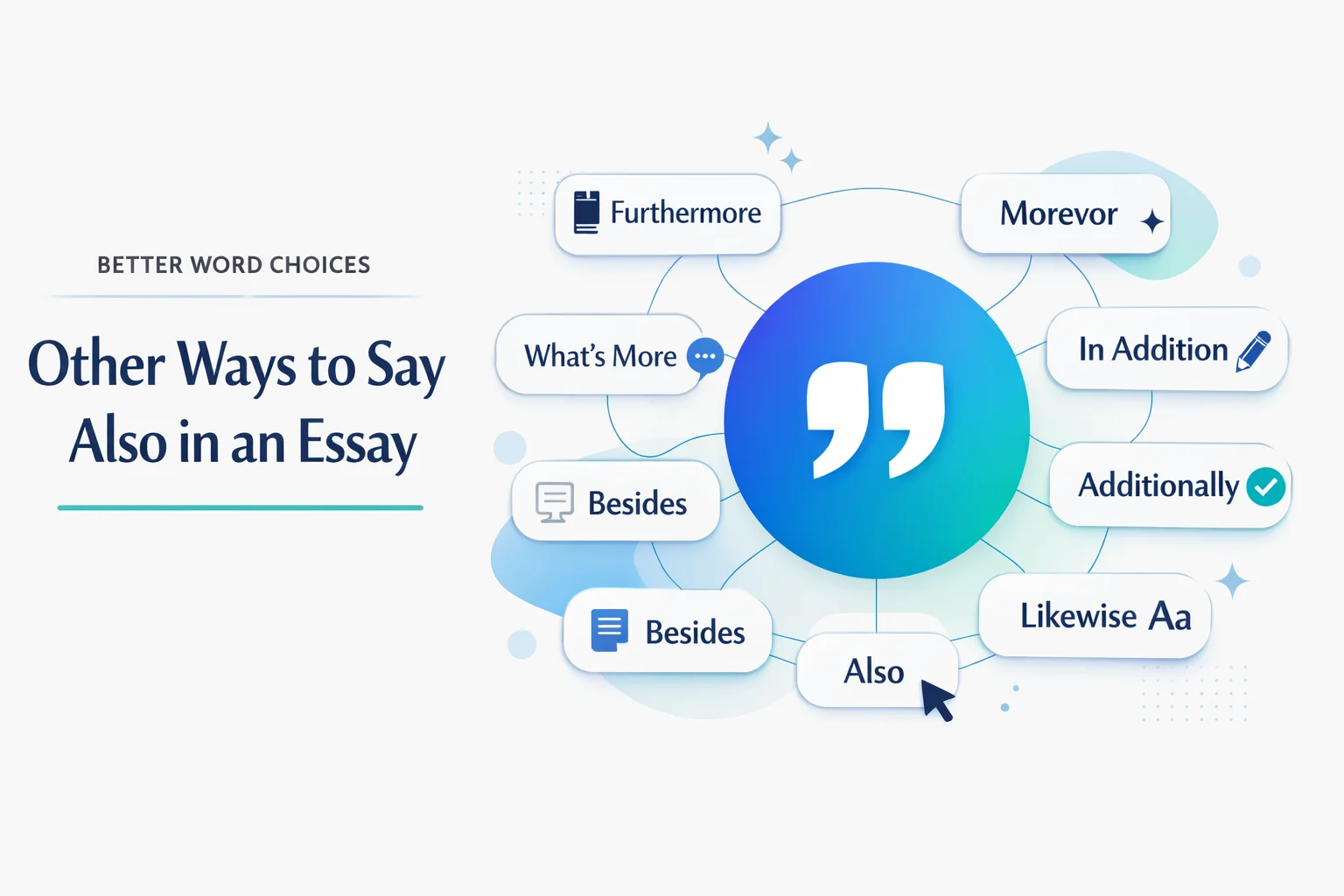
Looking for other ways to say also in an essay?Top alternatives include: additionally, furthermore, moreover, in addition, and as well. Each works best in different contexts choose based on your tone, audience, and the level of formality required.
Using “also” repeatedly can make your essays sound repetitive and less polished. Fortunately, there are many stronger alternatives for Other Ways to Say Also in an Essay that improve flow, connect ideas more effectively, and create a more professional tone. Whether you’re writing an academic paper, research report, or persuasive essay, choosing the right transition word can strengthen your arguments. In this guide, you’ll discover the best alternatives to “also,” along with their meanings, examples, and the situations where each one works best.
What Does “Also” Mean?
Also is an adverb used to add information, introduce an extra point, or show that something applies in addition to what has already been mentioned. It connects ideas smoothly and signals that you are building on a previous statement.
Example: “The study highlights economic factors. It also examines social implications.”
In grammar, also typically appears before the main verb or after the verb to be. It is one of the most common additive transition words in English.
When to Use “Also”
Use also when you want to:
- Add a supporting point to an argument
- Introduce an extra idea or example
- Show that something applies to multiple subjects
- Connect related thoughts in a natural flow
Spoken vs. Written: Also is widely used in both speech and writing. However, in formal essays and academic papers, overusing it can make your writing feel repetitive and unsophisticated.
Formal vs. Informal: Also is neutral it works in most settings but lacks the weight of more formal alternatives like furthermore or moreover.
Is It Professional or Polite to Say “Also”?
Polite? ✔️ Yes
Professional? ⚠️ It depends
Also is polite and generally accepted in professional communication. However, in formal business writing, academic essays, or reports, relying too heavily on also can make your writing sound simplistic. For high-stakes professional contexts, consider stronger alternatives.
Business Example: “Our revenue grew by 12% last quarter. We also expanded into three new markets.” This is acceptable but could be elevated to: “Our revenue grew by 12% last quarter. Additionally, we expanded into three new markets.”
Pros and Cons of Using “Also”
Pros ✅
- Simple and universally understood
- Works in both formal and casual settings
- Keeps sentences smooth and connected
- Easy to use for English learners
Cons ❌
- Can sound repetitive if overused
- Lacks emotional weight or emphasis
- May feel too casual for academic writing
- Does not add rhetorical strength to arguments
“The right tone makes your English sound professional and confident. Choosing precise alternatives to also shows you care about clarity.”
Quick Categories
Formal Alternatives to “Also”
- Furthermore
- Moreover
- In addition
- Additionally
- As well as
Casual Alternatives
- Plus
- Too
- As well
- And
- Along with
Professional Alternatives
- Additionally
- Furthermore
- In addition to
- Not only…but also
- Coupled with
Informal Expressions
- On top of that
- What’s more
- Plus
- Not to mention
- As a bonus
💡 Pro Tip: Match your alternative to your audience. Use furthermore and moreover in academic essays. Save plus and on top of that for emails to colleagues or casual conversations.
Common Mistakes Using “Also”
- Using “and also” together This is redundant.
- ❌ “The report is detailed and also includes charts.”
- ✅ “The report is detailed and includes charts.”
- Starting every sentence with “Also” Overuse weakens your writing.
- ❌ “Also, the data supports this. Also, the methodology is sound.”
- ✅ “Furthermore, the data supports this. Additionally, the methodology is sound.”
- Using “also” to contrast ideas Also adds; it does not contrast.
- ❌ “The policy helps small businesses. Also, it hurts large corporations.”
- ✅ “The policy helps small businesses. However, it hurts large corporations.”
- Placing “also” incorrectly It usually goes before the main verb.
- ❌ “She also is a talented writer.”
- ✅ “She is also a talented writer.”
- Using “as well” in formal academic writing It is considered too informal.
- ❌ “The experiment yielded positive results as well.”
- ✅ “The experiment yielded positive results as well.” (better: “The experiment also yielded positive results.”)
Other Ways to Say “Also” in an Essay
These alternatives to also will help you sound more fluent, confident, and natural in different situations. Use them according to tone, context, and audience to add variety and precision to your writing.
1. Phrase: Additionally
Meaning: Introduces an extra point or piece of information.
Explanation: A direct, formal synonym for also that fits seamlessly into academic and professional writing.
Example Sentence: “The new policy reduces costs. Additionally, it improves employee satisfaction.”
Best Use: Formal essays
Worst Use: Casual texts
Tone: Professional, neutral
Context Variability: Professional / Academic
2. Phrase: Furthermore
Meaning: Adds information that builds on and strengthens the previous point.
Explanation: More formal than also, often used to introduce a stronger or more significant argument.
Example Sentence: “The proposal is well-researched. Furthermore, it aligns with our long-term goals.”
Best Use: Academic writing
Worst Use: Friendly conversation
Tone: Formal, assertive
Context Variability: Professional / Academic
3. Phrase: Moreover
Meaning: Introduces extra information that reinforces or emphasizes the preceding idea.
Explanation: Similar to furthermore but often carries a slightly stronger tone of importance.
Example Sentence: “The solution is cost-effective. Moreover, it is environmentally sustainable.”
Best Use: Persuasive essays
Worst Use: Informal speech
Tone: Formal, confident
Context Variability: Professional / Academic
4. Phrase: In Addition
Meaning: Used to introduce something extra or to emphasize more information.
Explanation: A polished, professional phrase that works well in both writing and speech.
Example Sentence: “In addition to her research, she teaches two courses per semester.”
Best Use: Business writing
Worst Use: Quick text messages
Tone: Neutral, polished
Context Variability: Professional / Academic / Spoken
5. Phrase: As Well
Meaning: Means “too” or “in the same way”.
Explanation: Friendly and conversational; works beautifully in both writing and speech.
Example Sentence: “He attended the conference, and his assistant came as well.”
Best Use: Everyday conversation
Worst Use: Formal academic papers
Tone: Warm, casual
Context Variability: Casual / Spoken
6. Phrase: Too
Meaning: Shows similarity or addition.
Explanation: Short, simple, and personal ideal for informal writing and speech.
Example Sentence: “I’d love to join the team, too.”
Best Use: Friendly messages
Worst Use: Formal reports
Tone: Warm, lighthearted
Context Variability: Casual / Spoken
7. Phrase: Plus
Meaning: Adds information casually.
Explanation: Informal and conversational great for adding a bonus point.
Example Sentence: “The apartment is spacious. Plus, it has a great view.”
Best Use: Emails to colleagues
Worst Use: Academic essays
Tone: Casual, friendly
Context Variability: Casual / Professional (light)
8. Phrase: Along With
Meaning: Shows that something is included together with something else.
Explanation: Useful for connecting two related items or ideas.
Example Sentence: “Along with her degree in economics, she holds a master’s in public policy.”
Best Use: Professional bios
Worst Use: Simple lists
Tone: Neutral, professional
Context Variability: Professional / Academic
9. Phrase: Likewise
Meaning: In the same way; similarly.
Explanation: Emphasizes that something applies equally to another subject.
Example Sentence: “The first experiment succeeded. Likewise, the second trial produced positive results.”
Best Use: Comparative writing
Worst Use: Casual conversation
Tone: Formal, analytical
Context Variability: Professional / Academic
10. Phrase: Similarly
Meaning: Highlights that two things are alike or share a characteristic.
Explanation: Useful for drawing parallels between ideas or examples.
Example Sentence: “Urban areas face pollution challenges. Similarly, rural communities struggle with water quality.”
Best Use: Compare-and-contrast essays
Worst Use: Simple additions
Tone: Analytical, neutral
Context Variability: Professional / Academic
11. Phrase: Not Only…But Also
Meaning: Emphasizes two related points, often with the second being more significant.
Explanation: A powerful structure that adds rhetorical weight.
Example Sentence: “The policy not only reduces emissions but also creates new jobs.”
Best Use: Persuasive writing
Worst Use: Short sentences
Tone: Emphatic, professional
Context Variability: Professional / Academic
12. Phrase: As Well As
Meaning: Includes something in addition to what was already mentioned.
Explanation: A versatile connector that works in both formal and informal contexts.
Example Sentence: “She speaks French as well as Spanish.”
Best Use: Listing qualifications
Worst Use: Beginning sentences
Tone: Neutral, versatile
Context Variability: All contexts
13. Phrase: On Top Of That
Meaning: Adds a bonus or extra point.
Explanation: Informal and conversational adds emphasis to an additional benefit.
Example Sentence: “He fixed the issue quickly. On top of that, he offered a full refund.”
Best Use: Customer service
Worst Use: Academic writing
Tone: Casual, appreciative
Context Variability: Casual / Spoken
14. Phrase: What’s More
Meaning: Introduces an additional point, often with emphasis.
Explanation: Conversational but can work in semi-formal writing.
Example Sentence: “The software is user-friendly. What’s more, it’s completely free.”
Best Use: Blog posts
Worst Use: Formal essays
Tone: Engaging, persuasive
Context Variability: Casual / Professional (light)
15. Phrase: Not To Mention
Meaning: Adds an extra point, often one that is obvious or reinforcing.
Explanation: Informal and often used to add a point that strengthens the argument.
Example Sentence: “The hotel is affordable, not to mention the incredible location.”
Best Use: Reviews
Worst Use: Academic writing
Tone: Casual, conversational
Context Variability: Casual / Spoken
16. Phrase: Coupled With
Meaning: Combines two elements or factors together.
Explanation: Formal and precise often used in analytical writing.
Example Sentence: “Coupled with rising demand, supply chain issues have driven prices higher.”
Best Use: Business reports
Worst Use: Everyday speech
Tone: Formal, analytical
Context Variability: Professional / Academic
17. Phrase: In The Same Way
Meaning: Shows that something applies similarly to another situation.
Explanation: Useful for drawing analogies or comparisons.
Example Sentence: “In the same way that exercise benefits the body, reading benefits the mind.”
Best Use: Explanatory writing
Worst Use: Short additions
Tone: Analytical, neutral
Context Variability: Professional / Academic
18. Phrase: By The Same Token
Meaning: For the same reason; similarly.
Explanation: A formal phrase that draws a logical parallel.
Example Sentence: “The policy benefits large corporations. By the same token, it helps small businesses.”
Best Use: Logical arguments
Worst Use: Casual conversation
Tone: Formal, logical
Context Variability: Professional / Academic
19. Phrase: In Turn
Meaning: As a consequence or in response; similarly.
Explanation: Shows a chain of effects or a reciprocal relationship.
Example Sentence: “Higher wages boost consumer spending, which in turn stimulates economic growth.”
Best Use: Causal analysis
Worst Use: Simple lists
Tone: Analytical, formal
Context Variability: Professional / Academic
20. Phrase: Equally
Meaning: To the same degree; in the same way.
Explanation: Emphasizes that two things are comparable or balanced.
Example Sentence: “The two candidates are equally qualified for the position.”
Best Use: Comparative writing
Worst Use: Adding new points
Tone: Neutral, balanced
Context Variability: Professional / Academic
21. Phrase: Further
Meaning: In addition; to a greater extent.
Explanation: A concise, formal alternative to also.
Example Sentence: “Further research is needed to confirm these findings.”
Best Use: Academic writing
Worst Use: Casual speech
Tone: Formal, concise
Context Variability: Professional / Academic
22. Phrase: And
Meaning: A simple connector for adding information.
Explanation: The most basic way to add a point effective but can feel simplistic.
Example Sentence: “We need flour, sugar, and butter.”
Best Use: Lists
Worst Use: Complex arguments
Tone: Neutral, simple
Context Variability: All contexts
23. Phrase: Besides
Meaning: In addition to; apart from.
Explanation: Can mean “also” but often carries a sense of “apart from that.”
Example Sentence: “Besides being a talented musician, she is an excellent writer.”
Best Use: Adding extra qualities
Worst Use: Formal academic writing
Tone: Neutral to casual
Context Variability: Casual / Professional (light)
24. Phrase: Again
Meaning: Used to add another point, often one that reinforces a previous idea.
Explanation: Can sound repetitive if overused.
Example Sentence: “Again, the data suggests a clear trend.”
Best Use: Reminding or reinforcing
Worst Use: Introducing new points
Tone: Neutral, repetitive
Context Variability: Casual / Spoken
25. Phrase: In Like Manner
Meaning: In the same way.
Explanation: A formal, somewhat old-fashioned phrase.
Example Sentence: “In like manner, the second phase of the project proceeded smoothly.”
Best Use: Formal writing
Worst Use: Everyday conversation
Tone: Formal, literary
Context Variability: Professional / Academic
26. Phrase: As A Bonus
Meaning: As an extra benefit or advantage.
Explanation: Informal and positive highlights an added perk.
Example Sentence: “The software is easy to use. As a bonus, it comes with free customer support.”
Best Use: Marketing
Worst Use: Academic essays
Tone: Positive, casual
Context Variability: Casual / Professional (light)
27. Phrase: Apart From That
Meaning: In addition to that; besides that.
Explanation: A conversational way to add a point.
Example Sentence: “The hotel was clean and comfortable. Apart from that, the staff were incredibly friendly.”
Best Use: Reviews
Worst Use: Formal writing
Tone: Casual, conversational
Context Variability: Casual / Spoken
28. Phrase: Over And Above That
Meaning: Beyond that; in addition.
Explanation: Emphasizes that something is extra or beyond expectations.
Example Sentence: “The company met its targets. Over and above that, it exceeded customer satisfaction goals.”
Best Use: Performance reviews
Worst Use: Short sentences
Tone: Emphatic, formal
Context Variability: Professional
29. Phrase: Alongside That
Meaning: Together with that; in addition.
Explanation: Emphasizes that two things happen or exist simultaneously.
Example Sentence: “Alongside that initiative, we launched a new training program.”
Best Use: Project updates
Worst Use: Casual speech
Tone: Professional, neutral
Context Variability: Professional
30. Phrase: For Another Thing
Meaning: Introduces an additional point, often in a list of reasons.
Explanation: Useful when listing multiple arguments or reasons.
Example Sentence: “The proposal is too expensive. For another thing, it lacks clear objectives.”
Best Use: Argumentative writing
Worst Use: Positive additions
Tone: Analytical, neutral
Context Variability: Professional / Academic
“Great writers don’t just avoid repetition they choose words that add meaning. Each alternative to also brings a unique shade of emphasis.”
Comparison Table: Top 10 Alternatives
| Phrase | Tone | Best Use |
|---|---|---|
| Furthermore | Formal | Academic essays |
| Moreover | Formal | Persuasive arguments |
| Additionally | Professional | Business reports |
| In Addition | Neutral | All formal writing |
| As Well | Casual | Everyday conversation |
| Likewise | Formal | Comparative analysis |
| Similarly | Analytical | Drawing parallels |
| Not Only…But Also | Emphatic | Persuasive writing |
| Plus | Casual | Emails and blogs |
| On Top Of That | Informal | Friendly communication |
Mini Quiz / Self-Check
1. Which alternative is most appropriate for an academic research paper?
- A) Plus
- B) On top of that
- C) Furthermore
- D) As well
Answer: C) Furthermore
2. You are writing a friendly email to a colleague. Which phrase fits best?
- A) Moreover
- B) In like manner
- C) Plus
- D) Not only…but also
Answer: C) Plus
3. Which of the following is a common mistake when using also?
- A) Using it at the beginning of a sentence
- B) Using “and also” together
- C) Using it before the main verb
- D) Using it to add information
Answer: B) Using “and also” together
4. You are writing a business proposal. Which alternative adds the most professional weight?
- A) Too
- B) As well
- C) Additionally
- D) What’s more
Answer: C) Additionally
FAQs
1. What are other ways to say also in an essay?
Common alternatives include furthermore, moreover, additionally, in addition, and as well as. Choose based on the level of formality you need.
2. Is “as well” acceptable in academic writing?
Generally, no. As well is considered too informal for academic essays and research papers. Use additionally or furthermore instead.
3. What is the most formal synonym for also?
Moreover and furthermore are among the most formal synonyms for also. They are widely used in academic and professional writing.
4. Can I start a sentence with “also”?
Yes, but it can sound colloquial. In formal writing, it is better to start with furthermore, moreover, or additionally.
5. What is the difference between “also” and “too”?
Also usually appears before the main verb, while too typically comes at the end of a sentence. Both mean “in addition,” but too is more casual.
“Mastering alternatives to also is one of the quickest ways to elevate your English writing. Start with one new phrase each day.”
Conclusion
Learning other ways to say also in an essay is about more than avoiding repetition it is about communicating with precision, confidence, and style. Whether you are writing an academic paper, a business report, or a casual email, the right alternative can make your message clearer and more impactful.
Practice using these 30 alternatives in your daily writing. Pay attention to tone, context, and audience. With consistent effort, you will naturally expand your vocabulary and sound more fluent and professional in every situation.
Read More Related Articles
- Other Ways to Say Another Example | Like a Fluent English Speaker In 2026
- Other Ways to Say This Means | Express Your Ideas with Confidence In 2026
- Other Ways to Say “In the Text” | Upgrade Your Everyday Writing In 2026

Victoria Hughes is a content writer dedicated to making communication clearer and more effective. Through TextsResponse.com, she shares practical insights and thoughtfully crafted response ideas that help readers express themselves with confidence.