Quick Answer 🔥
Need alternatives to in the text?
Try: According to the source | The author states | As mentioned in the document | The passage indicates | The text reveals
The phrase “in the text” is a staple of academic writing, essays, and professional reports. It serves as a bridge between your ideas and the evidence that supports them a way of saying, “This information comes directly from what I’ve read.
Yet, using the same phrase repeatedly can make your writing feel mechanical, dull, and uninspired. Learning alternatives to “in the text” does more than just prevent repetition; it elevates your writing style, demonstrates a richer vocabulary, and signals to readers that you are a confident, articulate communicator. Whether you need to express excitement in English about a discovery in a document or formally cite a source, varying your language is key. This guide provides 30 powerful alternatives to help you sound more fluent, precise, and professional in any context.
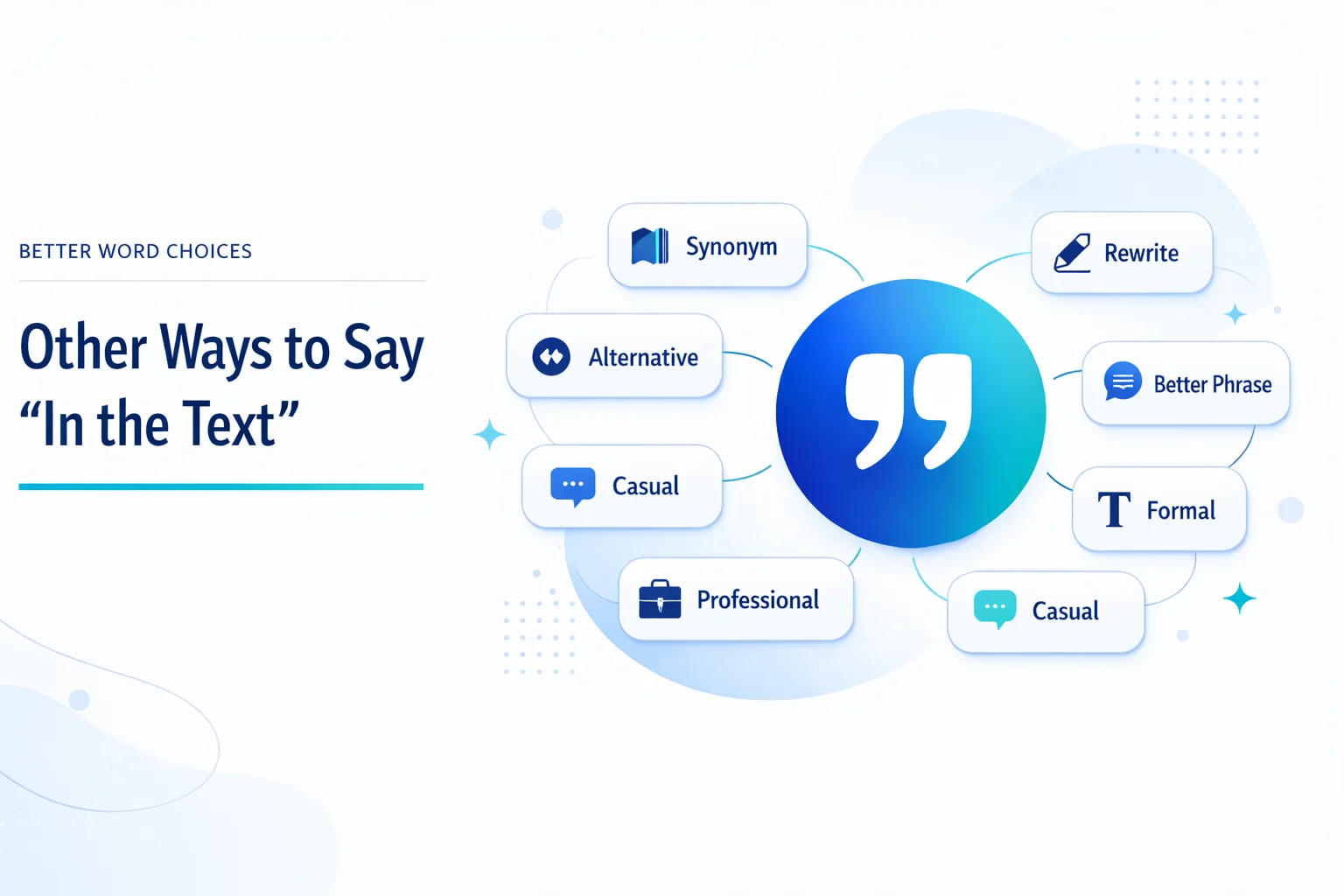
Quick Categories
Formal Alternatives to “In the Text”
- According to the text
- The text indicates
- As stated in the source
- The document specifies
Casual Alternatives
- The text says
- It says in the reading
- The material mentions
- As the text puts it
Professional Alternatives
- The research demonstrates
- The evidence shows
- The author asserts
- The study confirms
Informal Expressions
- The piece notes
- The write-up states
- The article points out
- As mentioned earlier
“The right phrase doesn’t just cite a source it builds your credibility as a writer.”
What Does “In the Text” Mean?
“In the text” is a referencing phrase used to indicate that specific information, an idea, or a quote can be found within a written document such as an article, book, report, or essay.
Example: “In the text, the author explains the economic impact of climate change.”
Grammar Note: This phrase is a prepositional phrase that typically introduces a clause or follows a linking verb. It is neutral in tone and functions as a clear signal to the reader that you are about to reference source material.
When to Use “In the Text”
Use this phrase when you need to:
- Cite evidence from an article, book, or report
- Paraphrase or summarize an author’s idea
- Introduce a direct quotation
- Support an argument with textual proof
- Reference a specific passage in academic writing
| Context | Suitability |
|---|---|
| Academic Essays | ✅ Highly suitable |
| Research Papers | ✅ Highly suitable |
| Business Reports | ✅ Suitable |
| Casual Conversation | ❌ Too formal |
| Emails | ⚠️ Use sparingly |
Is It Professional or Polite to Say “In the Text”?
Polite? ✔️ Yes it is neutral and respectful.
Professional? ❌ No in most cases, it is too vague and basic for high-level professional or academic writing.
Example: “In the text, it says the company’s revenue grew.” (Too informal for a business report.)
While the phrase is clear, it lacks the precision and authority that more sophisticated alternatives provide. Overusing it can make your writing sound repetitive and unpolished.
Pros and Cons of Using “In the Text”
Common Mistakes to Avoid
- Overusing the phrase in a single paragraph
- ❌ “In the text, the author says X. In the text, it also states Y.”
- ✅ Use a variety of alternatives to keep your writing fresh.
- Using it when the source is obvious
- ❌ “In the text, the sky is blue.” (If you’re already discussing the text, this is redundant.)
- Using it in spoken presentations
- ❌ “In the text, it states that…” (Sounds stiff; try “The author writes…”)
- Using it without a clear reference
- ❌ “In the text, it says this is important.” (What text? Be specific.)
- Confusing it with “in this text”
- ❌ “In this text, we will discuss…” (This refers to your own writing, not a source.)
“Fluency isn’t just about knowing words it’s about knowing which word fits the moment.”
Other Ways to Say “In the Text”
These alternatives will help you sound more fluent, confident, and natural in different situations. Use them according to tone, context, and audience to express ideas with precision and authority.
1. Phrase: According to the Text
Meaning: Directly attributes information to the written source.
Explanation: A classic, neutral way to introduce a fact or claim from the material.
Example Sentence: “According to the text, the policy was implemented in 2018.”
Best Use: Academic writing
Worst Use: Casual conversation
Tone: Formal, factual
Context Variability: Professional / Formal
2. Phrase: The Author States
Meaning: Emphasizes that the writer of the text has made a specific claim.
Explanation: Shifts focus from the text itself to the person who wrote it.
Example Sentence: “The author states that climate change is the defining issue of our time.”
Best Use: Literary analysis
Worst Use: When the author is unknown
Tone: Authoritative, clear
Context Variability: Academic / Professional
3. Phrase: As Mentioned in the Document
Meaning: Refers to a point that has already been introduced in the source.
Explanation: Useful for recalling or emphasizing previously stated details.
Example Sentence: “As mentioned in the document, the budget was approved last quarter.”
Best Use: Business reports
Worst Use: Creative writing
Tone: Professional, neutral
Context Variability: Professional / Formal
4. Phrase: The Text Indicates
Meaning: Suggests that the text points to or implies something.
Explanation: A more formal way of saying the text shows or suggests.
Example Sentence: “The text indicates that social media usage is linked to anxiety.”
Best Use: Research papers
Worst Use: Spoken summaries
Tone: Formal, analytical
Context Variability: Academic / Professional
5. Phrase: The Passage Suggests
Meaning: Implies an interpretation or inference from a specific section.
Explanation: Used when the text hints at something without stating it directly.
Example Sentence: “The passage suggests that the protagonist is deeply conflicted.”
Best Use: Literary criticism
Worst Use: Scientific data citation
Tone: Interpretive, thoughtful
Context Variability: Academic
6. Phrase: The Research Demonstrates
Meaning: Shows that the findings in the text provide strong evidence.
Explanation: Emphasizes the conclusive nature of the evidence presented.
Example Sentence: “The research demonstrates that early intervention improves outcomes.”
Best Use: Scientific papers
Worst Use: Opinion pieces
Tone: Authoritative, evidence-based
Context Variability: Professional / Academic
7. Phrase: As Stated in the Source
Meaning: Directly attributes information to the original material.
Explanation: Emphasizes accuracy and proper citation.
Example Sentence: “As stated in the source, the population has doubled since 1990.”
Best Use: Research writing
Worst Use: Informal emails
Tone: Formal, precise
Context Variability: Academic / Professional
8. Phrase: The Article Points Out
Meaning: Highlights a specific observation or fact from the article.
Explanation: Useful for drawing attention to a noteworthy detail.
Example Sentence: “The article points out that gender disparity persists in tech industries.”
Best Use: Analytical essays
Worst Use: Casual chat
Tone: Focused, direct
Context Variability: Professional
9. Phrase: The Writer Argues
Meaning: Indicates that the author takes a specific stance or position.
Explanation: Used to present the author’s perspective or opinion.
Example Sentence: “The writer argues that traditional education models need reform.”
Best Use: Critical analysis
Worst Use: Neutral summaries
Tone: Persuasive, strong
Context Variability: Academic
10. Phrase: As the Text Describes
Meaning: Refers to how the text portrays or explains something.
Explanation: Focuses on the descriptive quality of the source.
Example Sentence: “As the text describes, the process involves three key stages.”
Best Use: Explanatory writing
Worst Use: Argumentative essays
Tone: Informative, clear
Context Variability: Professional / Academic
11. Phrase: The Document Specifies
Meaning: Indicates that the text provides detailed, explicit information.
Explanation: Suggests precision and clarity in the source material.
Example Sentence: “The document specifies the exact requirements for compliance.”
Best Use: Legal or policy documents
Worst Use: Creative writing
Tone: Formal, exact
Context Variability: Professional
12. Phrase: The Text Reveals
Meaning: Suggests that the text makes something clear or exposes new information.
Explanation: Often used when discussing deeper insights or surprising findings.
Example Sentence: “The text reveals the character’s hidden motivations.”
Best Use: Analytical discussions
Worst Use: Factual reporting
Tone: Reflective, insightful
Context Variability: Academic
13. Phrase: According to the Passage
Meaning: Similar to “according to the text,” but more specific to a section.
Explanation: Focuses on a particular excerpt or paragraph.
Example Sentence: “According to the passage, the protagonist faces a moral dilemma.”
Best Use: Close reading exercises
Worst Use: Broad summaries
Tone: Academic, precise
Context Variability: Academic
14. Phrase: The Study Confirms
Meaning: Indicates that the research findings validate a hypothesis or claim.
Explanation: Emphasizes the conclusive nature of the evidence.
Example Sentence: “The study confirms that exercise improves cognitive function.”
Best Use: Scientific writing
Worst Use: Opinion-based writing
Tone: Authoritative, conclusive
Context Variability: Professional / Academic
15. Phrase: As Noted in the Passage
Meaning: Draws attention to a specific point made in the text.
Explanation: A polished way to reference a previously mentioned detail.
Example Sentence: “As noted in the passage, the economy began to recover in 2022.”
Best Use: Formal essays
Worst Use: Casual conversations
Tone: Professional, clear
Context Variability: Academic
16. Phrase: The Author Mentions
Meaning: Indicates that the author makes a brief reference to something.
Explanation: Used when the text refers to a point without extensive detail.
Example Sentence: “The author mentions the importance of teamwork in passing.”
Best Use: Summaries
Worst Use: In-depth analysis
Tone: Neutral, concise
Context Variability: Professional / Academic
17. Phrase: The Evidence Shows
Meaning: Points to the data or proof presented in the text.
Explanation: Emphasizes that the information is backed by evidence.
Example Sentence: “The evidence shows that the new policy reduced costs by 15%.”
Best Use: Business reports
Worst Use: Literary analysis
Tone: Factual, objective
Context Variability: Professional
18. Phrase: The Excerpt Explains
Meaning: Indicates that a specific section provides a clear explanation.
Explanation: Useful for scientific or instructional contexts.
Example Sentence: “The excerpt explains the process of photosynthesis in detail.”
Best Use: Educational writing
Worst Use: Creative writing
Tone: Instructional, clear
Context Variability: Academic
19. Phrase: As Highlighted in the Literature
Meaning: Refers to a point that has been emphasized in academic sources.
Explanation: Common in literature reviews and research papers.
Example Sentence: “As highlighted in the literature, this concept has evolved over time.”
Best Use: Literature reviews
Worst Use: Short articles
Tone: Formal, scholarly
Context Variability: Academic
20. Phrase: The Material Suggests
Meaning: Indicates that the content implies or hints at something.
Explanation: A versatile alternative for citing textual evidence.
Example Sentence: “The material suggests that consumers prefer sustainable products.”
Best Use: Market research
Worst Use: Formal legal documents
Tone: Neutral, suggestive
Context Variability: Professional
21. Phrase: In the Given Text
Meaning: Refers specifically to the text being discussed.
Explanation: Emphasizes that the information comes from a particular source.
Example Sentence: “In the given text, the historical context is thoroughly explored.”
Best Use: Academic discussions
Worst Use: Casual conversation
Tone: Formal, precise
Context Variability: Academic
22. Phrase: The Author Asserts
Meaning: Indicates that the author makes a strong, confident claim.
Explanation: Implies conviction and authority in the author’s statement.
Example Sentence: “The author asserts that democracy is the most effective system.”
Best Use: Persuasive essays
Worst Use: Neutral summaries
Tone: Confident, strong
Context Variability: Academic
23. Phrase: The Text Clarifies
Meaning: Shows that the text removes confusion or provides explanation.
Explanation: Useful when the source resolves ambiguity.
Example Sentence: “The text clarifies the relationship between the two variables.”
Best Use: Scientific writing
Worst Use: Opinion pieces
Tone: Clear, instructive
Context Variability: Academic
24. Phrase: As Written in the Text
Meaning: A simple, elegant way to direct readers to the source.
Explanation: Works well across academic levels and professional settings.
Example Sentence: “As written in the text, the journey represents a metaphor for growth.”
Best Use: Flexible use
Worst Use: Overly formal contexts
Tone: Neutral, clear
Context Variability: Academic / Professional
25. Phrase: The Source Reveals
Meaning: Suggests that the original material exposes or uncovers something.
Explanation: Often used when discussing new or significant information.
Example Sentence: “The source reveals that the data was previously misinterpreted.”
Best Use: Research papers
Worst Use: Casual reading
Tone: Analytical, insightful
Context Variability: Academic
26. Phrase: The Text States Clearly
Meaning: Emphasizes that the text presents information in an unambiguous way.
Explanation: Useful when the source is direct and explicit.
Example Sentence: “The text states clearly that all participants must sign the form.”
Best Use: Legal or instructional texts
Worst Use: Creative writing
Tone: Formal, direct
Context Variability: Professional
27. Phrase: The Reading Shows
Meaning: Indicates what the text demonstrates or proves.
Explanation: A more accessible alternative for less formal contexts.
Example Sentence: “The reading shows that economic growth slowed during the pandemic.”
Best Use: Classroom discussions
Worst Use: Formal research papers
Tone: Neutral, accessible
Context Variability: Casual / Academic
28. Phrase: The Article States
Meaning: Directly attributes a statement to the article.
Explanation: A straightforward way to cite a specific article.
Example Sentence: “The article states that the new technology will revolutionize the industry.”
Best Use: Professional writing
Worst Use: Literary analysis
Tone: Neutral, factual
Context Variability: Professional
29. Phrase: It Is Stated in the Text
Meaning: A passive construction that focuses on the information itself.
Explanation: Useful when the source or author is less important than the fact.
Example Sentence: “It is stated in the text that the war began in 1914.”
Best Use: Formal summaries
Worst Use: Active, engaging writing
Tone: Formal, neutral
Context Variability: Academic
30. Phrase: The Text Emphasizes
Meaning: Highlights that the text gives special importance to a point.
Explanation: Used when the source stresses a particular idea or theme.
Example Sentence: “The text emphasizes the importance of ethical leadership.”
Best Use: Analytical writing
Worst Use: Brief summaries
Tone: Strong, focused
Context Variability: Academic / Professional
“Great writers don’t just quote sources they weave them into their narrative with variety and precision.”
Mini Quiz: Test Your Knowledge
1. Which phrase is most appropriate for a formal research paper?
- A) The text says
- B) According to the source
- C) The piece notes
- Answer: B
2. Which alternative emphasizes the author’s strong opinion?
- A) The text mentions
- B) The author asserts
- C) As stated in the document
- Answer: B
3. Which phrase is best for a casual classroom discussion?
- A) The research demonstrates
- B) The text indicates
- C) The reading shows
- Answer: C
4. Which alternative is most suitable for citing legal documents?
- A) The passage suggests
- B) The document specifies
- C) The writer argues
- Answer: B
Comparison Table: Top 10 Alternatives
| Phrase | Tone | Best Use |
|---|---|---|
| According to the Text | Formal, Factual | Academic writing |
| The Author States | Authoritative | Literary analysis |
| The Research Demonstrates | Evidence-based | Scientific papers |
| The Text Indicates | Formal, Analytical | Research papers |
| The Document Specifies | Formal, Exact | Legal/policy documents |
| The Article Points Out | Focused, Direct | Analytical essays |
| The Writer Argues | Persuasive | Critical analysis |
| As Mentioned in the Document | Professional | Business reports |
| The Evidence Shows | Factual, Objective | Business reports |
| The Passage Suggests | Interpretive | Literary criticism |
FAQs
1. Is “in the text” grammatically correct?
Yes, it is grammatically correct. It is a prepositional phrase used to refer to information found within a written document.
2. What is a more formal alternative to “in the text”?
More formal alternatives include “according to the source,” “the text indicates,” and “as stated in the document”.
3. Can I use “in the text” in spoken English?
Yes, but it may sound overly formal in casual conversation. In spoken contexts, try “the author says” or “according to the article” for a more natural tone.
4. How can I avoid repeating “in the text” in an essay?
Use a variety of alternatives like “the passage suggests,” “the research demonstrates,” and “the author argues” to keep your writing engaging.
5. Is “in the text” suitable for business writing?
It is acceptable but not ideal. For business reports, use more precise alternatives like “the document specifies” or “the report indicates”.
Conclusion
Learning alternatives to “in the text” is one of the simplest yet most effective ways to elevate your English writing. Whether you are crafting an academic essay, a business report, or a professional email, varying your language demonstrates confidence, precision, and a command of the language that leaves a lasting impression.
Start by incorporating just a few of these alternatives into your daily writing. Pay attention to the tone of your context formal, casual, or professional and choose the phrase that fits best. With consistent practice, you’ll naturally develop a richer, more versatile vocabulary that sets you apart as a skilled communicator.
Read More Related Articles:
- Other Ways to Say For Example | Clearer and More Natural Writing In 2026
- Other Ways to Say Talks About | Every English Learner Should Know In 2026
- Other Ways to Say “This Evidence Shows” | Write with More Confidence In 2026

Victoria Hughes is a content writer dedicated to making communication clearer and more effective. Through TextsResponse.com, she shares practical insights and thoughtfully crafted response ideas that help readers express themselves with confidence.