Quick Answer 🔥
If you want to replace “much less” in a sentence, the best options depend on tone. Use let alone, never mind, not to mention, still less, or significantly less for most situations. These five cover formal writing, casual speech, and professional comparisons.
Knowing other ways to say much less can help you express ideas more clearly and naturally. Whether you are writing an essay, having a casual conversation, or communicating professionally, the right alternative can make your meaning easier to understand.
In this guide, you’ll discover useful alternatives to much less for different situations and contexts. From everyday expressions like “let alone” to more formal phrases like “to say nothing of,” these options will help you add variety to your writing and make your communication more effective.
What Is “Much Less”?
When you are comparing two things and the second one feels impossible, English gives you a compact phrase: much less. Imagine a colleague asks if you can attend a 6 a.m. meeting. You might reply, “I can barely wake up at 7, much less at 6.” This tiny phrase does heavy lifting. It signals that if the first thing is hard, the second is out of the question. If you are looking for alternatives to much less, you are in the right place. This guide does not cover how to express excitement in English. Instead, it focuses on a phrase that often expresses limitation or disbelief.
Much less is an adverbial phrase. It works as a comparative quantifier meaning “a considerably smaller amount” or as a conjunction meaning “and certainly not.” It is neutral to formal in tone. Example: “She has much less experience than the other candidates.” People use it in both spoken and written English, especially in arguments, comparisons, and professional writing.
When Should You Use “Much Less”?
- Comparing quantities: “This plan uses much less energy.”
- Emphasizing impossibility: “I can’t run a mile, much less a marathon.”
- Formal writing: reports, essays, and proposals.
- Spoken English: everyday comparisons and strong opinions.
- Professional emails: budget, time, or resource discussions.
Spoken vs Written: In speech, it can sound slightly stiff. In writing, it reads as clear and precise.
Formal vs Informal: It fits formal and neutral contexts. For casual chats, choose a lighter alternative.
Is It Professional or Just Polite?
Politeness and professionalism are not the same. “Much less” is polite because it avoids rude language. It is also professional in writing when used correctly. However, in a quick team chat, it may sound too formal or distant.
Business-style example: “The new vendor offers much less flexibility, so we should review the contract.”
Verdict:
Polite? ✔️ Yes
Professional? ✔️ Yes in formal writing, but ❌ No in casual chat.
For professional reaction phrases, consider “substantially less” or “considerably less” instead.
Pros and Cons of Using “Much Less”
Pros:
- Concise and emphatic.
- Widely understood by native speakers.
- Works in formal and neutral writing.
- Clear in direct comparisons.
Cons:
- Can be ambiguous between two meanings.
- Slightly stiff in casual conversation.
- Overuse weakens its impact.
- Not ideal for very informal team chat.
Common Mistakes People Make
- Confusing word order.
Incorrect: I have less much time.
Correct: I have much less time. - Using it as a standalone answer.
Incorrect: “Can you run a marathon?” “Much less.”
Correct: “No, I can’t even run a mile, much less a marathon.” - Mixing it with “let alone.”
Incorrect: I can’t afford a car, much less let alone a house.
Correct: I can’t afford a car, let alone a house. - Forgetting the negative before it.
Incorrect: I can run a mile, much less a marathon.
Correct: I can’t run a mile, much less a marathon. - Using it to mean “much more.”
Incorrect: This phone works much less better than that one.
Correct: This phone works much worse than that one.
Small tone mistakes can make confident English sound careless.
Alternatives by Category
Formal alternatives to “Much Less”
- let alone
- still less
- to say nothing of
- not to mention
Pro Tip: Use these in essays and reports when you need a polished, emphatic comparison.
Casual alternatives
- never mind
- way less
- a lot less
- a whole lot less
Pro Tip: In casual speech, “way less” and “a lot less” sound natural before nouns.
Professional alternatives
- substantially less
- considerably less
- markedly less
- appreciably less
Pro Tip: In business writing, choose “substantially less” for budgets and “appreciably less” for measurable changes.
Informal expressions
- no way
- forget about
- don’t even think about
- nowhere near as much
Pro Tip: Save these informal expressions in English for friends and relaxed settings. They can sound dismissive at work.
“Formal and informal English aren’t about correctness. They’re about context.”
Other Ways to Say “Much Less”
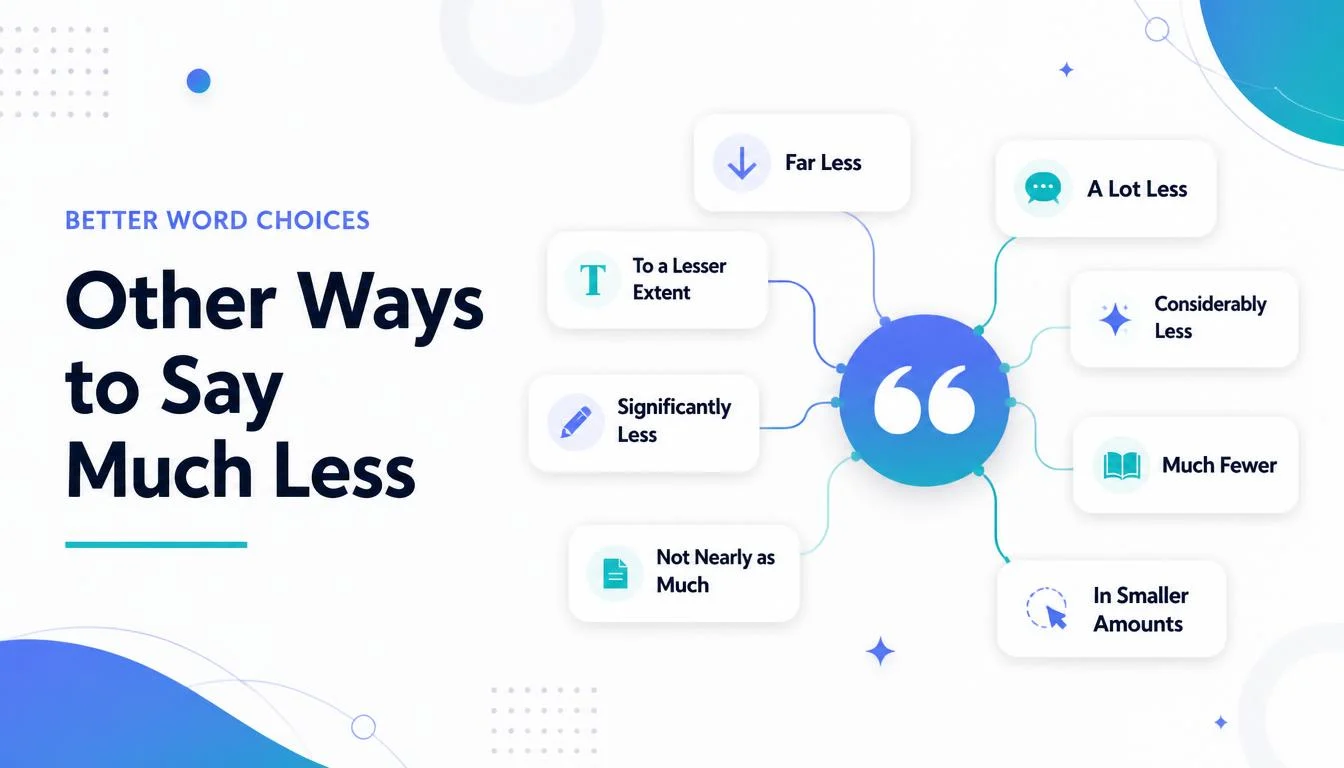
These other ways to say much less build fluency and help you express limitation, comparison, or disbelief depending on tone and context. Each alternative below includes a clear example and best-use guidance.
1. Phrase: Let alone
Meaning: And certainly not.
Explanation: Adds a stronger example after a negative.
Example: I can’t afford a phone, let alone a car.
Best Use: Formal writing
Worst Use: Slang settings
Tone: Neutral formal
Context Variability: casual / professional / spoken
2. Phrase: Never mind
Meaning: And certainly not.
Explanation: A casual phrase after a negative statement.
Example: I can’t cook pasta, never mind a feast.
Best Use: Casual speech
Worst Use: Formal reports
Tone: Informal friendly
Context Variability: casual / spoken
3. Phrase: Not to mention
Meaning: And also, even more so.
Explanation: Adds an extra point that is more surprising.
Example: He lacks time, not to mention patience.
Best Use: Professional emails
Worst Use: Strict academic
Tone: Neutral
Context Variability: casual / professional / spoken
4. Phrase: To say nothing of
Meaning: And even less so.
Explanation: A formal phrase for a stronger example.
Example: The team lacks funding, to say nothing of equipment.
Best Use: Formal writing
Worst Use: Text messages
Tone: Formal
Context Variability: professional / written
5. Phrase: Still less
Meaning: And even less so.
Explanation: A formal phrase that sounds literary.
Example: She rarely speaks publicly, still less at conferences.
Best Use: Academic essays
Worst Use: Casual talk
Tone: Formal literary
Context Variability: professional / written
6. Phrase: Far less
Meaning: A much smaller amount.
Explanation: A stronger way to compare two quantities.
Example: This option costs far less than the other one.
Best Use: Comparisons
Worst Use: Casual slang
Tone: Neutral emphatic
Context Variability: casual / professional / spoken
7. Phrase: Even less
Meaning: An even smaller amount.
Explanation: Highlights a more extreme second item.
Example: I have even less patience for delays than she does.
Best Use: Spoken emphasis
Worst Use: Academic abstracts
Tone: Neutral
Context Variability: casual / spoken
8. Phrase: Not to speak of
Meaning: And even less so.
Explanation: A formal phrase similar to “to say nothing of.
Example: He cannot manage a team, not to speak of a department.
Best Use: Formal writing
Worst Use: Friendly texts
Tone: Formal
Context Variability: professional / written
9. Phrase: And certainly not
Meaning: A direct rejection.
Explanation: Replaces “much less” for clear emphasis.
Example: I won’t accept a delay, and certainly not a cancellation.
Best Use: Strong statements
Worst Use: Soft suggestions
Tone: Firm
Context Variability: casual / professional / spoken
10. Phrase: And definitely not
Meaning: A firm rejection.
Explanation: A conversational version of “and certainly not.”
Example: We need a small loan, and definitely not a mortgage.
Best Use: Spoken English
Worst Use: Formal essays
Tone: Informal firm
Context Variability: casual / spoken
11. Phrase: No way
Meaning: Absolutely not.
Explanation: A very informal rejection of a possibility.
Example: I can’t run 5K, no way I can run a marathon.
Best Use: Casual talk
Worst Use: Business emails
Tone: Informal
Context Variability: casual / spoken
12. Phrase: Forget about
Meaning: It is impossible.
Explanation: An informal phrase after a negative clause.
Example: I can’t pay rent, forget about a holiday.
Best Use: Casual speech
Worst Use: Professional writing
Tone: Informal
Context Variability: casual / spoken
13. Phrase: Don’t even think about
Meaning: Do not consider it.
Explanation: A strong informal warning against a bigger request.
Example: You can’t borrow my car, don’t even think about my bike.
Best Use: Casual warnings
Worst Use: Formal meetings
Tone: Informal strong
Context Variability: casual / spoken
14. Phrase: Significantly less
Meaning: A much smaller amount.
Explanation: A precise phrase for data and reports.
Example: This plan requires significantly less money.
Best Use: Business writing
Worst Use: Poetic writing
Tone: Formal neutral
Context Variability: professional / written
15. Phrase: Considerably less
Meaning: A large reduction.
Explanation: Common in academic and professional contexts.
Example: The new method uses considerably less energy.
Best Use: Reports
Worst Use: Slang
Tone: Formal
Context Variability: professional / written
16. Phrase: Substantially less
Meaning: A major decrease.
Explanation: Suggests a meaningful and measurable difference.
Example: The revised budget is substantially less than last year’s.
Best Use: Business reports
Worst Use: Casual chats
Tone: Formal
Context Variability: professional / written
17. Phrase: Markedly less
Meaning: Noticeably less.
Explanation: Highlights a clear and often sudden difference.
Example: The second sample showed markedly less contamination.
Best Use: Academic writing
Worst Use: Everyday talk
Tone: Formal
Context Variability: professional / written
18. Phrase: Appreciably less
Meaning: Less in a noticeable way.
Explanation: Often used with measurements and outcomes.
Example: The treatment caused appreciably less pain.
Best Use: Scientific writing
Worst Use: Friendly texts
Tone: Formal
Context Variability: professional / written
19. Phrase: A lot less
Meaning: Much less in amount.
Explanation: Simple, direct, and widely understood.
Example: I have a lot less free time this semester.
Best Use: Casual speech
Worst Use: Formal essays
Tone: Informal
Context Variability: casual / spoken
20. Phrase: Way less
Meaning: Much less.
Explanation: An informal intensifier common in American English.
Example: This app is way less complicated than the old one.
Best Use: Casual talk
Worst Use: Business reports
Tone: Informal
Context Variability: casual / spoken
21. Phrase: A great deal less
Meaning: Much less.
Explanation: A slightly formal but emphatic phrase.
Example: She earns a great deal less than her colleague.
Best Use: Neutral emphasis
Worst Use: Slang settings
Tone: Neutral formal
Context Variability: casual / professional / spoken
22. Phrase: A good deal less
Meaning: A lot less.
Explanation: A friendly, emphatic phrase for everyday use.
Example: The repair cost a good deal less than we expected.
Best Use: Everyday writing
Worst Use: Academic papers
Tone: Neutral
Context Variability: casual / spoken
23. Phrase: Noticeably less
Meaning: Less in an obvious way.
Explanation: Focuses on a clear difference, not just a number.
Example: He was noticeably less nervous after the rehearsal.
Best Use: Observations
Worst Use: Legal documents
Tone: Neutral
Context Variability: casual / professional / spoken
24. Phrase: Materially less
Meaning: Less in an important way.
Explanation: Common in business, law, and finance.
Example: The new policy poses materially less risk.
Best Use: Legal writing
Worst Use: Casual talk
Tone: Formal
Context Variability: professional / written
25. Phrase: Meaningfully less
Meaning: Less in a way that matters.
Explanation: Emphasizes significance, not just quantity.
Example: The updated software uses meaningfully less memory.
Best Use: Tech reviews
Worst Use: Poetry
Tone: Neutral formal
Context Variability: professional / written
26. Phrase: Drastically less
Meaning: A dramatic reduction.
Explanation: Suggests a very large or sudden decrease.
Example: The company spent drastically less on advertising.
Best Use: Strong comparisons
Worst Use: Subtle writing
Tone: Emphatic
Context Variability: casual / professional / spoken
27. Phrase: Sharply less
Meaning: A steep reduction.
Explanation: Often describes drops in numbers or amounts.
Example: The region received sharply less rainfall this year.
Best Use: Data reports
Worst Use: Friendly notes
Tone: Formal
Context Variability: professional / written
28. Phrase: A whole lot less
Meaning: Much less.
Explanation: A very casual and emphatic phrase.
Example: I worry a whole lot less when I plan ahead.
Best Use: Casual speech
Worst Use: Formal emails
Tone: Informal warm
Context Variability: casual / spoken
29. Phrase: Nowhere near as much
Meaning: Much less than expected.
Explanation: Focuses on a large gap between amounts.
Example: I earn nowhere near as much as my sister.
Best Use: Casual comparisons
Worst Use: Formal reports
Tone: Informal
Context Variability: casual / spoken
30. Phrase: Not nearly as much
Meaning: Much less than a specific amount.
Explanation: Softer than “nowhere near” and works in many contexts.
Example: The event raised not nearly as much as we hoped.
Best Use: Neutral speech
Worst Use: Very formal writing
Tone: Neutral
Context Variability: casual / professional / spoken
Comparison Table: Top 10 Alternatives at a Glance
| Phrase | Tone | Best Use |
|---|---|---|
| Let alone | Neutral formal | Formal writing |
| Never mind | Informal friendly | Casual speech |
| Not to mention | Neutral | Professional emails |
| Still less | Formal literary | Academic essays |
| Far less | Neutral emphatic | Comparisons |
| Significantly less | Formal neutral | Business writing |
| Considerably less | Formal | Reports |
| A lot less | Informal | Casual speech |
| Way less | Informal | Casual talk |
| Substantially less | Formal | Business reports |
Mini Quiz / Self-Check
1. You are writing a formal report about budget cuts. Which phrase fits best?
A) Way less
B) Substantially less
C) No way
2. Your friend asks if you can join a 10K race. You want to be casual and funny. Which is best?
A) I can’t run 1K, never mind a 10K.
B) I cannot participate, still less a 10K.
C) I am unable, to say nothing of a 10K.
3. Which sentence is correct?
A) I can’t afford a car, much less a house.
B) I can’t afford a car, much less let alone a house.
C) I can afford a car, much less a house.
4. In a legal document, which phrase sounds most professional?
A) Forget about
B) Materially less
C) A whole lot less
Answers: 1 B, 2 A, 3 A, 4 B.
FAQs
1. What is the best formal alternative to “much less”?
“Let alone” and “still less” are strong formal choices. Use them after a negative clause.
2. Can I use “much less” in business writing?
Yes, it is acceptable in formal writing. For a clearer professional tone, try “substantially less” or “considerably less.”
3. Is “way less” grammatically correct?
It is grammatically common in casual English. Avoid it in formal reports or academic essays.
4. What is the difference between “much less” and “let alone”?
They often mean the same thing. “Let alone” is more common in speech, while “much less” can sound slightly more formal.
5. How do I choose the right alternative?
Match the phrase to your context. Use formal options for reports, casual options for friends, and professional options for work emails.
Conclusion
Building fluency with alternatives to “much less” helps you sound more precise and confident. You can shift from casual talk to formal writing without losing your meaning. The key is not memorizing every phrase, but noticing which tone fits your situation.
Practice one new phrase each day. Try “let alone” in a conversation, then use “substantially less” in an email. Over time, these choices become automatic.
Read More Related Articles:
- Other Ways to Say Thanks for Letting Me Know | Leave a Better Impression In 2026
- Other Ways to Say Thank You for Your Business | Customers Truly Appreciate In 2026
- Other Ways to Say “I Hope You’re Doing Well” | People Actually Enjoy Reading In 2026

Henry Walker is an American writer and blogger with a keen interest in communication, language and digital content. At TextsResponse.com, he creates informative and reader-focused resources designed to help people communicate with clarity, confidence and authenticity.