Quick Answer:
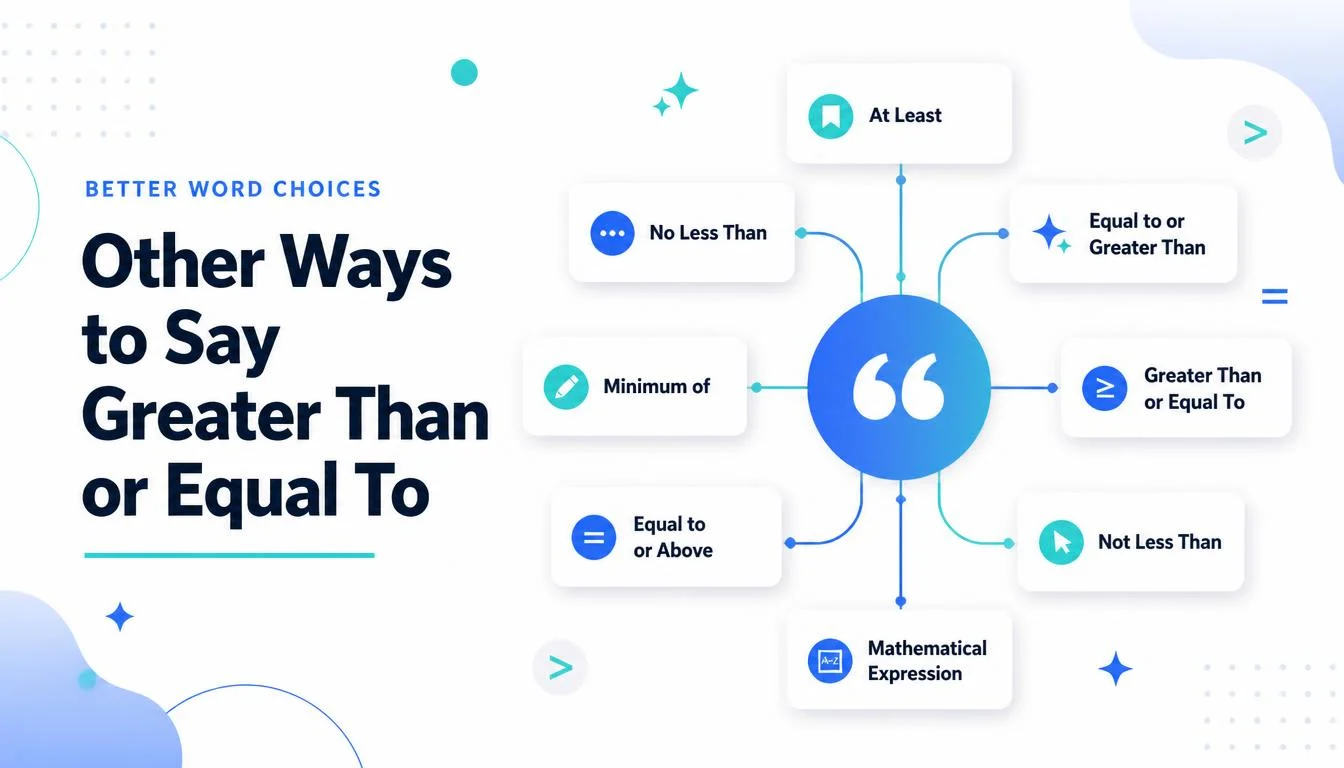
Other ways to say greater than or equal to include “at least,” “no less than,” “equal to or greater than,” and “a minimum of.” The mathematical symbol is ≥, meaning a value can be either greater than or equal to another value.
Understanding other ways to say greater than or equal to can make mathematical concepts easier to explain in writing, conversation, and academic work. Whether you are solving equations, comparing numbers, or describing minimum requirements, choosing the right expression helps communicate your meaning clearly.
In this guide, you’ll discover other ways to say greater than or equal to, along with their meanings and examples. From common phrases like “at least” to formal mathematical expressions, these alternatives will help you express numerical relationships accurately in different contexts.
What Is “Greater Than or Equal To”? (Meaning, Grammar and Real Use)
Imagine a university requires applicants to achieve a score of at least 75 to qualify for a scholarship. A student who scores exactly 75 meets the requirement, and a student who scores 90 qualifies too. A student who scores 74 does not. This everyday example demonstrates why understanding numerical comparisons matters in education, employment, finance, and business.
The phrase greater than or equal to describes a value that is either larger than another value or exactly the same. Its mathematical symbol is ≥. Learning alternatives to greater than or equal to helps you explain requirements clearly without repeating technical terminology in every sentence.
Although mathematical comparisons differ from language used to express excitement in English, both situations demonstrate the importance of choosing expressions that match your purpose and audience.
Meaning and grammar
“Greater than or equal to” is a comparative expression used to describe the relationship between two quantities. It is neutral, precise, and appropriate for technical writing, academic explanations, workplace documents, and everyday instructions.
Example: Applicants must be at least 18 years old.
This sentence expresses the condition age ≥ 18.
The phrase is useful when explaining minimum ages, test scores, financial limits, product quantities, performance targets, and eligibility requirements. In technical writing, the original phrase or symbol may be preferable. In ordinary conversation, shorter expressions such as at least often sound more natural.
When Should You Use “Greater Than or Equal To”?
Use this expression when you need to communicate that a value meets a minimum requirement or exceeds it.
- Mathematics: Explain inequalities, equations, and numerical conditions.
- Education: Describe passing scores, grading requirements, and scholarship eligibility.
- Employment: Specify minimum qualifications, age requirements, and years of experience.
- Business: Define performance standards, sales targets, and productivity goals.
- Finance: Explain minimum balances, qualifying payments, and financial thresholds.
- Technology: Write conditional statements in programming languages and spreadsheet formulas.
- Everyday conversations: Explain minimum quantities, acceptable scores, and required amounts.
Spoken vs. written English
In spoken English, at least is usually simpler and more natural.
- Spoken: “You need at least 70 marks to pass.”
- Written: “The qualifying score must be greater than or equal to 70.”
Technical documents benefit from precise terminology, while everyday conversations usually benefit from concise wording.
Formal vs. informal English
Formal contexts often favor equal to or greater than, not less than, or a minimum of. Informal expressions such as at least work well in conversations, messages, and straightforward instructions.
Always confirm that the replacement preserves the original meaning, particularly when the exact boundary value matters.
Is It Professional or Just Polite?
The phrase is both professional and technically appropriate. However, it expresses a numerical relationship rather than politeness itself.
Business example
“To qualify for the incentive, employees must achieve a performance score greater than or equal to 90%.”
This sentence is objective, precise, and suitable for policies, reports, and performance documentation.
- Polite? ✔️ Yes, when used in a respectful sentence.
- Professional? ✔️ Yes.
For a less technical alternative, write: “Employees must achieve a score of at least 90% to qualify for the incentive.”
Both sentences communicate the same requirement, but the second is easier to understand quickly.
Pros and Cons of Using “Greater Than or Equal To”
Pros
- Mathematical precision: Clearly includes values above a threshold and the threshold itself.
- Professional credibility: Appropriate for academic, technical, and business documents.
- Recognizable notation: The symbol ≥ is widely used in mathematics.
- Clear requirements: Helps establish eligibility rules without ambiguity about equality.
Cons
- Technical wording: The complete phrase can sound complicated in casual conversation.
- Repetition: Using it repeatedly can make general prose feel mechanical.
- Limited conversational warmth: It communicates a condition rather than a personal reaction.
- Grammatical adjustments: Some alternatives require restructuring the sentence to sound natural.
The expression is not inherently difficult or inappropriate. The best choice depends on whether your audience needs technical precision or straightforward everyday language.
Common Mistakes People Make
1. Excluding the exact minimum
Incorrect: Applicants must be older than 18.
Correct: Applicants must be at least 18 years old.
Why it matters: “Older than 18” excludes people who are exactly 18.
2. Confusing the inequality symbols
Incorrect: Writing \(5 \geq 7\) to mean that 5 is greater than or equal to 7.
Correct: Write \(7 \geq 5\) to show that 7 is greater than or equal to 5.
Why it matters: The open side of the symbol faces the larger value.
3. Replacing the phrase with “more than”
Incorrect: You need more than 50 points when exactly 50 points qualifies.
Correct: You need at least 50 points.
Why it matters: “More than 50” excludes 50 itself.
4. Confusing minimum and maximum limits
Incorrect: The fee must be no less than $100 when the maximum permitted fee is $100.
Correct: The fee must be no more than $100.
Why it matters: “No less than” sets a minimum, while “no more than” sets a maximum.
5. Using an awkward substitute in formal writing
Incorrect: The result should be equal to or more than the required benchmark in a technical specification.
Correct: The result must be equal to or greater than the required benchmark.
Why it matters: Grammatically understandable alternatives are not always the clearest choices for formal mathematical communication.
Small tone mistakes can make confident English sound careless.
Alternatives by Category
The following phrases provide a preview of the complete list below. Each category contains expressions suited to different audiences and communication settings.
Formal alternatives to “Greater Than or Equal To”
- Equal to or greater than
- Not less than
- Equal to or above
Pro Tip: Use explicit mathematical wording when a policy, contract, or technical specification must leave no doubt about whether equality is allowed.
Casual alternatives
- At least
- No less than
- As much as or more than
Pro Tip: Prefer at least when explaining everyday requirements to people who may not be familiar with mathematical terminology.
Professional alternatives
- A minimum of
- Meets or exceeds
- At or above
Pro Tip: Use meets or exceeds for targets and performance standards, particularly when describing results or achievements.
Informal expressions
- At least as much as
- As high as or higher than
- At or over
Pro Tip: Match the expression to the quantity being discussed. For countable items, use wording such as at least ten items rather than a phrase intended for levels or heights.
“Formal and informal English aren’t about correctness. They’re about context.”
Other Ways to Say “Greater Than or Equal To” (Full List with Examples)
These 30 alternatives help you describe minimum values, numerical comparisons, and qualifying conditions. Some are direct mathematical equivalents, while others work best in professional documents or everyday conversation.
1. Phrase: At Least
Meaning: Equal to or greater than a minimum.
Explanation: The most versatile everyday alternative.
Example Sentence: You need at least 60 marks to pass.
Best Use: Everyday instructions Worst Use: Formal proofs Tone: Clear, neutral Context Variability: casual / professional / spoken
2. Phrase: No Less Than
Meaning: Equal to or above a stated amount.
Explanation: Emphasizes a minimum requirement.
Example Sentence: The project requires no less than 20 participants.
Best Use: Formal requirements Worst Use: Casual chatting Tone: Formal, firm Context Variability: casual / professional / spoken
3. Phrase: Equal to or Greater Than
Meaning: Identical to or above a value.
Explanation: Preserves the mathematical relationship explicitly.
Example Sentence: The result must be equal to or greater than 75.
Best Use: Technical documents Worst Use: Casual conversation Tone: Technical, precise Context Variability: casual / professional / spoken
4. Phrase: A Minimum of
Meaning: The lowest acceptable amount.
Explanation: Introduces a minimum quantity or requirement.
Example Sentence: Applicants need a minimum of three years of experience.
Best Use: Eligibility criteria Worst Use: Maximum limits Tone: Professional, direct Context Variability: casual / professional / spoken
5. Phrase: Not Less Than
Meaning: Equal to or above a specified amount.
Explanation: A formal alternative for minimum thresholds.
Example Sentence: The deposit must be not less than $500.
Best Use: Formal policies Worst Use: Casual messages Tone: Formal, authoritative Context Variability: casual / professional / spoken
6. Phrase: Equal to or Above
Meaning: At the same level as or higher than a value.
Explanation: Suitable for scores, measurements, and thresholds.
Example Sentence: The result must be equal to or above 80.
Best Use: Measurement criteria Worst Use: Casual storytelling Tone: Neutral, technical Context Variability: casual / professional / spoken
7. Phrase: At a Minimum of
Meaning: At least the stated amount.
Explanation: Highlights the lowest acceptable quantity.
Example Sentence: Attendance is required at a minimum of four sessions.
Best Use: Formal instructions Worst Use: Quick conversations Tone: Formal, explanatory Context Variability: casual / professional / spoken
8. Phrase: Meets or Exceeds
Meaning: Reaches a target or goes beyond it.
Explanation: Effective for standards, expectations, and performance.
Example Sentence: Her score meets or exceeds the required benchmark.
Best Use: Performance reviews Worst Use: Algebraic proofs Tone: Professional, positive Context Variability: casual / professional / spoken
9. Phrase: At or Above
Meaning: Equal to or higher than a specified level.
Explanation: A concise option for scores, ages, and measurements.
Example Sentence: Participants must score at or above 80%.
Best Use: Qualification thresholds Worst Use: Unspecified comparisons Tone: Neutral, concise Context Variability: casual / professional / spoken
10. Phrase: As Much As or More Than
Meaning: Equal to or greater than an amount.
Explanation: Makes quantity comparisons understandable in conversation.
Example Sentence: The repair could cost as much as or more than $200.
Best Use: Cost estimates Worst Use: Mathematical proofs Tone: Conversational, explanatory Context Variability: casual / professional / spoken
11. Phrase: At Least as Much As
Meaning: Equal to or greater than an amount.
Explanation: Useful for comparing money, quantities, or resources.
Example Sentence: The new offer pays at least as much as the previous one.
Best Use: Salary comparisons Worst Use: Abstract equations Tone: Conversational, neutral Context Variability: casual / professional / spoken
12. Phrase: As High As or Higher Than
Meaning: At the same level as or above a benchmark.
Explanation: Best for levels, rates, scores, and heights.
Example Sentence: The final score was as high as or higher than 90.
Best Use: Score comparisons Worst Use: Countable quantities Tone: Descriptive, neutral Context Variability: casual / professional / spoken
13. Phrase: Equal to or More Than
Meaning: Equal to a value or greater in quantity.
Explanation: Understandable, though equal to or greater than is more precise in formal writing.
Example Sentence: The quantity must be equal to or more than 100 units.
Best Use: Simple explanations Worst Use: Formal specifications Tone: Plain, explanatory Context Variability: casual / professional / spoken
14. Phrase: No Fewer Than
Meaning: At least a specified number of countable items.
Explanation: Use with plural countable nouns.
Example Sentence: The committee must include no fewer than six members.
Best Use: Headcounts Worst Use: Uncountable quantities Tone: Formal, precise Context Variability: casual / professional / spoken
15. Phrase: No Lower Than
Meaning: At the stated level or higher.
Explanation: Useful for ratings, grades, and minimum levels.
Example Sentence: The rating must be no lower than four stars.
Best Use: Minimum ratings Worst Use: Unrelated quantities Tone: Neutral, firm Context Variability: casual / professional / spoken
16. Phrase: Equal to or Higher Than
Meaning: At the same numerical level as or above a value.
Explanation: Explicitly includes equality and higher values.
Example Sentence: The measurement must be equal to or higher than 12 centimeters.
Best Use: Technical measurements Worst Use: Casual greetings Tone: Technical, clear Context Variability: casual / professional / spoken
17. Phrase: At or Above the Minimum
Meaning: Meeting or surpassing the lowest acceptable threshold.
Explanation: Emphasizes compliance with a defined requirement.
Example Sentence: Every applicant must be at or above the minimum qualifying score.
Best Use: Selection criteria Worst Use: Casual storytelling Tone: Formal, objective Context Variability: casual / professional / spoken
18. Phrase: Meets the Minimum Requirement
Meaning: Satisfies the lowest acceptable standard.
Explanation: Focuses on eligibility rather than the comparison itself.
Example Sentence: Her qualifications meet the minimum requirement for the position.
Best Use: Hiring decisions Worst Use: Algebraic expressions Tone: Professional, objective Context Variability: casual / professional / spoken
19. Phrase: Reaches or Exceeds
Meaning: Arrives at a target or goes beyond it.
Explanation: Works well for goals, thresholds, and milestones.
Example Sentence: Sales must reach or exceed $10,000 this month.
Best Use: Business targets Worst Use: Static descriptions Tone: Motivational, professional Context Variability: casual / professional / spoken
20. Phrase: Equal to or Greater in Value Than
Meaning: The same value as or more than a reference value.
Explanation: Useful when comparing prices, assets, or measurements.
Example Sentence: The offer must be equal to or greater in value than the reserve price.
Best Use: Value comparisons Worst Use: Everyday chat Tone: Formal, precise Context Variability: casual / professional / spoken
21. Phrase: At Least as High As
Meaning: At the same level or higher.
Explanation: Suitable for rates, scores, heights, and levels.
Example Sentence: The revised estimate is at least as high as the original estimate.
Best Use: Level comparisons Worst Use: Headcounts Tone: Neutral, descriptive Context Variability: casual / professional / spoken
22. Phrase: Equal to or Above the Threshold
Meaning: Meeting or exceeding a defined cutoff.
Explanation: Useful for eligibility rules and automated decisions.
Example Sentence: Only applications equal to or above the threshold will be considered.
Best Use: Screening rules Worst Use: Friendly conversation Tone: Technical, formal Context Variability: casual / professional / spoken
23. Phrase: At Least the Required Amount
Meaning: Meeting or exceeding a specified quantity.
Explanation: Connects the minimum directly to a requirement.
Example Sentence: Please bring at least the required amount of documentation.
Best Use: Compliance instructions Worst Use: Mathematical proofs Tone: Direct, professional Context Variability: casual / professional / spoken
24. Phrase: Equal to or More Than the Minimum Limit
Meaning: At the minimum limit or above it.
Explanation: Use when the boundary represents a minimum, not a maximum.
Example Sentence: The value must be equal to or more than the minimum limit.
Best Use: Technical criteria Worst Use: Maximum restrictions Tone: Formal, precise Context Variability: casual / professional / spoken
25. Phrase: At or Over
Meaning: At a threshold or beyond it.
Explanation: A compact expression sometimes used in informal descriptions.
Example Sentence: Participants must be at or over the required age.
Best Use: Casual instructions Worst Use: Legal drafting Tone: Informal, direct Context Variability: casual / professional / spoken
26. Phrase: Equal to or Exceeding
Meaning: Matching a value or surpassing it.
Explanation: A formal construction for measurable standards and requirements.
Example Sentence: Applicants with scores equal to or exceeding 85 will qualify.
Best Use: Formal criteria Worst Use: Casual dialogue Tone: Formal, technical Context Variability: casual / professional / spoken
27. Phrase: Not Below
Meaning: At the stated value or higher.
Explanation: A compact expression for minimum levels.
Example Sentence: The pressure must remain not below the recommended level.
Best Use: Technical instructions Worst Use: Natural conversation Tone: Technical, firm Context Variability: casual / professional / spoken
28. Phrase: Equal to or Greater in Amount Than
Meaning: Matching or surpassing a quantity.
Explanation: Makes an amount comparison explicit.
Example Sentence: The reimbursement must be equal to or greater in amount than the approved expense.
Best Use: Expense policies Worst Use: Short messages Tone: Formal, precise Context Variability: casual / professional / spoken
29. Phrase: Meets the Threshold or Goes Beyond It
Meaning: Reaching a cutoff or surpassing it.
Explanation: A reader-friendly explanation of threshold-based decisions.
Example Sentence: Your application qualifies if it meets the threshold or goes beyond it.
Best Use: General explanations Worst Use: Compact formulas Tone: Clear, explanatory Context Variability: casual / professional / spoken
30. Phrase: At Least as Great As
Meaning: Equal to or greater than a reference value.
Explanation: A useful comparative construction when great refers to magnitude or degree.
Example Sentence: The new result must be at least as great as the previous result.
Best Use: Value comparisons Worst Use: Casual instructions Tone: Neutral, precise Context Variability: casual / professional / spoken
Comparison Table: Top 10 Alternatives at a Glance
| Phrase | Tone | Best Use |
|---|---|---|
| At least | Neutral | Everyday communication |
| No less than | Formal | Written requirements |
| Equal to or greater than | Technical | Mathematics |
| A minimum of | Professional | Eligibility criteria |
| Not less than | Formal | Policies and contracts |
| Equal to or above | Neutral | Measurements |
| Meets or exceeds | Professional | Performance reviews |
| At or above | Concise | Scores and thresholds |
| No fewer than | Formal | Countable quantities |
| Reaches or exceeds | Professional | Business targets |
Choose at least for everyday instructions, equal to or greater than for mathematical precision, and meets or exceeds for performance-related communication.
Quick Self-Check (Mini Quiz)
Test your understanding with these four practical situations.
1. Applicants qualify if they are exactly 18 years old or older. Which expression is best?Older than 18At least 18 years oldUnder 18
2. Sales must reach a target or go beyond it. Which phrase fits best?Meets or exceedsLess thanBelow the minimum
3. A committee needs a minimum of eight members. Which phrase is most precise?No more than eight membersNo fewer than eight membersFewer than eight members
4. Which wording correctly expresses x ≥ 12?x is greater than 12x is equal to or greater than 12x is less than or equal to 12
Check answers
FAQs
1. What is the simplest alternative to greater than or equal to?
At least is the simplest everyday alternative. For example, “You need at least 50 points” means 50 points or more.
2. Does greater than or equal to include the exact number?
Yes. The symbol ≥ includes equality and values above a specified number. For example, \(x \geq 10\) means that \(x\) can equal 10 or be greater than 10.
3. Is “at least” interchangeable with greater than or equal to?
Often, yes, when describing minimum requirements. However, the best replacement depends on the sentence structure and whether the original mathematical meaning is preserved.
4. What is the difference between “at least” and “more than”?
At least 20 includes 20 and every number above it. More than 20 excludes 20 and refers only to values greater than 20.
5. How should I express greater than or equal to in professional writing?
Use at least for straightforward requirements, a minimum of for eligibility criteria, and equal to or greater than when mathematical precision is essential.
For more vocabulary-building ideas, explore See also: Other Ways to Say “Amazing”. For workplace writing, read the See also: Professional English Communication Guide.
Conclusion
Choosing the right alternative helps you communicate numerical requirements clearly in everyday conversations, professional documents, and technical writing. While several expressions describe a minimum threshold, their grammatical structures and levels of formality differ.
Practice using at least, no less than, and meets or exceeds in sentences relevant to your work or studies. Always check whether the exact boundary value is included before choosing an alternative.
Read More Related Articles:
- Other Ways to Say You’re Beautiful | Beyond the Ordinary Compliment In 2026
- Other Ways to Say I Like You | Words They’ll Never Forget In 2026
- Other Ways to Say I Love You | Melt Hearts and Strengthen Your Bond In 2026

Daniel Murphy is a professional writer and blogger specializing in digital communication and messaging trends. As a contributor to TextsResponse.com, he creates reader-focused content designed to help people find the right words at the right time.