Quick Answer
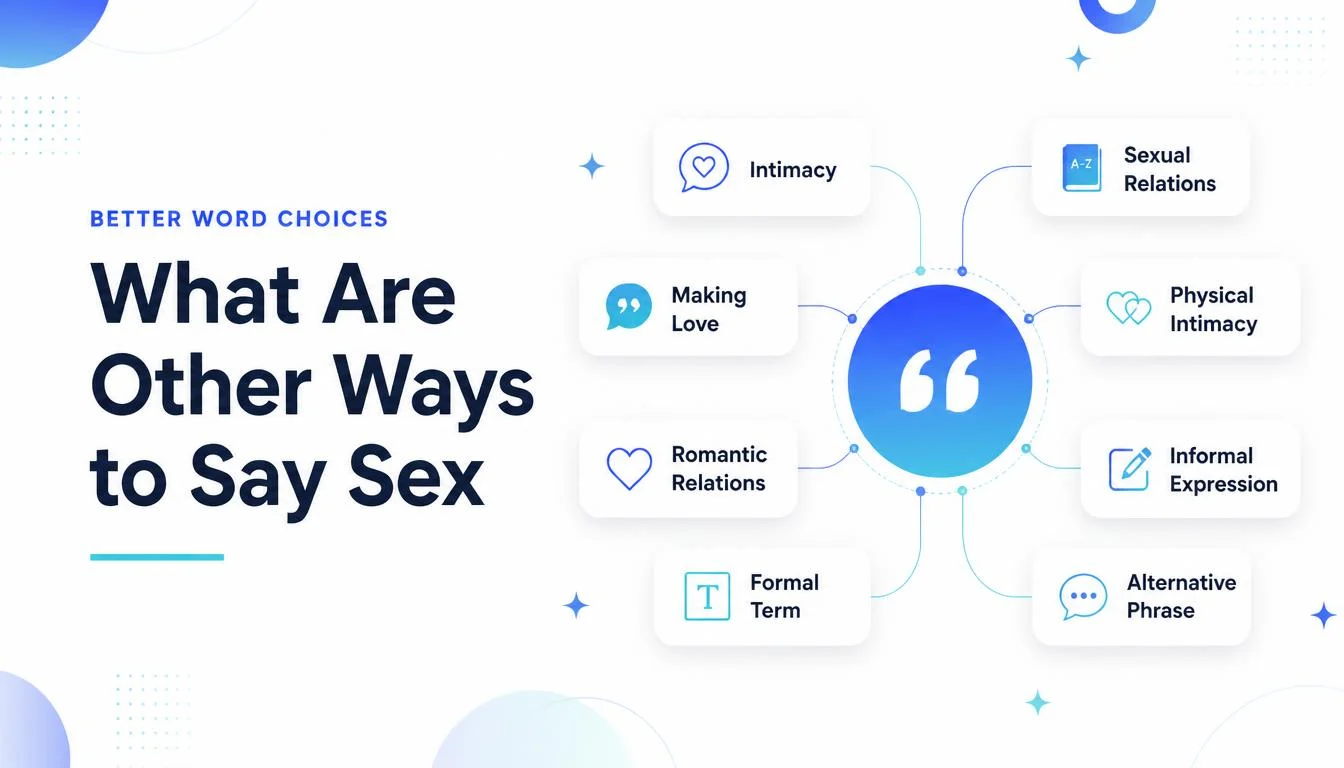
Other ways to say sex include sexual intercourse, intimacy, sexual activity, making love, and physical intimacy. The best alternative depends on the context, tone, and intended meaning.
Knowing other ways to say sex can help you communicate more clearly, respectfully, and appropriately in different situations. Whether you are discussing relationships, writing educational content, or having a personal conversation, choosing the right expression makes your meaning easier to understand.
Some alternatives are formal and suitable for medical or educational discussions, while others sound romantic, gentle, or conversational. For example, “sexual intercourse” is a more clinical term, “physical intimacy” emphasizes closeness, and “making love” often suggests a romantic connection. Understanding these differences helps you select language that fits your audience and purpose.
What Does “Sex” Mean? Meaning, Grammar and Real Use
Imagine discussing relationships with a friend, answering a doctor’s question, or writing an article about sexual health. In each situation, you may need different vocabulary to communicate clearly and respectfully. Understanding these differences helps English learners choose expressions that fit the audience and purpose.
In relationship-related contexts, sex generally refers to sexual activity. However, the word also refers to biological sex, so context matters. Some alternatives are precise and clinical, while others emphasize romance, emotional closeness, or discretion.
Learning alternatives to this term improves your ability to discuss sensitive subjects without sounding unnecessarily blunt. Unlike language used to express excitement in English, vocabulary related to sex often requires particular attention to privacy, consent, and appropriate register.
Definition: Sex can refer to sexual activity or, in another context, biological sex. The intended meaning determines which alternative is appropriate.
Grammar note: Sex is a noun. Expressions such as sexual activity, sexual intercourse, and intimacy are noun phrases with different meanings and levels of specificity.
Example: “The doctor asked whether the patient was sexually active.”
These expressions appear in everyday speech, healthcare, research, education, and relationship discussions. Choosing the right one makes your communication more accurate and considerate.
When Should You Use These Alternatives?
Different expressions are suitable for different situations. Consider your audience, the information you need to communicate, and the tone you want to establish.
Common contexts
- Healthcare: Use sexual activity or sexual intercourse when discussing medical history, contraception, or sexual health.
- Education: Use sexual behavior or sexual relations when explaining relationships and reproductive health.
- Romantic relationships: Choose intimacy or physical intimacy when discussing closeness and connection.
- Academic writing: Use sexual activity or sexual behavior when the terminology accurately reflects the research.
- Private conversations: Expressions such as being intimate may sound more discreet.
- Legal and policy documents: Prefer clearly defined terminology appropriate to the subject and applicable rules.
Spoken vs. written English
Spoken English: Having sex is direct and familiar. Being intimate is more discreet, although it may be less precise.
Written English: Sexual activity and sexual intercourse are common in clinical and educational contexts. Intimacy may be more appropriate in relationship-focused writing.
Formal vs. informal English
Formal language emphasizes clarity and precision. Informal language is usually more conversational and may rely on euphemisms. Neither register is automatically better; the situation determines the appropriate choice.
Is It Professional or Just Polite?
The word sex is not inherently unprofessional. It is appropriate when discussing relevant topics such as healthcare, research, sexual health education, and workplace policies.
Politeness vs. professionalism
- Politeness: Discussing a sensitive subject tactfully and respectfully.
- Professionalism: Using accurate, objective language appropriate to the setting.
Business-style example: “The training covers sexual harassment prevention, personal boundaries, and respectful workplace conduct.”
- Polite? ✔️ Yes, when relevant and respectful.
- Professional? ✔️ Yes, when used accurately.
For more guidance on choosing appropriate workplace language, see the Professional English Communication Guide.
Pros and Cons of Using Different Expressions
Knowing several expressions gives you more control over tone, precision, and clarity. However, related terms are not always interchangeable.
Pros
- Greater precision: Clinical terminology can communicate specific information accurately.
- Respectful communication: Discreet expressions can make sensitive conversations more comfortable.
- Audience awareness: Different phrases suit healthcare, education, relationships, and research.
- Improved comprehension: Understanding related vocabulary helps you interpret conversations and written material.
Cons
- Possible ambiguity: Intimacy may describe emotional closeness without sexual activity.
- Excessive formality: Clinical terminology can sound unnatural in casual conversations.
- Unintended implications: Romantic expressions may suggest affection or commitment.
- Reduced accuracy: Euphemisms can obscure important details in medical or academic discussions.
Common Mistakes People Make
Understanding the differences between related expressions helps you avoid confusion and communicate more naturally.
1. Assuming intimacy always means sex
❌ “Emotional intimacy always involves sexual activity.”
✔️ “Emotional intimacy can exist without sexual activity.”
2. Using overly formal language in casual conversation
❌ “We engaged in sexual intercourse” in a relaxed conversation about a relationship.
✔️ “We were intimate” when a discreet, personal expression is appropriate.
3. Confusing biological sex with sexual activity
❌ “The study measures how often people have biological sex.”
✔️ “The study measures how often people engage in sexual activity.”
4. Assuming sexual relations describes one specific act
❌ “Sexual relations always refers to one particular sexual act.”
✔️ “Sexual relations is a broader expression whose meaning depends on context.”
5. Using vague language when precision is necessary
❌ “The patient was close with a partner” in a medical history requiring information about sexual activity.
✔️ “The patient reported recent sexual activity,” if that accurately reflects the patient’s report.
Small tone mistakes can make confident English sound careless.
Alternatives by Category
These curated examples provide a quick introduction to the complete list below. Each phrase appears again in the full collection.
Formal alternatives to “sex”
- Sexual intercourse
- Sexual activity
- Sexual relations
Pro Tip: In medical or academic writing, select the term that precisely describes the subject being discussed.
Casual alternatives
- Having sex
- Being intimate
- Getting intimate
Pro Tip: Consider whether direct wording or a discreet expression is more suitable for your listener.
Professional alternatives
- Sexual behavior
- Sexual activity
- Sexual health
Pro Tip: Use neutral, evidence-based terminology in reports, consultations, and educational materials.
Informal expressions
- Sleeping together
- Making love
- Being physical
Pro Tip: Check the context because informal expressions can imply romance, physical affection, or sexual activity.
“Formal and informal English aren’t about correctness. They’re about context.”
Other Ways to Say Sex: 30 Alternatives With Examples
These 30 expressions help you discuss sexuality, relationships, health, and intimacy with greater awareness of tone and context. Some are direct alternatives, while others describe related concepts rather than sex itself.
1. Phrase: Sexual Activity
Meaning: Sexual behavior or actions.
Explanation: A neutral, inclusive term used in healthcare, education, and research.
Example Sentence: “The doctor asked about recent sexual activity.
Best Use: Medical discussions
Worst Use: Romantic poetry
Tone: Neutral, clinical
Context Variability: casual / professional / spoken
2. Phrase: Sexual Intercourse
Meaning: Sexual activity involving intercourse.
Explanation: A specific term commonly used in medical, educational, and legal contexts.
Example Sentence: “The consultation included questions about sexual intercourse.”
Best Use: Clinical writing
Worst Use: Casual flirting
Tone: Formal, precise
Context Variability: professional / educational / spoken
3. Phrase: Sexual Relations
Meaning: Sexual involvement or activity.
Explanation: A formal expression that describes sexual involvement without necessarily identifying a specific act.
Example Sentence: “The report examined sexual relations and relationship expectations.”
Best Use: Formal discussions
Worst Use: Playful banter
Tone: Formal, neutral
Context Variability: professional / written / spoken
4. Phrase: Intimacy
Meaning: Emotional or physical closeness.
Explanation: A broad term that may refer to emotional connection, physical affection, or sexual closeness.
Example Sentence: “They discussed intimacy and trust in their relationship.”
Best Use: Relationship discussions
Worst Use: Clinical precision
Tone: Gentle, personal
Context Variability: casual / professional / spoken
5. Phrase: Physical Intimacy
Meaning: Close physical contact that may be sexual.
Explanation: Useful when discussing affection and physical closeness without naming a specific sexual act.
Example Sentence: “They discussed physical intimacy and boundaries.”
Best Use: Personal conversations
Worst Use: Exact medical reporting
Tone: Respectful, discreet
Context Variability: casual / professional / spoken
6. Phrase: Having Sex
Meaning: Engaging in sexual activity.
Explanation: A direct, widely understood everyday expression.
Example Sentence: “They discussed when they felt ready to start having sex.”
Best Use: Everyday conversation
Worst Use: Formal reports
Tone: Direct, conversational
Context Variability: casual / spoken / personal
7. Phrase: Being Intimate
Meaning: Sharing close emotional or physical experiences.
Explanation: A tactful expression that may include sexual activity but can also describe nonsexual affection.
Example Sentence: “They wanted to feel comfortable before being intimate.”
Best Use: Private conversations
Worst Use: Technical definitions
Tone: Gentle, discreet
Context Variability: casual / spoken / personal
8. Phrase: Getting Intimate
Meaning: Becoming physically or emotionally close.
Explanation: A conversational expression often used when a relationship becomes more physically affectionate or sexual.
Example Sentence: “They discussed boundaries before getting intimate.”
Best Use: Casual discussions
Worst Use: Clinical documents
Tone: Informal, discreet
Context Variability: casual / spoken / personal
9. Phrase: Sexual Behavior
Meaning: Actions and behaviors related to sexuality.
Explanation: An objective term that can cover a range of behaviors, depending on the context.
Example Sentence: “The research explored changes in sexual behavior.”
Best Use: Academic research
Worst Use: Romantic conversation
Tone: Objective, formal
Context Variability: professional / written / educational
10. Phrase: Sexual Contact
Meaning: Physical contact of a sexual nature.
Explanation: Common in health, legal, and safeguarding contexts. Its precise scope depends on the circumstances.
Example Sentence: “The clinician asked whether there had been sexual contact.”
Best Use: Health assessments
Worst Use: Romantic storytelling
Tone: Neutral, precise
Context Variability: professional / educational / spoken
11. Phrase: Sexual Relations Between Partners
Meaning: Sexual involvement between people in a relationship.
Explanation: A descriptive expression that does not necessarily imply marriage or a particular relationship structure.
Example Sentence: “The counselor discussed sexual relations between partners.”
Best Use: Counseling sessions
Worst Use: Brief casual chat
Tone: Formal, descriptive
Context Variability: professional / written / spoken
12. Phrase: Making Love
Meaning: Having sex, often with an emphasis on affection.
Explanation: A romantic expression that commonly suggests emotional connection.
Example Sentence: “The novel describes the couple making love.”
Best Use: Romantic writing
Worst Use: Clinical reporting
Tone: Romantic, intimate
Context Variability: casual / literary / spoken
13. Phrase: Sleeping Together
Meaning: Sharing a bed or having sex.
Explanation: A common euphemism for sex, although it can also mean literally sleeping in the same place.
Example Sentence: “The characters admitted they had been sleeping together.”
Best Use: Informal storytelling
Worst Use: Ambiguous reporting
Tone: Informal, indirect
Context Variability: casual / spoken / literary
14. Phrase: Being Physical
Meaning: Engaging in physical affection or sexual contact.
Explanation: A broad expression that may refer to kissing, touching, or sexual activity.
Example Sentence: “They discussed what being physical meant to each of them.”
Best Use: Personal discussions
Worst Use: Medical documentation
Tone: Casual, indirect
Context Variability: casual / spoken / personal
15. Phrase: Sexual Experience
Meaning: An experience involving sexual activity.
Explanation: Useful for discussing personal history without describing specific details.
Example Sentence: “The workshop addressed communication during a first sexual experience.”
Best Use: Health education
Worst Use: Unrelated business meetings
Tone: Neutral, informative
Context Variability: professional / educational / spoken
16. Phrase: Sexual Encounter
Meaning: An occasion involving sexual contact or activity.
Explanation: Often used in research, reporting, and storytelling. It does not necessarily imply romance.
Example Sentence: “The study examined how participants perceived a sexual encounter.”
Best Use: Research writing
Worst Use: Affectionate dialogue
Tone: Neutral, descriptive
Context Variability: professional / written / spoken
17. Phrase: Sexual Intimacy
Meaning: Physical or relational closeness involving sexuality.
Explanation: Emphasizes closeness in a sexual context and can be useful in counseling.
Example Sentence: “They discussed how communication could strengthen sexual intimacy.”
Best Use: Relationship counseling
Worst Use: Casual technical answers
Tone: Respectful, thoughtful
Context Variability: professional / personal / spoken
18. Phrase: Consensual Sexual Activity
Meaning: Sexual activity agreed to freely by everyone involved.
Explanation: Highlights consent and is useful in sexual health education. Consent must be voluntary and ongoing.
Example Sentence: “The program teaches the importance of consensual sexual activity.”
Best Use: Health education
Worst Use: Romantic euphemisms
Tone: Precise, educational
Context Variability: professional / educational / spoken
19. Phrase: Sexual Engagement
Meaning: Participation in sexual activity.
Explanation: A relatively formal expression that may appear in specialized writing but can sound less natural in everyday conversation.
Example Sentence: “The survey examined patterns of sexual engagement.”
Best Use: Specialized writing
Worst Use: Everyday conversation
Tone: Formal, analytical
Context Variability: professional / written / educational
20. Phrase: Sexual Involvement
Meaning: Participation in sexual activity with another person.
Explanation: A broad phrase that may refer to an ongoing relationship or a particular situation.
Example Sentence: “They discussed sexual involvement in the relationship.”
Best Use: Relationship counseling
Worst Use: Lighthearted conversation
Tone: Neutral, cautious
Context Variability: professional / personal / spoken
21. Phrase: Consummation
Meaning: Completion of a marriage through sexual intercourse in traditional usage.
Explanation: A specialized term associated with marriage, law, and historical writing.
Example Sentence: “The historical text discussed the consummation of the marriage.”
Best Use: Historical discussion
Worst Use: Everyday conversation
Tone: Formal, specialized
Context Variability: professional / literary / written
22. Phrase: Carnal Relations
Meaning: Sexual relations expressed in a formal or literary style.
Explanation: An old-fashioned expression sometimes found in historical, legal, or literary texts.
Example Sentence: “The historical document referred to carnal relations.”
Best Use: Historical texts
Worst Use: Modern workplace
Tone: Old-fashioned, formal
Context Variability: literary / written / educational
23. Phrase: Sexual Union
Meaning: Sexual joining or intercourse.
Explanation: A formal or literary expression sometimes used in religious, philosophical, or relationship discussions.
Example Sentence: “The essay examined traditional beliefs about sexual union.”
Best Use: Literary analysis
Worst Use: Casual conversation
Tone: Formal, literary
Context Variability: written / educational / spoken
24. Phrase: Physical Relations
Meaning: Physical involvement that may be sexual.
Explanation: An indirect expression whose meaning depends on context. Specify sexual activity when accuracy matters.
Example Sentence: “They discussed physical relations and personal expectations.”
Best Use: Discreet discussions
Worst Use: Precise clinical notes
Tone: Indirect, neutral
Context Variability: casual / professional / spoken
25. Phrase: Sexual Relationship
Meaning: A relationship that includes sexual involvement.
Explanation: Describes the nature of a relationship rather than necessarily referring to a single act.
Example Sentence: “They discussed whether they wanted a sexual relationship.”
Best Use: Relationship discussions
Worst Use: Describing one act
Tone: Neutral, descriptive
Context Variability: casual / professional / spoken
26. Phrase: Sexual Relations Within a Relationship
Meaning: Sexual activity occurring within a relationship.
Explanation: A descriptive phrase suitable for discussing expectations, communication, and boundaries.
Example Sentence: “The counselor discussed sexual relations within a relationship.”
Best Use: Counseling sessions
Worst Use: Concise casual chat
Tone: Formal, explanatory
Context Variability: professional / educational / spoken
27. Phrase: Erotic Intimacy
Meaning: Intimacy involving erotic or sexual feelings.
Explanation: A literary or specialized expression that emphasizes desire and sensual connection.
Example Sentence: “The novel explores erotic intimacy and emotional vulnerability.”
Best Use: Literary analysis
Worst Use: Medical documentation
Tone: Literary, sensual
Context Variability: literary / written / spoken
28. Phrase: Sexual Activity Between Partners
Meaning: Sexual behavior involving partners.
Explanation: A clear, neutral expression suitable for educational materials, surveys, and relationship discussions.
Example Sentence: “The survey asked about sexual activity between partners.”
Best Use: Research questionnaires
Worst Use: Romantic dialogue
Tone: Objective, precise
Context Variability: professional / written / spoken
29. Phrase: Intimate Relations
Meaning: Close relations that may involve sexual activity.
Explanation: A discreet, somewhat formal phrase that can suggest a sexual relationship without identifying a specific act.
Example Sentence: “The article explored intimate relations and trust.”
Best Use: Formal discussions
Worst Use: Technical definitions
Tone: Discreet, formal
Context Variability: professional / literary / spoken
30. Phrase: Sexual Health and Intimacy
Meaning: Sexual well-being and intimate relationships.
Explanation: Describes a broader subject rather than sex itself. It is useful for discussing communication, safety, and relationship well-being.
Example Sentence: “The course covers sexual health and intimacy.”
Best Use: Educational resources
Worst Use: Naming one act
Tone: Informative, respectful
Context Variability: professional / educational / spoken
Comparison Table: Top 10 Alternatives at a Glance
| Phrase | Tone | Best Use |
|---|---|---|
| Sexual activity | Neutral, clinical | Healthcare |
| Sexual intercourse | Formal, precise | Medical writing |
| Sexual relations | Formal, neutral | Academic discussions |
| Intimacy | Gentle, personal | Relationships |
| Physical intimacy | Respectful, discreet | Personal conversations |
| Having sex | Direct, conversational | Everyday speech |
| Being intimate | Gentle, indirect | Private conversations |
| Sexual behavior | Objective, formal | Research |
| Sexual contact | Neutral, precise | Health assessments |
| Making love | Romantic, intimate | Romantic writing |
Quick Self-Check: Mini Quiz
Choose the most appropriate expression for each situation.
Question 1
A doctor asks a patient about their recent sexual history. Which expression is most appropriate?
- A. Making love
- B. Sexual activity
- C. Sleeping together
Question 2
You are writing a romantic story about two people who share affection and emotional closeness. Which phrase may fit best?
- A. Sexual behavior
- B. Sexual contact
- C. Making love
Question 3
A researcher is studying patterns of sexual behavior among adults. Which expression is most suitable?
- A. Sexual behavior
- B. Getting intimate
- C. Being physical
Question 4
You want to discuss emotional and physical closeness without automatically implying sex. Which term is most appropriate?
- A. Sexual intercourse
- B. Intimacy
- C. Consummation
Answer key: 1. B, 2. C, 3. A, 4. B.
FAQs
1. What are other ways to say sex in English?
Common alternatives include sexual activity, sexual intercourse, sexual relations, intimacy, and physical intimacy. The best choice depends on your audience and purpose.
2. What is a formal word for sex?
Sexual intercourse is a formal, relatively specific term, while sexual activity is broader. Choose terminology that accurately describes the subject.
3. What is a polite way to talk about sex?
Intimacy and physical intimacy can sound discreet and considerate. Use more specific language when clarity is important.
4. Is intimacy the same as sex?
No. Intimacy can involve emotional closeness, affection, trust, or physical contact. Sexual activity may be part of intimacy, but intimacy does not necessarily involve sex.
5. What is the difference between sexual activity and sexual intercourse?
Sexual activity is a broad term covering various sexual behaviors. Sexual intercourse is more specific, although its precise definition can vary by context.
Conclusion
Learning different expressions for sex helps you communicate more accurately and respectfully in personal conversations, healthcare settings, academic writing, and relationship discussions. Some expressions are direct, while others emphasize romance, privacy, or emotional closeness.
Build your vocabulary by practicing these phrases in complete sentences and noticing how they are used in authentic English. For additional guidance on choosing words for different audiences, read the Professional English Communication Guide.
Read More Related Articles:
- Other Ways to Say Contact Us on Website | Natural Phrases to Use In 2026
- Other Ways to Say Bless You After a Sneeze | Clever Ways to Respond In 2026
- Other Ways to Say I Hope You Feel Better Soon | Comforting Messages for Anyone In 2026

Daniel Murphy is a professional writer and blogger specializing in digital communication and messaging trends. As a contributor to TextsResponse.com, he creates reader-focused content designed to help people find the right words at the right time.