Quick Answer
Other ways to say “I can” include “I’m able to,” “I’m capable of,” “I can certainly,” and “I’d be happy to.” These alternatives help you express ability, willingness, and confidence naturally.
Learning other ways to say i can helps you improve your English vocabulary and communicate with greater confidence. Whether you are speaking with friends, writing emails, or participating in professional discussions, choosing the right expression makes your message clearer and more effective.
The phrase “I can” is commonly used to express ability, permission, or willingness to do something. Alternatives such as “I’m able to,” “I’m happy to help,” and “I’m confident I can” allow you to adapt your language to different situations. By understanding these expressions, you can make your everyday conversations and professional communication sound more natural and engaging.
What Is “Other Ways to Say i Can”? (Meaning, Grammar & Real Use)
Imagine your manager asks whether you can complete a report by Friday. You could simply answer, “I can do it.” However, “I can certainly complete it by Friday” sounds more confident, while “I would be happy to take care of it” emphasizes willingness. Choosing the right expression helps you communicate more clearly in professional and personal situations.
Learning other ways to say i can is useful for English learners who want to sound natural, polite, and confident. Different alternatives communicate different meanings, including ability, permission, availability, and willingness. Understanding these distinctions helps you select an expression that fits the situation instead of repeating the same phrase.
The alternatives to this expression also help you express excitement in English when accepting an opportunity or volunteering for a task.
Definition: “I can” expresses ability, possibility, permission, or willingness to do something.
Grammar note: “Can” is a modal verb followed by the base form of a verb, as in “I can help.” Alternatives use different grammatical structures, such as “I am able to help” and “I am capable of helping.”
Example: “I can assist you with the presentation.”
People use this expression in conversations, emails, meetings, academic writing, and everyday communication. The best replacement depends on whether you want to emphasize skill, confidence, availability, or willingness.
When Should You Use “I Can”?
Use these expressions when you want to communicate what you are able or willing to do.
- Describing ability: Explain a skill or task you can perform, such as “I am able to analyze the data.”
- Offering help: Show willingness with “I would be happy to help.”
- Accepting responsibility: Use “I can take care of that” to confirm ownership of a task.
- Discussing possibilities: Say “I may be able to attend” when your availability is uncertain.
- Requesting permission: Use “May I?” or “Would it be possible for me to?” when asking politely.
- Expressing confidence: Say “I am confident I can deliver the results” when discussing your capabilities.
Spoken vs. Written
In spoken English, short expressions such as “I can do that” and “I can handle it” sound natural. In emails and formal documents, “I am able to,” “I can confirm,” and “I would be pleased to” may suit the context better.
Formal vs. Informal
Formal communication often requires precise, measured wording. Informal conversations allow simpler expressions such as “I can help,” “I can do it,” or “I can give it a try.”
Choose an alternative based on the message you want to communicate, not simply on how formal it sounds.
Is “I Can” Professional or Just Polite?
“I can” is both professional and polite in many situations. It is a standard expression that communicates ability or willingness without unnecessary complexity.
Politeness concerns how respectfully you communicate. Professionalism involves clarity, reliability, and appropriate language for the workplace.
For example, in a business email, you might write:
“I can prepare the revised proposal and send it to you by Thursday.”
This sentence is professional because it clearly states the action and deadline. If you want a warmer tone, you could write, “I would be happy to prepare the revised proposal for you.”
- Polite? ✔️ Yes
- Professional? ✔️ Yes
The phrase itself is not unprofessional. However, the surrounding sentence, your tone, and the situation influence how your message is received.
For more workplace language guidance, see the Professional English Communication Guide.
Pros and Cons of Using “I Can”
Pros
- Simple and direct: Communicates ability without complicated wording.
- Widely understood: Suitable for most English-speaking audiences.
- Flexible: Works in casual conversations, professional emails, and meetings.
- Easy to remember: Beginners and advanced learners can use it confidently.
Cons
- Can sound repetitive: Using it in every sentence limits vocabulary variety.
- May seem abrupt: A short answer can sound less warm without context.
- Does not always express enthusiasm: Ability and willingness are not necessarily the same.
- Can overstate certainty: Saying “I can” may imply confidence even when you are unsure.
The goal is not to avoid “I can” completely. Instead, learn when a more specific expression communicates your intention more accurately.
Common Mistakes People Make
English learners sometimes use alternatives incorrectly because they focus on vocabulary rather than grammar or context.
1. Using “can” with an infinitive marker
Incorrect: I can to finish the assignment.
Correct: I can finish the assignment.
Why it matters: A modal verb such as “can” is followed directly by the base form of the main verb.
2. Confusing ability with willingness
Incorrect: I am capable of helping you, but I mean that I am happy to help.
Correct: I would be happy to help you.
Why it matters: “Capable of” emphasizes ability, while “happy to” emphasizes willingness.
3. Using “I am able to” in every situation
Incorrect: I am able to see you tomorrow, if you want to make casual plans.
Correct: I can see you tomorrow.
Why it matters: Both sentences can be correct, but the shorter expression is usually more natural in casual conversation.
4. Using “I can” when permission is required
Incorrect: I can leave early? (when formally asking a supervisor for permission)
Correct: May I leave early?
Why it matters: “Can I?” is common in conversation, but “May I?” can be more appropriate in formal requests.
5. Making promises without certainty
Incorrect: I can definitely finish everything today, even though I have not checked my workload.
Correct: I should be able to finish everything today.
Why it matters: Match your level of certainty to what you can realistically deliver.
Small tone mistakes can make confident English sound careless.
Alternatives by Category
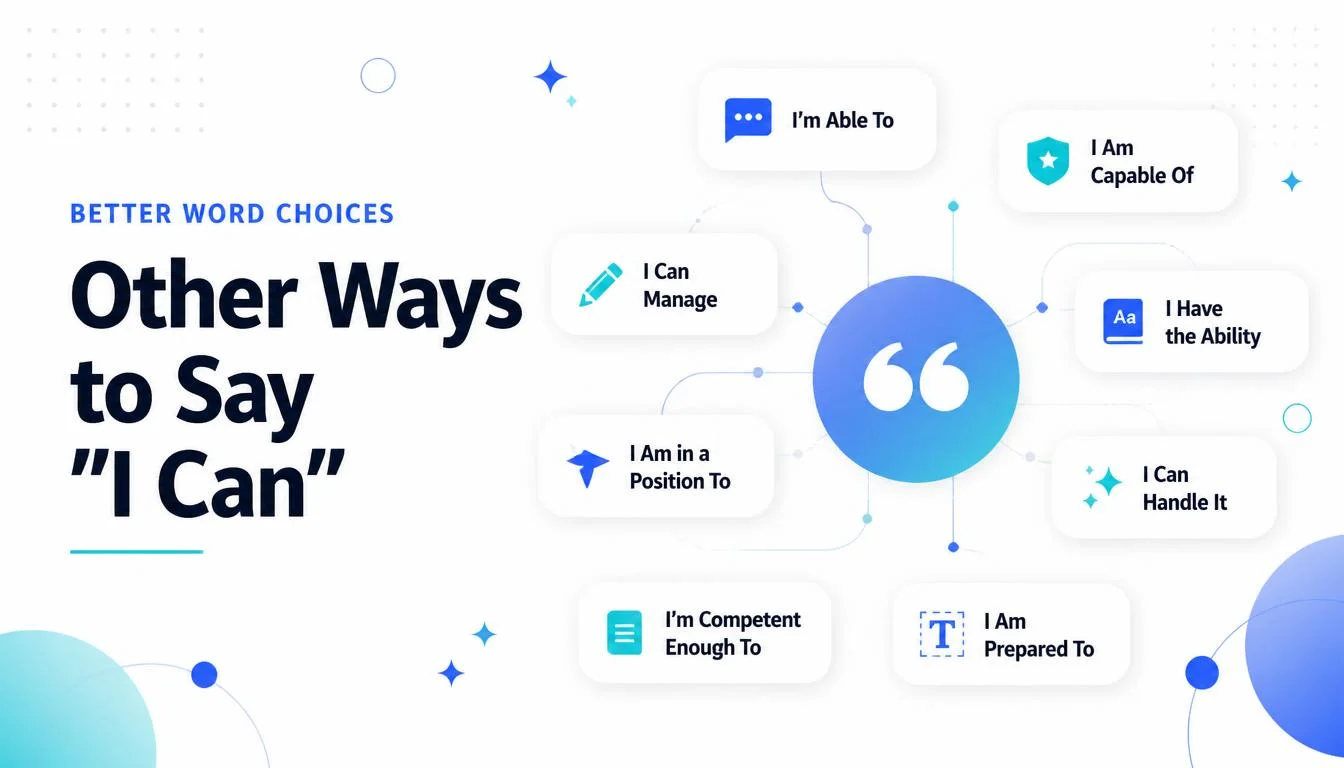
These selected phrases offer a preview of the 30 expressions explained in the full list below.
Formal alternatives to “I Can”
- I am able to
- I am capable of
- I would be pleased to
Pro Tip: Use formal alternatives when communicating with clients, senior colleagues, or unfamiliar professional contacts.
Casual alternatives
- I can do that
- I can manage
- I can give it a try
Pro Tip: Keep everyday conversations natural by choosing short expressions that match the level of certainty you genuinely feel.
Professional alternatives
- I can certainly
- I can take care of that
- I am confident I can
Pro Tip: In workplace communication, pair your commitment with a clear action or deadline.
Informal expressions
- Count me in
- I’ve got this
- I can handle it
Pro Tip: Save highly conversational expressions for situations where you already have a friendly relationship with the listener.
Formal and informal English aren’t about correctness. They’re about context.
Other Ways to Say i Can(Full List with Examples)
The following 30 alternatives help you communicate ability, willingness, confidence, and availability more precisely. Some are useful professional reaction phrases, while others are informal expressions in English for everyday situations.
1. Phrase: I Am Able To
Meaning: Having the ability to do something.
Explanation: A neutral, slightly more formal alternative that emphasizes capability.
Example Sentence: I am able to complete the report today.
Best Use: Formal communication
Worst Use: Casual banter
Tone: Neutral professional
Context Variability: Casual: moderate; professional: high; spoken: high.
2. Phrase: I Am Capable Of
Meaning: Having the necessary skills or capacity.
Explanation: Emphasizes competence, experience, or potential. Follow “capable of” with a noun or verb ending in -ing.
Example Sentence: I am capable of managing this project.
Best Use: Skills discussions
Worst Use: Simple requests
Tone: Confident formal
Context Variability: Casual: moderate; professional: high; spoken: high.
3. Phrase: I Can Certainly
Meaning: Being able to do something with confidence.
Explanation: Adds reassurance and a positive tone to an offer or commitment.
Example Sentence: I can certainly review your proposal.
Best Use: Client communication
Worst Use: Uncertain commitments
Tone: Polite confident
Context Variability: Casual: high; professional: high; spoken: high.
4. Phrase: I Would Be Happy To
Meaning: Being willing and pleased to help.
Explanation: Emphasizes willingness rather than technical ability. It is particularly useful when responding to requests.
Example Sentence: I would be happy to explain the process.
Best Use: Helpful responses
Worst Use: Reluctant offers
Tone: Warm professional
Context Variability: Casual: high; professional: high; spoken: high.
5. Phrase: I Can Manage
Meaning: Being able to handle a task or situation.
Explanation: Suggests that a task is within your capacity, even if it requires some effort.
Example Sentence: I can manage the additional workload.
Best Use: Workload discussions
Worst Use: Skill demonstrations
Tone: Calm practical
Context Variability: Casual: high; professional: high; spoken: high.
6. Phrase: I Can Handle It
Meaning: Being ready and able to deal with something.
Explanation: Communicates confidence and responsibility. Depending on delivery, it can sound reassuring or overly assertive.
Example Sentence: Thanks for offering, but I can handle it.
Best Use: Taking responsibility
Worst Use: Sensitive disagreements
Tone: Confident direct
Context Variability: Casual: high; professional: high; spoken: high.
7. Phrase: I Can Do That
Meaning: Being able to complete a requested action.
Explanation: A versatile, natural response to instructions, requests, or suggestions.
Example Sentence: You need the slides updated? I can do that.
Best Use: Everyday tasks
Worst Use: Formal declarations
Tone: Friendly direct
Context Variability: Casual: high; professional: high; spoken: high.
8. Phrase: I Am Confident I Can
Meaning: Believing strongly in your ability.
Explanation: Useful when discussing qualifications, responsibilities, or challenging assignments.
Example Sentence: I am confident I can meet the deadline.
Best Use: Job interviews
Worst Use: Unsupported claims
Tone: Assured professional
Context Variability: Casual: moderate; professional: high; spoken: high.
9. Phrase: I Can Take Care Of That
Meaning: Being willing to assume responsibility for something.
Explanation: Communicates ownership and reassures the listener that the task will be handled.
Example Sentence: I can take care of the booking.
Best Use: Task delegation
Worst Use: Unclear ownership
Tone: Helpful professional
Context Variability: Casual: high; professional: high; spoken: high.
10. Phrase: I Would Be Pleased To
Meaning: Being willing to do something with courtesy.
Explanation: A polished expression for formal correspondence, customer service, and respectful offers.
Example Sentence: I would be pleased to discuss the proposal.
Best Use: Formal offers
Worst Use: Casual chats
Tone: Courteous formal
Context Variability: Casual: low; professional: high; spoken: moderate.
11. Phrase: I Am Willing To
Meaning: Being prepared to do something.
Explanation: Emphasizes readiness or consent. It does not necessarily mean you are enthusiastic about the task.
Example Sentence: I am willing to work additional hours.
Best Use: Negotiations
Worst Use: Enthusiastic offers
Tone: Neutral deliberate
Context Variability: Casual: moderate; professional: high; spoken: high.
12. Phrase: I Am Prepared To
Meaning: Being ready for a task or situation.
Explanation: Highlights readiness, planning, or acceptance of a possible challenge.
Example Sentence: I am prepared to answer your questions.
Best Use: Formal discussions
Worst Use: Unplanned tasks
Tone: Serious confident
Context Variability: Casual: moderate; professional: high; spoken: high.
13. Phrase: I Have The Ability To
Meaning: Possessing the capacity to perform an action.
Explanation: Makes capability explicit, particularly in formal descriptions of skills and qualifications.
Example Sentence: I have the ability to analyze complex information.
Best Use: Skills statements
Worst Use: Quick replies
Tone: Formal descriptive
Context Variability: Casual: low; professional: high; spoken: moderate.
14. Phrase: I Am In A Position To
Meaning: Having the circumstances or authority to act.
Explanation: Often refers to resources, status, or practical circumstances rather than skill alone.
Example Sentence: I am in a position to offer additional support.
Best Use: Business discussions
Worst Use: Simple chores
Tone: Diplomatic formal
Context Variability: Casual: low; professional: high; spoken: high.
15. Phrase: I Can Assist
Meaning: Being able to provide help.
Explanation: A concise professional expression suitable for service, support, and workplace conversations.
Example Sentence: I can assist with your application.
Best Use: Customer support
Worst Use: Intimate conversations
Tone: Polite professional
Context Variability: Casual: moderate; professional: high; spoken: high.
16. Phrase: I Can Support
Meaning: Being able to help someone or contribute to a goal.
Explanation: Often describes ongoing help, teamwork, or backing for a proposal.
Example Sentence: I can support the team during implementation.
Best Use: Team collaboration
Worst Use: Solo tasks
Tone: Cooperative professional
Context Variability: Casual: moderate; professional: high; spoken: high.
17. Phrase: I Can Confirm
Meaning: Being able to verify or officially state information.
Explanation: Appropriate when you have reliable information and want to provide a clear assurance.
Example Sentence: I can confirm that your payment was received.
Best Use: Official updates
Worst Use: Unverified claims
Tone: Formal assured
Context Variability: Casual: moderate; professional: high; spoken: high.
18. Phrase: I Can Arrange That
Meaning: Being able to organize something.
Explanation: Suggests that you can coordinate details, bookings, schedules, or resources.
Example Sentence: I can arrange a meeting for next week.
Best Use: Scheduling tasks
Worst Use: Uncontrollable events
Tone: Helpful professional
Context Variability: Casual: high; professional: high; spoken: high.
19. Phrase: I Can Provide
Meaning: Being able to supply something needed.
Explanation: Commonly introduces information, documents, resources, or services.
Example Sentence: I can provide the requested documentation.
Best Use: Business correspondence
Worst Use: Personal emotions
Tone: Neutral formal
Context Variability: Casual: moderate; professional: high; spoken: high.
20. Phrase: I Can Offer
Meaning: Being able to present help, advice, or a possible solution.
Explanation: Emphasizes what you can contribute without suggesting that the listener must accept it.
Example Sentence: I can offer a few practical suggestions.
Best Use: Giving advice
Worst Use: Forced assistance
Tone: Considerate professional
Context Variability: Casual: high; professional: high; spoken: high.
21. Phrase: I Can Try
Meaning: Being willing to make an attempt.
Explanation: Useful when success is uncertain. It shows willingness without guaranteeing the result.
Example Sentence: I can try to fix the issue.
Best Use: Uncertain tasks
Worst Use: Guaranteed results
Tone: Cautious friendly
Context Variability: Casual: high; professional: high; spoken: high.
22. Phrase: I Can Give It A Try
Meaning: Being willing to attempt something.
Explanation: A conversational alternative that sounds approachable when learning or testing something new.
Example Sentence: I can give it a try this afternoon.
Best Use: New experiences
Worst Use: Formal commitments
Tone: Casual positive
Context Variability: Casual: high; professional: moderate; spoken: high.
23. Phrase: I Should Be Able To
Meaning: Expecting to be able to do something.
Explanation: Expresses reasonable confidence without making an absolute promise.
Example Sentence: I should be able to send the draft tomorrow.
Best Use: Tentative commitments
Worst Use: Firm guarantees
Tone: Cautious professional
Context Variability: Casual: high; professional: high; spoken: high.
24. Phrase: I May Be Able To
Meaning: Possibly having the ability or opportunity.
Explanation: Communicates uncertainty about availability, circumstances, or success.
Example Sentence: I may be able to join the call later.
Best Use: Uncertain availability
Worst Use: Firm commitments
Tone: Careful diplomatic
Context Variability: Casual: high; professional: high; spoken: high.
25. Phrase: I Am Available To
Meaning: Being free or ready to help.
Explanation: Emphasizes availability rather than skill. Follow it with a verb or suitable activity.
Example Sentence: I am available to discuss the issue this afternoon.
Best Use: Scheduling meetings
Worst Use: Skill descriptions
Tone: Polite professional
Context Variability: Casual: high; professional: high; spoken: high.
26. Phrase: Count Me In
Meaning: Agreeing to participate in an activity.
Explanation: An informal way to express willingness to join a plan, event, or group effort.
Example Sentence: Count me in for the volunteer project.
Best Use: Group activities
Worst Use: Formal applications
Tone: Enthusiastic casual
Context Variability: Casual: high; professional: moderate; spoken: high.
27. Phrase: I’ve Got This
Meaning: Feeling capable of handling a situation independently.
Explanation: A confident, conversational expression that can reassure others or motivate yourself.
Example Sentence: Don’t worry about the presentation. I’ve got this.
Best Use: Friendly reassurance
Worst Use: Formal reports
Tone: Confident informal
Context Variability: Casual: high; professional: low; spoken: high.
28. Phrase: Leave It To Me
Meaning: Asking someone to let you handle a task.
Explanation: Signals ownership and confidence. Use it only when you can reasonably take responsibility.
Example Sentence: Leave it to me, and I’ll contact the supplier.
Best Use: Taking ownership
Worst Use: Unclear authority
Tone: Assured conversational
Context Variability: Casual: high; professional: high; spoken: high.
29. Phrase: I Can Make It Happen
Meaning: Being confident about achieving a result.
Explanation: Communicates determination and a solution-focused attitude, especially in goal-oriented settings.
Example Sentence: Give me the requirements, and I can make it happen.
Best Use: Goal discussions
Worst Use: Unrealistic promises
Tone: Motivated assertive
Context Variability: Casual: high; professional: high; spoken: high.
30. Phrase: I Can Work With That
Meaning: Being able to proceed using the available option or conditions.
Explanation: Often expresses acceptance of a suggestion, compromise, or set of limitations.
Example Sentence: The revised schedule works for me. I can work with that.
Best Use: Practical compromises
Worst Use: Serious objections
Tone: Flexible collaborative
Context Variability: Casual: high; professional: high; spoken: high.
Comparison Table: Top 10 Alternatives at a Glance
| Phrase | Tone | Best Use |
|---|---|---|
| I am able to | Neutral, formal | Describing ability |
| I can certainly | Confident, polite | Responding to requests |
| I would be happy to | Warm, professional | Offering assistance |
| I can manage | Calm, practical | Discussing responsibilities |
| I can handle it | Confident, direct | Taking ownership |
| I can do that | Friendly, direct | Everyday tasks |
| I am confident I can | Assured, professional | Interviews and meetings |
| I can take care of that | Helpful, professional | Accepting responsibility |
| I can try | Cautious, friendly | Uncertain tasks |
| I should be able to | Careful, professional | Tentative commitments |
Quick Self-Check (Mini Quiz)
Test your understanding by choosing the phrase that best fits each situation.
1. Your manager asks you to review a document. You want to sound polite and helpful.
A. I’ve got this, obviously.
B. I would be happy to review it.
C. I may be able to, but I refuse to promise anything.
Correct answer: B. It communicates willingness in a professional, courteous way.
2. You are unsure whether you can attend a meeting tomorrow. What should you say?
A. I can definitely attend.
B. Count me in, no matter what.
C. I may be able to attend.
Correct answer: C. It communicates uncertainty without making a false commitment.
3. A friend invites you to join a fun activity. Which response sounds natural?
A. Count me in!
B. I am in a position to participate.
C. I have the ability to attend.
Correct answer: A. This informal expression communicates enthusiasm.
4. You want to explain your professional ability to manage a complex project. Which phrase is most suitable?
A. I’ve got this, whatever.
B. I am capable of managing complex projects.
C. I can give it a try, maybe.
Correct answer: B. It emphasizes competence and suits a professional discussion.
FAQs
1. What are the best alternatives to “I can”?
Some useful options are “I am able to,” “I can certainly,” “I would be happy to,” “I can manage,” and “I am capable of.” Choose according to your intended meaning.
2. How can I say “I can” professionally?
Use expressions such as “I can certainly assist,” “I would be pleased to,” or “I am confident I can complete the task.” Include a clear deadline when appropriate.
3. What is a formal way to say “I can”?
“I am able to” and “I am in a position to” are formal alternatives. “I would be pleased to” is particularly useful when expressing willingness politely.
4. What is the difference between “I can” and “I am able to”?
Both can express ability. “I can” is shorter and more conversational, while “I am able to” can place greater emphasis on capability or suitability for formal writing.
5. How can I avoid repeating “I can” in English?
Use alternatives that reflect your exact intention, such as “I can assist” for help, “I am capable of” for skill, and “I would be happy to” for willingness.
For more vocabulary practice, explore Other Ways to Say “Amazing.
Conclusion
Learning different expressions for ability and willingness helps you communicate more naturally in English. Although “i can” is correct in many situations, alternatives can make your message more precise, courteous, confident, or professional.
Practice using one or two new expressions each day. Pay attention to the listener, the setting, and the level of certainty your words communicate. Over time, selecting the right phrase will become easier in both conversation and writing.
Read More Related Articles:
- Other Ways to Say Courage | Powerful Words for Bravery In 2026
- Other Ways to Say Change | Say It Clearly and Naturally In 2026
- Other Ways to Say KYS | Less Offensive Ways to Express Frustration In 2026

Daniel Murphy is a professional writer and blogger specializing in digital communication and messaging trends. As a contributor to TextsResponse.com, he creates reader-focused content designed to help people find the right words at the right time.