Quick Answer
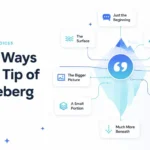
Other ways to say tip of the iceberg include just the beginning, the surface of a bigger issue, a small part of the whole, and only the start. These expressions suggest that much more remains hidden or undiscovered.
Learning other ways to say tip of the iceberg can make your English more expressive and help you communicate complex ideas clearly. Whether you are writing an essay, preparing a presentation, or speaking in everyday conversations, these alternatives help you describe situations where the visible part represents only a small portion of a much bigger picture.
The phrase “tip of the iceberg” is commonly used when discussing hidden problems, unexpected challenges, or larger situations that are not immediately obvious. Alternatives such as “just the beginning,” “the surface of a deeper problem,” and “a small piece of the puzzle” can help you vary your vocabulary and express your ideas naturally in both professional and casual settings.
What Is “Other Ways to Say Tip of the Iceberg”? Meaning, Grammar and Real Use
Imagine a company discovers a small accounting error during a routine review. At first, the mistake appears insignificant. However, further investigation reveals missing records, reporting problems, and several months of financial discrepancies. The original error was only the tip of the iceberg.
This familiar expression helps speakers and writers explain that a visible issue represents only a small part of something much larger. It is especially useful when discussing business challenges, research findings, personal experiences, and unexpected discoveries.
Learning other ways to say tip of the iceberg helps you avoid repetition and communicate the seriousness of a situation more accurately. Some alternatives emphasize hidden problems, while others suggest that an investigation or discussion has only just begun.
These expressions are useful for professional communication, academic writing, everyday conversation, and learning how to express excitement in English when a small discovery suggests something much more significant.
Meaning: The visible or known part of a situation is only a small portion of the whole.
Grammar: “Tip of the iceberg” is an idiomatic noun phrase. It commonly appears after the verb be, often with the article the.
Example: “The complaints we received are just the tip of the iceberg.”
People use this expression in both spoken and written English. It works in casual conversations and professional settings, although some alternatives provide greater precision in formal reports.
When Should You Use “Tip of the Iceberg”?
Choose this expression when you want to communicate that a visible detail reveals a much larger situation.
Common contexts include:
- Business problems: A few customer complaints may reveal widespread service issues.
- Academic research: Initial findings may point toward a much larger research question.
- Technology: One software error may indicate deeper system weaknesses.
- Personal experiences: A single disagreement may reveal an ongoing relationship problem.
- News and social issues: A reported incident may reflect broader structural challenges.
- Financial investigations: A small discrepancy may indicate extensive accounting problems.
- Everyday conversations: A few visible signs may suggest a more complicated situation.
Spoken vs. Written English
In conversation, “tip of the iceberg” sounds natural and is easy to understand. For example, you might tell a colleague, “These delays are just the tip of the iceberg.”
In formal writing, alternatives such as “one indication of a broader issue” or “a small part of a larger problem” may communicate the point more precisely.
Formal vs. Informal Usage
The original expression is acceptable in both formal and informal settings. However, its suitability depends on the surrounding sentence.
- Formal: “These findings represent only a small part of the broader challenge.”
- Informal: “This is just the beginning of a much bigger mess.”
- Professional: “The reported incidents may indicate a more extensive underlying issue.”
Is “Tip of the Iceberg” Professional or Just Polite?
“Tip of the iceberg” is both understandable and professionally acceptable. It is an established idiom, not merely a polite expression.
Politeness concerns how respectfully you communicate. Professionalism concerns whether your language suits the audience, purpose, and workplace situation.
Business example: “The initial customer complaints may be the tip of the iceberg, so we should investigate the underlying causes before implementing a solution.”
- Polite? ✔️ Yes
- Professional? ✔️ Yes
For executive reports, legal documents, or research papers, a more specific alternative may be preferable when you need to describe exactly what the evidence reveals.
Pros and Cons of Using “Tip of the Iceberg”
Pros
- Easy to understand: Most proficient English speakers recognize the expression.
- Creates a clear image: The visible tip suggests a much larger hidden structure.
- Works across contexts: It suits conversations, presentations, articles, and workplace discussions.
- Communicates significance: It signals that further investigation may uncover more information.
Cons
- Can be overused: Repeating the phrase may make your writing predictable.
- May sound dramatic: It can exaggerate the importance of a minor issue if used carelessly.
- Does not identify the hidden details: Readers may need more information about the larger problem.
- Can lack precision: Technical or academic writing may require a more specific description.
Common Mistakes People Make
The expression is straightforward, but learners sometimes use it incorrectly or choose it when a different phrase would be more accurate.
1. Using the phrase for a complete situation
Incorrect: “The report contains the tip of the iceberg, including every detail.”
Correct: “The report reveals the tip of the iceberg, with many details still unknown.”
The expression emphasizes the limited visible portion, not the complete picture.
2. Forgetting the article
Incorrect: “This is tip of the iceberg.”
Correct: “This is the tip of the iceberg.”
The standard idiom normally uses the before “tip.”
3. Assuming it always means a serious problem
Incorrect: “The first chapter is the tip of the iceberg of this wonderful book.”
Correct: “The first chapter offers a glimpse of the much larger story.”
The idiom often describes hidden problems or larger situations. A neutral alternative may work better for positive discoveries.
4. Using it without supporting details
Incorrect: “Our results are the tip of the iceberg.”
Correct: “Our results are the tip of the iceberg, as further testing has identified several additional issues.”
Explain what larger situation the visible evidence suggests.
5. Choosing an exaggerated alternative
Incorrect: “One late delivery proves a massive organizational failure.”
Correct: “One late delivery may indicate a broader logistical issue.”
Use measured language when the evidence is limited. A small sign can suggest a bigger problem without proving that one exists.
Small tone mistakes can make confident English sound careless.
Alternatives by Category
The best alternatives depend on whether you want to emphasize a hidden problem, an incomplete understanding, or the possibility of further discoveries.
Formal alternatives to “Tip of the Iceberg”
- One indication of a broader issue
- A small part of a larger problem
- An initial sign of a wider challenge
Pro Tip: In reports, connect the phrase to specific evidence rather than implying that a larger problem definitely exists.
Casual alternatives
- Just the beginning
- Only scratching the surface
- A small part of the picture
Pro Tip: Use conversational phrases when explaining a complicated situation to friends or colleagues in everyday discussions.
Professional alternatives
- An indication of underlying issues
- An early sign of a larger trend
- One piece of a bigger picture
Pro Tip: Choose an alternative that reflects whether your evidence suggests a problem, a pattern, or an incomplete understanding.
Informal expressions
- There’s more to the story
- There’s a lot more going on
- That’s only part of it
Pro Tip: Use these expressions in conversations where a natural, approachable tone matters more than technical precision.
Formal and informal English aren’t about correctness. They’re about context.
Other Ways to Say “Tip of the Iceberg”: 30 Alternatives with Examples
These 30 alternatives help you describe hidden problems, incomplete information, and larger situations without repeating the same idiom. Each expression has a slightly different meaning, so choose one that fits your intended message.
1. Phrase: Just the Beginning
Meaning: The first stage of something larger.
Explanation: Suggests that more developments or events are expected.
Example Sentence: “The first successful launch is just the beginning.”
Best Use: Future developments
Worst Use: Final outcomes
Tone: Optimistic, neutral
Context Variability: Casual / professional / spoken
2. Phrase: Only Scratching the Surface
Meaning: Exploring something without reaching its deeper aspects.
Explanation: Emphasizes that much remains to be investigated or understood.
Example Sentence: “Our initial research is only scratching the surface.”
Best Use: Ongoing research
Worst Use: Complete analysis
Tone: Neutral, explanatory
Context Variability: Casual / professional / spoken
3. Phrase: A Small Part of a Larger Problem
Meaning: One element of a more extensive difficulty.
Explanation: A direct alternative that works well in reports and discussions.
Example Sentence: “The delayed shipment is a small part of a larger problem.”
Best Use: Business reports
Worst Use: Casual greetings
Tone: Formal, direct
Context Variability: Professional / written / spoken
4. Phrase: A Glimpse of the Bigger Picture
Meaning: A brief view of a wider situation.
Explanation: Focuses on gaining an initial understanding of something more extensive.
Example Sentence: “These interviews offer a glimpse of the bigger picture.”
Best Use: Initial findings
Worst Use: Final conclusions
Tone: Thoughtful, neutral
Context Variability: Casual / professional / written
5. Phrase: The Beginning of a Much Bigger Problem
Meaning: An early indication of a more serious difficulty.
Explanation: Use when a small issue may develop into something more significant.
Example Sentence: “The missed deadline could be the beginning of a much bigger problem.”
Best Use: Emerging risks
Worst Use: Minor updates
Tone: Cautionary, serious
Context Variability: Professional / casual / spoken
6. Phrase: One Piece of a Bigger Picture
Meaning: One element of a larger situation.
Explanation: Highlights that an individual detail cannot explain the entire situation.
Example Sentence: “Customer feedback is one piece of a bigger picture.”
Best Use: Strategic planning
Worst Use: Isolated facts
Tone: Analytical, neutral
Context Variability: Professional / casual / written
7. Phrase: An Indication of Underlying Issues
Meaning: A sign that deeper problems may exist.
Explanation: A measured phrase suitable for professional analysis.
Example Sentence: “The repeated errors are an indication of underlying issues.”
Best Use: Workplace analysis
Worst Use: Friendly banter
Tone: Formal, analytical
Context Variability: Professional / written / spoken
8. Phrase: A Sign of Something Bigger
Meaning: Evidence that a situation may be more extensive than it appears.
Explanation: Simple wording that leaves room for further investigation.
Example Sentence: “The unusual activity may be a sign of something bigger.”
Best Use: Early warnings
Worst Use: Proven conclusions
Tone: Conversational, cautious
Context Variability: Casual / professional / spoken
9. Phrase: There’s More to the Story
Meaning: The available information does not explain everything.
Explanation: Suggests that additional details or context remain undiscovered.
Example Sentence: “Before we judge the decision, remember there’s more to the story.”
Best Use: Missing context
Worst Use: Technical summaries
Tone: Conversational, thoughtful
Context Variability: Casual / spoken / professional
10. Phrase: A Small Part of the Picture
Meaning: A limited portion of a larger situation.
Explanation: A flexible alternative when you want to avoid suggesting a serious problem.
Example Sentence: “These survey results represent a small part of the picture.”
Best Use: Data discussions
Worst Use: Complete summaries
Tone: Neutral, clear
Context Variability: Casual / professional / written
11. Phrase: An Early Warning Sign
Meaning: An initial indication of possible future trouble.
Explanation: Emphasizes prevention and the need to pay attention.
Example Sentence: “Rising customer complaints are an early warning sign.”
Best Use: Risk assessment
Worst Use: Positive announcements
Tone: Cautious, serious
Context Variability: Professional / written / spoken
12. Phrase: The Surface of a Deeper Issue
Meaning: The visible aspect of a more complicated problem.
Explanation: Highlights the difference between observable symptoms and underlying causes.
Example Sentence: “The disagreement was the surface of a deeper issue.”
Best Use: Root-cause analysis
Worst Use: Simple instructions
Tone: Analytical, serious
Context Variability: Professional / casual / written
13. Phrase: A Symptom of a Larger Problem
Meaning: A visible sign of an underlying difficulty.
Explanation: Particularly useful when a specific issue may result from a broader cause.
Example Sentence: “High employee turnover may be a symptom of a larger problem.”
Best Use: Organizational reviews
Worst Use: Unrelated events
Tone: Analytical, professional
Context Variability: Professional / written / spoken
14. Phrase: An Initial Sign of a Wider Challenge
Meaning: Early evidence of a broader difficulty.
Explanation: A diplomatic alternative for presentations and formal discussions.
Example Sentence: “The budget shortfall is an initial sign of a wider challenge.”
Best Use: Formal presentations
Worst Use: Casual storytelling
Tone: Diplomatic, formal
Context Variability: Professional / written / spoken
15. Phrase: The First Layer of a Complex Issue
Meaning: The earliest or most visible level of a complicated matter.
Explanation: Useful when a problem requires several stages of investigation.
Example Sentence: “The audit uncovered the first layer of a complex issue.”
Best Use: Detailed investigations
Worst Use: Simple questions
Tone: Analytical, formal
Context Variability: Professional / written / spoken
16. Phrase: A Fraction of the Whole
Meaning: A very small portion of a complete amount or situation.
Explanation: Emphasizes how limited the available information or visible portion is.
Example Sentence: “The figures represent only a fraction of the whole.”
Best Use: Quantitative analysis
Worst Use: Emotional reassurance
Tone: Precise, neutral
Context Variability: Professional / written / spoken
17. Phrase: A Small Piece of a Larger Puzzle
Meaning: One detail that contributes to understanding a complex situation.
Explanation: Suggests that other details are needed to understand the whole.
Example Sentence: “This discovery is a small piece of a larger puzzle.”
Best Use: Problem-solving
Worst Use: Final decisions
Tone: Thoughtful, analytical
Context Variability: Casual / professional / written
18. Phrase: An Early Indication of a Larger Trend
Meaning: An initial sign of a pattern that may continue or expand.
Explanation: Particularly effective in market research and data analysis.
Example Sentence: “The early sales figures may be an indication of a larger trend.”
Best Use: Trend analysis
Worst Use: Unsupported predictions
Tone: Analytical, professional
Context Variability: Professional / written / spoken
19. Phrase: A Warning of Deeper Trouble
Meaning: A sign that more serious difficulties may follow.
Explanation: Stronger than a neutral observation and suitable for serious concerns.
Example Sentence: “The repeated security failures are a warning of deeper trouble.”
Best Use: Security concerns
Worst Use: Minor successes
Tone: Serious, cautionary
Context Variability: Professional / casual / written
20. Phrase: The Visible Part of a Much Larger Issue
Meaning: The portion that can currently be observed.
Explanation: Clearly contrasts known information with a potentially larger situation.
Example Sentence: “The public complaints are the visible part of a much larger issue.”
Best Use: Public reports
Worst Use: Informal greetings
Tone: Formal, analytical
Context Variability: Professional / written / spoken
21. Phrase: A Sign of Deeper Problems
Meaning: Evidence that more fundamental difficulties may exist.
Explanation: A concise alternative for discussions about causes and consequences.
Example Sentence: “Frequent staff absences may be a sign of deeper problems.”
Best Use: Workplace reviews
Worst Use: Celebratory speeches
Tone: Serious, direct
Context Variability: Professional / casual / spoken
22. Phrase: The Tip of a Much Larger Problem
Meaning: The first visible portion of a more extensive difficulty.
Explanation: A variation of the original idiom that emphasizes the problem’s potential scale.
Example Sentence: “The missing invoices may be the tip of a much larger problem.”
Best Use: Financial concerns
Worst Use: Positive feedback
Tone: Cautionary, direct
Context Variability: Professional / written / spoken
23. Phrase: There’s a Lot More Going On
Meaning: The situation is more complicated than it appears.
Explanation: Natural conversational wording that suggests hidden factors.
Example Sentence: “There’s a lot more going on than the initial report suggests.”
Best Use: Casual discussions
Worst Use: Formal reports
Tone: Informal, explanatory
Context Variability: Casual / spoken / professional
24. Phrase: That’s Only Part of It
Meaning: The information provided is incomplete.
Explanation: A short response when you know additional details that change the overall picture.
Example Sentence: “The repair costs are high, but that’s only part of it.”
Best Use: Everyday explanations
Worst Use: Formal documentation
Tone: Casual, direct
Context Variability: Casual / spoken / professional
25. Phrase: An Indicator of a Broader Issue
Meaning: A measurable or observable sign of a more extensive concern.
Explanation: Useful in reports because it sounds measured and evidence-focused.
Example Sentence: “The declining retention rate is an indicator of a broader issue.”
Best Use: Business analysis
Worst Use: Casual greetings
Tone: Formal, analytical
Context Variability: Professional / written / spoken
26. Phrase: A Clue to a Bigger Problem
Meaning: A detail that suggests a larger difficulty may exist.
Explanation: Emphasizes investigation rather than certainty.
Example Sentence: “The inconsistent records may be a clue to a bigger problem.”
Best Use: Investigative work
Worst Use: Final verdicts
Tone: Curious, cautious
Context Variability: Casual / professional / spoken
27. Phrase: The First Sign of a Larger Pattern
Meaning: An early example of a recurring situation.
Explanation: Appropriate when one event may be connected to similar events.
Example Sentence: “This complaint could be the first sign of a larger pattern.”
Best Use: Pattern recognition
Worst Use: Isolated incidents
Tone: Analytical, cautious
Context Variability: Professional / written / spoken
28. Phrase: An Opening Look at a Much Bigger Issue
Meaning: An initial view of a more extensive subject.
Explanation: Useful when preliminary findings introduce a topic that needs deeper exploration.
Example Sentence: “The preliminary study provides an opening look at a much bigger issue.”
Best Use: Preliminary research
Worst Use: Final reports
Tone: Formal, explanatory
Context Variability: Professional / written / spoken
29. Phrase: Only the Surface
Meaning: The visible or immediately apparent part of something.
Explanation: A concise expression for situations where deeper details remain unknown.
Example Sentence: “What we have discovered so far is only the surface.”
Best Use: Brief explanations
Worst Use: Detailed analysis
Tone: Neutral, conversational
Context Variability: Casual / spoken / professional
30. Phrase: One Indication of a Broader Issue
Meaning: A single sign suggesting a wider concern.
Explanation: A careful, professional phrase that avoids presenting preliminary evidence as proof.
Example Sentence: “The increase in complaints is one indication of a broader issue.”
Best Use: Executive reports
Worst Use: Casual greetings
Tone: Formal, measured
Context Variability: Professional / written / spoken
Comparison Table: Top 10 Alternatives at a Glance
| Phrase | Tone | Best Use |
|---|---|---|
| Just the beginning | Neutral | Future developments |
| Only scratching the surface | Explanatory | Research |
| A small part of a larger problem | Formal | Business reports |
| A glimpse of the bigger picture | Thoughtful | Initial findings |
| An indication of underlying issues | Analytical | Workplace analysis |
| There’s more to the story | Conversational | Missing context |
| An early warning sign | Cautionary | Risk assessment |
| A symptom of a larger problem | Professional | Root-cause analysis |
| A small piece of a larger puzzle | Analytical | Problem-solving |
| One indication of a broader issue | Formal | Executive reports |
Quick Self-Check: Mini Quiz
Test your understanding by choosing the most suitable expression for each situation.
Question 1
Your company discovers several small accounting errors, and the team suspects more serious discrepancies.
Which expression fits best?
A. That’s the end of the story.
B. The errors may be a sign of deeper problems.
C. Everything is under control.
Correct answer: B. It communicates concern without claiming that further problems have already been proven.
Question 2
You are writing a research paper and want to explain that your preliminary findings do not cover the entire subject.
A. Our research is only scratching the surface.
B. Our research has answered every question.
C. Our research is completely unrelated.
Correct answer: A. This phrase communicates that more research is needed.
Question 3
A colleague asks whether a few customer complaints represent the full extent of a service problem. You know more issues are being investigated.
A. There’s more to the story.
B. That’s the final answer.
C. Nothing else matters.
Correct answer: A. It naturally signals that the available information is incomplete.
Question 4
You are preparing a formal executive report and want to describe a possible connection between falling retention rates and broader organizational challenges.
A. There’s a lot more going on.
B. One indication of a broader issue.
C. That’s only part of it.
Correct answer: B. It is measured, concise, and suitable for professional writing.
FAQs
1. What are the best alternatives to “tip of the iceberg”?
Some of the best options are “only scratching the surface,” “just the beginning,” “a small part of a larger problem,” and “an indication of underlying issues.” Choose according to the context.
2. What is a formal way to say “tip of the iceberg”?
Use “one indication of a broader issue,” “the visible part of a much larger issue,” or “an initial sign of a wider challenge” in formal reports and presentations.
3. Can I use “tip of the iceberg” in professional writing?
Yes. It is a widely understood idiom that works in workplace communication. For technical reports, consider a more precise alternative that identifies the evidence or underlying concern.
4. What is the difference between “tip of the iceberg” and “scratching the surface”?
“Tip of the iceberg” describes a small visible part of a larger situation. “Scratching the surface” means that an investigation or discussion has not yet explored the subject deeply.
5. How can I avoid repeating “tip of the iceberg” in an essay?
Rotate between precise alternatives such as “a symptom of a larger problem,” “a small part of the picture,” and “an early indication of a larger trend.” Match each phrase to your argument.
Conclusion
Learning other ways to say tip of the iceberg makes your English more precise, flexible, and effective. You can use conversational expressions to explain everyday situations and formal alternatives to discuss complex issues in professional reports. The most important skill is recognizing whether you are describing a hidden problem, an emerging trend, or simply incomplete information.
Practice using one new expression each day. Write an example, say it aloud, and consider whether it sounds natural in your intended context.
Read More Related Articles:
- Other Ways to Say Coffee | Unique Words for Your Favorite Brew In 2026
- Other Ways to Say Calm | Words for a Peaceful, Relaxed Tone In 2026
- Other Ways to Say Of Course | When You Want Better Word Choices In 2026

Daniel Murphy is a professional writer and blogger specializing in digital communication and messaging trends. As a contributor to TextsResponse.com, he creates reader-focused content designed to help people find the right words at the right time.