Quick Answer
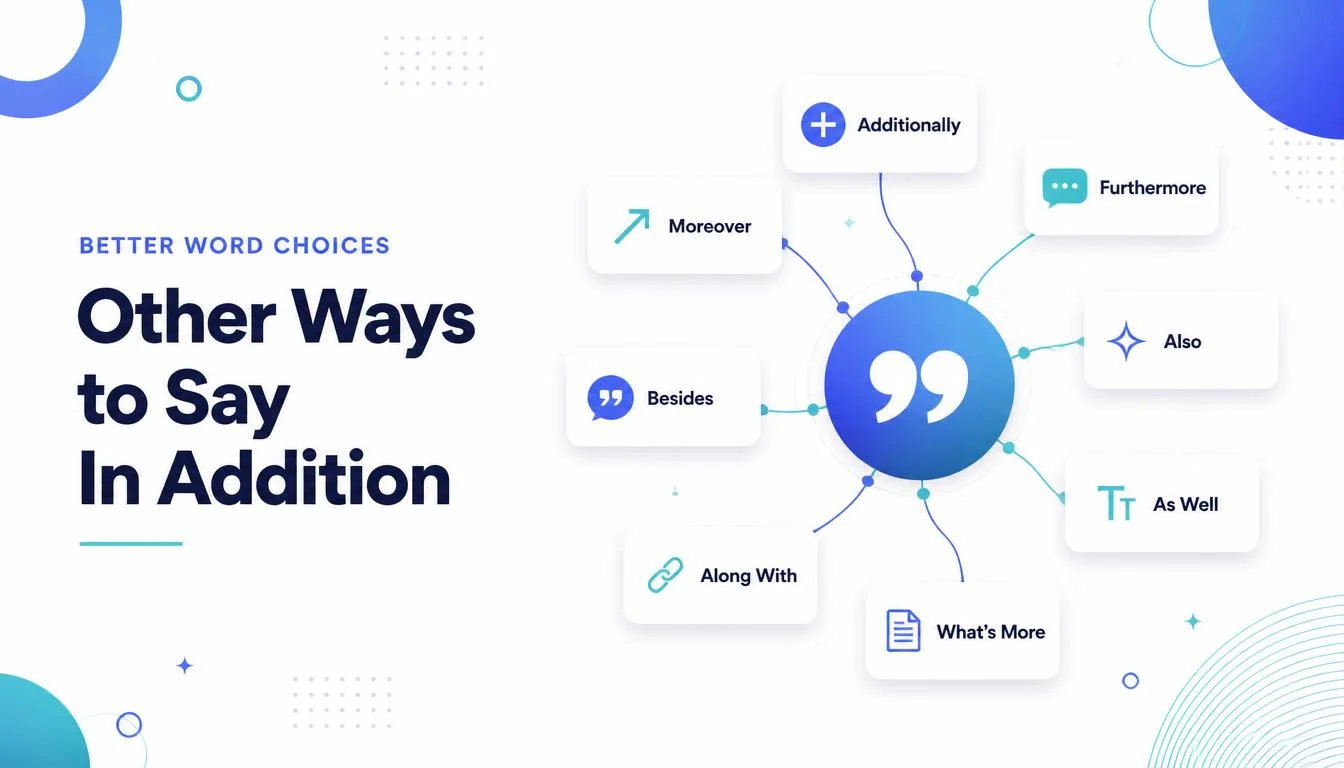
Other ways to say “in addition” include furthermore, moreover, additionally, also, besides, as well, on top of that, and what’s more.
Looking for other ways to say in addition? Whether you’re writing an essay, preparing a professional email, or having a conversation, using alternative expressions can make your English sound more natural, clear, and engaging.
In this guide, you’ll discover useful other ways to say in addition for both formal and informal situations. These alternatives will help you connect ideas smoothly, avoid repetition, and communicate more confidently in everyday and professional English.
What Is “In Addition”? (Meaning, Grammar & Real Use)
Imagine writing a business email where you need to explain that a project is progressing well and mention another achievement. Instead of repeating “in addition” throughout the message, you can use expressions such as “furthermore,” “moreover,” or “also” to connect your ideas naturally. These small changes make your writing easier to follow and more engaging.
Learning alternatives to “in addition” helps English learners improve their vocabulary, sentence structure, and communication skills. Whether you are preparing an academic essay, writing a professional email, or participating in a conversation, choosing the right transition can make your message clearer. Although phrases used to express excitement in English often communicate emotions, additive expressions help you introduce extra information and develop your ideas logically.
Definition
“In addition” is a transitional expression used to introduce extra information, another point, or an additional item related to something already mentioned.
Grammar Note
“In addition” functions as an adverbial phrase and is commonly used at the beginning of a sentence or clause. It is generally followed by a comma when it introduces a sentence.
Example: The course improves writing skills. In addition, it strengthens communication abilities.
Where and Why People Use It
- Academic writing: To add supporting arguments or evidence.
- Professional communication: To introduce extra details in reports, emails, and presentations.
- Everyday conversations: To mention another relevant point.
- Business writing: To present additional benefits, features, or requirements.
When Should You Use “In Addition”?
Use this expression when you want to add information that supports or extends a previous statement.
Common Contexts
- Adding another reason to support an argument.
- Introducing an extra benefit or feature.
- Expanding on an explanation or idea.
- Listing additional requirements or responsibilities.
- Connecting related points in a presentation.
Spoken vs. Written English
Spoken: “The restaurant has excellent food. In addition, the service is wonderful.”
Written: “The proposal reduces operating costs. In addition, it improves workflow efficiency.”
Formal vs. Informal English
Formal: “In addition, the findings suggest a need for further research.”
Informal: “We can watch a movie. Also, we could order dinner.”
Is It Professional or Just Polite?
“In addition” is both polite and professional. It is a neutral expression that works well in business emails, academic writing, reports, and presentations.
Politeness: It introduces information without sounding demanding or confrontational.
Professionalism: It creates a logical connection between ideas and helps organize information clearly.
Business-Style Example
“The revised proposal reduces production costs. In addition, it improves delivery efficiency.”
Polite? ✔️ Yes
Professional? ✔️ Yes
Pros and Cons of Using “In Addition”
Pros
- Simple and natural: Easy to understand and use in different situations.
- Professional tone: Suitable for business and academic communication.
- Common usage: Widely recognized in written and spoken English.
- Easy to understand: Clearly signals that more information is coming.
Cons
- Can sound repetitive: Frequent use may make writing monotonous.
- Limited emotional range: Primarily adds information rather than expressing feelings.
- May sound formal: Can feel slightly stiff in casual conversations.
- Requires logical connection: The additional information should relate to the previous point.
Common Mistakes People Make
Avoid these five common errors when using additive expressions.
1. Using “In Addition” Without a Clear Connection
Incorrect: The weather is sunny. In addition, my shoes are blue.
Correct: The weather is sunny. In addition, the forecast predicts warm temperatures.
2. Confusing “In Addition” With “In Addition To”
Incorrect: In addition to, the company hired five employees.
Correct: In addition, the company hired five employees.
3. Forgetting the Comma After a Sentence-Initial Transition
Incorrect: In addition the team completed the project early.
Correct: In addition, the team completed the project early.
4. Using “As Well As” Incorrectly
Incorrect: As well as, the company offers training.
Correct: The company offers training as well as career guidance.
5. Repeating the Same Transition Too Often
Incorrect: The plan saves money. In addition, it saves time. In addition, it improves efficiency.
Correct: The plan saves money. Furthermore, it saves time and improves efficiency.
“Small tone mistakes can make confident English sound careless.”
Alternatives by Category
These categories offer a curated preview of the full list below. Each expression appears again with its meaning, explanation, and example sentence.
Formal alternatives to “In Addition”
- Furthermore
- Moreover
- Additionally
- In conjunction with
Pro Tip: Use formal transitions in reports and academic writing when you want to build a clear, logical argument.
Casual alternatives
- Also
- Plus
- On top of that
- Another thing is
Pro Tip: Choose conversational expressions for everyday discussions, but avoid overly casual wording in formal documents.
Professional alternatives
- Additionally
- Furthermore
- Along with that
- In addition to that
Pro Tip: In workplace communication, select transitions that make your next point easy to identify.
Informal expressions
- Plus
- What’s more
- Besides
- Not only that
Pro Tip: Use informal expressions in English to keep conversations relaxed while ensuring the extra information remains relevant.
“Formal and informal English aren’t about correctness. They’re about context.”
Other Ways to Say “In Addition” (Full List With Examples)
These 30 alternatives will help you build fluency and connect ideas naturally in different situations. Choose the expression that matches your tone, audience, and purpose.
1. Phrase: Additionally
Meaning: Introduces extra information.
Explanation: A versatile alternative for adding another point.
Example Sentence: Additionally, the company offers flexible working hours.
Best Use: Professional writing
Worst Use: Casual chat
Tone: Neutral, polished
Context Variability: Casual: Additionally, we need snacks. Professional: Additionally, the report includes forecasts. Spoken: Additionally, we offer support.
2. Phrase: Furthermore
Meaning: Adds a supporting or related point.
Explanation: Often strengthens an argument or explanation.
Example Sentence: Furthermore, the new system reduces processing time.
Best Use: Formal writing
Worst Use: Casual conversation
Tone: Formal, persuasive
Context Variability: Casual: Furthermore, we need supplies. Professional: Furthermore, the strategy improves efficiency. Spoken: Furthermore, the results look promising.
3. Phrase: Moreover
Meaning: Introduces another relevant point.
Explanation: Often emphasizes an additional reason or benefit.
Example Sentence: Moreover, the service is available around the clock.
Best Use: Academic arguments
Worst Use: Relaxed chat
Tone: Formal, emphatic
Context Variability: Casual: Moreover, we have time. Professional: Moreover, the policy reduces risk. Spoken: Moreover, the results support our proposal.
4. Phrase: Also
Meaning: Adds another fact or detail.
Explanation: A simple, flexible alternative used in everyday English.
Example Sentence: The course also includes practical exercises.
Best Use: Everyday communication
Worst Use: Formal repetition
Tone: Neutral, natural
Context Variability: Casual: I also need coffee. Professional: We also provide training. Spoken: She also joined us.
5. Phrase: As Well
Meaning: Indicates that something is included too.
Explanation: Usually appears at the end of a clause or sentence.
Example Sentence: The package includes free installation as well.
Best Use: Casual communication
Worst Use: Formal openings
Tone: Friendly, neutral
Context Variability: Casual: I want dessert as well. Professional: The service includes maintenance as well. Spoken: We can invite Sara as well.
6. Phrase: As Well As
Meaning: Connects an additional person, thing, or activity.
Explanation: Usually links related nouns or phrases within a sentence.
Example Sentence: The role requires communication skills as well as technical knowledge.
Best Use: Connecting items
Worst Use: Sentence openings
Tone: Neutral, professional
Context Variability: Casual: We bought fruit as well as bread. Professional: The role requires planning as well as leadership. Spoken: She teaches English as well as science.
7. Phrase: Plus
Meaning: Introduces an additional point or benefit.
Explanation: Common in conversation and informal writing.
Example Sentence: The apartment is affordable, plus it is close to work.
Best Use: Casual discussions
Worst Use: Formal reports
Tone: Conversational, upbeat
Context Variability: Casual: Plus, the food is great. Professional: The plan saves time, plus it lowers costs. Spoken: Plus, we have extra space.
8. Phrase: On Top of That
Meaning: Introduces another point, often an extra benefit or problem.
Explanation: Adds emphasis to information already mentioned.
Example Sentence: The project is behind schedule. On top of that, the budget is limited.
Best Use: Everyday emphasis
Worst Use: Academic writing
Tone: Conversational, emphatic
Context Variability: Casual: On top of that, it was raining. Professional: On top of that, the team faces delays. Spoken: On top of that, we need approval.
9. Phrase: What’s More
Meaning: Introduces another important or interesting point.
Explanation: Often highlights an extra advantage or supporting detail.
Example Sentence: The software is easy to use. What’s more, it is free.
Best Use: Persuasive writing
Worst Use: Technical documents
Tone: Engaging, positive
Context Variability: Casual: What’s more, we have tickets. Professional: What’s more, the service is scalable. Spoken: What’s more, everyone agreed.
10. Phrase: Besides
Meaning: Introduces an additional reason or consideration.
Explanation: Can add supporting information or offer another reason.
Example Sentence: Besides being affordable, the course is highly practical.
Best Use: Supporting reasons
Worst Use: Formal transitions
Tone: Conversational, explanatory
Context Variability: Casual: Besides, we have time. Professional: Besides reducing costs, the plan improves output. Spoken: Besides, I already finished.
11. Phrase: In Addition To That
Meaning: Introduces another related detail.
Explanation: A slightly longer form that emphasizes an extra point.
Example Sentence: In addition to that, we provide free customer support.
Best Use: Clear explanations
Worst Use: Concise writing
Tone: Neutral, professional
Context Variability: Casual: In addition to that, we need milk. Professional: In addition to that, the contract includes support. Spoken: In addition to that, we offer training.
12. Phrase: Along With That
Meaning: Introduces something that accompanies another item or action.
Explanation: Commonly connects related services, tasks, or features.
Example Sentence: Along with that, the team will receive additional training.
Best Use: Related details
Worst Use: Formal arguments
Tone: Neutral, conversational
Context Variability: Casual: Along with that, bring your notebook. Professional: Along with that, employees receive mentoring. Spoken: Along with that, we need approval.
13. Phrase: Not Only That
Meaning: Introduces another point that adds emphasis.
Explanation: Often highlights an extra benefit or surprising detail.
Example Sentence: The service is affordable. Not only that, it is available 24 hours a day.
Best Use: Emphatic statements
Worst Use: Formal reports
Tone: Emphatic, engaging
Context Variability: Casual: Not only that, we got a discount. Professional: Not only that, the system improves accuracy. Spoken: Not only that, everyone enjoyed it.
14. Phrase: Another Point Is
Meaning: Introduces an additional idea or argument.
Explanation: Helps organize a discussion by signaling a new point.
Example Sentence: Another point is that the revised plan requires fewer resources.
Best Use: Structured discussions
Worst Use: Casual chat
Tone: Clear, neutral
Context Variability: Casual: Another point is that we are tired. Professional: Another point is that costs may increase. Spoken: Another point is that we need more time.
15. Phrase: Another Thing Is
Meaning: Introduces an extra detail or consideration.
Explanation: Common in informal conversations when adding a related thought.
Example Sentence: Another thing is that the office closes early on Fridays.
Best Use: Casual conversation
Worst Use: Formal writing
Tone: Conversational, natural
Context Variability: Casual: Another thing is, I forgot my keys. Professional: Another thing is that the deadline has changed. Spoken: Another thing is that we need supplies.
16. Phrase: To Add To That
Meaning: Introduces further information connected to a previous point.
Explanation: Emphasizes that the new detail builds on what was already said.
Example Sentence: To add to that, the team completed the work ahead of schedule.
Best Use: Discussions
Worst Use: Formal citations
Tone: Conversational, explanatory
Context Variability: Casual: To add to that, the food was delicious. Professional: To add to that, the proposal reduces risk. Spoken: To add to that, we have extra time.
17. Phrase: Beyond That
Meaning: Introduces information that goes further than the previous point.
Explanation: Often shifts from one benefit or consideration to another.
Example Sentence: Beyond that, the program offers opportunities for professional growth.
Best Use: Extended explanations
Worst Use: Simple lists
Tone: Neutral, thoughtful
Context Variability: Casual: Beyond that, everything was fine. Professional: Beyond that, the initiative supports innovation. Spoken: Beyond that, we need a decision.
18. Phrase: In Like Manner
Meaning: Indicates that something is done in a similar way.
Explanation: Adds a related point by highlighting similarity rather than simple addition.
Example Sentence: The first team completed the review. In like manner, the second team checked the final draft.
Best Use: Formal comparisons
Worst Use: Casual speech
Tone: Formal, technical
Context Variability: Casual: In like manner, we helped them. Professional: In like manner, both departments reviewed the policy. Spoken: In like manner, the teams responded.
19. Phrase: Equally Important
Meaning: Introduces another point of similar importance.
Explanation: Highlights the significance of the next idea.
Example Sentence: Equally important, the company must protect customer information.
Best Use: Key arguments
Worst Use: Minor details
Tone: Emphatic, professional
Context Variability: Casual: Equally important, we need rest. Professional: Equally important, the team must meet compliance standards. Spoken: Equally important, we should listen.
20. Phrase: More Importantly
Meaning: Introduces a point considered more significant than the previous one.
Explanation: Adds information while signaling a shift in priority.
Example Sentence: More importantly, the revised policy protects employee privacy.
Best Use: Prioritizing points
Worst Use: Equal details
Tone: Emphatic, analytical
Context Variability: Casual: More importantly, everyone is safe. Professional: More importantly, the proposal meets customer needs. Spoken: More importantly, we agree.
21. Phrase: On Another Note
Meaning: Introduces a different but related topic or point.
Explanation: Often signals a shift rather than a direct addition.
Example Sentence: On another note, the team meeting has been moved to Thursday.
Best Use: Topic transitions
Worst Use: Supporting evidence
Tone: Conversational, neutral
Context Variability: Casual: On another note, how was your trip? Professional: On another note, the budget review is tomorrow. Spoken: On another note, let’s discuss the schedule.
22. Phrase: Alongside
Meaning: Indicates that something exists or happens together with another thing.
Explanation: Often connects complementary activities, features, or responsibilities.
Example Sentence: Alongside technical training, employees receive communication workshops.
Best Use: Related activities
Worst Use: Standalone transitions
Tone: Neutral, professional
Context Variability: Casual: We served rice alongside vegetables. Professional: Alongside research, the team conducted interviews. Spoken: She works alongside experienced designers.
23. Phrase: Coupled With
Meaning: Indicates that one thing is combined with another.
Explanation: Often shows how two factors work together.
Example Sentence: Strong leadership, coupled with clear communication, improves teamwork.
Best Use: Combined factors
Worst Use: Casual lists
Tone: Analytical, formal
Context Variability: Casual: Exercise, coupled with rest, helps recovery. Professional: Innovation, coupled with investment, supports growth. Spoken: Experience, coupled with training, builds confidence.
24. Phrase: Together With
Meaning: Indicates that something accompanies or is combined with another thing.
Explanation: Commonly connects people, activities, or items.
Example Sentence: The report, together with the supporting documents, was submitted yesterday.
Best Use: Combined items
Worst Use: Sentence transitions
Tone: Neutral, formal
Context Variability: Casual: Bring your bag together with your books. Professional: The proposal, together with its budget, was approved. Spoken: She arrived together with her colleagues.
25. Phrase: In Conjunction With
Meaning: Indicates that something is done or used together with another thing.
Explanation: Common in formal and professional contexts involving coordinated activities.
Example Sentence: The campaign was developed in conjunction with the marketing team.
Best Use: Coordinated projects
Worst Use: Casual chat
Tone: Formal, technical
Context Variability: Casual: We worked in conjunction with our neighbors. Professional: The program runs in conjunction with local partners. Spoken: The teams worked in conjunction with each other.
26. Phrase: Added To That
Meaning: Introduces another detail or consideration.
Explanation: Highlights information that contributes to a previous point.
Example Sentence: Added to that, the new system is easier to maintain.
Best Use: Extra details
Worst Use: Formal reports
Tone: Conversational, neutral
Context Variability: Casual: Added to that, we need more chairs. Professional: Added to that, the system reduces errors. Spoken: Added to that, we have a deadline.
27. Phrase: As an Added Benefit
Meaning: Introduces an extra advantage.
Explanation: Highlights a positive feature beyond the main benefit.
Example Sentence: As an added benefit, employees receive access to online courses.
Best Use: Highlighting benefits
Worst Use: Negative details
Tone: Positive, professional
Context Variability: Casual: As an added benefit, parking is free. Professional: As an added benefit, the plan includes training. Spoken: As an added benefit, you get a discount.
28. Phrase: On That Note
Meaning: Introduces a point connected to the previous topic.
Explanation: Often transitions naturally to a related thought or next step.
Example Sentence: On that note, let’s review the next stage of the project.
Best Use: Smooth transitions
Worst Use: Technical evidence
Tone: Conversational, polished
Context Variability: Casual: On that note, let’s head home. Professional: On that note, we can begin the review. Spoken: On that note, I’d like to thank everyone.
29. Phrase: What’s Also Worth Mentioning
Meaning: Introduces another detail considered relevant or noteworthy.
Explanation: Draws attention to additional information that readers or listeners should notice.
Example Sentence: What’s also worth mentioning is that the service is available internationally.
Best Use: Extra observations
Worst Use: Concise writing
Tone: Informative, professional
Context Variability: Casual: What’s also worth mentioning is the great view. Professional: What’s also worth mentioning is the revised delivery date. Spoken: What’s also worth mentioning is the new feature.
30. Phrase: In the Same Vein
Meaning: Introduces a point that follows a similar line of thought.
Explanation: Connects related ideas, arguments, or observations.
Example Sentence: In the same vein, the second proposal emphasizes employee development.
Best Use: Related arguments
Worst Use: Unrelated topics
Tone: Formal, thoughtful
Context Variability: Casual: In the same vein, we should plan ahead. Professional: In the same vein, the report recommends further training. Spoken: In the same vein, we need better communication.
Comparison Table: Top 10 Alternatives at a Glance
| Phrase | Tone | Best Use |
|---|---|---|
| Additionally | Neutral, professional | Reports and emails |
| Furthermore | Formal, persuasive | Academic arguments |
| Moreover | Formal, emphatic | Supporting points |
| Also | Natural, neutral | Everyday communication |
| As well | Friendly, neutral | Casual additions |
| Plus | Conversational | Informal discussions |
| What’s more | Engaging, positive | Highlighting benefits |
| Besides | Conversational | Additional reasons |
| Along with that | Neutral, conversational | Related details |
| In addition to that | Professional, neutral | Expanded explanations |
Quick Self-Check (Mini Quiz)
Test your understanding with these four questions.
Question 1
Which phrase is most suitable for a formal academic essay?PlusFurthermoreAnother thing is
Question 2
You are chatting with a friend and want to add another benefit. Which phrase sounds natural?Pursuant toPlusIn conjunction with
Question 3
Which phrase introduces an additional benefit?As an added benefitOn another noteIn the same vein
Question 4
Which phrase is best for introducing a point that is more significant than the previous one?More importantlyAs wellAlongside
FAQs
1. What are the most common alternatives to “in addition”?
Common alternatives include “additionally,” “furthermore,” “moreover,” “also,” and “as well.” Each phrase adds information, but the best choice depends on context and tone.
2. What is a formal alternative to “in addition”?
“Furthermore,” “moreover,” and “additionally” are widely used in formal writing, academic essays, and professional reports.
3. How can I use alternatives to “in addition” in professional emails?
Use “additionally” to introduce extra details, “furthermore” to support an argument, and “along with that” for related information in a conversational business email.
4. Is “also” a good replacement for “in addition”?
Yes. “Also” is a natural, flexible alternative that works in both spoken and written English, although it is generally less formal.
5. What is the difference between “in addition” and “in addition to”?
“In addition” introduces an extra statement, while “in addition to” is followed by a noun, pronoun, or gerund to identify something extra.
conclusion
Learning alternatives to “in addition” helps you connect ideas more naturally, avoid repetitive writing, and communicate with greater confidence. Expressions such as “furthermore,” “also,” and “moreover” offer different levels of formality and emphasis.
Practice these expressions in emails, essays, presentations, and everyday conversations. Pay attention to tone and context so your transitions sound natural and your ideas remain clear.
Read More Related Articles:
- Other Ways to Say “From” in a Letter | For a More Professional Sign-Off In 2026
- Other Ways to Say Be Safe | Upgrade Your Farewells In 2026
- Other Ways to Say Feel Free | Formal Writing and Business Communication In 2026

Daniel Murphy is a professional writer and blogger specializing in digital communication and messaging trends. As a contributor to TextsResponse.com, he creates reader-focused content designed to help people find the right words at the right time.