Quick Answer
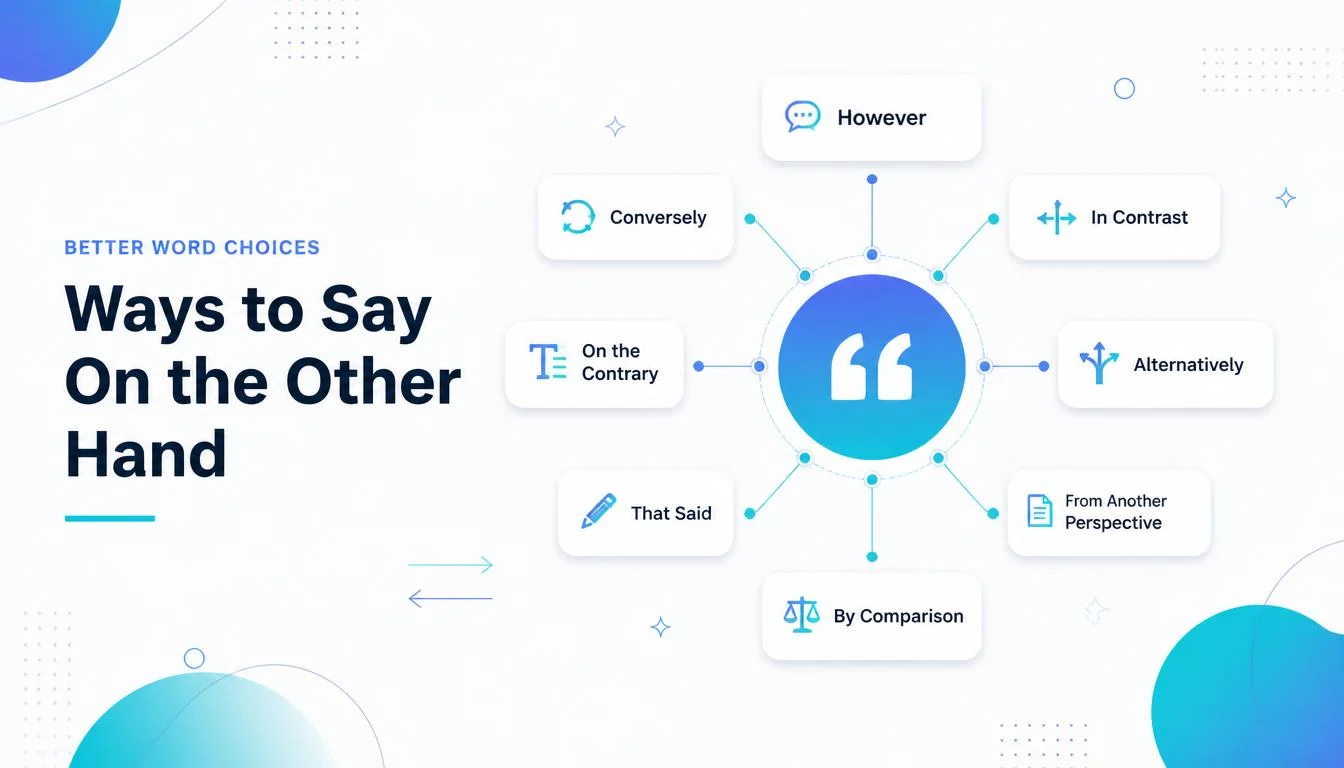
Other ways to say “on the other hand” include “however,” “in contrast,” “conversely,” “on the contrary,” and “alternatively.” These phrases help you express contrasting ideas clearly and naturally.
Knowing different ways to say on the other hand can help you make your writing more engaging and your conversations more fluent. Whether you’re writing an essay, preparing a professional email, or expressing an alternative viewpoint, using varied expressions makes your communication clearer and more effective.
In this guide, you’ll discover 30 ways to say on the other hand, along with their meanings and example sentences. These alternatives will help you express contrast, introduce a different perspective, and choose the right phrase for formal, academic, and everyday communication.
What Is “Ways to Say On the Other Hand”? (Meaning, Grammar & Real Use)
Imagine you are discussing whether to work from home or in an office. You might say, “Working from home saves commuting time. On the other hand, working in an office encourages teamwork.” This simple transition helps your audience understand that you are comparing two different perspectives.
Learning alternatives to “on the other hand” can make your English more flexible, especially when writing essays, preparing presentations, or participating in professional discussions. Expressions such as “in contrast,” “conversely,” and “however” help you present opposing ideas without repeating the same phrase. These alternatives to “on the other hand” also allow you to adjust your tone depending on the audience and context.
While some expressions help people express excitement in English, contrastive transitions serve a different purpose: they organize ideas and highlight differences. Whether you are writing a business report, explaining a decision, or sharing your opinion in a conversation, choosing the right transition makes your communication more coherent and engaging.
Meaning
“On the other hand” is a transitional phrase used to introduce a contrasting point, a different perspective, or an alternative to an idea previously mentioned.
It helps readers and listeners consider two sides of an issue.
Grammar Note
“On the other hand” is an idiomatic transitional phrase, not a conjunction. It commonly appears at the beginning of a sentence and is usually followed by a comma.
Example: The apartment is spacious. On the other hand, it is quite expensive.
It can also appear after a subject or within a sentence, depending on the structure.
Where and Why People Use It
- Academic writing: To compare arguments, theories, and research findings.
- Professional communication: To present different perspectives during meetings and reports.
- Everyday conversations: To explain the advantages and disadvantages of a choice.
- Persuasive writing: To acknowledge an opposing argument before presenting a conclusion.
When Should You Use “On the Other Hand”?
This expression is especially useful when you want to present a contrast without dismissing the first idea.
Common Contexts
- Comparing the advantages and disadvantages of two options.
- Explaining different opinions about a topic.
- Highlighting a drawback after describing a benefit.
- Presenting an alternative perspective in a discussion.
- Balancing positive and negative aspects in an essay or report.
Spoken vs. Written English
Spoken: “The restaurant is beautiful. On the other hand, the food is quite expensive.”
Written: “The proposed strategy could improve productivity. On the other hand, it may require substantial investment.”
Formal vs. Informal English
Formal: “The proposed approach offers greater flexibility. Conversely, it may increase operational complexity.”
Informal: “The trip sounds exciting. On the flip side, it could be expensive.”
Is It Professional or Just Polite?
“On the other hand” is both polite and professional in most contexts. It is a neutral transition that allows you to introduce a contrasting idea without sounding confrontational.
However, in highly formal writing, expressions such as “conversely,” “in contrast,” or “by contrast” may provide a more concise or precise transition.
Business-Style Example
“The new software may reduce administrative work. On the other hand, employees will need training to use it effectively.”
Polite? ✔️ Yes
Professional? ✔️ Yes
Pros and Cons of Using “On the Other Hand”
Pros
- Simple and natural: Easy to understand and use in everyday communication.
- Friendly tone: Introduces a contrasting point without sounding overly forceful.
- Common usage: Widely recognized in spoken and written English.
- Easy to understand: Clearly signals that another perspective is being presented.
Cons
- Repetitive in writing: Frequent use can make essays and reports sound monotonous.
- Overused: Repeating it in every paragraph can weaken your writing style.
- Limited emotional range: It primarily expresses contrast rather than strong emotion.
- Not ideal for every context: Some technical or highly formal documents may require more precise transitions.
Common Mistakes People Make
Here are five frequent errors English learners make when using contrastive transitions.
1. Using It Without a Clear Contrast
Incorrect: The weather is sunny. On the other hand, the sky is bright.
Correct: The weather is sunny. On the other hand, the forecast predicts heavy rain.
2. Using It to Introduce a Reason
Incorrect: I stayed home. On the other hand, I was feeling sick.
Correct: I stayed home because I was feeling sick.
3. Repeating It Too Frequently
Incorrect: The plan is affordable. On the other hand, it is practical. On the other hand, it is convenient.
Correct: The plan is affordable and practical. However, it may not be convenient for everyone.
4. Confusing It With “On the Other Side”
Incorrect: I enjoy working remotely. On the other side, I miss my colleagues.
Correct: I enjoy working remotely. On the other hand, I miss my colleagues.
5. Using It to Introduce a Similar Idea
Incorrect: She enjoys reading. On the other hand, she loves books.
Correct: She enjoys reading. Similarly, she loves listening to audiobooks.
Writing reminder: A contrast transition should introduce a genuinely different or opposing point, not simply repeat the same idea.
Alternatives by Category
The following categories offer a preview of useful alternatives. Each phrase also appears in the full list below.
Formal alternatives to “On the Other Hand”
- Conversely
- By contrast
- In contrast
- Nevertheless
Pro Tip: Use “conversely” when describing a reverse relationship and “by contrast” when directly comparing two situations.
Casual alternatives
- On the flip side
- Then again
- That said
Pro Tip: Use conversational alternatives in discussions where you want to sound natural without making the contrast feel overly formal.
Professional alternatives
- However
- Alternatively
- In comparison
Pro Tip: Choose “however” for a contrasting point and “alternatively” when presenting another possible course of action.
Informal expressions
- But then again
- Still
- At the same time
Pro Tip: Use informal expressions in everyday conversations, but make sure the relationship between the two ideas remains clear.
“Formal and informal English aren’t about correctness. They’re about context.”
Other Ways to Say “On the Other Hand” (30 Alternatives With Examples)
These 30 alternatives will help you build fluency and express contrasting ideas with greater precision. Choose each phrase according to its tone, context, and intended meaning.
1. Phrase: In Contrast
Meaning: Introduces a difference between two ideas or situations.
Explanation: Highlights a clear distinction between two things.
Example Sentence: The northern region is dry. In contrast, the southern region receives heavy rainfall.
Best Use: Direct comparisons
Worst Use: Similar ideas
Tone: Neutral, analytical
Context Variability: Casual: My room is small. In contrast, yours is spacious. Professional: Sales increased in June. In contrast, profits declined.
2. Phrase: Conversely
Meaning: Introduces an opposite or reverse relationship.
Explanation: Often describes a situation in which one condition produces an opposite result.
Example Sentence: Higher prices may reduce demand. Conversely, lower prices may increase sales.
Best Use: Reverse relationships
Worst Use: Casual storytelling
Tone: Formal, analytical
Context Variability: Casual: He likes mornings. Conversely, I prefer evenings. Professional: Costs rose in one division. Conversely, they fell in another.
3. Phrase: However
Meaning: Introduces a contrasting statement or qualification.
Explanation: A versatile transition that signals a difference from the previous idea.
Example Sentence: The proposal is promising. However, it requires further research.
Best Use: General contrast
Worst Use: Repeated transitions
Tone: Neutral, professional
Context Variability: Casual: I like the design. However, it is expensive. Professional: The results are positive. However, additional testing is required.
4. Phrase: Alternatively
Meaning: Introduces another option or possible course of action.
Explanation: Focuses on a different choice rather than simply an opposing idea.
Example Sentence: We could travel by train. Alternatively, we could rent a car.
Best Use: Alternative options
Worst Use: Simple comparisons
Tone: Professional, practical
Context Variability: Casual: We can eat out. Alternatively, we can cook. Professional: We can extend the deadline. Alternatively, we can reduce the project scope.
5. Phrase: On the Flip Side
Meaning: Introduces another aspect of a situation, often a drawback.
Explanation: A conversational way to present the opposite side of an issue.
Example Sentence: Freelancing offers flexibility. On the flip side, income can be unpredictable.
Best Use: Casual comparisons
Worst Use: Formal reports
Tone: Casual, conversational
Context Variability: Casual: The phone is affordable. On the flip side, its battery is weak. Professional: The schedule is flexible. On the flip side, coordination may be difficult.
6. Phrase: By Contrast
Meaning: Highlights a difference between two things.
Explanation: Commonly used when comparing characteristics, outcomes, or situations.
Example Sentence: The first proposal is expensive. By contrast, the second is budget-friendly.
Best Use: Clear comparisons
Worst Use: Unrelated ideas
Tone: Formal, analytical
Context Variability: Casual: My brother is quiet. By contrast, I am outgoing. Professional: The old system was slow. By contrast, the new system is efficient.
7. Phrase: That Said
Meaning: Introduces a qualification or contrasting point.
Explanation: Acknowledges a previous statement while adding a different perspective.
Example Sentence: The course is demanding. That said, it offers valuable experience.
Best Use: Balanced arguments
Worst Use: Strictly technical writing
Tone: Conversational, measured
Context Variability: Casual: The movie was long. That said, I enjoyed it. Professional: The budget is limited. That said, the project remains feasible.
8. Phrase: Nevertheless
Meaning: Introduces a statement that remains true despite a previous point.
Explanation: Emphasizes that an obstacle does not prevent a particular outcome.
Example Sentence: The task was difficult. Nevertheless, the team completed it on time.
Best Use: Concession and contrast
Worst Use: Casual small talk
Tone: Formal, emphatic
Context Variability: Casual: It was cold. Nevertheless, we went outside. Professional: The deadline was tight. Nevertheless, the team delivered the report.
9. Phrase: Nonetheless
Meaning: Introduces a point that remains valid despite a difficulty or limitation.
Explanation: Similar to “nevertheless,” it signals a concession followed by a contrasting outcome.
Example Sentence: The proposal has limitations. Nonetheless, it deserves consideration.
Best Use: Formal concessions
Worst Use: Simple alternatives
Tone: Formal, measured
Context Variability: Casual: The meal was simple. Nonetheless, it was delicious. Professional: The results were mixed. Nonetheless, the findings are useful.
10. Phrase: Still
Meaning: Introduces a contrasting point that remains relevant.
Explanation: A concise transition that often acknowledges a drawback without dismissing the main idea.
Example Sentence: The journey was tiring. Still, we enjoyed the experience.
Best Use: Brief contrasts
Worst Use: Highly formal prose
Tone: Casual, direct
Context Variability: Casual: The shoes are old. Still, they are comfortable. Professional: The proposal has risks. Still, it may be worth considering.
11. Phrase: Then Again
Meaning: Introduces a second thought or reconsideration.
Explanation: Often signals that the speaker is reconsidering an earlier statement.
Example Sentence: I could buy a new laptop. Then again, repairing this one might be cheaper.
Best Use: Reconsidering choices
Worst Use: Academic reports
Tone: Informal, reflective
Context Variability: Casual: I could go out. Then again, staying home sounds nice. Professional: We could hire more staff. Then again, automation may solve the problem.
12. Phrase: On the Contrary
Meaning: Introduces a statement that directly contradicts a previous claim.
Explanation: Stronger than a general contrast, it corrects or rejects an earlier statement.
Example Sentence: The task was not easy. On the contrary, it required considerable effort.
Best Use: Direct contradiction
Worst Use: Mild differences
Tone: Formal, emphatic
Context Variability: Casual: He is not lazy. On the contrary, he works hard. Professional: The policy did not reduce costs. On the contrary, expenses increased.
13. Phrase: In Comparison
Meaning: Introduces a point by comparing it with another situation.
Explanation: Highlights differences or similarities between two things.
Example Sentence: The first model is lightweight. In comparison, the second model is heavier.
Best Use: Comparative analysis
Worst Use: Unrelated topics
Tone: Neutral, analytical
Context Variability: Casual: My bag is small. In comparison, yours is huge. Professional: The previous quarter was profitable. In comparison, this quarter showed slower growth.
14. Phrase: Whereas
Meaning: Connects two contrasting facts or situations.
Explanation: Usually joins contrasting clauses within the same sentence.
Example Sentence: My sister enjoys hiking, whereas I prefer swimming.
Best Use: Sentence comparisons
Worst Use: Sentence fragments
Tone: Neutral, formal
Context Variability: Casual: I like tea, whereas my brother prefers coffee. Professional: One department focuses on sales, whereas another manages customer support.
15. Phrase: While
Meaning: Introduces a contrasting idea within a sentence.
Explanation: Can express contrast when the context makes the relationship clear.
Example Sentence: While the first option is affordable, the second offers greater flexibility.
Best Use: Balanced sentences
Worst Use: Ambiguous timing
Tone: Neutral, versatile
Context Variability: Casual: While I enjoy summer, I prefer winter. Professional: While the plan is practical, it requires additional funding.
16. Phrase: Although
Meaning: Introduces a concession that contrasts with the main statement.
Explanation: Shows that one fact does not prevent another from being true.
Example Sentence: Although the apartment is small, it is comfortable.
Best Use: Concessive clauses
Worst Use: Sentence fragments
Tone: Neutral, formal
Context Variability: Casual: Although it was raining, we went out. Professional: Although the results were encouraging, further analysis is necessary.
17. Phrase: Even So
Meaning: Introduces a point that remains true despite a previous difficulty.
Explanation: Emphasizes that a limitation does not change the overall conclusion.
Example Sentence: The project is expensive. Even so, it may provide long-term benefits.
Best Use: Concessive contrast
Worst Use: Simple alternatives
Tone: Conversational, emphatic
Context Variability: Casual: The weather was bad. Even so, we had fun. Professional: The timeline is challenging. Even so, the team expects to finish.
18. Phrase: All the Same
Meaning: Introduces a contrasting point that remains valid despite a previous statement.
Explanation: Similar to “even so,” it acknowledges a drawback while maintaining a position.
Example Sentence: The journey was tiring. All the same, it was worthwhile.
Best Use: Balanced opinions
Worst Use: Formal technical writing
Tone: Conversational, measured
Context Variability: Casual: It was expensive. All the same, I bought it. Professional: The proposal needs revision. All the same, it has potential.
19. Phrase: At the Same Time
Meaning: Introduces a second consideration that coexists with the first.
Explanation: Useful for balancing two ideas that can both be true.
Example Sentence: The job is rewarding. At the same time, it can be stressful.
Best Use: Balanced viewpoints
Worst Use: Direct contradictions
Tone: Neutral, thoughtful
Context Variability: Casual: I like the city. At the same time, I miss the countryside. Professional: The plan is ambitious. At the same time, it is achievable.
20. Phrase: Having Said That
Meaning: Introduces a qualification or contrasting observation after a previous statement.
Explanation: Signals that the speaker is about to add a different perspective.
Example Sentence: The training was demanding. Having said that, it improved our skills.
Best Use: Qualified opinions
Worst Use: Concise headlines
Tone: Conversational, professional
Context Variability: Casual: The restaurant was crowded. Having said that, the food was excellent. Professional: The costs are high. Having said that, the investment may be justified.
21. Phrase: Inversely
Meaning: Describes a relationship in which one quantity or effect changes in the opposite direction of another.
Explanation: Often used in technical or analytical contexts rather than as a general conversational transition.
Example Sentence: Inversely, demand may decrease as prices rise.
Best Use: Opposite relationships
Worst Use: Everyday contrast
Tone: Technical, analytical
Context Variability: Casual: The two measurements move inversely. Professional: The variables are inversely related. Spoken: The two values change inversely.
22. Phrase: Rather
Meaning: Introduces a correction, preference, or alternative to a previously mentioned idea.
Explanation: Often replaces an earlier expression with a more accurate or preferred one.
Example Sentence: The issue is not a lack of effort. Rather, it is a lack of resources.
Best Use: Corrections and alternatives
Worst Use: Unrelated contrasts
Tone: Formal, precise
Context Variability: Casual: I do not want tea. Rather, I would prefer coffee. Professional: The delay was not caused by staffing. Rather, it resulted from technical issues.
23. Phrase: In Opposition
Meaning: Introduces a position that conflicts with another position.
Explanation: Often used when describing opposing arguments, policies, or viewpoints.
Example Sentence: The first group supported the proposal. In opposition, the second group raised concerns.
Best Use: Opposing viewpoints
Worst Use: Mild differences
Tone: Formal, direct
Context Variability: Casual: One friend agreed. In opposition, another disagreed. Professional: The proposal received support. In opposition, several members requested changes.
24. Phrase: Unlike
Meaning: Highlights a difference between two people, things, or situations.
Explanation: Usually introduces a noun or noun phrase rather than a complete contrasting sentence.
Example Sentence: Unlike the previous model, this device uses less energy.
Best Use: Direct differences
Worst Use: Full clause transitions
Tone: Neutral, concise
Context Variability: Casual: Unlike me, my sister loves running. Professional: Unlike the earlier version, the new system supports remote access.
25. Phrase: In a Different Light
Meaning: Introduces a different way of viewing or interpreting something.
Explanation: Useful when presenting another interpretation rather than a simple opposite.
Example Sentence: The decision may seem unfair. In a different light, it could protect the team’s long-term interests.
Best Use: Alternative perspectives
Worst Use: Numerical comparisons
Tone: Reflective, thoughtful
Context Variability: Casual: In a different light, the mistake was a learning opportunity. Professional: In a different light, the delay may have prevented further issues.
26. Phrase: From Another Perspective
Meaning: Introduces a different viewpoint on an issue.
Explanation: Encourages readers or listeners to consider another way of interpreting a situation.
Example Sentence: From another perspective, the policy could improve workplace flexibility.
Best Use: Viewpoint analysis
Worst Use: Simple facts
Tone: Neutral, analytical
Context Variability: Casual: From another perspective, the trip was worth the cost. Professional: From another perspective, the change could improve efficiency.
27. Phrase: Looking at It Another Way
Meaning: Introduces a different interpretation or approach to a situation.
Explanation: Common in conversations when reconsidering an idea.
Example Sentence: Looking at it another way, the delay gave us time to improve the design.
Best Use: Reframing ideas
Worst Use: Formal academic prose
Tone: Conversational, thoughtful
Context Variability: Casual: Looking at it another way, we saved money. Professional: Looking at it another way, the revised schedule offers more flexibility.
28. Phrase: But Then
Meaning: Introduces a contrasting thought or an unexpected consideration.
Explanation: Often used in conversational English to add a qualification or reconsideration.
Example Sentence: I wanted to travel abroad, but then I realized I had other commitments.
Best Use: Conversational contrast
Worst Use: Formal reports
Tone: Informal, reflective
Context Variability: Casual: I wanted to buy it, but then I changed my mind. Professional: We considered expanding, but then we reviewed the budget.
29. Phrase: Even Though
Meaning: Introduces a fact that contrasts with the main clause.
Explanation: Shows that something happens despite a condition or circumstance.
Example Sentence: Even though the course is difficult, many students enjoy it.
Best Use: Concessive statements
Worst Use: Standalone transitions
Tone: Neutral, conversational
Context Variability: Casual: Even though it was late, we kept talking. Professional: Even though the budget is limited, the project can proceed.
30. Phrase: Despite That
Meaning: Introduces a point that remains true despite a previously mentioned fact.
Explanation: A concise way to acknowledge a difficulty while emphasizing a contrasting outcome.
Example Sentence: The task was complicated. Despite that, the team completed it successfully.
Best Use: Concessive contrast
Worst Use: Simple alternatives
Tone: Neutral, professional
Context Variability: Casual: The weather was cold. Despite that, we went hiking. Professional: The deadline was short. Despite that, the team delivered the project.
Comparison Table: Top 10 Alternatives at a Glance
| Phrase | Tone | Best Use |
|---|---|---|
| In contrast | Neutral, analytical | Direct comparisons |
| Conversely | Formal, analytical | Reverse relationships |
| However | Neutral, professional | General contrast |
| Alternatively | Professional, practical | Different options |
| On the flip side | Casual, conversational | Everyday comparisons |
| By contrast | Formal, analytical | Comparing differences |
| That said | Conversational, measured | Balanced arguments |
| Nevertheless | Formal, emphatic | Concessions |
| Still | Casual, direct | Brief contrasts |
| At the same time | Neutral, thoughtful | Balanced viewpoints |
Quick Self-Check (Mini Quiz)
Test your understanding of contrastive transitions with these four questions.
Question 1
You want to introduce a different option for completing a project. Which phrase fits best?AlternativelyIn the words ofBecause of
Question 2
Which phrase is most suitable for a casual conversation about a drawback?Pursuant toOn the flip sideIn accordance with
Question 3
Which phrase is most appropriate for a formal sentence describing a reverse relationship?Then againConverselyBut then
Question 4
You want to acknowledge a drawback but explain that your conclusion remains valid. Which phrase is appropriate?NeverthelessUnlikeWhereas
FAQs
1. What are the most common alternatives to “on the other hand”?
Common alternatives include “however,” “in contrast,” “conversely,” “by contrast,” and “on the flip side.” Each has a slightly different tone and use.
2. What is a formal alternative to “on the other hand”?
“Conversely,” “by contrast,” “in contrast,” and “nevertheless” are useful formal alternatives, depending on whether you are presenting a difference or a concession.
3. How can I replace “on the other hand” in professional writing?
Use “however” for general contrast, “in contrast” for comparisons, and “alternatively” when presenting another possible course of action.
4. Is “on the flip side” professional?
It is generally conversational and works well in informal discussions. For formal reports or business documents, “in contrast” or “however” may be more suitable.
5. What is the difference between “on the other hand” and “conversely”?
“On the other hand” introduces another perspective or contrasting point. “Conversely” usually indicates a reverse relationship or an opposite outcome.
conclusion
Learning different ways to express contrast can make your English more natural, precise, and engaging. Expressions such as “however,” “in contrast,” and “conversely” help you compare ideas, present alternatives, and communicate different viewpoints with confidence.
Practice these transitions in everyday conversations, professional emails, and academic writing. Pay attention to the relationship between your ideas and choose a phrase that matches the tone and context.
Read More Related Articles:
- Other Ways to Say Circle Back | Improve Your Workplace Communication In 2026
- Other Ways to Say Welcome to the Team | Warm First Impression In 2026
- Other Ways to Say I Hope All Is Well | Make a Better First Impression In 2026

Victoria Hughes is a content writer dedicated to making communication clearer and more effective. Through TextsResponse.com, she shares practical insights and thoughtfully crafted response ideas that help readers express themselves with confidence.