Quick Answer
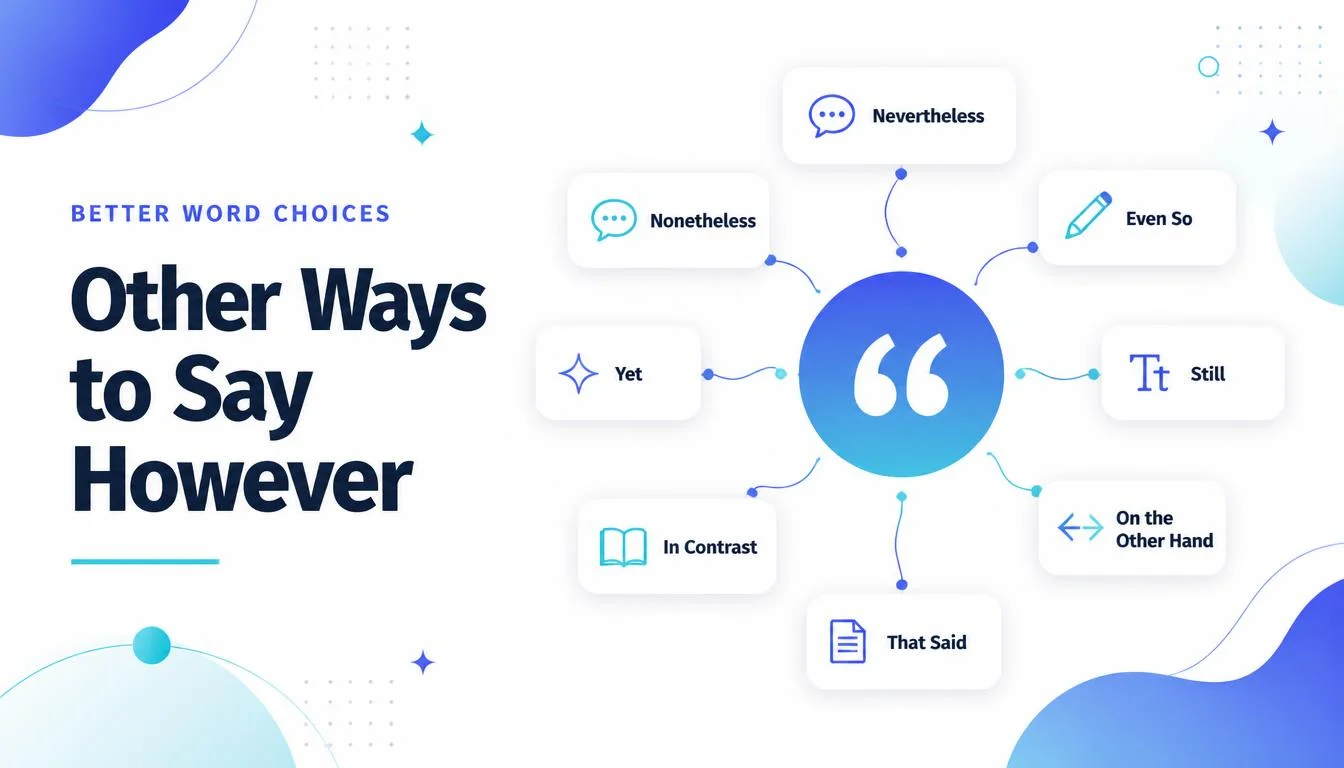
Other ways to say however include nevertheless, nonetheless, still, yet, although, on the other hand, in contrast, and despite this.
Looking for other ways to say however can help you make your writing more natural, varied, and precise. Whether you are writing an email, essay, report, or everyday message, choosing the right alternative can improve your communication.
In this guide, you’ll discover other ways to say however in formal, professional, academic, and casual contexts. Each alternative can help you express contrast while adding variety to your sentences.
Quick Categories
Formal alternatives to “however”
- Nevertheless
- Nonetheless
- Notwithstanding this
- Even so
These expressions work particularly well in academic essays, reports, formal correspondence, and carefully structured arguments.
Pro Tip: Use “nevertheless” or “nonetheless” when you want to acknowledge a limitation while emphasizing that the main point still stands.
Casual alternatives
- Still
- Yet
- That said
- Even so
These options sound natural in everyday conversations, messages, and less formal writing.
Pro Tip: In casual speech, “still” and “that said” often sound more conversational than “nevertheless.”
Professional alternatives
- On the other hand
- That being said
- Despite this
- In contrast
These expressions are useful in meetings, workplace emails, presentations, reports, and discussions where you need to acknowledge another perspective.
Pro Tip: Choose a professional transition that clearly shows whether you are introducing a limitation, contrast, or completely different perspective.
Informal expressions
- Then again
- At the same time
- Still
- All the same
These expressions can work well in conversations and relaxed workplace communication when the context is appropriate.
Pro Tip: Informal expressions in English should match your relationship with the listener and the seriousness of the situation.
“A good transition does more than connect sentences. It tells your reader how the ideas relate.”
Common Mistakes
1. Using “however” without understanding the contrast
Incorrect idea: Using it simply because it sounds formal.
Example: “I went to the store. However, I bought some milk.”
There is no clear contrast between the two ideas.
Better: “I wanted to buy bread. However, the store was closed.”
2. Using “however” in every sentence
Problem: Repetition can make your writing feel mechanical.
Example: “However, the plan is useful. However, it is expensive. However, we can modify it.”
Better: Use alternatives such as “nevertheless,” “still,” or “that said” where appropriate.
3. Confusing “however” with “although”
“However” usually functions as a transition or adverb, while “although” introduces a dependent clause.
Example: “Although the project was difficult, we completed it.”
4. Incorrect punctuation
When “however” connects two independent sentences, punctuation matters.
Example: “The idea is interesting. However, it needs more research.”
A semicolon can also be used:
Example: “The idea is interesting; however, it needs more research.”
5. Choosing an overly formal alternative
Using “notwithstanding this” in a casual conversation can sound unnecessarily formal.
Example: “The movie was long. Notwithstanding this, I enjoyed it.”
Better for casual speech: “The movie was long. Still, I enjoyed it.”
“The most sophisticated English is not always the most formal English. The best choice is the one that fits the context.”
What Does “However” Mean?
However is a transition word used to introduce a contrast, qualification, limitation, or idea that differs from what was just stated.
It often means “despite that,” “in contrast,” or “on the other side of the argument.”
Grammar Explanation
“However” is commonly used as a conjunctive adverb.
Example:
“The product is affordable. However, it has limited features.”
It can appear at the beginning of a sentence, after a semicolon, or within a sentence depending on the grammatical structure.
When to Use “However”
You can use “however” when:
- You want to introduce a contrasting idea.
- You need to qualify a previous statement.
- You are presenting a limitation.
- You want to acknowledge an opposing point.
- You are writing an essay, report, email, or presentation.
- You are speaking in a situation where a neutral contrast is needed.
Spoken vs Written
Spoken English: “It is a little expensive, but I still like it.”
Written English: “The product is effective. However, its high cost may limit adoption.”
Formal vs Informal
Formal: “Nevertheless, the findings require further investigation.”
Informal: “Still, I think it is worth trying.”
Is It Professional or Polite to Say “However”?
Polite? Yes
Professional? Yes
However is a standard professional transition and is widely used in business emails, reports, presentations, academic writing, and workplace discussions.
Business example:
“The proposal meets most of our requirements. However, we need additional information before making a final decision.”
The requested distinction between politeness and professionalism is important here: however is both polite and professional when used correctly.
Pros and Cons of Using “However”
Pros
- Simple and natural: Easy for most English speakers to understand.
- Friendly tone: Can introduce disagreement without sounding aggressive.
- Common usage: Familiar in spoken and written English.
- Easy to understand: Clearly signals a contrast.
Cons
- Can become repetitive: Frequent use may make writing monotonous.
- May sound formulaic: Repeated use in essays can reduce stylistic variety.
- Limited emotional range: It mainly signals contrast rather than emotion.
- Needs correct punctuation: Its position can affect punctuation requirements.
Other Ways to Say “However” With Examples
These alternatives will help you sound more fluent, confident, and natural in different situations.
Use them according to tone, context, and audience to express contrast, qualification, disagreement, or a change in direction.
1. Phrase: Nevertheless
Meaning: Despite what was just mentioned.
Explanation: “Nevertheless” emphasizes that something remains true despite a previous limitation.
Example Sentence: The project faced several challenges; nevertheless, the team completed it on time.
Best Use: Formal writing
Worst Use: Casual chat
Tone: Formal, confident, polished
Context Variability: Professional reports, academic writing, formal speech
2. Phrase: Nonetheless
Meaning: Despite that or nevertheless.
Explanation: “Nonetheless” introduces a contrasting point while maintaining the importance of the main idea.
Example Sentence: The process is time consuming; nonetheless, it produces reliable results.
Best Use: Professional writing
Worst Use: Casual texting
Tone: Formal, precise, composed
Context Variability: Reports, essays, presentations
3. Phrase: Still
Meaning: Despite what was previously mentioned.
Explanation: “Still” is a natural and flexible alternative that often sounds conversational.
Example Sentence: The instructions were complicated. Still, I managed to complete the task.
Best Use: Everyday speech
Worst Use: Formal reports
Tone: Casual, natural, friendly
Context Variability: Conversation, emails, informal writing
4. Phrase: Yet
Meaning: Despite that or nevertheless.
Explanation: “Yet” can introduce a surprising contrast in a concise way.
Example Sentence: The task was difficult, yet everyone remained motivated.
Best Use: Concise writing
Worst Use: Awkward repetition
Tone: Concise, natural, balanced
Context Variability: Speech, essays, professional writing
5. Phrase: On the Other Hand
Meaning: Considering a different or contrasting perspective.
Explanation: This phrase is especially useful when comparing two sides of an issue.
Example Sentence: Working remotely saves commuting time. On the other hand, some employees miss face to face collaboration.
Best Use: Balanced comparisons
Worst Use: Simple contrast
Tone: Analytical, balanced, professional
Context Variability: Meetings, essays, presentations
6. Phrase: That Said
Meaning: Despite the previous point.
Explanation: “That said” acknowledges what was just discussed before introducing a qualification or contrast.
Example Sentence: The software has a steep learning curve. That said, it offers several powerful features.
Best Use: Professional speech
Worst Use: Formal legal text
Tone: Conversational, professional, measured
Context Variability: Meetings, emails, discussions
7. Phrase: That Being Said
Meaning: Even after considering the previous point.
Explanation: This expression smoothly introduces a different or qualifying perspective.
Example Sentence: The schedule is demanding. That being said, the experience could be valuable.
Best Use: Workplace discussions
Worst Use: Very casual chat
Tone: Professional, balanced, thoughtful
Context Variability: Meetings, presentations, emails
8. Phrase: Even So
Meaning: Despite that fact.
Explanation: “Even so” emphasizes that the next statement remains true despite the previous information.
Example Sentence: The weather was terrible. Even so, the event attracted hundreds of people.
Best Use: Moderate contrast
Worst Use: Technical definitions
Tone: Natural, balanced, neutral
Context Variability: Speech, articles, general writing
9. Phrase: Despite This
Meaning: In spite of what was just mentioned.
Explanation: It directly connects an existing problem or limitation with a continuing result.
Example Sentence: The first test produced unexpected results. Despite this, the researchers continued the study.
Best Use: Formal writing
Worst Use: Casual conversation
Tone: Formal, clear, objective
Context Variability: Reports, essays, research writing
10. Phrase: In Contrast
Meaning: In a way that differs from something previously discussed.
Explanation: “In contrast” is useful when clearly comparing different situations, characteristics, or outcomes.
Example Sentence: The first proposal focuses on cost. In contrast, the second emphasizes quality.
Best Use: Comparisons
Worst Use: Minor disagreement
Tone: Analytical, formal, precise
Context Variability: Reports, presentations, essays
11. Phrase: By Contrast
Meaning: When compared with something different.
Explanation: This phrase highlights a noticeable difference between two ideas.
Example Sentence: The first quarter showed strong growth. By contrast, the second quarter was relatively stable.
Best Use: Data comparison
Worst Use: Casual speech
Tone: Analytical, formal, objective
Context Variability: Reports, presentations, business writing
12. Phrase: On the Contrary
Meaning: Used to introduce an idea that directly contradicts a previous statement.
Explanation: It should be used for direct contradiction rather than ordinary contrast.
Example Sentence: The policy did not reduce costs. On the contrary, expenses increased.
Best Use: Direct contradiction
Worst Use: Mild contrast
Tone: Strong, formal, corrective
Context Variability: Debate, essays, formal discussion
13. Phrase: At the Same Time
Meaning: While recognizing another fact or consideration.
Explanation: This expression can balance two ideas without presenting them as complete opposites.
Example Sentence: The position offers good benefits. At the same time, the workload is demanding.
Best Use: Balanced discussion
Worst Use: Direct contradiction
Tone: Neutral, balanced, conversational
Context Variability: Meetings, conversations, workplace writing
14. Phrase: Then Again
Meaning: Considering another possibility or perspective.
Explanation: “Then again” often introduces a thought that causes you to reconsider a previous point.
Example Sentence: The apartment is expensive. Then again, it is close to my office.
Best Use: Informal discussion
Worst Use: Formal reports
Tone: Casual, reflective, conversational
Context Variability: Conversation, informal writing
15. Phrase: All the Same
Meaning: Despite that.
Explanation: “All the same” shows that the previous point does not change the conclusion.
Example Sentence: The journey was exhausting. All the same, I would gladly do it again.
Best Use: Personal speech
Worst Use: Formal reports
Tone: Conversational, warm, natural
Context Variability: Speech, personal writing, informal emails
16. Phrase: Even Then
Meaning: Despite that particular condition.
Explanation: “Even then” emphasizes that something remains true despite a specific circumstance.
Example Sentence: The deadline was extended by a week. Even then, the team struggled to finish.
Best Use: Time related contrast
Worst Use: Simple comparisons
Tone: Natural, emphatic, conversational
Context Variability: Speech, narratives, informal writing
17. Phrase: Regardless
Meaning: Without being affected by the previous condition.
Explanation: “Regardless” indicates that a decision or result remains unchanged.
Example Sentence: The forecast is uncertain. Regardless, we will continue with the event.
Best Use: Firm decisions
Worst Use: Gentle disagreement
Tone: Direct, confident, neutral
Context Variability: Workplace speech, emails, general writing
18. Phrase: Regardless of This
Meaning: Despite the situation just described.
Explanation: This phrase stresses that the following action or conclusion remains unchanged.
Example Sentence: The initial response was disappointing. Regardless of this, we will continue improving the service.
Best Use: Formal communication
Worst Use: Casual speech
Tone: Formal, firm, objective
Context Variability: Business writing, reports, official communication
19. Phrase: In Spite of This
Meaning: Despite this situation.
Explanation: It introduces a result that occurs even though an obstacle exists.
Example Sentence: The company faced several setbacks. In spite of this, it continued to expand.
Best Use: Formal explanation
Worst Use: Very casual chat
Tone: Formal, clear, measured
Context Variability: Essays, reports, professional writing
20. Phrase: Despite That
Meaning: Even though that is true.
Explanation: “Despite that” is a straightforward way to introduce a contrasting result.
Example Sentence: The course was challenging. Despite that, I learned a great deal.
Best Use: Clear contrast
Worst Use: Highly formal writing
Tone: Neutral, natural, clear
Context Variability: Conversation, emails, essays
21. Phrase: Conversely
Meaning: In the opposite way or direction.
Explanation: “Conversely” is mainly used when presenting an opposing relationship or result.
Example Sentence: Increasing supply can reduce prices. Conversely, limited supply can cause prices to rise.
Best Use: Analytical writing
Worst Use: Casual conversation
Tone: Academic, precise, analytical
Context Variability: Reports, essays, research, presentations
22. Phrase: Alternatively
Meaning: As another possibility.
Explanation: “Alternatively” presents another option rather than simply disagreeing with a previous point.
Example Sentence: We could postpone the meeting. Alternatively, we could hold it online.
Best Use: Presenting options
Worst Use: Direct contradiction
Tone: Professional, practical, neutral
Context Variability: Emails, meetings, proposals
23. Phrase: In Spite of That
Meaning: Despite the fact just mentioned.
Explanation: This phrase emphasizes that an outcome occurs even though the previous point might suggest otherwise.
Example Sentence: The instructions were unclear. In spite of that, the employees completed the task.
Best Use: Explanatory writing
Worst Use: Casual texting
Tone: Neutral, clear, formal
Context Variability: Essays, reports, conversations
24. Phrase: Be That as It May
Meaning: Even accepting that point.
Explanation: This formal expression acknowledges an argument before moving to another consideration.
Example Sentence: Be that as it may, we still need to consider the long term costs.
Best Use: Formal argument
Worst Use: Casual speech
Tone: Formal, traditional, deliberate
Context Variability: Formal writing, debate, legal style
25. Phrase: Having Said That
Meaning: Despite what was just stated.
Explanation: “Having said that” introduces a qualification after acknowledging a previous idea.
Example Sentence: The design needs improvement. Having said that, the overall concept is strong.
Best Use: Constructive feedback
Worst Use: Extremely casual chat
Tone: Professional, diplomatic, balanced
Context Variability: Feedback, meetings, emails
26. Phrase: With That in Mind
Meaning: Considering the previous information.
Explanation: It connects a previous point with a new conclusion or action rather than simply contradicting it.
Example Sentence: The budget is limited. With that in mind, we should prioritize essential features.
Best Use: Decision making
Worst Use: Simple disagreement
Tone: Professional, practical, thoughtful
Context Variability: Meetings, proposals, business writing
27. Phrase: Still and All
Meaning: Despite everything mentioned.
Explanation: This expression means that the following statement remains true despite previous considerations.
Example Sentence: The task was difficult. Still and all, the team handled it well.
Best Use: Conversational English
Worst Use: Formal reports
Tone: Informal, conversational, relaxed
Context Variability: Speech, personal writing, informal conversation
28. Phrase: Yet at the Same Time
Meaning: Despite one point, another consideration also exists.
Explanation: This phrase is useful when balancing two ideas that are not completely opposite.
Example Sentence: The role is demanding, yet at the same time, it provides valuable experience.
Best Use: Balanced opinions
Worst Use: Concise writing
Tone: Conversational, balanced, explanatory
Context Variability: Speech, essays, discussions
29. Phrase: Even Though
Meaning: Despite the fact that.
Explanation: “Even though” introduces a dependent clause showing a contrast or unexpected result.
Example Sentence: Even though the project was difficult, the team completed it successfully.
Best Use: Clause contrast
Worst Use: Sentence transition
Tone: Natural, clear, versatile
Context Variability: Speech, emails, essays
30. Phrase: Although
Meaning: Despite the fact that.
Explanation: “Although” introduces a dependent clause and is one of the most useful ways to express contrast within a sentence.
Example Sentence: Although the product is expensive, many customers consider it worthwhile.
Best Use: Sentence contrast
Worst Use: Standalone transition
Tone: Neutral, polished, versatile
Context Variability: Academic, professional, spoken English
“Do not memorize every synonym equally. Learn which expressions naturally belong in each context.”
Mini Quiz and Self Check
1. Which option is most appropriate for a formal report?
A. Then again
B. Nevertheless
C. Still and all
D. Yeah, but
Answer: B. Nevertheless
2. You are comparing two different approaches in a business presentation. Which phrase fits best?
A. On the other hand
B. Still and all
C. Then again
D. Even then
Answer: A. On the other hand
3. Which sentence uses “on the contrary” correctly?
A. The restaurant was expensive. On the contrary, I enjoyed the dessert.
B. The plan did not reduce expenses. On the contrary, it increased them.
C. The meeting was long. On the contrary, it ended at five.
D. I was tired. On the contrary, I went home.
Answer: B. The plan did not reduce expenses. On the contrary, it increased them.
4. Which phrase sounds most natural in a casual conversation?
A. Notwithstanding this
B. Be that as it may
C. Still
D. Conversely
Answer: C. Still
Comparison Table: Top Alternatives
| Phrase | Tone | Best Use |
|---|---|---|
| Nevertheless | Formal | Academic and professional writing |
| Nonetheless | Formal | Reports and essays |
| Still | Casual | Everyday conversation |
| Yet | Neutral | General contrast |
| On the other hand | Professional | Comparing perspectives |
| That said | Professional | Meetings and discussions |
| That being said | Professional | Workplace communication |
| Even so | Neutral | General contrast |
| Despite this | Formal | Reports and formal writing |
| In contrast | Analytical | Comparisons and presentations |
FAQs
1. What are the best alternatives to “however”?
Common alternatives include nevertheless, nonetheless, still, yet, even so, that said, on the other hand, and despite this. The best choice depends on tone and context.
2. What is a professional way to say “however”?
Nevertheless, nonetheless, that said, in contrast, and despite this can work well in professional communication. Choose based on whether you are showing contrast, limitation, or comparison.
3. Is “however” formal or informal?
“However” is neutral and works in both professional and everyday English. It is especially common in formal writing because it clearly signals contrast.
4. Can I use “nevertheless” instead of “however”?
Yes. In many contexts, “nevertheless” can replace “however” when you want to emphasize that something remains true despite a previous point.
5. What is the difference between “however” and “on the other hand”?
“However” usually introduces a contrast or qualification, while “on the other hand” is especially useful for presenting a different perspective, option, or side of a comparison.
Conclusion
Learning different ways to express contrast gives you more control over your English. Instead of relying on one transition repeatedly, you can choose expressions such as “nevertheless,” “still,” “that said,” or “on the other hand” according to the situation.
Read More Related Articles:
- Other Ways to Say Circle Back | Improve Your Workplace Communication In 2026
- Other Ways to Say Welcome to the Team | Warm First Impression In 2026
- Other Ways to Say I Hope All Is Well | Make a Better First Impression In 2026

Henry Walker is an American writer and blogger with a keen interest in communication, language and digital content. At TextsResponse.com, he creates informative and reader-focused resources designed to help people communicate with clarity, confidence and authenticity.