Quick Answer
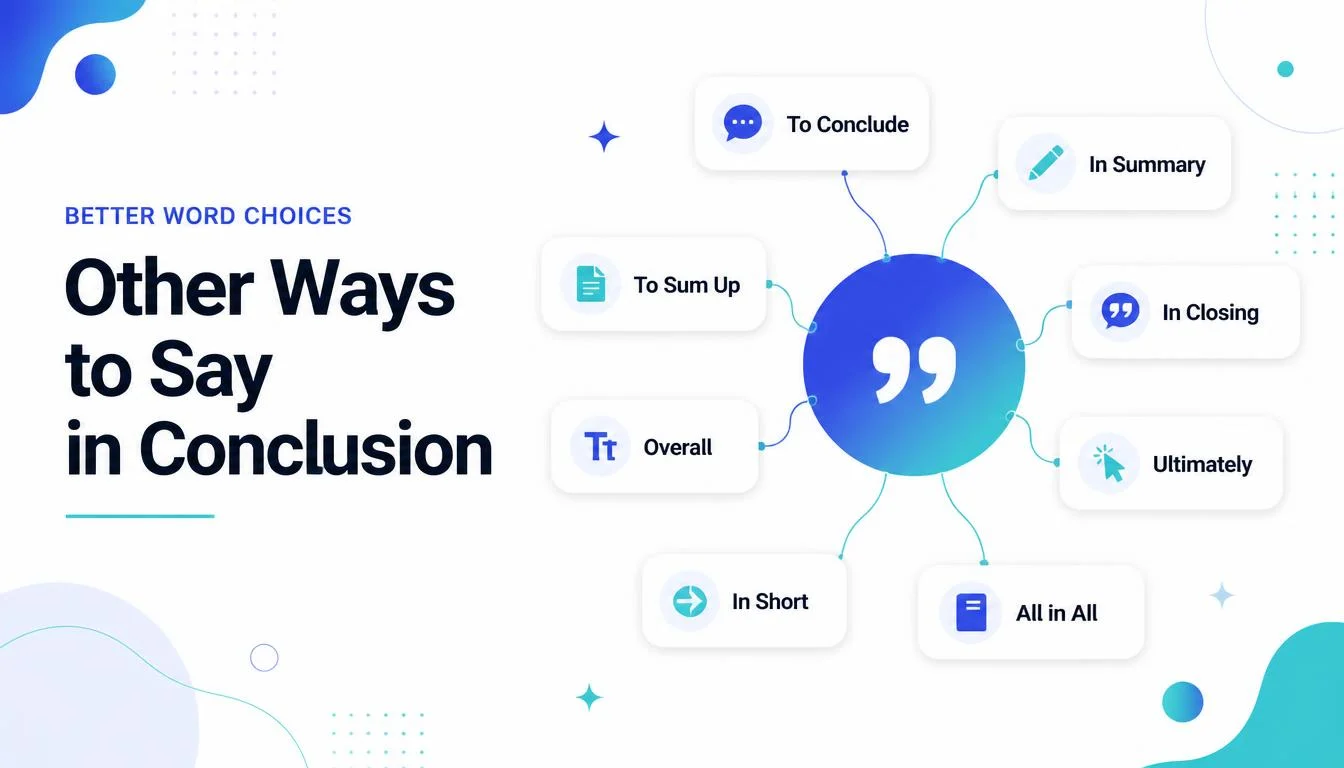
Other ways to say in conclusion include to sum up, in summary, overall, to conclude, and ultimately.
Choose the expression that best matches your tone and context.
Looking for other ways to say in conclusion? Using different concluding phrases can make your writing sound more natural, polished, and engaging while helping you avoid repetition.
Whether you are writing an essay, report, email, presentation, or professional document, knowing other ways to say in conclusion can help you introduce your final thoughts clearly and confidently.
Quick Categories
Formal alternatives to “in conclusion”
- To conclude
- In summary
- To summarize
- In closing
These phrases are especially useful in academic essays, reports, presentations, and formal speeches.
Pro Tip: Use formal transitions when your writing requires a structured and objective tone.
Casual alternatives
- Overall
- All in all
- To sum things up
- When all is said and done
These options can make conversations and less formal writing sound more natural.
Pro Tip: Choose a shorter phrase when speaking because concise transitions are usually easier for listeners to follow.
Professional alternatives
- To summarize
- In summary
- Ultimately
- On the whole
These phrases work well in business emails, presentations, reports, and workplace discussions.
Pro Tip: Match the closing phrase to your purpose rather than using the same expression in every professional situation.
Informal expressions
- So, to wrap things up
- To put it simply
- The bottom line is
- At the end of the day
These expressions are suitable for friendly conversations and relaxed workplace communication.
Pro Tip: Avoid highly conversational expressions in formal academic writing unless the style specifically allows them.
“A strong conclusion does more than end a message. It reminds your audience why your main point matters.”
Common Mistakes
1. Using “in conclusion” repeatedly
Mistake: Beginning every essay or presentation conclusion with the same phrase.
Example: “In conclusion, exercise is important. In conclusion, healthy food is important.”
Better: Use different transitions such as “overall” or “to summarize.”
2. Using a casual phrase in formal writing
Mistake: Using “at the end of the day” in a formal academic essay.
Example: “At the end of the day, climate change is a serious issue.”
Better: “In conclusion, climate change remains a serious issue.”
3. Confusing a summary with a new argument
Mistake: Introducing completely new evidence in the conclusion.
Example: “In summary, the plan works. Another study also shows that the company should expand.”
Better: Keep the conclusion focused on ideas already discussed.
4. Using “finally” as a complete replacement every time
Mistake: Treating “finally” as identical to “in conclusion.”
Example: “Finally, the research proves that communication matters.”
Better: Use “finally” mainly when presenting the last point in a sequence.
5. Choosing a phrase that does not match the tone
Mistake: Mixing formal and highly conversational expressions.
Example: “The evidence supports the proposal. To wrap things up, therefore, the methodology is reliable.”
Better: Keep the transition consistent with the surrounding language.
What Does “In Conclusion” Mean?
“In conclusion” is a transition phrase used to introduce the final part of a discussion, argument, essay, presentation, or explanation.
It tells the audience that you are summarizing the important points or giving your final statement.
Grammar
“In conclusion” is an introductory transition or discourse marker. It is usually followed by a comma when it appears at the beginning of a sentence.
Example:
“In conclusion, the proposed changes could improve workplace communication.”
It does not normally introduce a completely unrelated idea.
When to Use “In Conclusion”
You can use “in conclusion” in several contexts:
- Academic essays: To introduce a final summary or conclusion.
- Business reports: To restate the main findings.
- Presentations: To signal the closing section.
- Speeches: To introduce final remarks.
- Formal discussions: To summarize an argument.
- Professional communication: To bring several points together.
Spoken vs Written
Written: “In conclusion, the findings support the proposed approach.”
Spoken: “So, overall, the project has achieved its main goals.”
Formal vs Informal
Formal: “In summary, the results indicate a significant improvement.”
Informal: “All in all, things worked out well.”
“Fluent English is not about memorizing one perfect phrase. It is about knowing which phrase fits the situation.”
Is It Professional or Polite to Say “In Conclusion”?
“In conclusion” is both polite and professional. It is especially common in formal writing, academic communication, speeches, presentations, and structured discussions.
For everyday workplace conversations, however, alternatives such as “overall,” “to summarize,” or “to wrap things up” may sound more natural depending on the situation.
Polite? Yes
Professional? Yes
Business Style Example
“In conclusion, the proposed strategy addresses the primary concerns identified during the review.”
This sounds appropriate in a report, presentation, or formal business discussion.
Pros and Cons of Using “In Conclusion”
Pros
- Simple and natural: Most English speakers understand it immediately.
- Friendly tone: It can sound clear and approachable when used naturally.
- Common usage: It is widely recognized in speech and writing.
- Easy to understand: It clearly signals that the discussion is ending.
Cons
- Too formal for some casual conversations: It may sound stiff in relaxed dialogue.
- Overused: Repeating it can make writing feel predictable.
- Limited emotional range: It mainly signals a conclusion rather than adding a specific attitude.
- Not always suitable for conversational writing: More natural transitions may work better in casual speech.
Other Ways to Say “In Conclusion” With Examples
These alternatives will help you sound more fluent, confident, and natural in different situations.
Use them according to tone, context, and audience to express excitement, admiration, or approval when appropriate.
1. Phrase: To Conclude
Meaning: Used to introduce a final statement or summary.
Explanation: This is a formal and direct alternative to “in conclusion.”
Example Sentence: “To conclude, the evidence strongly supports the proposed solution.”
Best Use: Formal writing
Worst Use: Casual chat
Tone: Formal, direct, polished
Context Variability: Casual: limited | Professional: excellent | Spoken: excellent
2. Phrase: In Summary
Meaning: Used to briefly restate the main points.
Explanation: It clearly tells the reader that the important information is being condensed.
Example Sentence: “In summary, the project met its primary objectives.”
Best Use: Reports and essays
Worst Use: Casual conversation
Tone: Formal, clear, objective
Context Variability: Casual: moderate | Professional: excellent | Spoken: excellent
3. Phrase: To Summarize
Meaning: Used to introduce a concise review of the main ideas.
Explanation: It is one of the most useful professional alternatives.
Example Sentence: “To summarize, we need to improve communication across departments.”
Best Use: Business communication
Worst Use: Very casual talk
Tone: Professional, concise, neutral
Context Variability: Casual: moderate | Professional: excellent | Spoken: excellent
4. Phrase: In Closing
Meaning: Used to introduce final remarks.
Explanation: It works especially well in speeches, presentations, and formal messages.
Example Sentence: “In closing, I would like to thank everyone for their contributions.”
Best Use: Speeches
Worst Use: Casual texting
Tone: Formal, courteous, composed
Context Variability: Casual: limited | Professional: excellent | Spoken: excellent
5. Phrase: Overall
Meaning: Used to give a general final assessment.
Explanation: It is concise and natural in both professional and everyday English.
Example Sentence: “Overall, the results were encouraging.”
Best Use: Final assessment
Worst Use: Detailed summary
Tone: Neutral, concise, natural
Context Variability: Casual: excellent | Professional: excellent | Spoken: excellent
6. Phrase: All in All
Meaning: Used to express a general final judgment or summary.
Explanation: It is more conversational than “in conclusion.”
Example Sentence: “All in all, the event was a success.”
Best Use: Casual summaries
Worst Use: Academic papers
Tone: Casual, natural, friendly
Context Variability: Casual: excellent | Professional: moderate | Spoken: excellent
7. Phrase: Ultimately
Meaning: Used to state the final or most important point.
Explanation: It can emphasize the final outcome of a situation.
Example Sentence: “Ultimately, effective communication determines the success of the project.”
Best Use: Professional analysis
Worst Use: Simple summaries
Tone: Professional, thoughtful, authoritative
Context Variability: Casual: good | Professional: excellent | Spoken: excellent
8. Phrase: On the Whole
Meaning: Used to describe something considered as a whole.
Explanation: It provides a balanced overall assessment.
Example Sentence: “On the whole, the training program was effective.”
Best Use: Balanced assessments
Worst Use: Formal conclusions
Tone: Neutral, measured, professional
Context Variability: Casual: good | Professional: excellent | Spoken: excellent
9. Phrase: To Sum Up
Meaning: Used to briefly state the main points.
Explanation: It is shorter and more conversational than “to summarize.”
Example Sentence: “To sum up, we need a clearer communication strategy.”
Best Use: Presentations
Worst Use: Highly formal papers
Tone: Clear, conversational, professional
Context Variability: Casual: excellent | Professional: excellent | Spoken: excellent
10. Phrase: To Sum Things Up
Meaning: Used to give a simple final summary.
Explanation: This phrase has a friendly and conversational quality.
Example Sentence: “To sum things up, the proposal offers several practical benefits.”
Best Use: Workplace discussion
Worst Use: Formal reports
Tone: Friendly, conversational, clear
Context Variability: Casual: excellent | Professional: good | Spoken: excellent
11. Phrase: In Brief
Meaning: Used to present the essential point concisely.
Explanation: It is useful when a short summary is needed.
Example Sentence: “In brief, the new policy improves flexibility while reducing unnecessary costs.”
Best Use: Concise summaries
Worst Use: Casual chat
Tone: Concise, formal, efficient
Context Variability: Casual: moderate | Professional: excellent | Spoken: good
12. Phrase: In Short
Meaning: Used to reduce a longer explanation to its main point.
Explanation: It is concise and works in both speech and writing.
Example Sentence: “In short, the team needs additional resources.”
Best Use: Quick summary
Worst Use: Elaborate conclusion
Tone: Concise, direct, natural
Context Variability: Casual: excellent | Professional: excellent | Spoken: excellent
13. Phrase: To Put It Simply
Meaning: Used to explain the final idea in straightforward language.
Explanation: It is useful when simplifying a complex discussion.
Example Sentence: “To put it simply, the new system saves time.”
Best Use: Clear explanations
Worst Use: Academic conclusions
Tone: Simple, conversational, accessible
Context Variability: Casual: excellent | Professional: good | Spoken: excellent
14. Phrase: When All Is Said and Done
Meaning: Used to describe the final result after considering everything.
Explanation: This is a conversational idiom rather than a formal transition.
Example Sentence: “When all is said and done, customer satisfaction remains our priority.”
Best Use: Conversations
Worst Use: Academic essays
Tone: Conversational, reflective, natural
Context Variability: Casual: excellent | Professional: moderate | Spoken: excellent
15. Phrase: At the End of the Day
Meaning: Used to emphasize the most important final consideration.
Explanation: It is an idiomatic expression that is common in spoken English.
Example Sentence: “At the end of the day, clear communication benefits everyone.”
Best Use: Discussion
Worst Use: Formal research
Tone: Conversational, emphatic, natural
Context Variability: Casual: excellent | Professional: moderate | Spoken: excellent
16. Phrase: To Bring It All Together
Meaning: Used to connect several ideas into one final point.
Explanation: It works especially well when concluding a presentation or discussion.
Example Sentence: “To bring it all together, the strategy focuses on quality, efficiency, and customer needs.”
Best Use: Presentations
Worst Use: Formal reports
Tone: Professional, clear, cohesive
Context Variability: Casual: good | Professional: excellent | Spoken: excellent
17. Phrase: To Wrap Things Up
Meaning: Used to signal that something is coming to an end.
Explanation: It is a common conversational expression for closing a discussion.
Example Sentence: “To wrap things up, let’s review the three key actions.”
Best Use: Meetings
Worst Use: Academic essays
Tone: Casual, friendly, practical
Context Variability: Casual: excellent | Professional: good | Spoken: excellent
18. Phrase: Taking Everything Into Account
Meaning: Used to give a conclusion after considering multiple factors.
Explanation: It is useful for balanced evaluations and recommendations.
Example Sentence: “Taking everything into account, the proposal remains practical.”
Best Use: Evaluations
Worst Use: Casual chat
Tone: Formal, balanced, thoughtful
Context Variability: Casual: moderate | Professional: excellent | Spoken: excellent
19. Phrase: Considering Everything
Meaning: Used to introduce a final judgment based on several factors.
Explanation: It emphasizes that the conclusion considers the whole situation.
Example Sentence: “Considering everything, the revised plan offers several advantages.”
Best Use: Final assessment
Worst Use: Simple summary
Tone: Neutral, thoughtful, professional
Context Variability: Casual: good | Professional: excellent | Spoken: excellent
20. Phrase: All Things Considered
Meaning: Used to present a conclusion after reviewing relevant factors.
Explanation: It is particularly useful for balanced opinions and assessments.
Example Sentence: “All things considered, the project achieved its primary goals.”
Best Use: Balanced evaluation
Worst Use: Quick announcements
Tone: Formal, balanced, reflective
Context Variability: Casual: good | Professional: excellent | Spoken: excellent
21. Phrase: In the Final Analysis
Meaning: Used to introduce the ultimate assessment of an issue.
Explanation: This phrase suits analytical and professional writing.
Example Sentence: “In the final analysis, the policy depends on effective implementation.”
Best Use: Analytical writing
Worst Use: Casual conversation
Tone: Formal, analytical, authoritative
Context Variability: Casual: limited | Professional: excellent | Spoken: good
22. Phrase: The Bottom Line Is
Meaning: Used to identify the most important final point.
Explanation: It is common in business and conversational English.
Example Sentence: “The bottom line is that we need a sustainable solution.”
Best Use: Business discussion
Worst Use: Academic essay
Tone: Direct, practical, conversational
Context Variability: Casual: excellent | Professional: excellent | Spoken: excellent
23. Phrase: The Main Point Is
Meaning: Used to emphasize the central takeaway.
Explanation: It is straightforward and easy for any audience to understand.
Example Sentence: “The main point is that effective planning reduces unnecessary costs.”
Best Use: Clear explanation
Worst Use: Formal conclusion
Tone: Direct, simple, accessible
Context Variability: Casual: excellent | Professional: good | Spoken: excellent
24. Phrase: The Key Takeaway Is
Meaning: Used to highlight the most important lesson or conclusion.
Explanation: It is especially common in presentations, meetings, and professional communication.
Example Sentence: “The key takeaway is that customer feedback should guide future improvements.”
Best Use: Business presentations
Worst Use: Traditional essays
Tone: Professional, modern, focused
Context Variability: Casual: good | Professional: excellent | Spoken: excellent
25. Phrase: In Essence
Meaning: Used to state the fundamental idea in a concise way.
Explanation: It focuses on the core meaning rather than listing every detail.
Example Sentence: “In essence, the proposal aims to make the process more efficient.”
Best Use: Formal explanation
Worst Use: Casual chat
Tone: Formal, concise, intellectual
Context Variability: Casual: moderate | Professional: excellent | Spoken: excellent
26. Phrase: In the Final Assessment
Meaning: Used to introduce an ultimate evaluation.
Explanation: It works well in reports and analytical discussions.
Example Sentence: “In the final assessment, the program delivered measurable improvements.”
Best Use: Professional reports
Worst Use: Friendly conversation
Tone: Formal, analytical, objective
Context Variability: Casual: limited | Professional: excellent | Spoken: good
27. Phrase: To Close
Meaning: Used to introduce a final remark.
Explanation: It is concise and can work in presentations and professional speech.
Example Sentence: “To close, I would like to emphasize the importance of collaboration.”
Best Use: Presentations
Worst Use: Casual conversation
Tone: Formal, concise, polished
Context Variability: Casual: moderate | Professional: excellent | Spoken: excellent
28. Phrase: In Final Consideration
Meaning: Used to indicate the final stage of evaluating an issue.
Explanation: It can introduce a concluding observation in formal contexts.
Example Sentence: “In final consideration, the benefits outweigh the implementation challenges.”
Best Use: Formal analysis
Worst Use: Casual speech
Tone: Formal, analytical, measured
Context Variability: Casual: limited | Professional: good | Spoken: moderate
29. Phrase: To End With
Meaning: Used to introduce the final idea or statement.
Explanation: It is useful when deliberately ending a presentation or discussion.
Example Sentence: “To end with, I would like to thank everyone who contributed to the project.”
Best Use: Final remarks
Worst Use: Academic summary
Tone: Simple, polite, direct
Context Variability: Casual: good | Professional: good | Spoken: excellent
30. Phrase: As a Final Point
Meaning: Used to introduce the last important idea.
Explanation: It is particularly useful when the final point is part of a structured argument.
Example Sentence: “As a final point, we should consider the long-term impact of the decision.”
Best Use: Presentations
Worst Use: Casual chat
Tone: Professional, structured, clear
Context Variability: Casual: moderate | Professional: excellent | Spoken: excellent
“The best alternative is not always the most formal one. It is the phrase that fits your audience, purpose, and context.”
Mini Quiz and Self Check
1. Which phrase is most suitable for a formal academic conclusion?
A. To wrap things up
B. All in all
C. In summary
D. At the end of the day
Answer: C. In summary
2. You are ending a team meeting. Which phrase sounds natural?
A. To wrap things up
B. In the final analysis
C. final consideration
D. find essence
Answer: A. To wrap things
3. Which phrase is useful for emphasizing the central lesson from a presentation?
A. The key takeaway is
B. All in all
C. To end with
D. When all is said and done
Answer: A. The key takeaway is
4. Which sentence is most appropriate for a professional report?
A. “At the end of the day, the numbers look good.”
B. “In summary, the findings support the proposed strategy.”
C. “To wrap things up, the numbers look okay.”
D. “All in all, everything was pretty good.”
Answer: B. “In summary, the findings support the proposed strategy.”
Comparison Table: Top Alternatives
| Phrase | Tone | Best Use |
|---|---|---|
| To conclude | Formal | Essays and reports |
| In summary | Formal | Academic writing |
| To summarize | Professional | Business communication |
| In closing | Formal | Speeches |
| Overall | Neutral | General conclusions |
| All in all | Casual | Everyday conversation |
| Ultimately | Professional | Analysis |
| To sum up | Neutral | Presentations |
| The key takeaway is | Professional | Meetings and presentations |
| To wrap things up | Casual | Team discussions |
FAQs
1. What are the best alternatives to “in conclusion”?
Common alternatives include to conclude, in summary, to summarize, overall, ultimately, to sum up, and in closing. The best choice depends on your audience and level of formality.
2. What is a professional way to say “in conclusion”?
In summary, to summarize, to conclude, ultimately, and in closing are professional options. “In summary” is particularly useful for reports and formal presentations.
3. Can I use “overall” instead of “in conclusion”?
Yes. “Overall” works well when you want to provide a general assessment rather than explicitly signal the final paragraph or section.
4. Is “in conclusion” too formal for everyday English?
It can sound formal in casual conversation, although it is not incorrect. In everyday speech, expressions such as overall, all in all, or to wrap things up may sound more natural.
5. Should I avoid using “in conclusion” in essays?
No. “In conclusion” is grammatically correct and appropriate for many essays. However, using suitable alternatives can make your writing more varied and prevent repetitive transitions.
Conclusion
Learning different alternatives to “in conclusion” gives you greater control over tone, clarity, and style. Formal options such as “in summary” and “to conclude” work well in academic and professional writing, while “overall,” “all in all,” and “to wrap things up” can sound more natural in everyday communication.
Read More Related Articles:
- Other Ways to Say Circle Back | Improve Your Workplace Communication In 2026
- Other Ways to Say Welcome to the Team | Warm First Impression In 2026
- Other Ways to Say I Hope All Is Well | Make a Better First Impression In 2026

Victoria Hughes is a content writer dedicated to making communication clearer and more effective. Through TextsResponse.com, she shares practical insights and thoughtfully crafted response ideas that help readers express themselves with confidence.