Quick Answer
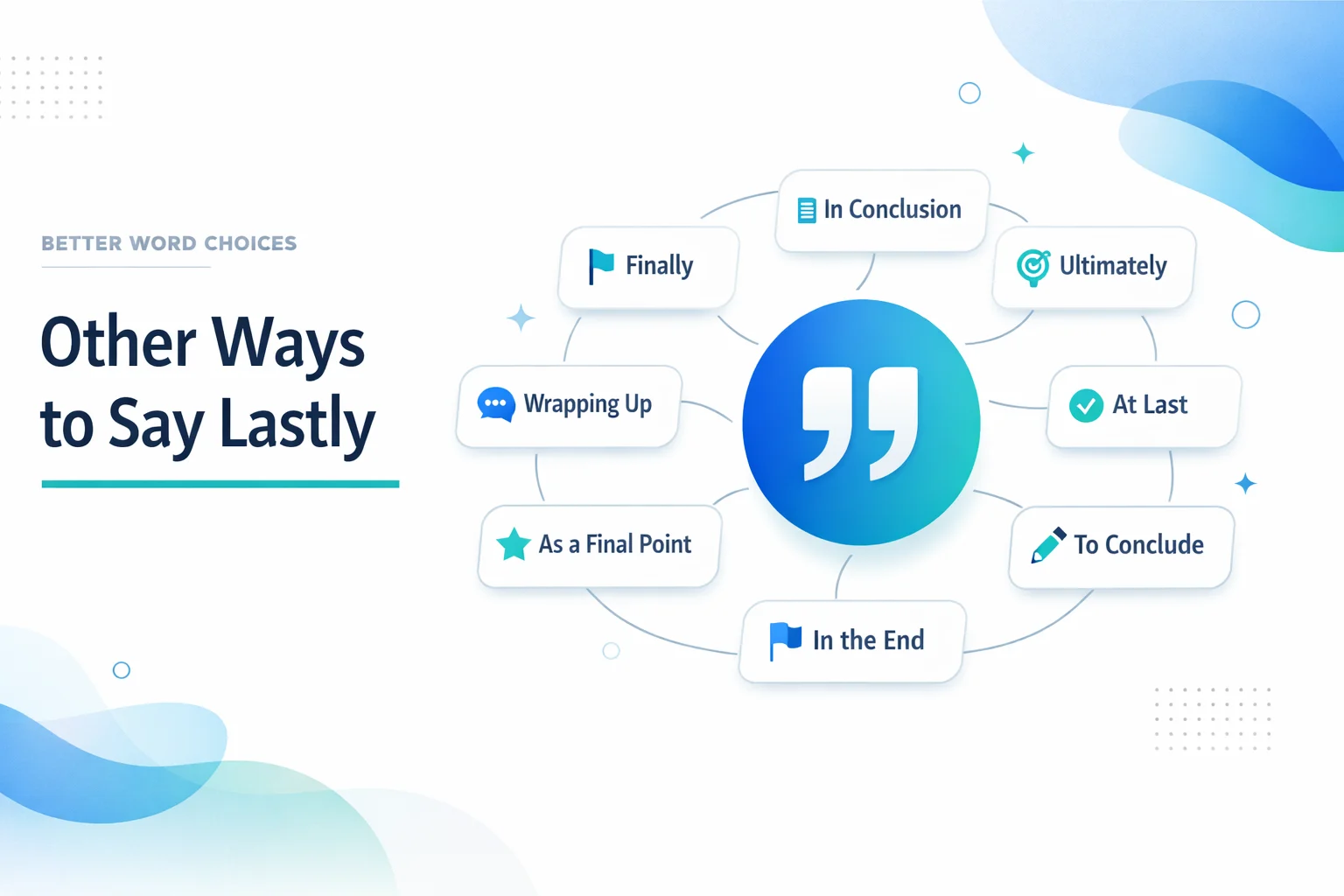
Looking for alternatives to “lastly”?The most natural options are finally, in conclusion, to conclude, last but not least, and as a final point.
“Lastly” is a transition word used to introduce the final point, item, or idea in a list, speech, essay, or conversation. It signals to the listener or reader that the sequence of information is coming to an end.
People use “lastly” in essays, presentations, emails, and everyday speech to organize ideas clearly. However, repeating the same word again and again can make writing sound flat or repetitive. Learning other ways to say lastly helps you sound more fluent and keeps your audience engaged from start to finish.
Knowing multiple alternatives to “lastly” also helps you match your tone to the situation, whether you need something formal for a report or something casual to express excitement in English while telling a story to friends.
Quick Categories
Formal Alternatives to “Lastly”
- In conclusion
- To conclude
- As a final point
- Finally
Pro Tip: Use formal alternatives like “in conclusion” or “to conclude” in essays, reports, and academic writing to sound polished and structured.
Casual Alternatives
- Last but not least
- Oh, and one more thing
- Before I forget
- One last thing
Pro Tip: Casual alternatives work best in spoken conversations or informal emails where a relaxed tone feels natural.
Professional Alternatives
- To wrap up
- In summary
- As a closing point
- Finally
Pro Tip: In business settings, pair professional alternatives with a brief summary sentence to leave a strong final impression.
Informal Expressions
- Last thing
- And finally
- To top it off
- One more thing before I go
Pro Tip: Informal expressions suit texts, chats, and casual storytelling, but avoid them in formal documents.
Common Mistakes People Make Using “Lastly”
- Overusing it in every list. Repeating “lastly” in multiple sections of the same document feels robotic. Example: “Lastly, we will discuss marketing. Lastly, we will discuss sales.”
- Using it without a preceding sequence. “Lastly” should follow words like “firstly” or “secondly” for clarity. Example: “Lastly, submit the form.” (No earlier steps mentioned.)
- Mixing formal and informal transitions. Combining “lastly” with slang breaks tone consistency. Example: “Firstly, prepare the data. Lastly, that’s a wrap.”
- Starting every paragraph with it. This makes writing sound like a checklist instead of natural prose. Example: “Lastly, the results were positive. Lastly, we recommend expansion.”
- Using it in casual speech when a simpler word fits better. “Lastly” can sound stiff in relaxed conversation. Example: “Lastly, I’m heading home now.” (Sounds overly formal for a casual chat.)
What Does “Lastly” Mean?
“Lastly” is an adverb used to introduce the final item, point, or step in a sequence. It typically appears at the beginning of a sentence, often following transition words like “firstly” and “secondly.”
Grammar note: “Lastly” functions as a sentence adverb and is usually followed by a comma when it starts a sentence.
Example sentence: “Lastly, remember to save your document before closing the program.”
When to Use “Lastly”
- Concluding a list of instructions or steps
- Summarizing the final argument in an essay
- Wrapping up a presentation or speech
- Adding a final reminder in written communication
Spoken vs Written
- Spoken: Often replaced with “and finally” or “one last thing” for a natural flow.
- Written: Commonly used in essays, reports, and structured emails.
Formal vs Informal
- Formal: “Lastly,” “in conclusion,” “to conclude”
- Informal: “Oh, and one more thing,” “last but not least”
Is It Professional or Polite to Say “Lastly”?
“Lastly” is both polite and professional in most written contexts, especially in structured communication like reports, presentations, and emails.
Business example: “Lastly, I’d like to thank the entire team for their hard work this quarter.
Polite? ✔️ Yes Professional? ✔️ Yes
Small word choices shape how confident and organized you sound.
Pros and Cons of Using “Lastly”
Pros
- Simple and easy to understand
- Clearly signals the end of a sequence
- Works well in both spoken and written English
- Suitable for formal and semi-formal contexts
Cons
- Can sound repetitive if overused
- Feels stiff in very casual conversations
- Limited emotional or expressive range
- May sound mechanical in creative writing
Other Ways to Say Lastly
These alternatives will help you sound more fluent, confident, and natural in different situations. Use them according to tone, context, and audience to express excitement, admiration, or approval when closing your thoughts.
1. Finally
Meaning: Indicates the last item in a sequence.
Explanation: A common and versatile alternative that works well in both speaking and writing when introducing the final point.
Example Sentence: Finally, let’s review the budget for next quarter.
Best Use: Presentations, essays
Worst Use: Repetitive lists where every point begins the same way
Tone: Neutral, clear
Context Variability:
- Casual: “Finally, we made it home.”
- Professional: “Finally, we’ll discuss the implementation timeline.”
2. In conclusion
Meaning: Introduces the final statement or summary.
Explanation: One of the most common closing phrases in academic and formal writing.
Example Sentence: In conclusion, the results support our original hypothesis.
Best Use: Essays, reports
Worst Use: Casual conversations
Tone: Formal, structured
Context Variability:
- Academic: “In conclusion, the evidence supports the proposed theory.”
- Professional: “In conclusion, we recommend approving the proposal.”
3. To conclude
Meaning: Signals the final point of a discussion.
Explanation: Slightly more formal than In conclusion and often used in presentations.
Example Sentence: To conclude, our team recommends moving forward with the plan.
Best Use: Formal presentations
Worst Use: Text messages
Tone: Formal, confident
Context Variability:
- Academic: “To conclude, further research is recommended.”
- Professional: “To conclude, these changes will improve efficiency.”
4. Last but not least
Meaning: Introduces the final point while emphasizing its importance.
Explanation: A friendly expression that reminds the audience the last point is just as valuable as the others.
Example Sentence: Last but not least, I want to thank our volunteers.
Best Use: Speeches, thank you messages
Worst Use: Technical reports
Tone: Warm, appreciative
Context Variability:
- Casual: “Last but not least, don’t forget dessert.”
- Professional: “Last but not least, I’d like to recognize our partners.”
5. As a final point
Meaning: Introduces the closing idea or argument.
Explanation: Common in debates, presentations, and structured discussions.
Example Sentence: As a final point, cost efficiency remains our top priority.
Best Use: Debates, business meetings
Worst Use: Casual storytelling
Tone: Formal, direct
Context Variability:
- Professional: “As a final point, customer satisfaction remains our focus.”
- Academic: “As a final point, additional research is needed.”
6. To wrap up
Meaning: Signals the end of a discussion.
Explanation: Frequently used in meetings and workplace conversations to conclude smoothly.
Example Sentence: To wrap up, let’s confirm the next steps before we leave.
Best Use: Meetings, conference calls
Worst Use: Academic essays
Tone: Friendly, professional
Context Variability:
- Professional: “To wrap up, let’s review today’s action items.”
- Spoken: “To wrap up, thanks for joining us.”
7. In summary
Meaning: Introduces a brief recap of the main points.
Explanation: Ideal for combining a conclusion with a concise review.
Example Sentence: In summary, sales increased by 12 percent this year.
Best Use: Reports, presentations
Worst Use: Informal conversations
Tone: Formal, concise
Context Variability:
- Academic: “In summary, the evidence supports our findings.”
- Professional: “In summary, the project met all objectives.”
8. As a closing point
Meaning: Introduces the final idea before ending.
Explanation: A polished phrase commonly used in speeches and formal communication.
Example Sentence: As a closing point, we appreciate your continued support.
Best Use: Speeches, formal emails
Worst Use: Casual text messages
Tone: Polished, respectful
Context Variability:
- Professional: “As a closing point, I’d like to thank everyone.”
- Academic: “As a closing point, future studies should explore this issue.”
9. One last thing
Meaning: Introduces a final reminder or comment.
Explanation: A very common phrase in everyday spoken English.
Example Sentence: One last thing, don’t forget your ID card tomorrow.
Best Use: Casual reminders
Worst Use: Formal reports
Tone: Casual, direct
Context Variability:
- Casual: “One last thing, text me when you arrive.”
- Spoken: “One last thing before we finish.”
10. Before I forget
Meaning: Introduces something the speaker almost forgot to mention.
Explanation: Creates a natural, conversational transition.
Example Sentence: Before I forget, the meeting time has changed.
Best Use: Casual conversations
Worst Use: Academic writing
Tone: Friendly, spontaneous
Context Variability:
- Casual: “Before I forget, happy birthday!”
- Spoken: “Before I forget, here’s the address.”
11. And finally
Meaning: Smoothly introduces the last point.
Explanation: A softer alternative to Finally that’s common in presentations.
Example Sentence: And finally, we’ll open the floor for questions.
Best Use: Presentations, speeches
Worst Use: Formal reports
Tone: Smooth, conversational
Context Variability:
- Professional: “And finally, let’s discuss future goals.”
- Spoken: “And finally, thanks for listening.”
12. To finish
Meaning: Signals the closing part of a discussion.
Explanation: Simple and direct, especially effective in spoken English.
Example Sentence: To finish, I’d like to highlight our team’s dedication.
Best Use: Speeches
Worst Use: Technical documents
Tone: Direct, simple
Context Variability:
- Professional: “To finish, let’s review our priorities.”
- Spoken: “To finish, I’d like to thank everyone.”
13. In closing
Meaning: Introduces the final remarks.
Explanation: Frequently used in formal letters, speeches, and presentations.
Example Sentence: In closing, thank you for considering our proposal.
Best Use: Formal letters, speeches
Worst Use: Casual conversations
Tone: Formal, respectful
Context Variability:
- Professional: “In closing, we appreciate your partnership.”
- Academic: “In closing, the study achieved its objectives.”
14. To sum up
Meaning: Gives a brief final summary.
Explanation: Slightly more conversational than In summary while remaining professional.
Example Sentence: To sum up, the project is on track and within budget.
Best Use: Meetings, presentations
Worst Use: Formal essays
Tone: Clear, balanced
Context Variability:
- Professional: “To sum up, we achieved all major goals.”
- Spoken: “To sum up, everything went well.”
15. One more thing before I go
Meaning: Adds one final point before ending.
Explanation: A very informal phrase commonly used in everyday conversation.
Example Sentence: One more thing before I go, can you lock the door?
Best Use: Casual farewells
Worst Use: Business writing
Tone: Casual, friendly
Context Variability:
- Casual: “One more thing before I go, call me later.”
- Spoken: “One more thing before I go, thanks again.”
16. To end with
Meaning: Introduces the final idea.
Explanation: A structured phrase suitable for speeches and essays.
Example Sentence: To end with, let’s revisit our main goal.
Best Use: Essays, speeches
Worst Use: Text messages
Tone: Structured, formal
Context Variability:
- Academic: “To end with, the results confirm our theory.”
- Professional: “To end with, customer satisfaction remains our priority.”
17. Ultimately
Meaning: Refers to the final outcome or most important conclusion.
Explanation: Focuses on results rather than sequence.
Example Sentence: Ultimately, customer satisfaction matters most.
Best Use: Analysis, essays
Worst Use: Step by step instructions
Tone: Reflective, formal
Context Variability:
- Academic: “Ultimately, the evidence favors the first explanation.”
- Professional: “Ultimately, success depends on execution.”
18. At the end of the day
Meaning: Introduces the practical or overall conclusion.
Explanation: A common idiom in both casual and professional conversations.
Example Sentence: At the end of the day, results matter more than effort alone.
Best Use: Discussions, meetings
Worst Use: Academic essays
Tone: Practical, conversational
Context Variability:
- Casual: “At the end of the day, we’re all learning.”
- Professional: “At the end of the day, customer trust is what matters.”
19. To top it off
Meaning: Introduces a final impressive or surprising point.
Explanation: Adds emphasis to the last item in a series.
Example Sentence: To top it off, we finished the project two days early.
Best Use: Storytelling, casual updates
Worst Use: Formal reports
Tone: Enthusiastic, expressive
Context Variability:
- Casual: “To top it off, it started snowing.”
- Spoken: “To top it off, we got a bonus.”
20. In the end
Meaning: Refers to the final result after everything has happened.
Explanation: Common in storytelling and reflective writing.
Example Sentence: In the end, hard work paid off for the whole team.
Best Use: Stories, reflections
Worst Use: Technical instructions
Tone: Reflective, warm
Context Variability:
- Casual: “In the end, everything worked out.”
- Written: “In the end, persistence made the difference.”
21. As my final thought
Meaning: Introduces a personal concluding opinion.
Explanation: Frequently used in speeches and opinion pieces.
Example Sentence: As my final thought, I encourage everyone to stay curious.
Best Use: Speeches, personal essays
Worst Use: Business emails
Tone: Personal, sincere
Context Variability:
- Spoken: “As my final thought, never stop learning.”
- Professional: “As my final thought, teamwork drives success.”
22. To close things out
Meaning: Signals the end of a discussion or meeting.
Explanation: Sounds conversational while remaining appropriate for professional settings.
Example Sentence: To close things out, let’s schedule our next check in.
Best Use: Meetings, conference calls
Worst Use: Academic essays
Tone: Friendly, professional
Context Variability:
- Professional: “To close things out, let’s review the action items.”
- Spoken: “To close things out, thank you all for coming.”
23. Last of all
Meaning: Introduces the final item in a sequence.
Explanation: Slightly more formal than Lastly and useful for emphasizing the closing point.
Example Sentence: Last of all, we need approval from the finance team.
Best Use: Instructions, formal lists
Worst Use: Casual conversations
Tone: Formal, direct
Context Variability:
- Professional: “Last of all, complete the evaluation form.”
- Academic: “Last of all, consider the long term effects.”
24. To conclude my point
Meaning: Signals the end of an argument or explanation.
Explanation: Particularly useful in persuasive writing and debates.
Example Sentence: To conclude my point, the data clearly supports our decision.
Best Use: Debates, persuasive essays
Worst Use: Casual conversations
Tone: Confident, formal
Context Variability:
- Academic: “To conclude my point, further evidence strengthens this claim.”
- Professional: “To conclude my point, the proposal offers measurable benefits.”
25. Bringing this to a close
Meaning: Announces the conclusion of a discussion or presentation.
Explanation: A polished phrase suited to formal occasions.
Example Sentence: Bringing this to a close, I want to thank everyone for attending.
Best Use: Formal speeches
Worst Use: Text messages
Tone: Polished, respectful
Context Variability:
- Professional: “Bringing this to a close, I’d like to acknowledge our team.”
- Spoken: “Bringing this to a close, thank you for your time.”
26. As a last remark
Meaning: Introduces a brief final comment.
Explanation: Common in professional correspondence and reports.
Example Sentence: As a last remark, please review the attached document.
Best Use: Emails, reports
Worst Use: Casual conversations
Tone: Formal, concise
Context Variability:
- Professional: “As a last remark, remember the submission deadline.”
- Academic: “As a last remark, additional research is encouraged.”
27. To put it simply, lastly
Meaning: Introduces a simplified final point.
Explanation: Combines a straightforward explanation with a concluding transition.
Example Sentence: To put it simply, lastly, our goal is customer satisfaction.
Best Use: Presentations
Worst Use: Formal essays
Tone: Clear, approachable
Context Variability:
- Professional: “To put it simply, lastly, quality comes first.”
- Spoken: “To put it simply, lastly, we all benefit.”
28. One final note
Meaning: Introduces one last important comment.
Explanation: Commonly used in emails, memos, and workplace communication.
Example Sentence: One final note, please submit your feedback by Friday.
Best Use: Emails, memos
Worst Use: Casual chats
Tone: Professional, polite
Context Variability:
- Professional: “One final note, the deadline has been extended.”
- Written: “One final note, contact us with any questions.”
29. To draw this to a close
Meaning: Signals the formal conclusion of a discussion.
Explanation: Frequently used in speeches and presentations.
Example Sentence: To draw this to a close, let’s summarize our key takeaways.
Best Use: Formal speeches
Worst Use: Informal text messages
Tone: Formal, structured
Context Variability:
- Professional: “To draw this to a close, I’d like to thank our sponsors.”
- Academic: “To draw this to a close, the evidence strongly supports the conclusion.”
30. All things considered
Meaning: Introduces a balanced conclusion after evaluating every factor.
Explanation: Ideal for reflective, analytical, and evaluative writing.
Example Sentence: All things considered, the new strategy is worth pursuing.
Best Use: Analysis, essays, evaluations
Worst Use: Casual small talk
Tone: Thoughtful, balanced
Context Variability:
Academic: “All things considered, the research supports the original hypothesis.”
Professional: “All things considered, the investment was worthwhile.”
“Fluency isn’t about big words, it’s about choosing the right word at the right moment.”
Mini Quiz Self-Check
1. Which phrase is the best choice for ending a formal academic essay?
A) One more thing before I go
B) To conclude
C) Oh, and one more thing
D) To top it off
2. Which phrase sounds most natural in a casual conversation with a friend?
A) In closing
B) As a closing point
C) Before I forget
D) To draw this to a close
3. In a professional business meeting, which phrase is best for wrapping up the discussion?
A) One last thing
B) To wrap up
C) To top it off
D) Last of all
4. Which phrase emphasizes the final outcome rather than the last step in a sequence?
A) Firstly
B) Ultimately
C) Lastly
D) One more thing
Answers:
- B
- C
- B
- B
“Choosing the right transition word instantly makes your English sound more natural.”
Comparison Table: Top Alternatives
| Phrase | Tone | Best Use |
|---|---|---|
| Finally | Neutral, clear | Presentations, essays |
| In conclusion | Formal, structured | Essays, reports |
| To conclude | Formal, confident | Formal presentations |
| Last but not least | Warm, appreciative | Speeches, gratitude notes |
| As a final point | Formal, direct | Debates, business meetings |
| To wrap up | Friendly, professional | Meetings, calls |
| In summary | Formal, concise | Reports, presentations |
| One last thing | Casual, direct | Casual reminders |
| To sum up | Clear, balanced | Meetings, presentations |
| At the end of the day | Practical, conversational | Discussions, casual meetings |
FAQs
1. What is a formal way to say “lastly” in an essay?
“In conclusion” or “to conclude” are the most formal and widely accepted alternatives for academic essays.
2. Is “last but not least” appropriate for professional writing?
It works best in speeches and light professional contexts, but “as a final point” is more suitable for formal reports.
3. Can I use “finally” instead of “lastly”?
Yes, “finally” is a neutral and versatile alternative suitable for both spoken and written English.
4. What’s a casual alternative to “lastly” in conversation?
One last thing” or “before I forget” sound natural and friendly in everyday speech.
5. Why should I avoid repeating “lastly” throughout a document?
Repetition makes writing sound mechanical. Using varied alternatives to “lastly” keeps your writing engaging and fluent.
Conclusion
Learning other ways to say lastly helps you communicate with more precision, confidence, and fluency across different settings, from formal essays to casual conversations. Whether you choose “in conclusion” for a report or “one last thing” for a quick chat, matching tone to context is the key to sounding natural.
Practice using these alternatives daily in your writing and speech. Over time, being mindful of tone and context will make your English sound more polished, professional, and effortlessly fluent.
Read More Related Articles:
- Other Ways to Say “First of All” | Make You Sound More Fluent In 2026
- Other Ways to Say That Being Said | Smarter & More Fluent Alternatives In 2026
- Other Ways to Say “In This Article” | That Instantly Elevate Your Writing In 2026

Henry Walker is an American writer and blogger with a keen interest in communication, language and digital content. At TextsResponse.com, he creates informative and reader-focused resources designed to help people communicate with clarity, confidence and authenticity.