Quick Answer
“Really” is one of the most overused words in English, and swapping it out instantly makes your speech and writing sound more fluent and confident. The top alternatives to “really” are: truly, genuinely, honestly, absolutely, and indeed.
“Really” is a small word that carries a lot of weight. People use it to add emphasis, confirm truth, or express excitement in English conversations, emails, and everyday speech. It shows up so often that many learners rely on it as a default emphasis word, even when a more precise phrase would sound more natural.
Learning alternatives to “really” helps you match your tone to the situation, whether you are writing a formal report, chatting with friends, or replying to a colleague. Using varied vocabulary also signals fluency and makes your English sound less repetitive and more polished.
This guide breaks down formal, casual, professional, and informal alternatives to “really,” along with meanings, examples, and tips so you always pick the right word for the right moment.
“The right tone makes your English sound professional and confident.”
Quick Categories
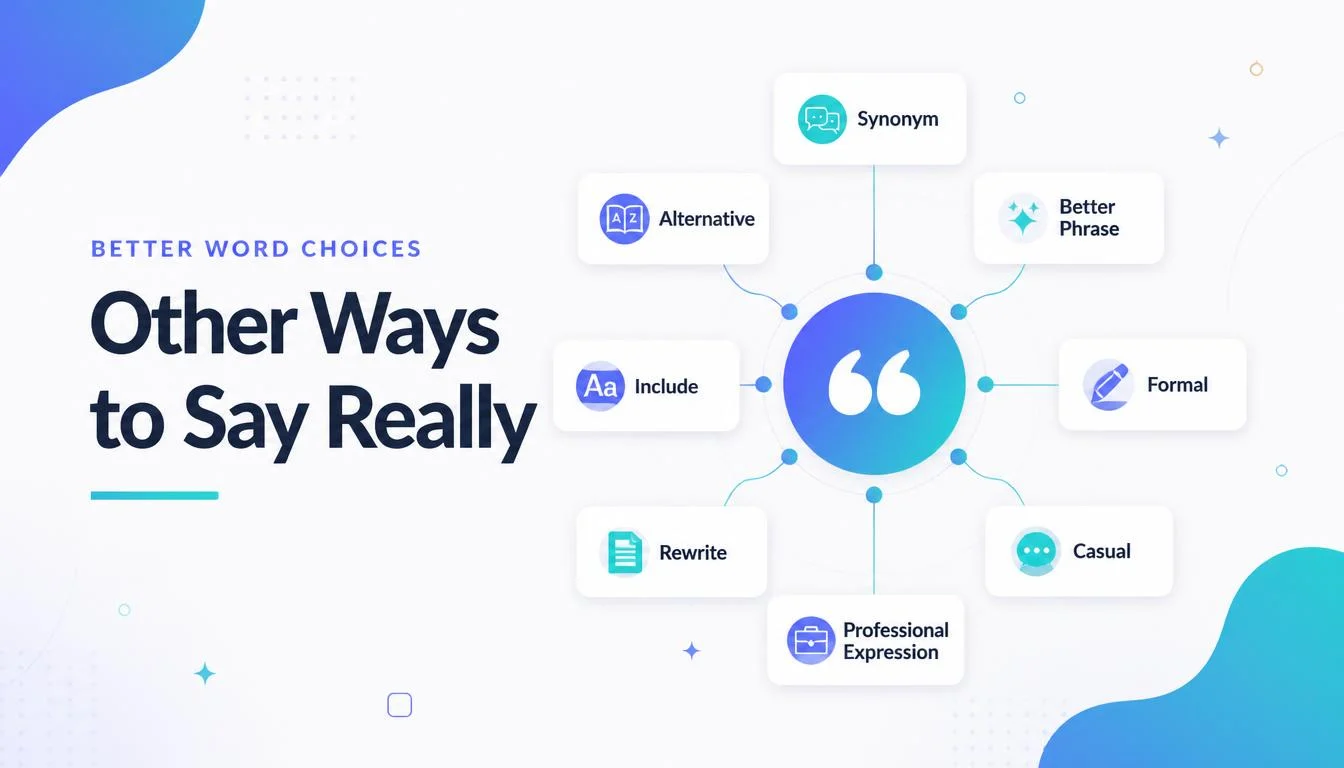
Formal alternatives to “Really”
- Truly used in writing and formal speech
- Genuinely shows sincerity in professional contexts
- Indeed confirms a statement formally
- Undeniably emphasizes a fact with certainty
Pro Tips Box: Save formal alternatives like “indeed” and “genuinely” for reports, emails, and presentations where credibility matters most.
Casual alternatives
- For real common in spoken English
- No joke adds emphasis casually
- Legit informal way to confirm something is true
- Straight up casual emphasis among friends
Pro Tips Box: Casual alternatives work well in texting and relaxed conversations, but avoid them in workplace emails.
Professional alternatives
- Certainly confident and workplace-appropriate
- Definitely clear and professional emphasis
- Frankly adds honesty to professional feedback
- Without a doubt strong professional confirmation
Pro Tips Box: Use professional alternatives when giving feedback, writing reports, or speaking in meetings to sound confident and clear.
Informal expressions
- Seriously common in everyday spoken English
- Literally often used for emphasis in casual talk
- Absolutely versatile but leans informal in speech
- For sure friendly, everyday confirmation
Pro Tips Box: Informal expressions are great for daily conversation, but overusing them can make writing sound unpolished.
Small word swaps create big improvements in how fluent you sound.”
Common Mistakes to Avoid
- Using “really” repeatedly in one paragraph Example: “It was really good and really fun and really exciting.”
- Using casual alternatives in formal emails Example: “The results were legit impressive.” (too informal for business writing)
- Overusing “literally” when nothing literal is happening Example: “I literally died laughing.” (used loosely, not literally true)
- Confusing “really” with “very” in grammar structure Example: “She is really more talented.” (should be “far more talented”)
- Using informal expressions with senior colleagues or clients Example: “For real, this project rocks.” (unsuitable for professional settings)
What Does “Really” Mean?
“Really” is an adverb used to add emphasis or confirm that something is true. Grammatically, it modifies adjectives, verbs, or entire statements to intensify meaning.
Example Sentence: “I am really happy with the results.”
When to Use “Really”
- To emphasize a feeling or opinion
- To confirm truth in a statement
- To express excitement in English casually
- Spoken English: very common in everyday conversation
- Written English: appropriate in casual writing, less so in formal documents
- Formal contexts: best replaced with words like “genuinely” or “truly
- Informal contexts: natural and widely accepted
Is It Professional or Polite to Say “Really”?
Really” is polite and friendly, but it is not always seen as professional in formal business communication because it can sound casual or unspecific.
Business Example: “We are really pleased with your performance this quarter” could be strengthened to “We are genuinely pleased with your performance this quarter” for a more polished tone.
Polite? ✔️ Yes Professional? ❌ No (in most formal settings)
Pros and Cons of Using “Really”
Pros:
- Simple and natural to use
- Friendly, approachable tone
- Extremely common in everyday usage
- Easy for learners to understand
Cons:
- Too informal for professional writing
- Overused in casual conversation
- Limited emotional range compared to alternatives
- Not suitable for formal reports or business emails
“Fluency isn’t about big words, it’s about the right word.”
Other Ways to Say Really
These alternatives will help you sound more fluent, confident, and natural in different situations. Use them according to tone, context, and audience to express excitement, admiration, or approval.
1. Phrase: Truly
Meaning: In a genuine or sincere way.
Explanation: Used to add sincerity to a statement.
Example Sentence: “I am truly grateful for your support.”
Best Use: Formal writing
Worst Use: Casual texting
Tone: Sincere, warm, formal
Context Variability: Professional, written
2. Phrase: Genuinely
Meaning: In an authentic, honest manner.
Explanation: Highlights sincerity without exaggeration.
Example Sentence: “I’m genuinely impressed by your presentation.”
Best Use: Workplace feedback
Worst Use: Slang conversations
Tone: Honest, professional, warm
Context Variability: Professional, spoken
3. Phrase: Honestly
Meaning: Speaking truthfully or sincerely.
Explanation: Adds emphasis while signaling honesty.
Example Sentence: “Honestly, this is the best solution we have.”
Best Use: Conversations, feedback
Worst Use: Formal reports
Tone: Direct, sincere, casual
Context Variability: Casual, spoken
4. Phrase: Actually
Meaning: Used to confirm a fact or correct information.
Explanation: Adds clarity or mild correction.
Example Sentence: “The meeting was actually very productive.”
Best Use: Clarifications
Worst Use: Overuse in writing
Tone: Neutral, clear, conversational
Context Variability: Casual, professional
5. Phrase: In Fact
Meaning: Used to emphasize or add supporting detail.
Explanation: Strengthens a statement with additional truth.
Example Sentence: “In fact, the results exceeded expectations.”
Best Use: Reports, essays
Worst Use: Casual texting
Tone: Formal, precise
Context Variability: Written, professional
6. Phrase: Indeed
Meaning: Used to confirm something strongly.
Explanation: Formal way to agree or emphasize truth.
Example Sentence: “The proposal was, indeed, well received.”
Best Use: Formal speech
Worst Use: Casual chats
Tone: Formal, confident
Context Variability: Professional, written
7. Phrase: Without a Doubt
Meaning: With complete certainty.
Explanation: Emphasizes strong confidence in a statement.
Example Sentence: “This is, without a doubt, our best product.”
Best Use: Presentations
Worst Use: Small talk
Tone: Confident, assertive
Context Variability: Professional, spoken
8. Phrase: For Real
Meaning: Confirming something is true informally.
Explanation: Casual way to emphasize sincerity.
Example Sentence: “That movie was for real amazing.”
Best Use: Friendly chats
Worst Use: Business emails
Tone: Casual, playful
Context Variability: Casual, spoken
9. Phrase: No Joke
Meaning: Emphasizing that something is true or serious.
Explanation: Adds informal emphasis to a statement.
Example Sentence: “That test was no joke difficult.”
Best Use: Everyday conversation
Worst Use: Formal writing
Tone: Casual, expressive
Context Variability: Casual, spoken
10. Phrase: Legit
Meaning: Genuinely true or authentic.
Explanation: Informal confirmation of truth.
Example Sentence: “That restaurant is legit the best in town.”
Best Use: Casual conversation
Worst Use: Professional settings
Tone: Slang, energetic
Context Variability: Casual, spoken
11. Phrase: Straight Up
Meaning: Honestly and directly.
Explanation: Adds bluntness and sincerity.
Example Sentence: “Straight up, that was a great idea.”
Best Use: Friendly talk
Worst Use: Formal writing
Tone: Blunt, casual
Context Variability: Casual, spoken
12. Phrase: Absolutely
Meaning: Completely and without exception.
Explanation: Strong agreement or emphasis.
Example Sentence: “I absolutely loved the concert.”
Best Use: Enthusiastic responses
Worst Use: Neutral reports
Tone: Enthusiastic, confident
Context Variability: Casual, professional
13. Phrase: Positively
Meaning: In a definite and certain way.
Explanation: Adds strong emphasis to a claim.
Example Sentence: “She was positively thrilled with the news.”
Best Use: Descriptive writing
Worst Use: Casual texting
Tone: Expressive, formal
Context Variability: Written, professional
14. Phrase: Undeniably
Meaning: In a way that cannot be denied.
Explanation: Emphasizes certainty and fact.
Example Sentence: “This is undeniably the strongest option.”
Best Use: Persuasive writing
Worst Use: Casual speech
Tone: Strong, formal
Context Variability: Written, professional
15. Phrase: Sincerely
Meaning: In a genuine, heartfelt manner.
Explanation: Common in formal and emotional statements.
Example Sentence: “I sincerely appreciate your patience.”
Best Use: Formal letters
Worst Use: Casual banter
Tone: Warm, formal
Context Variability: Written, professional
16. Phrase: Veritably
Meaning: In a true or accurate way.
Explanation: A more literary, formal emphasis word.
Example Sentence: “The results were veritably outstanding.”
Best Use: Academic writing
Worst Use: Everyday conversation
Tone: Formal, literary
Context Variability: Written, professional
17. Phrase: In Truth
Meaning: Speaking honestly about a matter.
Explanation: Adds formality and reflection to a statement.
Example Sentence: “In truth, we underestimated the workload.”
Best Use: Reflective writing
Worst Use: Casual chats
Tone: Thoughtful, formal
Context Variability: Written, professional
18. Phrase: As a Matter of Fact
Meaning: Used to confirm or add supporting truth.
Explanation: Common in both spoken and written English.
Example Sentence: “As a matter of fact, sales increased last quarter.”
Best Use: Business updates
Worst Use: Casual small talk
Tone: Confident, informative
Context Variability: Professional, spoken
19. Phrase: Frankly
Meaning: Speaking honestly, sometimes bluntly.
Explanation: Adds directness to feedback or opinions.
Example Sentence: “Frankly, the results speak for themselves.”
Best Use: Honest feedback
Worst Use: Sensitive conversations
Tone: Direct, professional
Context Variability: Professional, spoken
20. Phrase: Certainly
Meaning: Without any doubt.
Explanation: A confident and professional confirmation.
Example Sentence: “This is certainly a step in the right direction.”
Best Use: Business communication
Worst Use: Casual texting
Tone: Confident, professional
Context Variability: Professional, written
21. Phrase: Definitely
Meaning: Without question or doubt.
Explanation: A versatile emphasis word for many contexts.
Example Sentence: “This is definitely the right approach.”
Best Use: General conversation
Worst Use: Overly formal writing
Tone: Confident, neutral
Context Variability: Casual, professional
22. Phrase: Unquestionably
Meaning: In a way that leaves no doubt.
Explanation: A strong, formal emphasis word.
Example Sentence: “She is unquestionably the top performer.”
Best Use: Performance reviews
Worst Use: Casual talk
Tone: Strong, formal
Context Variability: Professional, written
23. Phrase: In Earnest
Meaning: With sincere and serious intent.
Explanation: Slightly old-fashioned but formal and sincere.
Example Sentence: “The team began working in earnest on the project.
Best Use: Formal narratives
Worst Use: Everyday speech
Tone: Formal, serious
Context Variability: Written, professional
24. Phrase: For Sure
Meaning: Certainly, without doubt.
Explanation: A relaxed way to confirm agreement.
Example Sentence: “That plan will work, for sure.”
Best Use: Friendly conversation
Worst Use: Formal emails
Tone: Casual, friendly
Context Variability: Casual, spoken
25. Phrase: No Kidding
Meaning: Expressing genuine surprise or confirmation.
Explanation: Informal reaction to something true or surprising.
Example Sentence: “No kidding, that was a fantastic show.”
Best Use: Reactions in conversation
Worst Use: Professional writing
Tone: Casual, expressive
Context Variability: Casual, spoken
26. Phrase: Honest to Goodness
Meaning: Emphasizing complete sincerity.
Explanation: An expressive, old-fashioned way to confirm truth.
Example Sentence: “It was, honest to goodness, the best meal I’ve had.”
Best Use: Storytelling
Worst Use: Business writing
Tone: Expressive, casual
Context Variability: Casual, spoken
27. Phrase: Verily
Meaning: In truth or certainty.
Explanation: Rarely used today but appears in literary or humorous contexts.
Example Sentence: “Verily, this is a remarkable achievement.”
Best Use: Creative writing
Worst Use: Everyday conversation
Tone: Formal, literary
Context Variability: Written
28. Phrase: Surely
Meaning: Confidently expecting something to be true.
Explanation: Adds emphasis while implying expectation.
Example Sentence: “Surely, this deserves recognition.”
Best Use: Persuasive speech
Worst Use: Neutral statements
Tone: Confident, assertive
Context Variability: Spoken, professional
29. Phrase: Literally
Meaning: Used for emphasis, sometimes loosely.
Explanation: Common in casual spoken English, though often used inaccurately.
Example Sentence: “I literally couldn’t stop laughing.”
Best Use: Casual storytelling
Worst Use: Formal writing
Tone: Casual, expressive
Context Variability: Casual, spoken
30. Phrase: Seriously
Meaning: Used to emphasize sincerity or surprise.
Explanation: A common informal emphasis word in spoken English.
Example Sentence: “Seriously, this is the best news all week.”
Best Use: Everyday conversation
Worst Use: Formal reports
Tone: Casual, expressive
Context Variability: Casual, spoken
“Great communicators don’t repeat words, they choose the right ones.”
Mini Quiz: Test Your Understanding
1. Which alternative is best suited for a formal business report?
A) Legit
B) Genuinely
C) No kidding
D) Straight up
Answer: B) Genuinely
2. Which phrase fits a casual conversation with friends?
A) Undeniably
B) In earnest
C) For real
D) Veritably
Answer: C) For real
3. Which sentence uses a professional alternative correctly?
A) “The results were legit good.”
B) “The results were certainly impressive.”
C) “The results were no joke good.”
D) “The results were straight up great.”
Answer: B) “The results were certainly impressive.”
4. Which word is considered old-fashioned or literary?
A) Actually
B) Verily
C) For sure
D) Seriously
Answer: B) Verily
4. Which phrase suggests returning to a topic later?
A) Circle back
B) Say hi
C) Ping
D) Meet up
Answer: A) Circle back
Comparison Table: Top Alternatives
| Phrase | Tone | Best Use |
|---|---|---|
| Truly | Sincere, formal | Formal writing |
| Genuinely | Honest, professional | Workplace feedback |
| Indeed | Formal, confident | Formal speech |
| Without a doubt | Confident, assertive | Presentations |
| Absolutely | Enthusiastic, confident | Enthusiastic responses |
| Certainly | Confident, professional | Business communication |
| Definitely | Confident, neutral | General conversation |
| For real | Casual, playful | Friendly chats |
| Legit | Slang, energetic | Casual conversation |
| Seriously | Casual, expressive | Everyday conversation |
FAQs
What is a formal way to say “really”?
Formal alternatives include “truly,” “genuinely,” and “indeed,” which work well in professional writing and speech.
What can I say instead of “really” in a text message?
Casual alternatives like “for real,” “legit,” or “no joke” fit naturally in text messages.
Is “really” too informal for business emails?
Yes, “really” is often too casual for business emails. Words like “certainly” or “genuinely” sound more polished.
What are professional reaction phrases similar to “really”?
Professional reaction phrases include “certainly,” “definitely,” and “without a doubt.
How can I stop overusing “really” in my writing?
Practice replacing “really” with alternatives from formal, casual, professional, and informal categories, and vary your word choice across sentences.
Conclusion
Learning alternatives to “really” gives you more control over tone, clarity, and confidence in both spoken and written English. Whether you need a formal alternative for a report or a casual expression for daily conversation, having a variety of options helps you communicate more naturally.
Practice using these other ways to say “really” daily, and pay close attention to tone awareness so your word choice always matches the situation. Small vocabulary upgrades like these make a noticeable difference in how fluent and professional your English sounds.
Read More Related Articles:
- Other Ways to Say “That’s Good” | More Positive Way In 2026
- Other Ways to Say I Have | Smart Alternatives for Any Situation In 2026
- Other Ways to Say Very Important | Powerful Phrases to Know In 2026

Henry Walker is an American writer and blogger with a keen interest in communication, language and digital content. At TextsResponse.com, he creates informative and reader-focused resources designed to help people communicate with clarity, confidence and authenticity.