Quick Answer
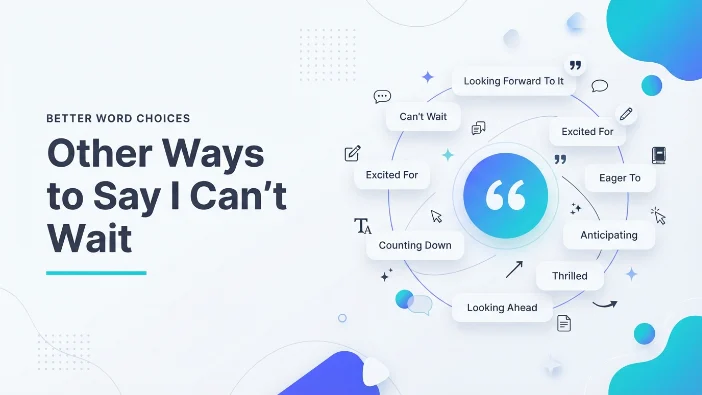
When you want alternatives to “I can’t wait,” you can use phrases like I’m so excited, I’m looking forward to it, I’m counting down the days, I’m thrilled, or I’m eager to. These alternatives to “I can’t wait” help you express excitement in English while matching the right tone for casual chats, professional emails, or formal writing.Top 5 alternatives: I’m looking forward to it, I’m thrilled, I’m eager to, I’m counting down the days, I can hardly wait.
I can’t wait” is one of the most common phrases English speakers use to express excitement about a future event. It shows anticipation, enthusiasm, and positive energy, whether you are talking about a vacation, a meeting, a celebration, or good news.
People use this phrase in everyday conversation because it feels natural and emotional. However, in professional settings, it can sound too casual. Learning other ways to say “I can’t wait” gives you more flexibility to express excitement in English across different situations.
Knowing several alternatives to “I can’t wait” also helps you avoid sounding repetitive. Whether you need casual expressions for friends or professional reaction phrases for coworkers, expanding your vocabulary makes your English sound more fluent and confident.
The right tone makes your English sound professional and confident.
Formal Alternatives to “I Can’t Wait”
I Am Eager To
Used in formal writing and business communication to show enthusiasm politely.
I Am Looking Forward To
A classic formal phrase suitable for emails, interviews, and meetings.
I Anticipate With Enthusiasm
A more elevated, formal expression used in official or academic writing.
I Am Delighted At The Prospect Of
A polished, formal way to express excitement about an upcoming event.
Pro Tip: In formal emails, pair these phrases with a reason, such as “I am looking forward to collaborating with your team,” to sound professional and specific.
Casual Alternatives
I’m So Excited
A friendly, everyday phrase used with friends and family.
I Can Hardly Wait
A slightly more expressive casual version of “I can’t wait.”
I’m Dying To
An informal, high-energy phrase showing strong anticipation.
I’m Counting Down The Days
A casual expression often used before trips or special events.
Pro Tip: Casual alternatives work best in texting, social media captions, and conversations with friends, not in workplace emails.
Professional Alternatives
I Look Forward To This Opportunity
Common in job interviews, cover letters, and business emails.
I Am Enthusiastic About This Project
Shows professional excitement without sounding overly emotional.
I Welcome The Chance To
A polite, workplace-appropriate way to show interest and readiness.
I Am Optimistic About What’s Ahead
Suitable for professional updates and forward-looking statements.
Pro Tip: Professional alternatives should sound confident but controlled. Avoid exclamation marks in formal business writing.
Informal Expressions
I’m Stoked
A very casual, energetic phrase popular in spoken English.
I’m Pumped
An informal expression showing high excitement, often used by younger speakers.
I’m Itching To
A vivid, informal way to say you are impatient with excitement.
I’m Buzzing
A casual British expression meaning very excited.
Pro Tip: Save informal expressions for spoken conversations or casual messages, since they can sound unprofessional in writing.
“Great communicators do not just know words, they know when to use them.”
Common Mistakes When Using “I Can’t Wait”
- Using it in formal emails Incorrect: “I can’t wait for the meeting tomorrow.” Better: “I am looking forward to the meeting tomorrow.”
- Overusing it repeatedly in one conversation Incorrect: “I can’t wait! I can’t wait! I can’t wait!” Better: Vary your phrasing with alternatives like “I’m thrilled” or “I’m eager.”
- Using it without context Incorrect: “I can’t wait.” Better: “I can’t wait to see the results of the project.”
- Mixing casual tone with formal writing Incorrect: “I can’t wait, boss, this is gonna be great.” Better: “I am eager to contribute to this initiative.”
- Using it to express negative anticipation sarcastically without context Incorrect: “Oh great, I can’t wait.” (without clarifying tone in writing) Better: Add context or emojis in casual chats to avoid confusion, or rephrase entirely in formal writing.
What Does “I Can’t Wait” Mean?
“I can’t wait” means you are extremely excited or eager for something to happen. It expresses strong positive anticipation.
Grammar Note: It is an idiomatic negative construction. Literally, it suggests inability to wait, but it functions as an expression of enthusiasm rather than impatience.
Example Sentence: “I can’t wait to start my new job next week.”
When to Use “I Can’t Wait”
- Talking about upcoming vacations or trips
- Expressing excitement about seeing friends or family
- Reacting to good news
- Anticipating events like weddings, parties, or holidays
Spoken vs Written:
- Spoken: Very common and natural in daily conversation.
- Written: Best used in informal messages, not formal documents.
Formal vs Informal:
- Formal: Avoid using directly; choose alternatives instead.
- Informal: Perfectly acceptable and widely used.
Is It Professional or Polite to Say “I Can’t Wait”?
“I can’t wait” is polite and friendly, but it is not always professional. In business communication, it can sound too casual or overly emotional.
Business Example: Instead of “I can’t wait to work with you,” say “I look forward to working with you.
Polite? Yes Professional? No (in most cases)
Pros and Cons of Using “I Can’t Wait”
Pros:
- Simple and natural
- Friendly tone
- Common usage
- Easy to understand
Cons:
- Too informal for work
- Overused
- Limited emotional range
- Not suitable for formal writing
Small word choices create big impressions in professional communication.
Other Ways to Say I Can’t Wait
These alternatives will help you sound more fluent, confident, and natural in different situations. Use them according to tone, context, and audience to express excitement, admiration, or approval.
1. Phrase: I’m looking forward to it
Meaning: You are excited about something coming up. Explanation: A versatile phrase suitable for both formal and semi-formal contexts. Example Sentence: “I’m looking forward to the conference next month.” Best Use: Emails, interviews Worst Use: Very casual chats Tone: Polite, professional, warm Context Variability: professional, spoken
2. Phrase: I’m thrilled
Meaning: You feel great excitement or joy. Explanation: Expresses strong enthusiasm in a polished way. Example Sentence: “I’m thrilled to announce our new product launch.” Best Use: Announcements, presentations Worst Use: Minor everyday events Tone: Enthusiastic, formal, confident Context Variability: professional, written
3. Phrase: I’m eager to
Meaning: You are ready and enthusiastic to start something. Explanation: Common in job applications and professional settings. Example Sentence: “I’m eager to contribute my skills to this team.” Best Use: Cover letters, interviews Worst Use: Casual texting Tone: Formal, motivated, sincere Context Variability: professional
4. Phrase: I’m counting down the days
Meaning: You are excitedly waiting for a specific date. Explanation: Common before trips, holidays, or events. Example Sentence: “I’m counting down the days until summer vacation.” Best Use: Travel talk, celebrations Worst Use: Business emails Tone: Casual, playful, excited Context Variability: casual, spoken
5. Phrase: I can hardly wait
Meaning: A slightly stronger version of “I can’t wait.” Explanation: Adds emphasis to excitement. Example Sentence: “I can hardly wait to open my birthday presents.” Best Use: Personal conversations Worst Use: Formal writing Tone: Excited, informal, expressive Context Variability: casual, spoken
6. Phrase: I’m dying to
Meaning: You want something very badly. Explanation: A very informal, high-energy expression. Example Sentence: “I’m dying to try that new restaurant.” Best Use: Friends, casual talk Worst Use: Workplace communication Tone: Casual, dramatic, playful Context Variability: casual, spoken
7. Phrase: I’m stoked
Meaning: You are very excited. Explanation: A slang term popular among younger speakers. Example Sentence: “I’m stoked for the weekend trip.” Best Use: Social media, friends Worst Use: Business settings Tone: Slang, energetic, informal Context Variability: casual, spoken
8. Phrase: I’m pumped
Meaning: You feel very energized and excited. Explanation: Common in sports and casual conversations. Example Sentence: “I’m pumped for the game tonight.” Best Use: Sports, casual events Worst Use: Formal emails Tone: Energetic, informal, enthusiastic Context Variability: casual, spoken
9. Phrase: I’m itching to
Meaning: You feel impatient excitement to do something. Explanation: A vivid expression showing eagerness. Example Sentence: “I’m itching to start my new project.” Best Use: Informal writing, conversation Worst Use: Formal reports Tone: Expressive, informal, eager Context Variability: casual, spoken
10. Phrase: I’m buzzing
Meaning: You are extremely excited. Explanation: A British informal expression. Example Sentence: “I’m buzzing about the concert this weekend.” Best Use: Casual UK English Worst Use: American formal writing Tone: Excited, regional, informal Context Variability: casual, spoken
11. Phrase: I welcome the chance to
Meaning: You are glad to have an opportunity. Explanation: A polite, professional way to show interest. Example Sentence: “I welcome the chance to collaborate on this initiative.” Best Use: Business proposals Worst Use: Casual talk Tone: Formal, polite, professional Context Variability: professional
12. Phrase: I anticipate with enthusiasm
Meaning: You expect something with excitement. Explanation: A formal and slightly academic expression. Example Sentence: “I anticipate with enthusiasm the results of this research.” Best Use: Academic or formal writing Worst Use: Everyday conversation Tone: Formal, elevated, precise Context Variability: professional, written
13. Phrase: I am delighted at the prospect of
Meaning: You are happy about a future possibility. Explanation: A refined, formal phrase for professional writing. Example Sentence: “I am delighted at the prospect of joining your team.” Best Use: Cover letters, formal emails Worst Use: Texting Tone: Formal, gracious, polished Context Variability: professional
14. Phrase: I’m optimistic about what’s ahead
Meaning: You feel positive about the future. Explanation: A forward-looking professional phrase. Example Sentence: “I’m optimistic about what’s ahead for our team this quarter.” Best Use: Business updates Worst Use: Personal excitement about small events Tone: Professional, hopeful, composed Context Variability: professional
15. Phrase: I’m enthusiastic about this
Meaning: You show genuine interest and excitement. Explanation: Balanced tone, suitable for workplace communication. Example Sentence: “I’m enthusiastic about this new opportunity.” Best Use: Meetings, presentations Worst Use: Very casual chats Tone: Professional, warm, sincere Context Variability: professional, spoken
16. Phrase: I’m raring to go
Meaning: You are fully ready and excited to start. Explanation: An energetic, informal expression of readiness. Example Sentence: “I’m raring to go for the first day of training.” Best Use: Casual motivation talk Worst Use: Formal reports Tone: Energetic, informal, motivated Context Variability: casual, spoken
17. Phrase: I’m looking forward with excitement
Meaning: A combination phrase emphasizing anticipation. Explanation: Useful when you want to sound both formal and warm. Example Sentence: “I’m looking forward with excitement to our upcoming event.” Best Use: Semi-formal communication Worst Use: Purely casual texting Tone: Warm, formal, expressive Context Variability: professional, spoken
18. Phrase: I can’t stop thinking about it
Meaning: You are excited and preoccupied with anticipation. Explanation: Shows strong emotional excitement. Example Sentence: “I can’t stop thinking about our trip next week.” Best Use: Personal conversations Worst Use: Professional writing Tone: Emotional, casual, sincere Context Variability: casual, spoken
19. Phrase: I’m on the edge of my seat
Meaning: You are eagerly anticipating something exciting. Explanation: A vivid idiom describing suspenseful excitement. Example Sentence: “I’m on the edge of my seat waiting for the results.” Best Use: Storytelling, casual talk Worst Use: Formal business writing Tone: Dramatic, expressive, casual Context Variability: casual, spoken
20. Phrase: I’m bursting with excitement
Meaning: You feel overwhelming excitement. Explanation: A strong, emotional expression. Example Sentence: “I’m bursting with excitement for the wedding.” Best Use: Personal celebrations Worst Use: Workplace emails Tone: Emotional, expressive, casual Context Variability: casual, spoken
21. Phrase: I await this eagerly
Meaning: You are formally expecting something with anticipation. Explanation: A polished, slightly old-fashioned formal expression. Example Sentence: “I await this eagerly, as it marks an important milestone.” Best Use: Formal letters Worst Use: Everyday speech Tone: Formal, refined, traditional Context Variability: professional, written
22. Phrase: I’m all set and excited
Meaning: You are prepared and enthusiastic. Explanation: Combines readiness with excitement. Example Sentence: “I’m all set and excited for the presentation.” Best Use: Semi-formal updates Worst Use: Highly formal documents Tone: Positive, confident, balanced Context Variability: professional, spoken
23. Phrase: I’m keen to
Meaning: You have strong interest and enthusiasm. Explanation: A polite, slightly formal British expression. Example Sentence: “I’m keen to learn more about this opportunity.” Best Use: Interviews, professional emails Worst Use: Very casual texting Tone: Polite, professional, sincere Context Variability: professional
24. Phrase: I’m thrilled beyond words
Meaning: You feel extremely excited, more than usual. Explanation: An intensified version showing deep excitement. Example Sentence: “I’m thrilled beyond words about this achievement.” Best Use: Personal announcements Worst Use: Neutral business updates Tone: Emotional, expressive, warm Context Variability: casual, spoken
25. Phrase: I’m brimming with anticipation
Meaning: You are full of excitement and expectation. Explanation: A descriptive, literary expression. Example Sentence: “I’m brimming with anticipation for the show tonight.” Best Use: Creative writing, storytelling Worst Use: Simple daily conversation Tone: Poetic, expressive, formal Context Variability: written, professional
26. Phrase: I’m champing at the bit
Meaning: You are very eager and impatient to start. Explanation: An idiom often used in professional and casual contexts. Example Sentence: “I’m champing at the bit to begin this new role.” Best Use: Interviews, motivated talk Worst Use: Purely casual chats Tone: Idiomatic, energetic, confident Context Variability: professional, spoken
27. Phrase: I’m geared up for
Meaning: You are prepared and excited for an event. Explanation: Shows readiness combined with enthusiasm. Example Sentence: “I’m geared up for the big presentation tomorrow.” Best Use: Workplace motivation talk Worst Use: Very formal documents Tone: Confident, energetic, professional Context Variability: professional, spoken
28. Phrase: I’m rearing with excitement
Meaning: You are full of eagerness and energy. Explanation: A vivid, informal expression of enthusiasm. Example Sentence: “I’m rearing with excitement for the road trip.” Best Use: Casual conversations Worst Use: Business writing Tone: Energetic, casual, playful Context Variability: casual, spoken
29. Phrase: I’m looking ahead with excitement
Meaning: You feel positive anticipation about the future. Explanation: A forward-looking, semi-formal phrase. Example Sentence: “I’m looking ahead with excitement to this new chapter.” Best Use: Career updates, semi-formal writing Worst Use: Very casual texting Tone: Positive, professional, warm Context Variability: professional, written
30. Phrase: I’m psyched
Meaning: You are very excited and energized. Explanation: A popular informal American expression. Example Sentence: “I’m psyched for the concert this weekend.” Best Use: Casual talk, social media Worst Use: Professional communication Tone: Slang, energetic, informal Context Variability: casual, spoken
“Confident English speakers know how to match tone to context.”
Mini Quiz Self Check
1. Which phrase is most appropriate for a formal job interview?
A) I’m stoked
B) I’m eager to
C) I’m dying to
✅ Answer: B) I’m eager to
2. Which phrase fits best in a casual text to a friend about an upcoming concert?
A) I anticipate it with enthusiasm
B) I’m buzzing
C) I await it eagerly
✅ Answer: B) I’m buzzing
3. True or False:
“I can’t wait” is appropriate for formal business emails.
✅ Answer: False
4. Which phrase works best in a business update about future plans?
A) I’m psyched
B) I’m optimistic about what’s ahead
C) I’m champing at the bit
✅ Answer: B) I’m optimistic about what’s ahead
Answer Key
- B
- B
- False
- B
“Practicing tone awareness daily builds real fluency.”
Comparison Table Top Alternatives
| Phrase | Tone | Best Use |
|---|---|---|
| I’m looking forward to it | Polite, warm | Emails, interviews |
| I’m thrilled | Enthusiastic, formal | Announcements |
| I’m eager to | Formal, motivated | Cover letters |
| I’m counting down the days | Casual, playful | Travel talk |
| I can hardly wait | Excited, informal | Personal talk |
| I’m dying to | Casual, dramatic | Friends |
| I’m stoked | Slang, energetic | Social media |
| I welcome the chance to | Formal, polite | Business proposals |
| I’m keen to | Polite, professional | Interviews |
| I’m psyched | Slang, informal | Casual talk |
FAQs
What is a professional way to say “I can’t wait”?
Use phrases like “I look forward to it” or “I am eager to,” which sound polished in emails and interviews.
Is “I can’t wait” grammatically correct?
Yes, it is a common idiomatic expression used to show excitement, not literal impossibility.
What are casual alternatives to “I can’t wait”?
Try “I’m stoked,” “I’m dying to,” or “I’m counting down the days” for informal conversations.
Can I use “I can’t wait” in a cover letter?
It is better to use formal alternatives like “I am eager to” or “I look forward to” in cover letters.
Why should I learn other ways to say “I can’t wait”?
Learning alternatives helps you express excitement in English naturally while adjusting tone for different situations.
Conclusion
Learning other ways to say “I can’t wait” helps you communicate excitement clearly, confidently, and appropriately in any setting. From formal professional reaction phrases to informal expressions in English, having a variety of options makes your language sound natural and fluent.
Practice using these alternatives daily in conversations, emails, and social interactions. Paying attention to tone and context will help you express excitement in English with confidence, whether you are speaking casually with friends or writing a professional message.
Read More Related Articles:
- Other Ways to Say “This Shows That” | Express Your Ideas with Confidence In 2026
- Other Ways to Say “Which” in English | Beyond the Common Choices In 2026
- Other Ways to Say Also in an Essay | Make Your Writing Shine In 2026

Daniel Murphy is a professional writer and blogger specializing in digital communication and messaging trends. As a contributor to TextsResponse.com, he creates reader-focused content designed to help people find the right words at the right time.