Quick Answer
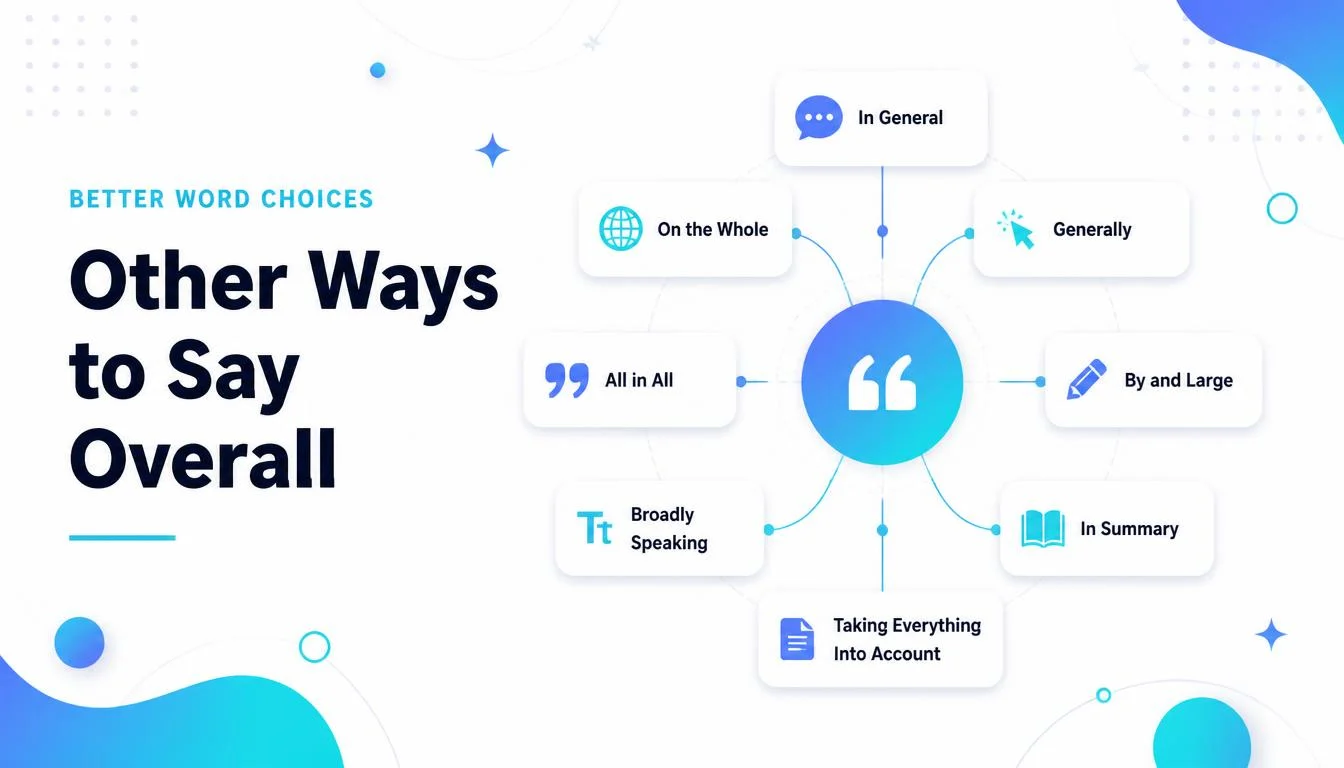
Other ways to say overall include in general, on the whole, all things considered, by and large, and generally speaking.
“Overall” is useful when you want to summarize the main idea or give a general assessment. However, using other ways to say overall can make your writing more varied, precise, and natural.
These alternatives work across different contexts, from academic essays and professional reports to everyday conversations. Choosing the right expression depends on whether you want a formal, neutral, or conversational tone.
What Is “Overall”? Meaning, Grammar & Real Use
Imagine giving feedback after a team presentation. You noticed a few small mistakes, but the presentation was informative, organized, and successful. Instead of describing every detail again, you might say, “Overall, the presentation was effective.” The word quickly communicates your general judgment while acknowledging that individual details may differ.
Overall means considering something as a whole rather than focusing on individual parts. It is especially useful when summarizing a situation, performance, experience, or result after examining several details.
For English learners, understanding alternatives to overall can make writing more varied and precise. Different expressions can show whether you are giving a broad summary, making a cautious judgment, or presenting a professional conclusion. They can also help you express excitement in English when discussing a positive experience without repeating the same adjective.
Definition
Overall refers to the general result, impression, or situation when all relevant aspects are considered together.
Grammar Note
“Overall” can function mainly as an adverb or adjective. As an adverb, it often appears at the beginning or end of a sentence.
Example: Overall, the project was successful.
As an adjective, it can describe something general or complete.
Example: The overall result was positive.
Where and Why People Use It
People use “overall” in:
- Academic summaries
- Business reports
- Performance reviews
- Product reviews
- Everyday conversations
- Presentations
- Written conclusions
It works in both spoken and written English and is generally neutral rather than strongly formal or informal.
When Should You Use “Overall”?
Use “overall” when you want to summarize several details into one general conclusion.
Common Contexts
- Summarizing results: Overall, the survey produced encouraging results.
- Giving feedback: Overall, your presentation was clear and engaging.
- Reviewing an experience: Overall, the trip was enjoyable.
- Describing performance: Her overall performance improved significantly.
- Making a conclusion: Overall, the evidence supports the proposal.
Spoken vs Written
Spoken: Overall, I think the event went well.
Written: Overall, the findings suggest that the proposed method is effective.
Formal vs Informal
“Overall” is versatile enough for both formal and informal situations.
Formal: Overall, the findings indicate a significant improvement.
Informal: Overall, I had a really good time.
Is It Professional or Just Polite?
“Overall” is both polite and professional. It is especially useful in reports, evaluations, presentations, and workplace discussions because it allows you to summarize an assessment without sounding unnecessarily absolute.
Business example: Overall, the project met its objectives despite several scheduling challenges.
Polite? ✔️ Yes
Professional? ✔️ Yes
Pros and Cons of Using “Overall”
Pros
- Simple and natural: Easy to use in everyday and professional English.
- Neutral tone: Does not sound overly emotional or judgmental.
- Common usage: Widely understood by native and advanced English speakers.
- Flexible: Works for summaries, opinions, reviews, and conclusions.
Cons
- Can become repetitive: Frequent use can make writing predictable.
- May sound vague: It does not identify which specific details support the conclusion.
- Limited precision: It gives a general judgment rather than a detailed evaluation.
- Can oversimplify: A complex situation may need more specific language.
“A strong summary should capture the big picture without hiding the important details.”
Common Mistakes People Make
1. Confusing “Overall” With “Over All”
Incorrect: Over all, the results were encouraging.
Correct: Overall, the results were encouraging.
“Overall” is normally written as one word when it means “in general.”
2. Using “Overall” for a Specific Detail
Incorrect: Overall, the third paragraph contains one spelling mistake.
Correct: Specifically, the third paragraph contains one spelling mistake.
Use “overall” for a broad assessment, not one isolated detail.
3. Repeating “Overall” Too Often
Incorrect: Overall, the report is clear. Overall, the examples are useful. Overall, the conclusion is strong.
Correct: Overall, the report is clear, and the examples and conclusion support its main argument.
4. Treating “Overall” as an Absolute Judgment
Incorrect: Overall, every part of the project was perfect.
Correct: Overall, the project was successful despite a few challenges.
“Overall” allows for a general assessment, but it does not mean every individual detail was positive.
5. Using an Informal Alternative in a Formal Report
Incorrect: By and large, the financial findings indicate improved performance.
Correct: Overall, the financial findings indicate improved performance.
Choose the expression that matches the level of formality required.
“Small tone mistakes can make confident English sound careless.”
Alternatives by Category
Formal alternatives to “Overall”
- On the whole
- All things considered
- Taken as a whole
- In general
Pro Tip: Use these expressions when summarizing research, reports, evaluations, or formal conclusions.
Casual alternatives
- In general
- Generally speaking
- By and large
Pro Tip: In conversation, choose the alternative that sounds natural with the rest of your sentence rather than forcing a formal expression.
Professional alternatives
- On balance
- Taken together
- In summary
- In conclusion
Pro Tip: Use evidence focused alternatives when you need to connect a broad conclusion with several specific findings.
Informal expressions
- All in all
- All things considered
- On the whole
- Generally speaking
Pro Tip: These expressions work well in discussions and reviews when you want to summarize an experience without sounding overly technical.
“Formal and informal English are not about correctness. They are about context.”
Other Ways to Say “Overall”
These other ways to say overall can help you vary your English while expressing a general conclusion, assessment, or summary.
The right alternative can also help you express excitement in English, show approval, or use professional reaction phrases more naturally.
1. Phrase: On the Whole
Meaning: Considering everything together.
Explanation: A natural alternative for making a broad assessment.
Example Sentence: On the whole, the training session was highly effective.
Best Use: General assessment
Worst Use: Specific details
Tone: Neutral, polished
Context Variability: Casual: The trip was good on the whole. Professional: On the whole, the results were positive. Spoken: On the whole, I enjoyed it.
2. Phrase: In General
Meaning: Referring to something broadly rather than specifically.
Explanation: Useful when discussing a general pattern or impression.
Example Sentence: In general, customers responded positively to the changes.
Best Use: Broad statements
Worst Use: Exact findings
Tone: Neutral, clear
Context Variability: Casual: In general, I like the design. Professional: In general, sales improved. Spoken: In general, people agreed.
3. Phrase: Generally Speaking
Meaning: Making a broad statement that allows for exceptions.
Explanation: Common in both conversation and professional discussion.
Example Sentence: Generally speaking, the new system is easier to use.
Best Use: Broad opinions
Worst Use: Exact data
Tone: Conversational, neutral
Context Variability: Casual: Generally speaking, it was fun. Professional: Generally speaking, productivity increased. Spoken: Generally speaking, the plan worked.
4. Phrase: All in All
Meaning: Considering everything together.
Explanation: A natural way to summarize an experience or situation.
Example Sentence: All in all, the conference was a valuable experience.
Best Use: Final impressions
Worst Use: Technical analysis
Tone: Friendly, conversational
Context Variability: Casual: All in all, it was great. Professional: All in all, the event achieved its purpose. Spoken: All in all, I enjoyed it.
5. Phrase: All Things Considered
Meaning: After considering all relevant factors.
Explanation: Useful when reaching a balanced conclusion.
Example Sentence: All things considered, accepting the proposal seems reasonable.
Best Use: Balanced conclusions
Worst Use: Simple facts
Tone: Thoughtful, measured
Context Variability: Casual: All things considered, we had a good day. Professional: All things considered, the investment remains viable. Spoken: All things considered, I agree.
6. Phrase: On Balance
Meaning: After considering positive and negative factors.
Explanation: Particularly useful for measured professional judgments.
Example Sentence: On balance, the benefits outweigh the costs.
Best Use: Balanced judgment
Worst Use: Casual greetings
Tone: Formal, analytical
Context Variability: Casual: On balance, I liked it. Professional: On balance, the proposal is beneficial. Spoken: On balance, I agree.
7. Phrase: Taken Together
Meaning: Considered collectively.
Explanation: Connects multiple facts, findings, or pieces of evidence.
Example Sentence: Taken together, these findings support the original conclusion.
Best Use: Combined evidence
Worst Use: Single facts
Tone: Analytical, professional
Context Variability: Casual: Taken together, the signs look positive. Professional: Taken together, the results indicate improvement. Spoken: Taken together, the points make sense.
8. Phrase: Taken as a Whole
Meaning: Considered in its complete form.
Explanation: Emphasizes the entire subject rather than individual parts.
Example Sentence: Taken as a whole, the report provides useful insights.
Best Use: Complete evaluation
Worst Use: Small details
Tone: Formal, analytical
Context Variability: Casual: Taken as a whole, the book is enjoyable. Professional: Taken as a whole, the proposal is practical. Spoken: Taken as a whole, it works.
9. Phrase: By and Large
Meaning: Generally or for the most part.
Explanation: A traditional expression used to describe a broad tendency.
Example Sentence: By and large, employees supported the new policy.
Best Use: General trends
Worst Use: Precise statistics
Tone: Neutral, idiomatic
Context Variability: Casual: By and large, I liked it. Professional: By and large, clients were satisfied. Spoken: By and large, the team agreed.
10. Phrase: In Summary
Meaning: Presenting the main points briefly.
Explanation: More directly signals that a conclusion or recap is coming.
Example Sentence: In summary, the proposal offers several practical benefits.
Best Use: Written conclusions
Worst Use: Casual greetings
Tone: Formal, concise
Context Variability: Casual: In summary, it went well. Professional: In summary, the evidence supports the proposal. Spoken: In summary, we achieved our goal.
11. Phrase: In Conclusion
Meaning: Introducing a final judgment or summary.
Explanation: Frequently used to close essays, presentations, and formal discussions.
Example Sentence: In conclusion, the research supports further investigation.
Best Use: Formal conclusions
Worst Use: Casual conversation
Tone: Formal, academic
Context Variability: Casual: In conclusion, it was fun. Professional: In conclusion, the strategy is viable. Spoken: In conclusion, we recommend approval.
12. Phrase: To Sum Up
Meaning: To give the main idea briefly.
Explanation: A concise expression for summarizing several points.
Example Sentence: To sum up, the project was successful.
Best Use: Short summaries
Worst Use: Detailed evidence
Tone: Neutral, direct
Context Variability: Casual: To sum up, I loved it. Professional: To sum up, the results were encouraging. Spoken: To sum up, we need more time.
13. Phrase: In Short
Meaning: Stating something briefly.
Explanation: Useful when reducing a longer explanation to its central message.
Example Sentence: In short, the plan needs more preparation.
Best Use: Brief summaries
Worst Use: Detailed reports
Tone: Concise, direct
Context Variability: Casual: In short, it was great. Professional: In short, costs exceeded expectations. Spoken: In short, we need help.
14. Phrase: Broadly Speaking
Meaning: Considering something from a general perspective.
Explanation: Signals that the statement is intentionally broad.
Example Sentence: Broadly speaking, the two approaches produce similar results.
Best Use: General comparisons
Worst Use: Exact figures
Tone: Analytical, neutral
Context Variability: Casual: Broadly speaking, I agree. Professional: Broadly speaking, demand remains stable. Spoken: Broadly speaking, the idea works.
15. Phrase: For the Most Part
Meaning: Mostly or generally.
Explanation: Useful when something is true in most cases but has exceptions.
Example Sentence: For the most part, the feedback was positive.
Best Use: Qualified assessment
Worst Use: Absolute claims
Tone: Natural, neutral
Context Variability: Casual: For the most part, I enjoyed it. Professional: For the most part, the process worked. Spoken: For the most part, everyone agreed.
16. Phrase: Generally
Meaning: In most cases or broadly.
Explanation: A concise alternative that works well in both speech and writing.
Example Sentence: Generally, the new approach has produced better results.
Best Use: Broad observations
Worst Use: Exact conclusions
Tone: Neutral, concise
Context Variability: Casual: Generally, I like it. Professional: Generally, performance improved. Spoken: Generally, people agreed.
17. Phrase: Broadly
Meaning: In a general rather than detailed sense.
Explanation: Useful for high level descriptions and conclusions.
Example Sentence: Broadly, the findings support the proposed strategy.
Best Use: High level summaries
Worst Use: Detailed analysis
Tone: Professional, concise
Context Variability: Casual: Broadly, I agree. Professional: Broadly, the results are encouraging. Spoken: Broadly, the plan works.
18. Phrase: In Overall Terms
Meaning: Considering the general result.
Explanation: Makes the summarizing function particularly explicit.
Example Sentence: In overall terms, the project achieved its objectives.
Best Use: Formal evaluation
Worst Use: Casual chat
Tone: Formal, precise
Context Variability: Casual: In overall terms, it went well. Professional: In overall terms, performance improved. Spoken: In overall terms, the plan succeeded.
19. Phrase: As a Whole
Meaning: Considering something collectively.
Explanation: Focuses attention on the complete subject rather than separate components.
Example Sentence: The organization as a whole benefited from the changes.
Best Use: Collective assessment
Worst Use: Individual details
Tone: Neutral, formal
Context Variability: Casual: The group as a whole enjoyed it. Professional: The company as a whole improved. Spoken: The team as a whole agreed.
20. Phrase: Collectively
Meaning: Considered or viewed together.
Explanation: Often used when several people, factors, or results form one larger picture.
Example Sentence: Collectively, the findings suggest that further research is needed.
Best Use: Combined findings
Worst Use: Personal opinions
Tone: Formal, analytical
Context Variability: Casual: Collectively, we did well. Professional: Collectively, the results are significant. Spoken: Collectively, the team succeeded.
21. Phrase: Taken Collectively
Meaning: Considered together as a group.
Explanation: Clearly emphasizes that multiple factors contribute to the conclusion.
Example Sentence: Taken collectively, the results provide strong evidence.
Best Use: Research evidence
Worst Use: Casual remarks
Tone: Formal, analytical
Context Variability: Casual: Taken collectively, the points make sense. Professional: Taken collectively, the findings are important. Spoken: Taken collectively, they support the idea.
22. Phrase: In the Main
Meaning: Generally or for the most part.
Explanation: A concise expression for describing the dominant situation.
Example Sentence: In the main, the changes have been successful.
Best Use: General evaluation
Worst Use: Exact statistics
Tone: Formal, restrained
Context Variability: Casual: In the main, I agree. Professional: In the main, the strategy worked. Spoken: In the main, everyone supported it.
23. Phrase: For the Most Part
Meaning: In most respects or situations.
Explanation: Useful when acknowledging that some exceptions exist.
Example Sentence: For the most part, the training was effective.
Best Use: Qualified summary
Worst Use: Absolute claims
Tone: Natural, neutral
Context Variability: Casual: For the most part, it was good. Professional: For the most part, the process worked. Spoken: For the most part, I agree.
24. Phrase: In Broad Terms
Meaning: Without focusing on specific details.
Explanation: Useful when giving a high level summary.
Example Sentence: In broad terms, the strategy aims to reduce operating costs.
Best Use: High level overview
Worst Use: Detailed evidence
Tone: Professional, analytical
Context Variability: Casual: In broad terms, I agree. Professional: In broad terms, the plan is practical. Spoken: In broad terms, it works.
25. Phrase: On the Whole
Meaning: Considering the entire situation.
Explanation: A flexible expression for general judgments and summaries.
Example Sentence: On the whole, the revised process is more efficient.
Best Use: Overall assessment
Worst Use: Single details
Tone: Neutral, polished
Context Variability: Casual: On the whole, I enjoyed it. Professional: On the whole, the process improved. Spoken: On the whole, we succeeded.
26. Phrase: All Things Taken Into Account
Meaning: After considering all relevant factors.
Explanation: Emphasizes careful consideration before reaching a conclusion.
Example Sentence: All things taken into account, the decision was reasonable.
Best Use: Careful judgment
Worst Use: Quick answers
Tone: Formal, thoughtful
Context Variability: Casual: All things taken into account, it was worthwhile. Professional: All things taken into account, the plan is feasible. Spoken: All things taken into account, I agree.
27. Phrase: At a General Level
Meaning: When considering something without detailed analysis.
Explanation: Useful when deliberately discussing the broad picture.
Example Sentence: At a general level, the proposal addresses the main concerns.
Best Use: High level discussion
Worst Use: Precise analysis
Tone: Professional, neutral
Context Variability: Casual: At a general level, I agree. Professional: At a general level, the strategy is sound. Spoken: At a general level, it makes sense.
28. Phrase: In Broad Perspective
Meaning: From a wide or general viewpoint.
Explanation: Helps frame an issue without concentrating on individual elements.
Example Sentence: In broad perspective, the changes represent significant progress.
Best Use: General perspective
Worst Use: Specific details
Tone: Formal, reflective
Context Variability: Casual: In broad perspective, it worked. Professional: In broad perspective, the policy was effective. Spoken: In broad perspective, I agree.
29. Phrase: Considering Everything
Meaning: After taking all relevant details into account.
Explanation: A natural conversational way to introduce a balanced conclusion.
Example Sentence: Considering everything, the experience was worthwhile.
Best Use: Balanced opinions
Worst Use: Technical reports
Tone: Conversational, thoughtful
Context Variability: Casual: Considering everything, I enjoyed it. Professional: Considering everything, the plan remains practical. Spoken: Considering everything, I agree.
30. Phrase: Taking Everything Into Account
Meaning: Considering all important factors before reaching a judgment.
Explanation: Useful for careful conclusions where several factors matter.
Example Sentence: Taking everything into account, the recommendation remains appropriate.
Best Use: Final evaluation
Worst Use: Simple statements
Tone: Thoughtful, professional
Context Variability: Casual: Taking everything into account, it was good. Professional: Taking everything into account, the proposal is viable. Spoken: Taking everything into account, I agree.
Comparison Table: Top 10 Alternatives at a Glance
| Phrase | Tone | Best Use |
|---|---|---|
| On the whole | Neutral | General assessments |
| In general | Neutral | Broad statements |
| Generally speaking | Conversational | General opinions |
| All in all | Friendly | Final impressions |
| All things considered | Thoughtful | Balanced conclusions |
| On balance | Formal | Professional judgments |
| Taken together | Analytical | Combined evidence |
| In summary | Formal | Written conclusions |
| To sum up | Neutral | Short summaries |
| Broadly speaking | Analytical | General comparisons |
Quick Self Check
Question 1
You are writing a formal report about several research findings. Which option is most appropriate?
A. All in all
B. Taken together
C. It was pretty good
Answer: B. “Taken together” clearly connects several findings to one conclusion.
Question 2
You are casually describing a vacation to a friend. Which phrase sounds natural?
A. All in all
B. Pursuant to
C. Taken collectively
Answer: A. “All in all” is natural for casual final impressions.
Question 3
You want to make a balanced business judgment after considering advantages and disadvantages. Which option fits best?
A. On balance
B. In short
C. Generally
Answer: A. “On balance” clearly signals a considered judgment.
Question 4
You want to summarize an essay in its final paragraph. Which expression is suitable?
A. In conclusion
B. By and large
C. All in all
Answer: A. “In conclusion” is widely used to introduce a formal final summary.
FAQs
What are the best alternatives to “overall”?
Useful alternatives include on the whole, in general, all in all, all things considered, on balance, and taken together. The best choice depends on the context and desired tone.
What is a formal alternative to “overall”?
On the whole, on balance, taken as a whole, and in summary can work well in formal writing, depending on whether you are summarizing an assessment, evidence, or conclusion.
What can I say instead of “overall” in professional English?
Try on balance, taken together, in summary, broadly speaking, or taking everything into account when communicating a professional conclusion.
Is “all in all” the same as “overall”?
They can have similar meanings when summarizing an experience or situation. However, “all in all” is generally more conversational, while “overall” works comfortably in both professional and casual contexts.
What is the difference between “overall” and “in general”?
“Overall” commonly summarizes a complete situation or assessment, while “in general” usually describes a broad tendency or statement that may have exceptions.
conclusion
Learning alternatives to overall gives you more control over tone, precision, and sentence variety. Expressions such as “on the whole,” “on balance,” “taken together,” and “all things considered” allow you to communicate broad conclusions without relying on one repeated expression.
Build fluency by practicing these phrases in realistic situations such as emails, presentations, reviews, conversations, and reports. Pay attention to whether you are summarizing evidence, expressing an opinion, or giving a final impression.
Read More Related Articles:
- Other Ways to Say “It Was a Pleasure Meeting You” | Make a Strong Final Impression In 2026
- Other Ways to Say Looking Forward to Seeing You | Leave a Great Impression In 2026
- Other Ways to Say “LOL” | When Something Is Actually Hilarious In 2026

Daniel Murphy is a professional writer and blogger specializing in digital communication and messaging trends. As a contributor to TextsResponse.com, he creates reader-focused content designed to help people find the right words at the right time.