Quick Answer 🔥
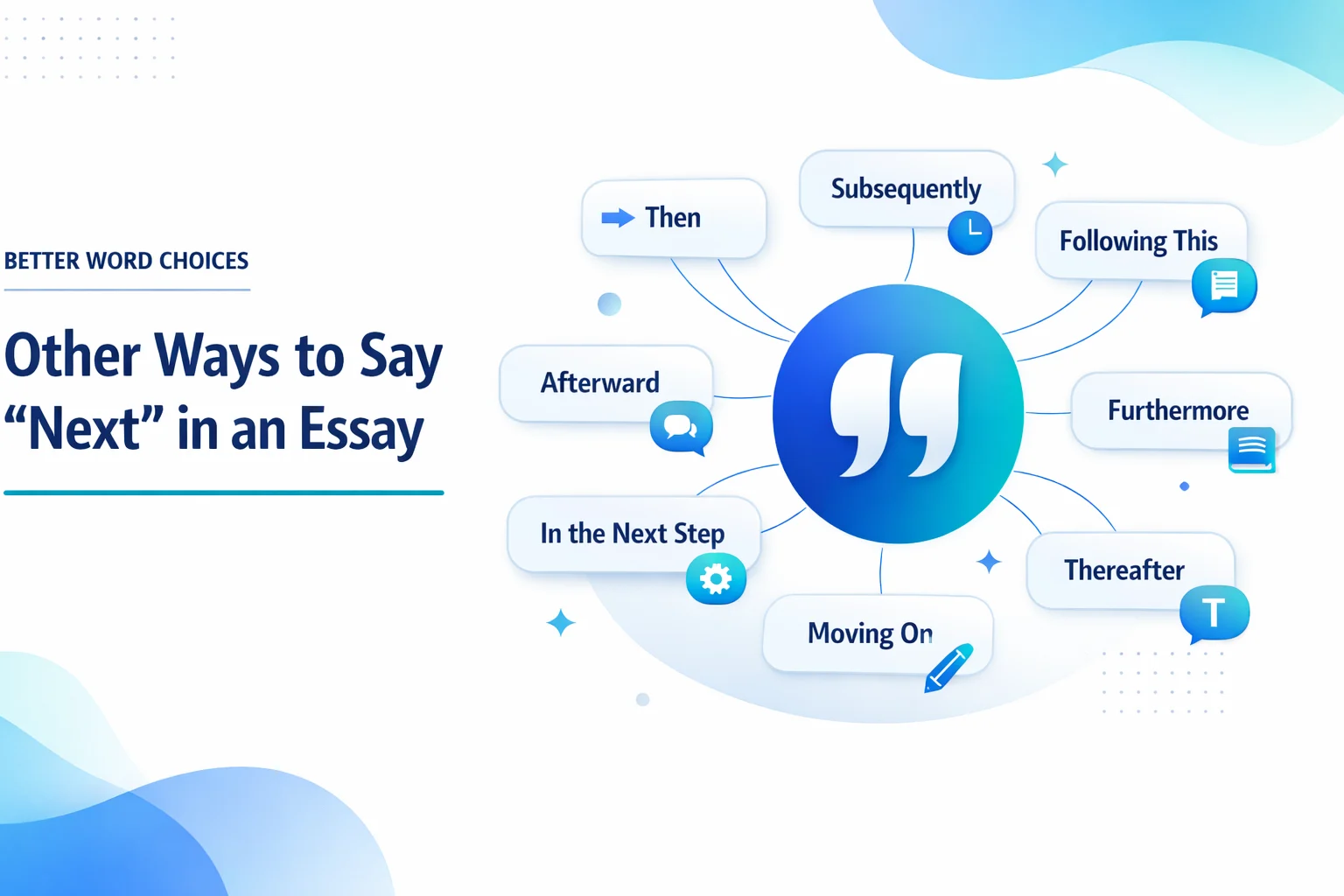
Next is a common transition word, but overusing it makes writing feel repetitive.Top alternatives include: subsequently, following this, then, after that, and thereafter.
The word next is one of the most frequently used transition words in English. It signals sequence, order, and what comes after the current point. Whether you are writing an academic essay, a business report, or a casual email, “next” helps guide your reader through your ideas.
However, relying on “next” too often can make your writing sound monotonous and unsophisticated. Learning alternatives to “next” in an essay will elevate your writing, improve fluency, and help you sound more confident and professional. By expanding your vocabulary, you gain the ability to match your tone to any context from formal academic papers to everyday conversations.
This guide provides 30 powerful alternatives to “next,” organized by tone and context, with clear examples so you can start using them immediately.
“The right transition word can turn a choppy paragraph into a smooth, compelling narrative.”
Quick Categories
Formal Alternatives to “Next”
- Subsequently
- Following this / Following that
- Thereafter
- In addition
- Furthermore
- Moreover
- Consequently
- Accordingly
- Hence
- Thereafter
Casual Alternatives
- Then
- After that
- Moving on
- Next up
- From there
- And then
- Soon after
- Later on
Professional Alternatives
- Subsequently
- The next step
- Moving forward
- Proceeding to
- As a next measure
- In the subsequent phase
- Following on from this
Informal Expressions
- Next thing
- Coming up next
- What’s next
- Then again
- Afterward
💡 Pro Tip: Match your transition word to your audience. Formal essays demand sophisticated choices like subsequently; casual blogs welcome simpler options like then or after that.
What Does “Next” Mean?
Next (adjective, adverb, or determiner) means coming immediately after the present one in time, order, or space.
- As an adjective: “The next chapter explains the methodology.”
- As an adverb: “Next, we will examine the results.”
It is a versatile word used to indicate sequence, succession, or proximity.
When to Use “Next”
- Essays: To introduce the following point in a sequence
- Instructions: To indicate the subsequent step
- Presentations: To transition to the next slide or topic
- Conversations: To move the discussion forward
- Written vs Spoken: Common in both, but overused in informal speech
- Formal vs Informal: Acceptable in both, but formal writing benefits from variety
Is It Professional or Polite to Say “Next”?
Polite? ✔️ Yes it is neutral and courteous.
Professional? ⚠️ It depends. While “next” is not unprofessional, overusing it in formal writing can make your work seem simplistic or repetitive.
Example in a business context:
“Next, we will review the quarterly earnings.” (Acceptable but basic)
For stronger professional impact, consider: “Subsequently, we will review the quarterly earnings.”
Pros and Cons of Using “Next”
Pros
- Simple and universally understood
- Friendly and approachable tone
- Common in everyday speech and writing
- Easy for non-native speakers to use correctly
Cons
- Too informal for high-stakes academic or business writing
- Overused can make writing feel repetitive
- Limited emotional or rhetorical range
- Not suitable for sophisticated or nuanced arguments
Other Ways to Say “Next” in an Essay
These 30 alternatives will help you sound more fluent, confident, and natural in different situations. Use them according to tone, context, and audience to express sequence clearly and professionally.
1. Subsequently
- Meaning: Afterward; later in time or order.
- Explanation: A formal, academic alternative that emphasizes chronological sequence.
- Example Sentence: “The data was collected in Phase One; subsequently, it was analyzed using statistical software.”
- Best Use: Academic papers
- Worst Use: Casual conversation
- Tone: Formal, precise
- Context Variability: Professional / formal writing
2. Following This
- Meaning: Immediately after this point.
- Explanation: A clear, professional transition for step-by-step explanations.
- Example Sentence: “The initial survey was completed. Following this, focus groups were conducted.”
- Best Use: Research reports
- Worst Use: Informal chats
- Tone: Professional, orderly
- Context Variability: Professional / academic
3. Thereafter
- Meaning: After that time; from that point onward.
- Explanation: Formal and somewhat literary; suggests a lasting sequence.
- Example Sentence: “The policy was implemented in 2020; thereafter, compliance rates improved significantly.”
- Best Use: Formal reports, legal documents
- Worst Use: Everyday conversation
- Tone: Formal, authoritative
- Context Variability: Professional / formal
4. Then
- Meaning: At that time; after that.
- Explanation: The most common and natural alternative to “next.”
- Example Sentence: “First, we identified the problem. Then, we developed a solution.”
- Best Use: All contexts
- Worst Use: Overuse in formal writing
- Tone: Neutral, versatile
- Context Variability: All
5. After That
- Meaning: Following that event or point.
- Explanation: Simple, clear, and conversational.
- Example Sentence: “We finished the prototype. After that, we ran user tests.”
- Best Use: Casual writing, storytelling
- Worst Use: Academic essays
- Tone: Casual, accessible
- Context Variability: Casual / spoken
6. Moving On
- Meaning: Transitioning to the next topic.
- Explanation: Commonly used in presentations and conversations to shift focus.
- Example Sentence: “Moving on, let’s discuss the marketing strategy.”
- Best Use: Presentations, meetings
- Worst Use: Formal academic writing
- Tone: Professional, dynamic
- Context Variability: Professional / spoken
7. In Addition
- Meaning: Adding another point to the previous one.
- Explanation: Emphasizes that the next point builds on or adds to the previous.
- Example Sentence: “The company reduced costs. In addition, it improved customer service.”
- Best Use: Business writing, essays
- Worst Use: Sequential step-by-step instructions
- Tone: Professional, additive
- Context Variability: Professional / formal
8. Furthermore
- Meaning: In addition; moreover.
- Explanation: A formal transition that introduces supporting or additional information.
- Example Sentence: “The results were significant. Furthermore, they were consistent across all demographics.”
- Best Use: Academic essays, persuasive writing
- Worst Use: Casual speech
- Tone: Formal, persuasive
- Context Variability: Professional / academic
9. Moreover
- Meaning: In addition to what has been said.
- Explanation: Similar to “furthermore” but slightly more emphatic.
- Example Sentence: “The project was completed on time. Moreover, it came in under budget.”
- Best Use: Formal arguments, reports
- Worst Use: Everyday conversation
- Tone: Formal, emphatic
- Context Variability: Professional / formal
10. Consequently
- Meaning: As a result; therefore.
- Explanation: Shows that the next point follows logically from the previous one.
- Example Sentence: “The team missed the deadline; consequently, the launch was postponed.”
- Best Use: Cause-and-effect explanations
- Worst Use: Simple sequencing
- Tone: Formal, logical
- Context Variability: Professional / academic
11. Accordingly
- Meaning: In a way that is appropriate to the circumstances; therefore.
- Explanation: Formal transition showing logical progression.
- Example Sentence: “The budget was increased; accordingly, we expanded the team.”
- Best Use: Business reports, formal writing
- Worst Use: Casual conversation
- Tone: Formal, measured
- Context Variability: Professional / formal
12. Hence
- Meaning: As a consequence; therefore.
- Explanation: A concise, formal alternative indicating logical result.
- Example Sentence: “The evidence was inconclusive; hence, further research is needed.”
- Best Use: Academic writing
- Worst Use: Spoken English
- Tone: Formal, concise
- Context Variability: Professional / academic
13. From There
- Meaning: Starting from that point.
- Explanation: Casual phrase indicating progression from a previous stage.
- Example Sentence: “We secured funding. From there, we hired a development team.”
- Best Use: Storytelling, casual writing
- Worst Use: Formal essays
- Tone: Casual, narrative
- Context Variability: Casual / spoken
14. Next Up
- Meaning: The next item in a sequence.
- Explanation: Very casual; common in presentations and informal lists.
- Example Sentence: “Next up, we have the quarterly review.”
- Best Use: Presentations, casual lists
- Worst Use: Academic or formal writing
- Tone: Casual, energetic
- Context Variability: Casual / professional (spoken)
15. Soon After
- Meaning: Shortly following that time.
- Explanation: Emphasizes a short time gap between events.
- Example Sentence: “The announcement was made; soon after, the stock price rose.”
- Best Use: Narrative writing, reports
- Worst Use: Step-by-step instructions
- Tone: Neutral, temporal
- Context Variability: All
16. Later On
- Meaning: At a later time.
- Explanation: Casual phrase indicating future sequence.
- Example Sentence: “We’ll address the budget now; later on, we’ll discuss staffing.”
- Best Use: Casual writing, meetings
- Worst Use: Formal academic essays
- Tone: Casual, conversational
- Context Variability: Casual / spoken
17. Proceeding To
- Meaning: Moving forward to the next item.
- Explanation: Professional and structured.
- Example Sentence: “Proceeding to the next agenda item, we will review the marketing plan.”
- Best Use: Meetings, formal agendas
- Worst Use: Casual conversation
- Tone: Professional, structured
- Context Variability: Professional
18. As a Next Step
- Meaning: The following action in a process.
- Explanation: Clear and professional for project updates and instructions.
- Example Sentence: “As a next step, we will finalize the contract.”
- Best Use: Project management, business writing
- Worst Use: Academic essays
- Tone: Professional, actionable
- Context Variability: Professional
19. Following On From This
- Meaning: Continuing from this point.
- Explanation: Slightly formal; emphasizes continuity.
- Example Sentence: “Following on from this, we will examine the long-term effects.”
- Best Use: Formal reports, academic writing
- Worst Use: Casual conversation
- Tone: Formal, continuous
- Context Variability: Professional / academic
20. In the Subsequent Phase
- Meaning: In the next stage or period.
- Explanation: Professional and precise for multi-stage projects.
- Example Sentence: “In the subsequent phase, we will conduct field tests.”
- Best Use: Project proposals, research papers
- Worst Use: Everyday writing
- Tone: Formal, technical
- Context Variability: Professional / academic
21. Afterward
- Meaning: At a later or subsequent time.
- Explanation: Simple, neutral alternative.
- Example Sentence: “We completed the first trial; afterward, we analyzed the data.”
- Best Use: All contexts
- Worst Use: Overuse in formal writing
- Tone: Neutral, clear
- Context Variability: All
22. Then Again
- Meaning: On the other hand; alternatively (but can also mean “next” in sequence).
- Explanation: More commonly used as a contrasting transition; use carefully.
- Example Sentence: “We could expand now; then again, we might wait for more data.”
- Best Use: Persuasive writing, debates
- Worst Use: Simple sequencing
- Tone: Reflective, contrasting
- Context Variability: Professional / casual
23. And Then
- Meaning: Following that.
- Explanation: Very common in spoken English and informal writing.
- Example Sentence: “We gathered the materials, and then we began construction.”
- Best Use: Storytelling, casual writing
- Worst Use: Academic writing
- Tone: Casual, narrative
- Context Variability: Casual / spoken
24. Moving Forward
- Meaning: From this point onward.
- Explanation: Professional phrase for future-oriented transitions.
- Example Sentence: “Moving forward, we will implement these changes.”
- Best Use: Business writing, strategic plans
- Worst Use: Academic essays
- Tone: Professional, forward-looking
- Context Variability: Professional
25. The Next Step
- Meaning: The following action or stage.
- Explanation: Clear and direct for instructions and processes.
- Example Sentence: “The next step is to secure stakeholder approval.”
- Best Use: Instructions, project updates
- Worst Use: Overuse in formal writing
- Tone: Neutral, clear
- Context Variability: All
26. What’s Next
- Meaning: What follows; the next item.
- Explanation: Casual and conversational; often used rhetorically.
- Example Sentence: “What’s next? We need to finalize the design.”
- Best Use: Casual writing, presentations
- Worst Use: Formal academic writing
- Tone: Casual, engaging
- Context Variability: Casual / spoken
27. Coming Up Next
- Meaning: The next item about to be presented.
- Explanation: Common in presentations and media.
- Example Sentence: “Coming up next: our analysis of the competition.”
- Best Use: Presentations, videos
- Worst Use: Academic writing
- Tone: Casual, anticipatory
- Context Variability: Casual / professional (spoken)
28. Next Thing
- Meaning: The next event or item.
- Explanation: Very casual and often used in storytelling.
- Example Sentence: “We finished the meeting; the next thing was to send the report.”
- Best Use: Storytelling, casual writing
- Worst Use: Formal writing
- Tone: Casual, narrative
- Context Variability: Casual / spoken
29. Thereupon
- Meaning: Immediately after that; in consequence.
- Explanation: Formal and somewhat archaic; used in legal or very formal contexts.
- Example Sentence: “The contract was signed; thereupon, the work commenced.”
- Best Use: Legal documents, very formal writing
- Worst Use: Everyday English
- Tone: Very formal, legalistic
- Context Variability: Professional / formal
30. Succeeding
- Meaning: Coming after something else in a series.
- Explanation: Formal alternative emphasizing succession or replacement.
- Example Sentence: “The succeeding chapter addresses the implementation phase.”
- Best Use: Academic writing, formal reports
- Worst Use: Casual conversation
- Tone: Formal, sequential
- Context Variability: Professional / academic
“Great writers don’t just say what happens next they show how ideas connect and flow.”
Common Mistakes Section
1. Using “next” too frequently in a single paragraph
❌ “Next, we analyzed the data. Next, we interpreted the results. Next, we drew conclusions.”
✅ “First, we analyzed the data. Subsequently, we interpreted the results. Finally, we drew conclusions.”
2. Using “next” when you mean “in addition”
❌ “The product is affordable. Next, it is durable.”
✅ “The product is affordable. Moreover, it is durable.”
3. Using “next” in formal academic writing without variety
❌ “Next, the experiment was conducted. Next, the results were recorded.”
✅ “The experiment was conducted. Subsequently, the results were recorded.”
4. Confusing “next” with “then” in complex sequences
❌ “First, we planned. Next, we executed. Next, we reviewed.” (Too repetitive)
✅ “First, we planned. Then, we executed. After that, we reviewed.”
5. Using “next” for physical proximity when you mean sequence
❌ “The next building is the library.” (Correct for proximity)
⚠️ Do not use “next” for sequence when subsequent or following would be more precise.
Comparison Table: Top 10 Alternatives
| Phrase | Tone | Best Use |
|---|---|---|
| Subsequently | Formal | Academic papers, research |
| Following this | Professional | Reports, step-by-step guides |
| Thereafter | Formal | Legal, formal documents |
| Then | Neutral | All contexts |
| After that | Casual | Storytelling, casual writing |
| Furthermore | Formal | Persuasive essays, arguments |
| Moreover | Formal | Adding strong supporting points |
| Consequently | Formal | Cause-and-effect explanations |
| Moving forward | Professional | Business, strategic planning |
| Afterward | Neutral | General writing |
Mini Quiz / Self-Check
1. Which alternative is most appropriate for an academic research paper?
- A) Next up
- B) Subsequently
- C) After that
- D) And then
Answer: B Subsequently is formal and precise, ideal for academic writing.
2. You are writing a casual blog post. Which transition sounds most natural?
- A) Thereupon
- B) Hence
- C) After that
- D) Consequently
Answer: C After that is simple, clear, and fits casual contexts perfectly.
3. Which phrase would you use to introduce an additional supporting point in a persuasive essay?
- A) Next up
- B) Furthermore
- C) From there
- D) Then again
Answer: B Furthermore adds supporting information in a formal, persuasive tone.
4. True or False: “Next” is always inappropriate in professional writing.
- A) True
- B) False
Answer: B “Next” is acceptable in professional writing, but overuse makes it sound simplistic. Variety is key.
FAQs
1. What is the best formal alternative to “next” in an essay?
Subsequently and following this are excellent formal alternatives. They signal sequence clearly while maintaining an academic tone.
2. Can I use “then” instead of “next” in academic writing?
Yes, but sparingly. Then is neutral and acceptable, but overusing it can make your writing feel repetitive. Vary your transitions for better flow.
3. Is “next” considered informal?
“Next” is not strictly informal, but it is simple and overused. In formal academic or business writing, more sophisticated alternatives like subsequently or furthermore are preferred.
4. What are some casual ways to say “next”?
After that, then, next up, and from there are all casual, conversational alternatives perfect for blogs, emails, and everyday speech.
5. How can I avoid overusing “next” in my writing?
Create a “transition word bank” with 5–10 alternatives and rotate them. Match each choice to your tone formal for academic work, casual for blogs, and professional for business reports.
Conclusion
Learning other ways to say “next” in an essay is one of the simplest yet most effective ways to elevate your English writing. By replacing this overused word with precise, tone-appropriate alternatives, you will sound more fluent, confident, and professional.
Start by mastering alternatives from this list and practice using them in your daily writing. Pay attention to tone what works in a casual email may not suit a research paper. With consistent practice, varying your transitions will become second nature, and your writing will flow more naturally than ever.
Read More Related Articles:
- Other Ways to Say Example | Add Variety to Every Sentence In 2026
- Other Ways to Say Conclusion | End Any Piece with Confidence In 2026
- Other Ways to Say “Similarly” | Smart Synonyms You’ll Use Every Day In 2026
Victoria Hughes is a content writer dedicated to making communication clearer and more effective. Through TextsResponse.com, she shares practical insights and thoughtfully crafted response ideas that help readers express themselves with confidence.