Quick Answer
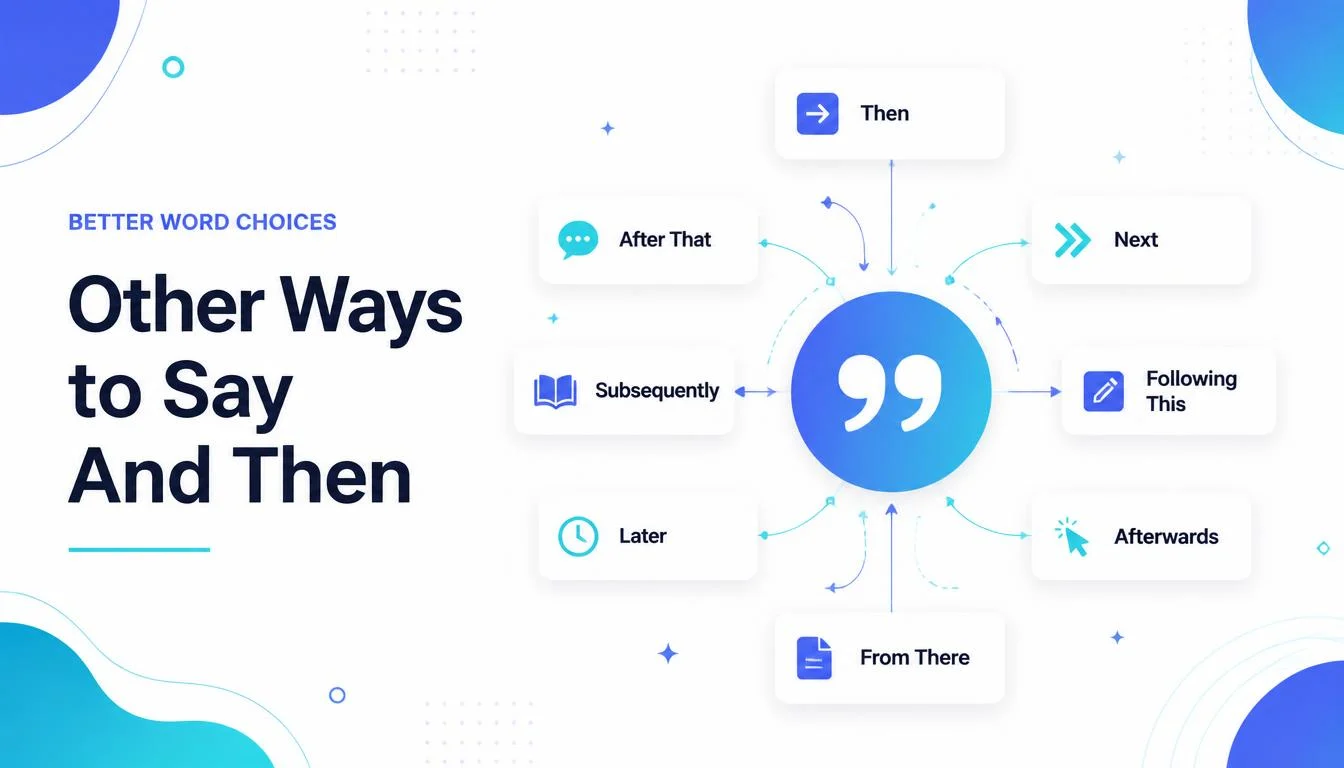
Other ways to say and then include afterward, next, subsequently, following that, and later.
Choose the alternative based on whether you want a formal, casual, or sequential tone.
Looking for other ways to say and then? Using different transition words can make your English sound more natural, fluent, and engaging. The right alternative helps you connect ideas smoothly without repeating the same phrase.
Whether you are writing an essay, telling a story, explaining a process, or speaking in everyday conversations, learning other ways to say and then can improve your communication. These alternatives also help you express sequence and show clearly what happened next.
What Is “Other Ways to Say and Then”? Meaning, Grammar & Real Use
Imagine explaining a project to a colleague, describing a recipe to a friend, or telling someone what happened during your day. You may naturally say, “First, I checked my email, and then I started the report.” The phrase works perfectly, but repeating it several times can make your speech or writing sound predictable. Learning alternatives to and then gives you more control over sequence, timing, and tone.
For English learners, these alternatives are especially useful when you need to move smoothly from one event to another. In professional writing, words such as “subsequently” or “following this” can create a more polished flow. In conversation, “after that” and “next” usually sound more natural.
Understanding these choices also helps when you want to express excitement in English, tell a story clearly, or explain a process without relying on the same transition repeatedly.
Definition
“And then” is a coordinating expression used to show that one event or action happens after another.
Grammar Note
“And then” is commonly used as a transition between clauses or sentences. It is natural in both speech and writing, although some alternatives have a more formal register.
Example: “We finished the meeting, and then we reviewed the notes.”
Where and Why It Is Used
“And then” is common in everyday conversation, storytelling, instructions, narratives, and informal writing. More precise alternatives can help distinguish immediate sequence, later timing, or formal progression.
When Should You Use “And Then”?
Choose a different transition when you want to make the sequence clearer or vary your language.
Spoken English
Use next, after that, or later when explaining events naturally in conversation.
Written English
Use subsequently, following this, or thereafter when a more formal or structured style is appropriate.
Formal Contexts
Academic papers, reports, procedures, and business documents may benefit from precise sequencing words instead of repeatedly using “and then.”
Storytelling
Use afterward, later on, or following that to create smoother movement between events.
Step-by-Step Instructions
Use next, after that, or once this is complete to make procedures easy to follow.
Is It Professional or Just Polite?
“And then” is not impolite. It is a normal, widely understood transition. However, professional communication may sometimes benefit from more specific alternatives, particularly in reports, presentations, and formal instructions.
| Question | Verdict |
|---|---|
| Polite? | ✔️ Yes |
| Professional? | ✔️ Yes, depending on context |
| Formal? | Sometimes |
| Suitable for conversation? | ✔️ Yes |
Business example: “We reviewed the proposal, and then we discussed the implementation timeline.”
For more polished workplace communication, compare it with other professional reaction phrases and transition expressions.
Pros and Cons of Using “And Then”
Pros
- Simple: Easy for English learners and native speakers to understand.
- Natural: Very common in everyday conversation.
- Flexible: Works with many kinds of events and actions.
- Clear sequence: Shows that one event follows another.
Cons
- Can become repetitive: Frequent use may make writing sound monotonous.
- Limited precision: It does not always show how much time passed.
- Less formal in some contexts: Formal documents may benefit from more precise transitions.
- Can weaken variety: Repeating the same transition can make storytelling less engaging.
Common Mistakes People Make
Mistake 1: Repeating “and then” in every sentence
Incorrect: “I woke up, and then I ate, and then I left, and then I arrived.”
Correct: “I woke up, ate breakfast, and then left. After that, I arrived at work.”
Mistake 2: Using a formal transition in casual conversation
Awkward: “I finished lunch. Subsequently, I went shopping.”
Natural: “I finished lunch. After that, I went shopping.”
Mistake 3: Confusing sequence with simultaneous action
Incorrect: “I cooked dinner and then watched TV at the same time.”
Correct: “I cooked dinner and then watched TV.”
Mistake 4: Using “afterward” when naming a specific time
Incorrect: “Afterward at 6 p.m., we met.”
Correct: “Later, at 6 p.m., we met.”
Mistake 5: Overusing “subsequently”
Awkward: “I subsequently went home and subsequently made dinner.”
Better: “I went home and then made dinner.”
“Small tone mistakes can make confident English sound careless.”
Alternatives by Category
Formal alternatives to “and then”
- Subsequently
- Thereafter
- Following this
- Following that
Pro Tip: Use formal transitions when the sequence needs to sound structured, especially in reports, academic writing, and formal explanations.
Casual alternatives
- After that
- Next
- Later
- Afterward
Pro Tip: Choose short, familiar transitions in everyday conversation so your English sounds natural rather than overly formal.
Professional alternatives
- Subsequently
- Following this
- Following the meeting
- Once this is complete
Pro Tip: In workplace writing, select the transition that communicates the exact relationship between two actions.
Informal expressions
- After that
- Next up
- Later on
- From there
Pro Tip: Informal expressions in English work well in conversations and relaxed messages, but consider your audience before using them in formal documents.
“Formal and informal English aren’t about correctness. They’re about context.”
Other Ways to Say “And Then” (Full List with Examples)
These other ways to say and then help you vary your English while making sequences clearer. Choose each expression according to tone, timing, and context.
1. Phrase: After That
Meaning: Following the previous event.
Explanation: A natural transition for everyday sequences.
Example Sentence: “We had lunch, and after that, we went shopping.”
Best Use: Everyday conversation
Worst Use: Formal reports
Tone: Natural, friendly
Context Variability: casual / professional / spoken
2. Phrase: Next
Meaning: The following action or event.
Explanation: Short and clear for ordered steps.
Example Sentence: “Next, we reviewed the final proposal.”
Best Use: Instructions
Worst Use: Formal analysis
Tone: Clear, direct
Context Variability: casual / professional / spoken
3. Phrase: Afterwards
Meaning: At a later time.
Explanation: Shows that something happens after a previous event.
Example Sentence: “We finished the presentation and spoke afterwards.”
Best Use: General writing
Worst Use: Immediate actions
Tone: Neutral, polished
Context Variability: casual / professional / spoken
4. Phrase: Afterward
Meaning: At a later point.
Explanation: Common in American English for describing a later event.
Example Sentence: “She completed the interview and called me afterward.”
Best Use: Everyday writing
Worst Use: Formal procedures
Tone: Neutral, natural
Context Variability: casual / professional / spoken
5. Phrase: Subsequently
Meaning: After something else happens.
Explanation: A formal transition often used in professional and academic writing.
Example Sentence: “The team tested the system and subsequently released it.”
Best Use: Formal writing
Worst Use: Casual chat
Tone: Formal, precise
Context Variability: casual / professional / written
6. Phrase: Following This
Meaning: After the event just mentioned.
Explanation: Clearly connects one action with the next.
Example Sentence: “Following this, the committee reviewed the evidence.”
Best Use: Business reports
Worst Use: Casual stories
Tone: Professional, formal
Context Variability: casual / professional / written
7. Phrase: Following That
Meaning: After the previously mentioned event.
Explanation: Useful for connecting related events without repetition.
Example Sentence: “We discussed the issue, and following that, we agreed on a solution.”
Best Use: Formal explanation
Worst Use: Casual chat
Tone: Neutral, polished
Context Variability: casual / professional / written
8. Phrase: Thereafter
Meaning: From that time onward.
Explanation: More formal than “after that” and often used in official writing.
Example Sentence: “The agreement was signed, and thereafter, implementation began.”
Best Use: Legal writing
Worst Use: Friendly conversation
Tone: Formal, official
Context Variability: casual / professional / written
9. Phrase: Later
Meaning: At a time after the current event.
Explanation: Simple when the exact sequence matters less.
Example Sentence: “We discussed the plan later.”
Best Use: Everyday speech
Worst Use: Precise instructions
Tone: Simple, neutral
Context Variability: casual / professional / spoken
10. Phrase: Later On
Meaning: At some later time.
Explanation: A conversational alternative that sounds relaxed and natural.
Example Sentence: “We can discuss the details later on.”
Best Use: Casual conversation
Worst Use: Academic writing
Tone: Casual, relaxed
Context Variability: casual / professional / spoken
11. Phrase: From There
Meaning: Continuing from that point.
Explanation: Useful when describing progress from one stage to another.
Example Sentence: “We finalized the plan and moved forward from there.”
Best Use: Process discussions
Worst Use: Legal documents
Tone: Natural, conversational
Context Variability: casual / professional / spoken
12. Phrase: Once This Is Complete
Meaning: After the current task finishes.
Explanation: Clearly indicates that the next action depends on completion.
Example Sentence: “Once this is complete, we will send the report.”
Best Use: Work instructions
Worst Use: Casual stories
Tone: Professional, clear
Context Variability: casual / professional / written
13. Phrase: Once That Is Done
Meaning: After that task has finished.
Explanation: Useful for practical instructions and workplace communication.
Example Sentence: “Once that is done, please notify the manager.”
Best Use: Workplace instructions
Worst Use: Academic arguments
Tone: Direct, professional
Context Variability: casual / professional / spoken
14. Phrase: In the Next Step
Meaning: At the following stage.
Explanation: Highlights progression in a process.
Example Sentence: “In the next step, we compare the two results.”
Best Use: Process guides
Worst Use: Personal stories
Tone: Structured, clear
Context Variability: casual / professional / written
15. Phrase: At the Next Stage
Meaning: At the following point in a process.
Explanation: Useful when describing projects, procedures, or development.
Example Sentence: “At the next stage, the team will conduct testing.”
Best Use: Project updates
Worst Use: Casual conversation
Tone: Professional, structured
Context Variability: casual / professional / written
16. Phrase: Afterward, We
Meaning: We did something after the previous event.
Explanation: Places the focus directly on the following action.
Example Sentence: “Afterward, we met with the client.”
Best Use: Event summaries
Worst Use: Formal analysis
Tone: Neutral, natural
Context Variability: casual / professional / spoken
17. Phrase: From That Point
Meaning: Starting from that moment.
Explanation: Useful when a later development begins at a particular point.
Example Sentence: “From that point, the project moved quickly.”
Best Use: Progress summaries
Worst Use: Casual instructions
Tone: Neutral, polished
Context Variability: casual / professional / written
18. Phrase: In Turn
Meaning: One after another or as a consequence.
Explanation: Useful when actions or effects follow in sequence.
Example Sentence: “Each department reviewed the proposal in turn.”
Best Use: Formal explanations
Worst Use: Simple directions
Tone: Formal, precise
Context Variability: casual / professional / written
19. Phrase: In Sequence
Meaning: In a particular order.
Explanation: Emphasizes orderly progression rather than simply saying what happened next.
Example Sentence: “The tasks were completed in sequence.”
Best Use: Technical writing
Worst Use: Casual storytelling
Tone: Technical, precise
Context Variability: casual / professional / written
20. Phrase: The Next Thing
Meaning: The following action or event.
Explanation: Common in spoken storytelling and informal explanations.
Example Sentence: “The next thing we did was check the equipment.”
Best Use: Spoken storytelling
Worst Use: Formal reports
Tone: Casual, conversational
Context Variability: casual / professional / spoken
21. Phrase: Next Up
Meaning: The next item or activity.
Explanation: A concise conversational transition, especially for presentations or schedules.
Example Sentence: “Next up, we will discuss the budget.”
Best Use: Presentations
Worst Use: Legal writing
Tone: Casual, energetic
Context Variability: casual / professional / spoken
22. Phrase: Moving Forward
Meaning: Continuing to the next stage.
Explanation: Often used in business discussions to introduce future actions.
Example Sentence: “Moving forward, we will review the process monthly.”
Best Use: Business communication
Worst Use: Historical narrative
Tone: Professional, forward-looking
Context Variability: casual / professional / written
23. Phrase: From That Point On
Meaning: Beginning at that time and continuing afterward.
Explanation: Focuses on what happened after a particular moment.
Example Sentence: “From that point on, the team worked independently.”
Best Use: Narratives
Worst Use: Simple instructions
Tone: Neutral, narrative
Context Variability: casual / professional / spoken
24. Phrase: In What Followed
Meaning: In the events that happened afterward.
Explanation: A polished expression for narratives and formal descriptions.
Example Sentence: “In what followed, several important changes occurred.”
Best Use: Formal narratives
Worst Use: Casual messages
Tone: Formal, literary
Context Variability: casual / professional / written
25. Phrase: At That Point
Meaning: At that particular moment or stage.
Explanation: Connects a later action to a specific point in time.
Example Sentence: “At that point, we decided to revise the plan.”
Best Use: Explanations
Worst Use: Step instructions
Tone: Neutral, precise
Context Variability: casual / professional / spoken
26. Phrase: In the Meantime
Meaning: During the period before another event.
Explanation: Use this when something happens during an intervening period, not simply afterward.
Example Sentence: “The report was being prepared. In the meantime, we gathered feedback.”
Best Use: Parallel actions
Worst Use: Simple sequence
Tone: Neutral, practical
Context Variability: casual / professional / written
27. Phrase: Following the Meeting
Meaning: After the meeting ends.
Explanation: Names the preceding event directly and sounds professional.
Example Sentence: “Following the meeting, we sent the revised proposal.”
Best Use: Business writing
Worst Use: Casual storytelling
Tone: Professional, formal
Context Variability: casual / professional / written
28. Phrase: Upon Completion
Meaning: Immediately after something is completed.
Explanation: A concise formal expression often used in instructions and procedures.
Example Sentence: “Upon completion, submit the form to reception.”
Best Use: Formal instructions
Worst Use: Casual speech
Tone: Formal, concise
Context Variability: casual / professional / written
29. Phrase: As a Next Step
Meaning: As the following action in a process.
Explanation: Clearly signals what should happen next.
Example Sentence: “As a next step, we will contact the supplier.”
Best Use: Project updates
Worst Use: Personal stories
Tone: Professional, structured
Context Variability: casual / professional / spoken
30. Phrase: Subsequently to This
Meaning: After this event.
Explanation: Intended to express sequence, but “subsequently” or “following this” is usually more natural.
Example Sentence: “Following this, the team began implementation.”
Best Use: Formal revision
Worst Use: Everyday speech
Tone: Formal, awkward
Context Variability: casual / professional / written
Comparison Table: Top 10 Alternatives at a Glance
| Phrase | Tone | Best Use |
|---|---|---|
| After that | Neutral | Everyday conversation |
| Next | Direct | Instructions |
| Afterwards | Neutral | General writing |
| Afterward | Natural | Everyday English |
| Subsequently | Formal | Reports |
| Following this | Professional | Business writing |
| Following that | Polished | Formal explanations |
| Thereafter | Formal | Official writing |
| Later | Neutral | Conversation |
| Moving forward | Professional | Business communication |
Quick Self-Check
Question 1
You are giving a friend directions about what to do after lunch. Which transition sounds most natural?
A. Thereafter
B. Subsequently
C. After that
D. Upon completion
Answer: C. After that
Question 2
You are writing a formal project report. Which phrase is more appropriate?
A. Later on
B. Subsequently
C. Next up
D. The next thing
Answer: B. Subsequently
Question 3
You are explaining the next stage of a workplace project. Which option fits best?
A. As a next step
B. Later on, I guess
C. The next thing
D. Next up, maybe
Answer: A. As a next step
Question 4
Which phrase means that something happens during the period before another event?
A. Thereafter
B. In the meantime
C. Subsequently
D. Following that
Answer: B. In the meantime
FAQs
What are the best alternatives to “and then”?
Common choices include after that, afterward, next, subsequently, following this, and later. The best option depends on your sentence and level of formality.
What is a formal way to say “and then”?
Subsequently, thereafter, and following this are formal alternatives that work well in reports, academic writing, and professional documents.
Can I use “after that” in professional English?
Yes. “After that” is grammatically correct and professional enough for many workplace conversations. More formal alternatives may be preferable in highly formal documents.
What is another way to say “and then” in an essay?
For an essay, consider subsequently, following this, thereafter, or in what followed, depending on the relationship between the events.
How can I avoid repeating “and then”?
Vary your transitions according to meaning. Use next for clear steps, afterward for later events, subsequently for formal writing, and in the meantime for actions happening during an intervening period.
conclusion
Learning other ways to say and then can make your English more flexible, precise, and natural. Instead of automatically repeating one transition, choose an expression that matches the timing, relationship, and formality of the situation.
The goal is not to replace “and then” every time. It is to understand when a different transition makes your speech or writing clearer. Regular practice with these alternatives can strengthen both everyday communication and professional writing.
Read More Related Articles:
- Other Ways to Say You’re Beautiful | Beyond the Ordinary Compliment In 2026
- Other Ways to Say I Like You | Words They’ll Never Forget In 2026
- Other Ways to Say I Love You | Melt Hearts and Strengthen Your Bond In 2026

Henry Walker is an American writer and blogger with a keen interest in communication, language and digital content. At TextsResponse.com, he creates informative and reader-focused resources designed to help people communicate with clarity, confidence and authenticity.