Quick Answer
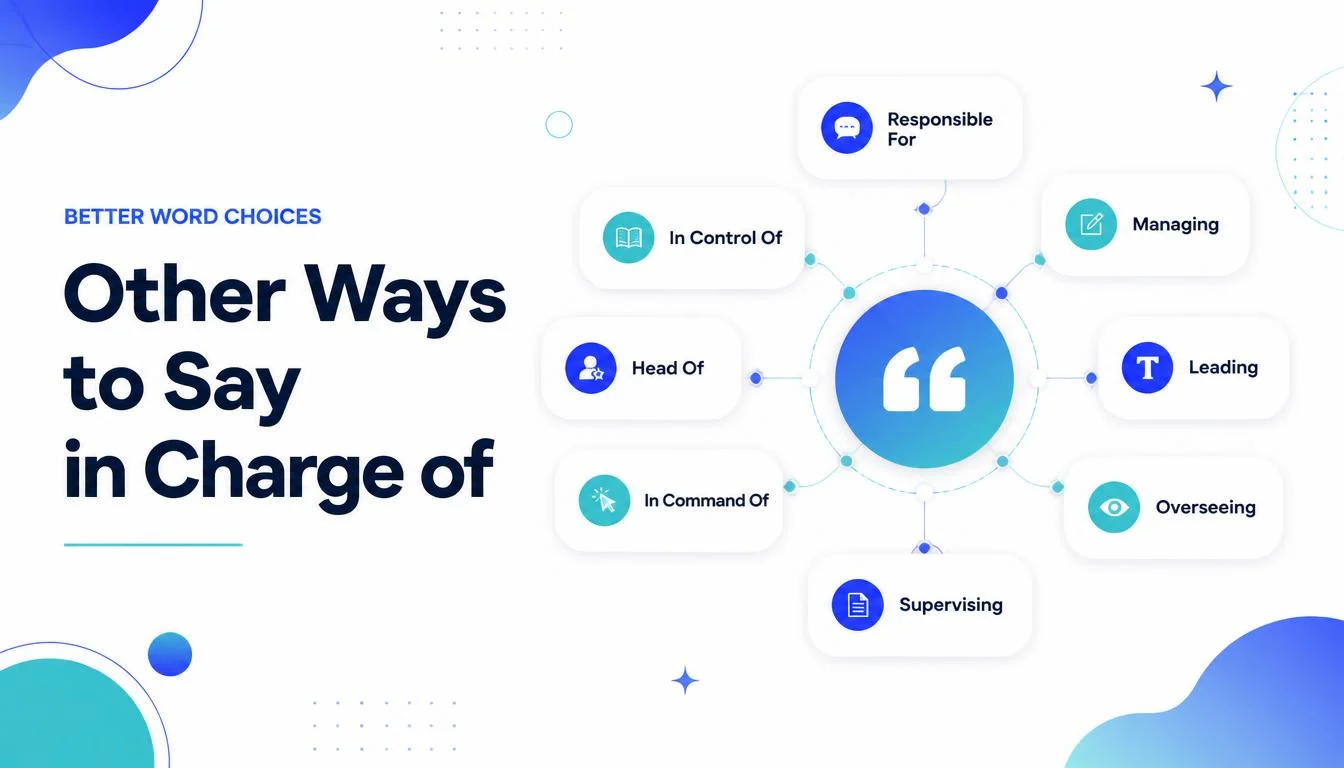
Other ways to say “in charge of” include responsible for, overseeing, managing, supervising, leading, and handling.
Looking for other ways to say in charge of can help you sound more natural, precise, and confident in English. Different alternatives work better in professional emails, workplace conversations, resumes, and everyday situations.
Whether you mean managing a team, overseeing a project, or being responsible for a task, learning these alternatives gives you more flexibility. These expressions can help you communicate your role clearly without repeating the same phrase.
What Is “In Charge of”? (Meaning, Grammar & Real Use)
Imagine you are introducing yourself during a team meeting. Saying, “I am in charge of the marketing project” immediately tells your colleagues that you have responsibility for that work. The phrase is common in everyday professional conversations, workplace introductions, emails, and discussions about duties. However, English offers many alternatives to in charge of, and each one can communicate a slightly different relationship with responsibility, authority, or leadership.
For example, responsible for emphasizes accountability, while overseeing highlights supervision. Managing suggests active control of people, tasks, or resources, whereas leading focuses more on direction and guidance. Choosing the right expression helps you sound accurate rather than repetitive.
If you are learning how to express responsibility naturally, understanding these differences can also help you express excitement in English, participate confidently in meetings, and choose professional reaction phrases that fit your role.
Definition: “In charge of” means having responsibility, authority, or control over a person, activity, project, department, or task.
Grammar: It is a prepositional phrase. It is usually followed by a noun or gerund.
Example: “Maria is in charge of organizing the annual conference.”
People use it in both spoken and written English. It is especially common in workplace communication, although some alternatives sound more formal.
When Should You Use “In Charge of”?
Use the expression when you want to clearly communicate responsibility or authority.
- Managing a project: “He is in charge of the new website.”
- Supervising employees: “She is in charge of the sales team.”
- Handling an activity: “I am in charge of arranging the meeting.”
- Taking responsibility: “Who is in charge of this department?”
- Explaining workplace roles: “David is in charge of customer support.”
Spoken vs Written
In charge of is very natural in conversation. It also works in emails and workplace writing, particularly when the tone is straightforward and conversational.
For highly formal reports, resumes, academic writing, or official documents, expressions such as responsible for, overseeing, or directing may sound more precise.
Formal vs Informal
The phrase itself is neither strongly formal nor strongly informal. It is a neutral expression that works across many situations.
In casual conversation, you might say, “Who is in charge here?” In a professional report, you might write, “She is responsible for overseeing the department.”
Is It Professional or Just Polite?
Politeness concerns how respectfully you communicate. Professionalism concerns whether your language is appropriate, precise, and suitable for a workplace or formal setting.
“In charge of” is generally professional enough for everyday workplace communication. However, alternatives such as responsible for, overseeing, and directing can sound more formal when describing official duties.
Business example: “Ms. Patel is responsible for overseeing the company’s regional operations.
Polite? ✔️ Yes
Professional? ✔️ Yes
For more workplace vocabulary and communication guidance, see See also: Professional English Communication Guide.
Pros and Cons of Using “In Charge of”
Pros
- Clear: It immediately communicates responsibility.
- Natural: Native speakers use it frequently.
- Versatile: It works with people, projects, tasks, and departments.
- Easy to understand: English learners and professionals can use it confidently.
Cons
- Can sound general: It does not always explain the exact type of responsibility.
- May imply authority: The phrase can suggest decision-making power that the person does not actually have.
- Less precise: “Responsible for” or “overseeing” may better describe specific duties.
- Can become repetitive: Frequent use in professional writing may make descriptions less varied.
Common Mistakes People Make
1. Using the wrong preposition
❌ “She is in charge for the project.”
✔️ “She is in charge of the project.”
Always use of after “in charge.”
2. Forgetting the gerund after “of”
❌ “He is in charge of organize the event.”
✔️ “He is in charge of organizing the event.”
When a verb follows “of,” use the gerund form.
3. Confusing responsibility with participation
❌ “I am in charge of attending the meeting.”
✔️ “I am attending the meeting.”
“Being in charge of” means having responsibility, not simply taking part.
4. Overstating authority
❌ “I am in charge of approving all company policies.”
✔️ “I am responsible for coordinating policy reviews.”
Choose wording that accurately reflects your actual authority.
5. Using it repeatedly in formal writing
❌ “She is in charge of sales and in charge of training.”
✔️ “She manages sales and oversees employee training.”
Using different precise verbs can make professional writing clearer and more polished.
Small tone mistakes can make confident English sound careless.
Alternatives by Category
Formal alternatives to “In Charge of”
- Responsible for
- Overseeing
- Directing
Pro Tip: Use responsible for when accountability matters, and overseeing when your role involves supervision rather than direct control.
Casual alternatives
- Running
- Handling
- Taking care of
Pro Tip: Use these expressions in everyday conversations when the exact level of authority is not important.
Professional alternatives
- Managing
- Leading
- Supervising
- Heading
Pro Tip: Choose the verb that describes your actual role instead of using a broad expression for every responsibility.
Informal expressions
- Taking care of
- Calling the shots
- Running the show
Pro Tip: Reserve highly informal expressions for relaxed conversations because they may sound too casual in formal workplace writing.
“Formal and informal English aren’t about correctness. They’re about context.”
Other Ways to Say “In Charge of” (Full List with Examples)
These 30 alternatives build fluency and help you communicate responsibility, authority, leadership, or supervision according to tone and context.
1. Phrase: Responsible for
Meaning: Accountable for something.
Explanation: A precise, widely accepted professional alternative.
Example Sentence: “She is responsible for client communication.”
Best Use: Professional writing
Worst Use: Casual banter
Tone: Clear, professional
Context Variability: casual / professional / spoken
2. Phrase: Overseeing
Meaning: Supervising an activity or process.
Explanation: Emphasizes monitoring and coordination rather than doing every task personally.
Example Sentence: “He is overseeing the recruitment process.”
Best Use: Management roles
Worst Use: Simple tasks
Tone: Formal, professional
Context Variability: casual / professional / spoken
3. Phrase: Managing
Meaning: Controlling or organizing work.
Explanation: Strong choice when someone actively handles people, resources, projects, or operations.
Example Sentence: “Nina is managing the development team.”
Best Use: Workplace communication
Worst Use: Minor duties
Tone: Professional, direct
Context Variability: casual / professional / spoken
4. Phrase: Leading
Meaning: Guiding a person or group.
Explanation: Focuses on leadership, direction, and decision-making.
Example Sentence: “Carlos is leading the research team.”
Best Use: Team leadership
Worst Use: Administrative chores
Tone: Confident, professional
Context Variability: casual / professional / spoken
5. Phrase: Supervising
Meaning: Monitoring people’s work.
Explanation: Best when your responsibility involves checking performance, progress, or procedures.
Example Sentence: “She is supervising the warehouse staff.”
Best Use: Staff management
Worst Use: Strategic leadership
Tone: Professional, precise
Context Variability: casual / professional / spoken
6. Phrase: Heading
Meaning: Being the leader of something.
Explanation: Commonly describes someone who leads a department, team, organization, or initiative.
Example Sentence: “James is heading the marketing department.”
Best Use: Leadership roles
Worst Use: Small tasks
Tone: Professional, confident
Context Variability: casual / professional / spoken
7. Phrase: Directing
Meaning: Guiding or controlling activities.
Explanation: Suggests significant authority and decision-making responsibility.
Example Sentence: “She is directing the company’s expansion project.”
Best Use: Senior positions
Worst Use: Routine duties
Tone: Formal, authoritative
Context Variability: casual / professional / spoken
8. Phrase: Running
Meaning: Operating or managing something.
Explanation: Natural in speech and useful for businesses, teams, events, and operations.
Example Sentence: “Tom is running the customer service team.
Best Use: Everyday workplace talk
Worst Use: Formal reports
Tone: Casual, direct
Context Variability: casual / professional / spoken
9. Phrase: Handling
Meaning: Dealing with or managing something.
Explanation: Useful when responsibility involves practical tasks, problems, or situations.
Example Sentence: “I am handling the client accounts.”
Best Use: Practical responsibilities
Worst Use: Executive leadership
Tone: Neutral, practical
Context Variability: casual / professional / spoken
10. Phrase: Taking care of
Meaning: Looking after something.
Explanation: Friendly and flexible, but less precise about formal authority or seniority.
Example Sentence: “I am taking care of the travel arrangements.”
Best Use: Everyday tasks
Worst Use: Formal reports
Tone: Friendly, casual
Context Variability: casual / professional / spoken
11. Phrase: In control of
Meaning: Having control over something.
Explanation: Emphasizes authority and control more strongly than ordinary responsibility.
Example Sentence: “She is in control of the operation.”
Best Use: Authority situations
Worst Use: Support roles
Tone: Strong, direct
Context Variability: casual / professional / spoken
12. Phrase: Accountable for
Meaning: Answerable for results.
Explanation: Strong professional wording that emphasizes responsibility for outcomes.
Example Sentence: “Managers are accountable for team performance.”
Best Use: Formal workplaces
Worst Use: Casual conversation
Tone: Formal, professional
Context Variability: casual / professional / spoken
13. Phrase: Responsible for managing
Meaning: Accountable for management.
Explanation: Adds specificity by identifying management as the responsibility.
Example Sentence: “She is responsible for managing operations.”
Best Use: Job descriptions
Worst Use: Informal chat
Tone: Formal, precise
Context Variability: casual / professional / spoken
14. Phrase: In control of operations
Meaning: Managing operational activity.
Explanation: Appropriate when someone has direct authority over ongoing business operations.
Example Sentence: “Mr. Lee is in control of operations.”
Best Use: Business settings
Worst Use: Casual introductions
Tone: Formal, authoritative
Context Variability: casual / professional / spoken
15. Phrase: At the helm of
Meaning: Leading something.
Explanation: A more expressive phrase often used for organizations, companies, or major initiatives.
Example Sentence: “She is at the helm of the new division.”
Best Use: Leadership writing
Worst Use: Routine tasks
Tone: Formal, expressive
Context Variability: casual / professional / spoken
16. Phrase: Leading the way on
Meaning: Taking a leading role.
Explanation: Highlights initiative and leadership in a particular area or activity.
Example Sentence: “Our team is leading the way on sustainability.
Best Use: Positive messaging
Worst Use: Neutral reporting
Tone: Confident, positive
Context Variability: casual / professional / spoken
17. Phrase: Coordinating
Meaning: Organizing different activities or people.
Explanation: Ideal when responsibility involves bringing several tasks or groups together.
Example Sentence: “Priya is coordinating the conference.”
Best Use: Project work
Worst Use: Executive authority
Tone: Neutral, professional
Context Variability: casual / professional / spoken
18. Phrase: Administering
Meaning: Managing an organized process.
Explanation: Common in formal, institutional, educational, and administrative contexts.
Example Sentence: “He is administering the scholarship program.”
Best Use: Formal administration
Worst Use: Casual conversation
Tone: Formal, precise
Context Variability: casual / professional / spoken
19. Phrase: Operating
Meaning: Running a system or organization.
Explanation: Useful for businesses, machinery, systems, and organized activities.
Example Sentence: “They are operating the regional office.”
Best Use: Operational contexts
Worst Use: Personal duties
Tone: Neutral, professional
Context Variability: casual / professional / spoken
20. Phrase: Overseeing the work of
Meaning: Supervising someone’s work.
Explanation: Clearly identifies responsibility for monitoring another person’s or team’s activities.
Example Sentence: “She is overseeing the work of three analysts.”
Best Use: Team supervision
Worst Use: Peer relationships
Tone: Formal, professional
Context Variability: casual / professional / spoken
21. Phrase: Supervising the work of
Meaning: Monitoring another person’s work.
Explanation: A precise option when formal supervision is part of someone’s duties.
Example Sentence: “He is supervising the work of new employees.”
Best Use: Staff supervision
Worst Use: Equal partnerships
Tone: Formal, direct
Context Variability: casual / professional / spoken
22. Phrase: Taking responsibility for
Meaning: Accepting responsibility.
Explanation: Emphasizes accountability and ownership rather than organizational authority.
Example Sentence: “She is taking responsibility for the project.”
Best Use: Accountability discussions
Worst Use: Routine introductions
Tone: Serious, professional
Context Variability: casual / professional / spoken
23. Phrase: Charged with
Meaning: Officially assigned responsibility.
Explanation: Formal wording often used for duties, assignments, investigations, or official roles.
Example Sentence: “He was charged with reviewing the proposal.”
Best Use: Formal assignments
Worst Use: Friendly conversation
Tone: Formal, official
Context Variability: casual / professional / spoken
24. Phrase: Entrusted with
Meaning: Given responsibility or trust.
Explanation: Highlights that someone has been trusted with an important duty or responsibility.
Example Sentence: “She was entrusted with managing the account.”
Best Use: Formal recognition
Worst Use: Minor errands
Tone: Formal, respectful
Context Variability: casual / professional / spoken
25. Phrase: Responsible for overseeing
Meaning: Accountable for supervision.
Explanation: Combines accountability with oversight and works well in professional descriptions.
Example Sentence: “He is responsible for overseeing compliance.”
Best Use: Job descriptions
Worst Use: Casual speech
Tone: Formal, professional
Context Variability: casual / professional / spoken
26. Phrase: In command of
Meaning: Having authority over people or operations.
Explanation: Stronger than ordinary responsibility and often associated with official authority or command structures.
Example Sentence: “She is in command of the unit.”
Best Use: Authority contexts
Worst Use: Peer teamwork
Tone: Strong, formal
Context Variability: casual / professional / spoken
27. Phrase: Calling the shots
Meaning: Making the important decisions.
Explanation: An informal expression emphasizing decision-making power rather than routine responsibility.
Example Sentence: “The director is calling the shots.”
Best Use: Informal conversation
Worst Use: Formal reports
Tone: Informal, assertive
Context Variability: casual / professional / spoken
28. Phrase: Running the show
Meaning: Managing an activity or situation.
Explanation: Informal wording that suggests someone is controlling how something operates.
Example Sentence: “Who is running the show today?”
Best Use: Casual conversation
Worst Use: Formal emails
Tone: Informal, conversational
Context Variability: casual / professional / spoken
29. Phrase: Taking the lead on
Meaning: Accepting primary leadership.
Explanation: Useful when someone takes initiative and becomes the main person responsible for an activity.
Example Sentence: “Lena is taking the lead on the campaign.”
Best Use: Team projects
Worst Use: Routine duties
Tone: Confident, professional
Context Variability: casual / professional / spoken
30. Phrase: In charge of managing
Meaning: Responsible for management.
Explanation: Makes the management responsibility explicit and works well when describing workplace duties.
Example Sentence: “He is in charge of managing the regional team.”
Best Use: Role descriptions
Worst Use: Casual introductions
Tone: Neutral, professional
Context Variability: casual / professional / spoken
Comparison Table: Top 10 Alternatives at a Glance
| Phrase | Tone | Best Use |
|---|---|---|
| Responsible for | Professional | Workplace writing |
| Overseeing | Formal | Management duties |
| Managing | Professional | Team management |
| Leading | Professional | Team leadership |
| Supervising | Formal | Staff oversight |
| Heading | Professional | Department leadership |
| Directing | Formal | Senior leadership |
| Handling | Neutral | Practical duties |
| Coordinating | Professional | Project organization |
| Taking the lead on | Confident | Team projects |
Quick Self-Check (Mini Quiz)
1. You are writing a formal job description. Which phrase best emphasizes accountability?
A. Running
B. Responsible for
C. Calling the shots
D. Running the show
Answer: B. Responsible for
2. Your colleague supervises a team but does not make all strategic decisions. Which phrase is most precise?
A. Supervising
B. In command of
C. Calling the shots
D. Running the show
Answer: A. Supervising
3. You are talking casually about the person making the main decisions.
A. Administering
B. Charged with
C. Calling the shots
D. Responsible for overseeing
Answer: C. Calling the shots
4. You want to describe someone who has taken primary responsibility for a project.
A. Taking the lead on
B. Taking care of
C. Operating
D. Administering
Answer: A. Taking the lead on
FAQs
What are the most professional alternatives to “in charge of”?
Responsible for, overseeing, managing, supervising, and directing are strong professional choices. Select one based on the exact responsibility involved.
Is “in charge of” professional English?
Yes. “In charge of” is a neutral expression that is widely used in professional conversations and workplace communication. More formal alternatives can provide greater precision in official writing.
What is a formal way to say “in charge of”?
Responsible for, accountable for, overseeing, directing, and charged with can sound more formal, depending on the context.
What is a casual way to say “in charge of”?
Running, handling, and taking care of are natural in casual or conversational English. Calling the shots and running the show are more distinctly informal.
What is the difference between “in charge of” and “responsible for”?
“In charge of” often suggests authority or control, while “responsible for” focuses more directly on accountability for a task, activity, or result.
conclusion
Learning different expressions for responsibility helps you communicate with greater precision. Instead of repeating one phrase, you can choose managing, overseeing, leading, supervising, or responsible for according to the actual role and level of authority.
Pay attention to context, especially when moving between everyday conversation and professional writing. Practicing these alternatives in emails, meetings, presentations, and everyday conversations can make your English more flexible and confident.
Read More Related Articles:
- Other Ways to Say “Work Hard” | Say It Better in Work and Life In 2026
- Other Ways to Say Touch Base | Better Phrases for Every Situation In 2026
- Other Ways to Say Happy Sunday | Lovely Wishes Beyond the Usual In 2026

Daniel Murphy is a professional writer and blogger specializing in digital communication and messaging trends. As a contributor to TextsResponse.com, he creates reader-focused content designed to help people find the right words at the right time.