Quick Answer
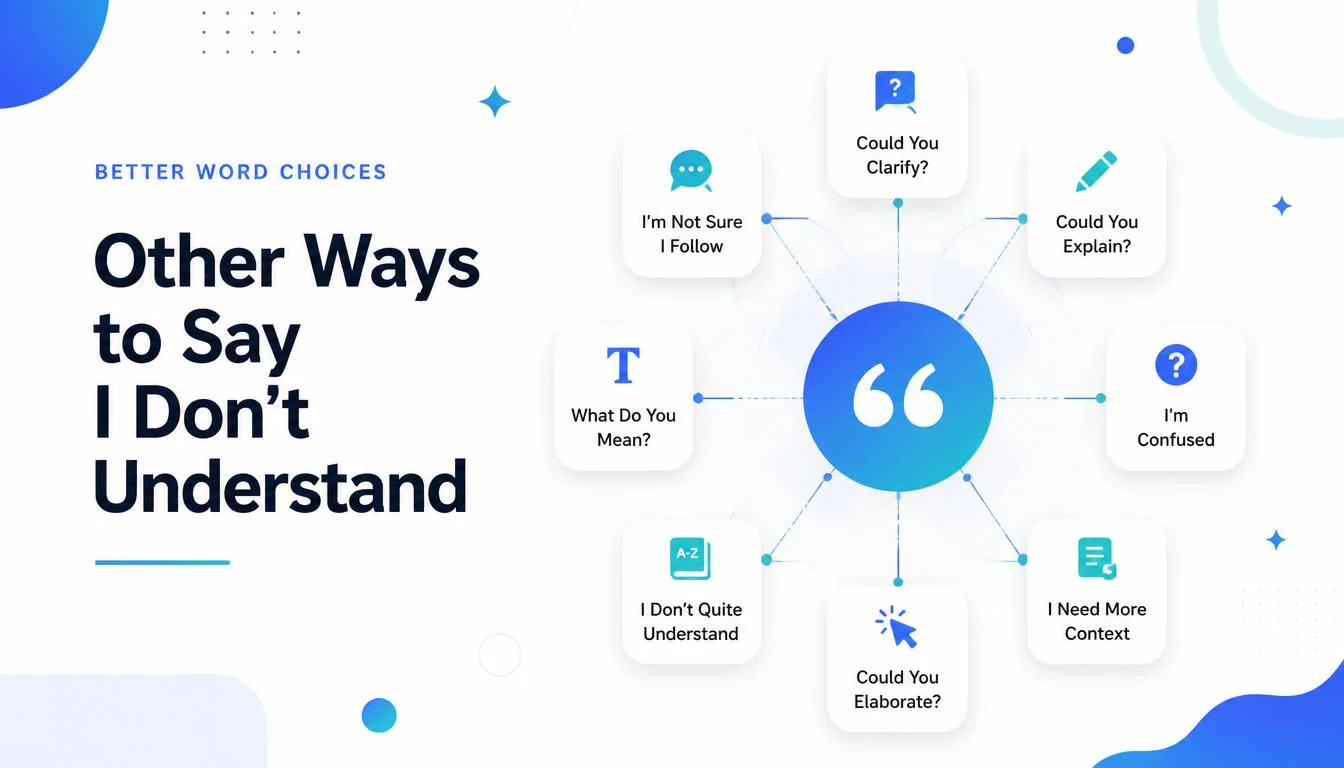
Other ways to say “I don’t understand” include I’m not sure I follow, Could you clarify?, I’m confused, and I don’t quite get it.
“I don’t understand” is useful when you need someone to explain something more clearly. However, using different alternatives can help you sound more natural, polite, and confident in English.
Whether you are speaking with a friend, colleague, teacher, or client, choosing the right alternative depends on the situation and tone. These phrases can help you ask for clarification without sounding abrupt.
What Is “I Don’t Understand”? Meaning, Grammar & Real Use
Imagine you are in a meeting and someone explains a complicated process using unfamiliar terms. Simply saying “I don’t understand” is grammatically correct, but depending on your tone, it may sound direct or even slightly abrupt. A more specific response can show that you are listening and genuinely trying to follow the discussion.
Knowing alternatives to I don’t understand gives English learners more control over conversations. You can ask someone to repeat information, request an explanation, check a detail, or politely admit that something is unclear. These choices are especially useful in classrooms, meetings, emails, interviews, and everyday conversations.
The phrase “I don’t understand” means that you do not currently comprehend the meaning, explanation, instruction, or information being presented. It is a negative statement using the verb phrase “understand.”
Grammar-wise, “I don’t understand” is a present-simple statement. It is common in both spoken and written English and is generally neutral, although its directness can vary with context and tone.
Example: “I don’t understand how this calculation works.”
People use it when information is unclear or unfamiliar. In professional situations, a softer alternative can make a request for clarification sound more collaborative.
When Should You Use “I Don’t Understand”?
You can use the phrase when you genuinely need clarification and want to communicate the problem directly. The best alternative depends on your relationship with the listener and the setting.
- Everyday conversation: Use “I don’t understand” when speaking with friends, family, or acquaintances.
- Classrooms: Ask for repetition or a simpler explanation when a lesson is unclear.
- Work meetings: Use a professional clarification phrase rather than interrupting with a blunt statement.
- Emails: Explain exactly which point is unclear so the recipient knows how to help.
- Instructions: Ask someone to clarify a specific step rather than saying the entire task is confusing.
- Technical discussions: Request an example, definition, or additional explanation.
- Cross-cultural communication: Use polite clarification phrases when you want to avoid sounding impatient.
Spoken vs Written
In speech, phrases such as “I’m not quite following” and “Could you explain that again?” sound natural.
In writing, “Could you clarify this point?” or “Could you provide some additional context?” can sound more precise.
Formal vs Informal
Formal settings generally benefit from specific and courteous requests. Informal conversations allow shorter expressions such as “I’m confused” or “I don’t quite get it.”
Is It Professional or Just Polite?
Politeness and professionalism overlap, but they are not identical. “I don’t understand” is polite enough in many everyday situations, but it can sound direct when used without additional context.
A professional version identifies what needs clarification and keeps the conversation constructive.
Business example: “Could you clarify how this change will affect the project timeline?”
Polite? ✔️ Yes
Professional? ✔️ Yes, when used with appropriate context and tone
Pros and Cons of Using “I Don’t Understand”
Pros
- Simple: The meaning is immediately clear.
- Common: Most English speakers understand it instantly.
- Honest: It directly communicates a comprehension problem.
- Flexible: It works in many everyday situations.
Cons
- Can sound blunt: The direct statement may feel abrupt in sensitive conversations.
- Can be vague: It does not explain what part is unclear.
- Less collaborative: It focuses on the speaker’s difficulty rather than the next step.
- Limited tone range: It does not offer the variety available through more specific clarification phrases.
Common Mistakes People Make
Using clarification phrases correctly is not only about grammar. Tone, specificity, and context also matter.
1. Saying “I am not understanding”
Incorrect: “I am not understanding what you mean.”
Correct: “I don’t understand what you mean.”
For a general state of comprehension, the simple present “I don’t understand” is normally more natural.
2. Using “I don’t get it” in a formal meeting
Incorrect: “Sorry, I don’t get it.”
Correct: “Sorry, could you clarify that point?”
“I don’t get it” is common in casual speech but may sound too informal for professional communication.
3. Asking “What?” without context
Incorrect: “What?”
Correct: “Could you repeat that, please?”
A complete request sounds more courteous and makes your intention clearer.
4. Saying “You are confusing me”
Incorrect: “You are confusing me.”
Correct: “I’m having trouble following this part.”
The second version focuses on your understanding rather than directly blaming the other speaker.
5. Using “I don’t understand anything”
Incorrect: “I don’t understand anything about this.”
Correct: “I’m unclear about this particular section.”
A specific statement communicates exactly where you need help.
Pull Quote: “Small tone mistakes can make confident English sound careless.”
Alternatives by Category
Formal alternatives to “I Don’t Understand”
- Could you clarify?
- Could you elaborate?
- Could you provide further explanation?
Pro Tip: In formal writing, identify the exact point that needs clarification whenever possible.
Casual alternatives
- I’m not quite following.
- I don’t quite get it.
- I’m a little confused.
Pro Tip: Use relaxed expressions with people you know well, especially in informal conversation.
Professional alternatives
- Could you clarify that point?
- Could you walk me through it?
- I’m having trouble following this.
Pro Tip: Pair your clarification request with a specific question to keep the conversation productive.
Informal expressions
- I’m confused.
- I’m lost.
- That doesn’t make sense to me.
Pro Tip: Reserve very casual expressions for situations where an informal tone is already established.
Pull Quote: “Formal and informal English aren’t about correctness. They’re about context.”
Other Ways to Say “I Don’t Understand” (Full List with Examples)
These 30 alternatives build fluency by helping you request clarification with different levels of formality, directness, and confidence.
1. Phrase: Could You Clarify?
Meaning: Ask someone to make something clearer.
Explanation: Polite and concise.
Example Sentence: “Could you clarify the final requirement?”
Best Use: Professional requests
Worst Use: Casual banter
Tone: Polite, direct
Context Variability: professional / spoken / written
2. Phrase: Could You Explain That Again?
Meaning: Ask someone to repeat an explanation.
Explanation: Useful when you heard the information but did not understand it.
Example Sentence: “Could you explain that again, please?”
Best Use: Everyday clarification
Worst Use: Urgent interruptions
Tone: Polite, neutral
Context Variability: casual / professional / spoken
3. Phrase: I’m Not Quite Following
Meaning: Say that an explanation is unclear.
Explanation: Softer than directly saying you do not understand.
Example Sentence: “I’m not quite following the last step.”
Best Use: Meetings, discussions
Worst Use: Formal documents
Tone: Polite, cautious
Context Variability: casual / professional / spoken
4. Phrase: Could You Elaborate?
Meaning: Ask for more detail.
Explanation: Appropriate when the speaker has provided an incomplete explanation.
Example Sentence: “Could you elaborate on that proposal?”
Best Use: Formal discussions
Worst Use: Casual chat
Tone: Formal, courteous
Context Variability: professional / spoken / written
5. Phrase: I’m Having Trouble Understanding
Meaning: Say that something is difficult to comprehend.
Explanation: Clearly communicates difficulty without blaming the speaker.
Example Sentence: “I’m having trouble understanding this section.”
Best Use: Difficult material
Worst Use: Quick replies
Tone: Honest, polite
Context Variability: casual / professional / spoken
6. Phrase: Could You Walk Me Through It?
Meaning: Ask for a step-by-step explanation.
Explanation: Especially useful for procedures, processes, and technical tasks.
Example Sentence: “Could you walk me through the process?”
Best Use: Learning procedures
Worst Use: Simple questions
Tone: Collaborative, polite
Context Variability: professional / spoken / written
7. Phrase: I’m a Little Confused
Meaning: Say that something is unclear.
Explanation: A friendly way to acknowledge uncertainty.
Example Sentence: “I’m a little confused about the instructions.”
Best Use: Friendly discussions
Worst Use: Formal reports
Tone: Friendly, honest
Context Variability: casual / professional / spoken
8. Phrase: Could You Give Me More Context?
Meaning: Ask for background information.
Explanation: Useful when the information makes little sense without additional details.
Example Sentence: “Could you give me more context about this decision?”
Best Use: Workplace discussions
Worst Use: Simple requests
Tone: Professional, neutral
Context Variability: professional / spoken / written
9. Phrase: I’m Not Sure I Follow
Meaning: Politely indicate that you are unsure about an explanation.
Explanation: Softens disagreement or confusion.
Example Sentence: “I’m not sure I follow your reasoning.”
Best Use: Professional discussions
Worst Use: Casual jokes
Tone: Diplomatic, polite
Context Variability: professional / spoken / written
10. Phrase: Could You Put That Another Way?
Meaning: Ask someone to explain something differently.
Explanation: Useful when the original wording is difficult to understand.
Example Sentence: “Could you put that another way?”
Best Use: Clarifying concepts
Worst Use: Formal complaints
Tone: Polite, direct
Context Variability: casual / professional / spoken
11. Phrase: I’m Not Clear on That
Meaning: Say that a point remains unclear.
Explanation: Concise and particularly useful in workplace communication.
Example Sentence: “I’m not clear on that requirement.”
Best Use: Workplace clarification
Worst Use: Casual greetings
Tone: Professional, neutral
Context Variability: professional / spoken / written
12. Phrase: Could You Give an Example?
Meaning: Ask for an example to make an idea clearer.
Explanation: Excellent when a definition or explanation feels too abstract.
Example Sentence: “Could you give an example of what you mean?”
Best Use: Learning concepts
Worst Use: Obvious points
Tone: Curious, polite
Context Variability: casual / professional / spoken
13. Phrase: I Don’t Quite Get It
Meaning: Say that you do not fully understand.
Explanation: Natural and common in relaxed conversation.
Example Sentence: “I don’t quite get it. Could you explain?”
Best Use: Casual conversation
Worst Use: Formal emails
Tone: Casual, friendly
Context Variability: casual / spoken / professional
14. Phrase: That Isn’t Clear to Me
Meaning: State that information remains unclear.
Explanation: A neutral alternative that avoids sounding confrontational.
Example Sentence: “That isn’t clear to me. Could you explain?”
Best Use: Clarification requests
Worst Use: Casual banter
Tone: Neutral, polite
Context Variability: casual / professional / spoken
15. Phrase: Could You Rephrase That?
Meaning: Ask someone to use different wording.
Explanation: Useful when the idea may be understandable but the wording is difficult.
Example Sentence: “Could you rephrase that for me?”
Best Use: Clearer wording
Worst Use: Informal greetings
Tone: Polite, direct
Context Variability: professional / spoken / written
16. Phrase: I’m Lost
Meaning: Say that you no longer understand the discussion.
Explanation: Very natural but informal.
Example Sentence: “I’m lost. Could we go back to the previous step?”
Best Use: Informal learning
Worst Use: Formal reports
Tone: Casual, honest
Context Variability: casual / spoken / professional
17. Phrase: I Need Some Clarification
Meaning: State that additional explanation is needed.
Explanation: Direct, professional, and useful in written communication.
Example Sentence: “I need some clarification regarding the deadline.”
Best Use: Business communication
Worst Use: Casual chatter
Tone: Professional, direct
Context Variability: professional / written / spoken
18. Phrase: Could You Break That Down?
Meaning: Ask for a simpler explanation.
Explanation: Helpful when a subject contains several complicated parts.
Example Sentence: “Could you break that down into a few steps?”
Best Use: Complex topics
Worst Use: Formal reports
Tone: Friendly, practical
Context Variability: casual / professional / spoken
19. Phrase: I’m Unclear About This
Meaning: Say that you lack clarity about something.
Explanation: A concise professional expression for conversations and emails.
Example Sentence: “I’m unclear about this part of the agreement.”
Best Use: Written clarification
Worst Use: Casual jokes
Tone: Formal, neutral
Context Variability: professional / written / spoken
20. Phrase: Could You Provide Further Explanation?
Meaning: Request more information or clarification.
Explanation: More formal than “Could you explain that again?”
Example Sentence: “Could you provide further explanation of this requirement?”
Best Use: Formal writing
Worst Use: Casual conversation
Tone: Formal, courteous
Context Variability: professional / written / spoken
21. Phrase: I’m Not Sure What You Mean
Meaning: Say that the speaker’s intended meaning is unclear.
Explanation: Useful when you understand the words but not the message.
Example Sentence: “I’m not sure what you mean by ‘adjust the plan.’”
Best Use: Clarifying meaning
Worst Use: Heated arguments
Tone: Neutral, cautious
Context Variability: casual / professional / spoken
22. Phrase: Can You Explain What You Mean?
Meaning: Ask for clarification of someone’s meaning.
Explanation: Straightforward and useful across many conversations.
Example Sentence: “Can you explain what you mean by that?”
Best Use: Direct clarification
Worst Use: Sensitive criticism
Tone: Direct, neutral
Context Variability: casual / professional / spoken
23. Phrase: I’m Having Difficulty Following
Meaning: Say that you are struggling to follow an explanation.
Explanation: A polished alternative for meetings and academic settings.
Example Sentence: “I’m having difficulty following the proposed changes.”
Best Use: Formal discussions
Worst Use: Casual chat
Tone: Formal, polite
Context Variability: professional / spoken / written
24. Phrase: Could You Simplify That?
Meaning: Ask someone to make an explanation easier.
Explanation: Useful when terminology or sentence structure is too complex.
Example Sentence: “Could you simplify that explanation for the team?”
Best Use: Complex information
Worst Use: Sensitive feedback
Tone: Direct, courteous
Context Variability: professional / spoken / written
25. Phrase: I May Be Missing Something
Meaning: Politely suggest that you may not have understood a point.
Explanation: This softens the request and avoids placing blame.
Example Sentence: “I may be missing something, but how does this affect the budget?”
Best Use: Professional questions
Worst Use: Simple instructions
Tone: Diplomatic, cautious
Context Variability: professional / spoken / written
26. Phrase: Could You Clarify What You Mean?
Meaning: Ask the speaker to explain a particular statement.
Explanation: More specific than simply saying you do not understand.
Example Sentence: “Could you clarify what you mean by ‘revised scope’?”
Best Use: Workplace discussions
Worst Use: Casual greetings
Tone: Professional, polite
Context Variability: professional / spoken / written
27. Phrase: I’m Not Following the Logic
Meaning: Say that the reasoning is difficult to understand.
Explanation: Useful during analytical or argumentative discussions.
Example Sentence: “I’m not following the logic behind that conclusion.”
Best Use: Analytical discussions
Worst Use: Casual conversation
Tone: Direct, analytical
Context Variability: professional / spoken / written
28. Phrase: That Doesn’t Make Sense to Me
Meaning: Say that an idea seems unclear or illogical from your perspective.
Explanation: Natural but potentially more direct than other options.
Example Sentence: “That doesn’t make sense to me. Could you explain?”
Best Use: Informal discussion
Worst Use: Sensitive feedback
Tone: Direct, informal
Context Variability: casual / professional / spoken
29. Phrase: Could You Clarify That Point?
Meaning: Ask for more information about a specific point.
Explanation: Precise and especially suitable for meetings and professional writing.
Example Sentence: “Could you clarify that point before we proceed?”
Best Use: Business meetings
Worst Use: Casual banter
Tone: Professional, courteous
Context Variability: professional / spoken / written
30. Phrase: I Need More Information to Understand
Meaning: Say that additional details are necessary.
Explanation: Clearly identifies the need for more information rather than simply expressing confusion.
Example Sentence: “I need more information to understand the proposed process.”
Best Use: Detailed discussions
Worst Use: Quick questions
Tone: Professional, direct
Context Variability: professional / written / spoken
Comparison Table: Top 10 Alternatives at a Glance
| Phrase | Tone | Best Use |
|---|---|---|
| Could you clarify? | Polite, professional | Meetings |
| Could you explain that again? | Polite, neutral | Everyday clarification |
| I’m not quite following | Soft, diplomatic | Discussions |
| Could you elaborate? | Formal, courteous | Formal discussions |
| I’m having trouble understanding | Honest, polite | Difficult topics |
| Could you walk me through it? | Collaborative | Processes |
| Could you give me more context? | Professional, neutral | Workplace discussions |
| I’m not sure I follow | Diplomatic, polite | Professional conversations |
| Could you rephrase that? | Polite, direct | Difficult wording |
| I need some clarification | Professional, direct | Business communication |
Quick Self-Check
Test whether you can choose the right phrase for the situation.
1. You are in a formal work meeting and need more detail.
A. “I’m lost.”
B. “Could you elaborate?”
C. “What?”
Answer: B. “Could you elaborate?” It is concise, professional, and appropriate for a formal discussion.
2. A friend explains something complicated, but you still do not understand.
A. “I don’t quite get it.”
B. “Could you provide further explanation?”
C. “I require additional clarification.”
Answer: A. “I don’t quite get it.” Its relaxed tone fits an informal conversation.
3. You need someone to explain a process step by step.
A. “I’m lost.”
B. “Could you walk me through it?”
C. “What do you mean?”
Answer: B. “Could you walk me through it?” It specifically asks for a structured explanation.
4. You are writing a professional email about an unclear requirement.
A. “I don’t get it.”
B. “I’m lost.”
C. “I need some clarification regarding this requirement.”
Answer: C. “I need some clarification regarding this requirement.” It is clear and suitable for professional writing.
FAQs
What is a polite way to say “I don’t understand”?
“Could you clarify?” is one of the simplest polite alternatives. “Could you explain that again?” is also natural and courteous.
What is a professional way to say “I don’t understand”?
Try “I’m not clear on that,” “I need some clarification,” or “Could you clarify that point?” These expressions work well in meetings and emails.
How can I say “I don’t understand” without sounding rude?
Focus on the information rather than blaming the speaker. For example, say “I’m not quite following” or “Could you put that another way?”
What are informal expressions in English for “I don’t understand”?
Common choices include “I don’t quite get it,” “I’m confused,” and “I’m lost.” Their relaxed tone makes them more suitable for casual conversations.
How can I ask for clarification in English?
Use a specific request such as “Could you clarify that?”, “Could you give me an example?”, or “Could you walk me through it?” The best choice depends on the situation.
conclusion
Learning other ways to say I don’t understand gives you more control over how you communicate. Instead of relying on one phrase, you can choose language that sounds casual, diplomatic, academic, or professional depending on your audience.
Regular practice will also help you become more precise in everyday conversations and workplace communication. The same principle applies when you want to express excitement in English, make professional reaction phrases sound natural, or choose suitable language for other situations.
Read More Related Articles:
- Other Ways to Say Circle Back | Improve Your Workplace Communication In 2026
- Other Ways to Say Welcome to the Team | Warm First Impression In 2026
- Other Ways to Say I Hope All Is Well | Make a Better First Impression In 2026

Victoria Hughes is a content writer dedicated to making communication clearer and more effective. Through TextsResponse.com, she shares practical insights and thoughtfully crafted response ideas that help readers express themselves with confidence.