Quick Answer
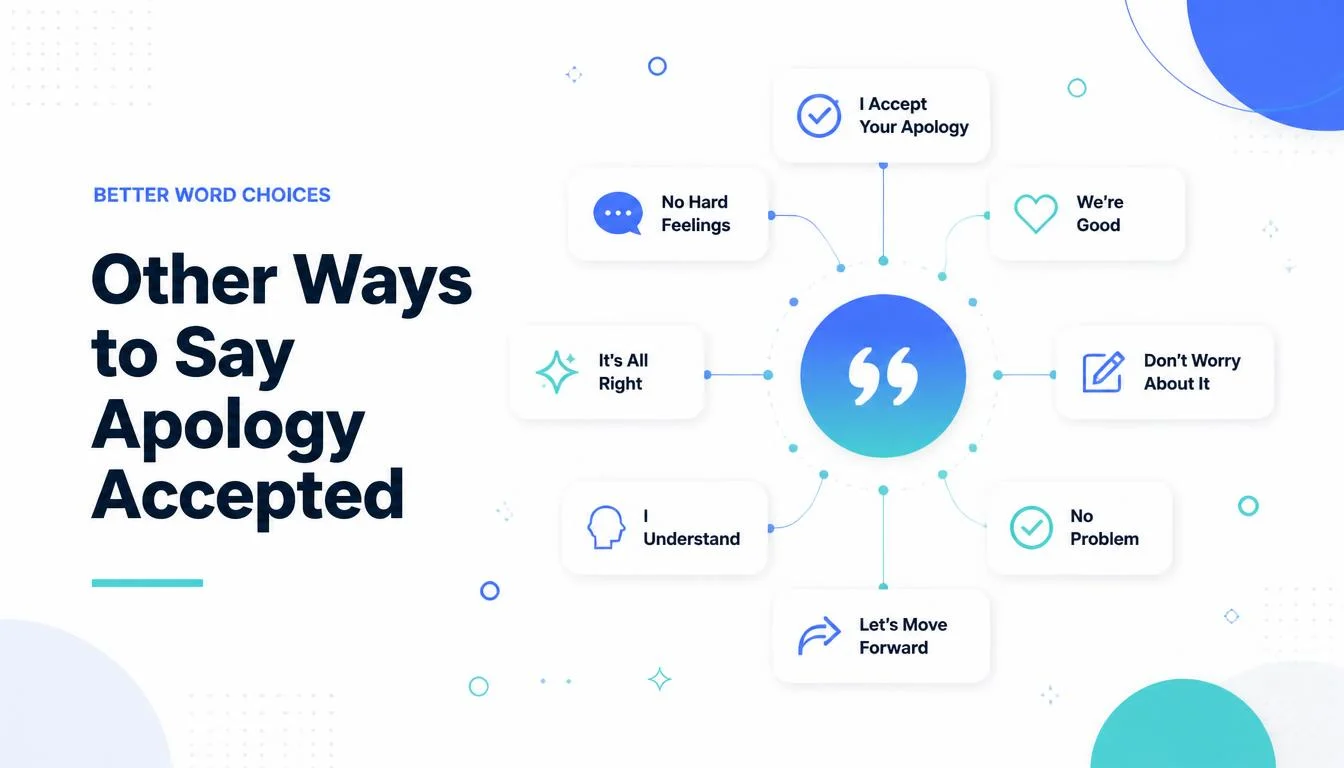
Other ways to say apology accepted include “I forgive you,” “No worries,” “It’s all good,” “We’re okay,” and “I appreciate your apology.” Choose an expression that fits the situation and your relationship.
Learning other ways to say apology accepted can help you respond naturally when someone apologizes. Whether you are talking to a friend, replying to a coworker, or handling a professional situation, the right words can communicate forgiveness, understanding, and respect.
The phrase “apology accepted” is a polite way to acknowledge someone’s apology and show that you are ready to move forward. However, alternatives such as “No worries,” “I appreciate you saying that,” and “Let’s move forward” can sound warmer, more personal, or more professional, depending on the context.
What Is “Apology Accepted”? (Meaning, Grammar & Real Use)
Imagine that a colleague misses an important deadline and later says, “I’m sorry I couldn’t finish the report on time.” You want to acknowledge the apology without creating tension or making the conversation uncomfortable. You might say, “Apology accepted,” “I appreciate you letting me know,” or “Thank you for apologizing.” Each response communicates acceptance differently.
The expression apology accepted means that you acknowledge someone’s apology and indicate that you accept it. Depending on your tone, it can sound warm, neutral, formal, or slightly distant. Understanding alternatives to this expression helps you communicate more naturally in personal relationships, academic settings, and professional conversations.
Learning these phrases also improves your ability to express yourself in English without relying on the same response every time. Just as choosing the right words helps you express excitement in English, selecting an appropriate response to an apology helps you communicate forgiveness, reassurance, or professional courtesy.
Definition: “Apology accepted” is a response used to acknowledge and accept another person’s apology.
Grammar note: The phrase is a shortened construction equivalent to “Your apology is accepted.” It is grammatically correct, but it can sound formal or direct in everyday conversation.
Example: “Thank you for apologizing. I appreciate it.”
People use this expression in spoken conversations, text messages, emails, and workplace discussions. The best alternative depends on whether you want to forgive someone, reassure them, acknowledge their responsibility, or simply move the conversation forward.
When Should You Use “Apology Accepted”?
Choose a response based on the seriousness of the mistake, your relationship with the person, and whether you genuinely feel ready to accept the apology.
Common situations
- Personal relationships: Say “I forgive you” when you want to communicate forgiveness sincerely.
- Workplace conversations: Use “Thank you for acknowledging that” when you want to recognize someone’s accountability.
- Minor mistakes: Say “No worries” or “It’s okay” when the issue is small and you are comfortable moving on.
- Serious misunderstandings: Use “I appreciate your apology” to acknowledge the apology without minimizing what happened.
- Text messages: Say “We’re good” or “It’s all right” when the relationship is comfortable and informal.
- Formal communication: Use “I accept your apology” when clarity and professionalism matter.
Spoken vs. written English
Spoken English: “No worries,” “It’s okay,” and “We’re good” sound natural in everyday conversation. Your tone of voice helps communicate warmth and sincerity.
Written English: “Thank you for your apology” and “I appreciate you acknowledging the issue” work well in emails and professional messages.
Formal vs. informal English
Formal responses emphasize clarity, courtesy, and accountability. Informal expressions often focus on reassurance and restoring a comfortable relationship.
Remember that accepting an apology does not mean you must immediately forget the incident, rebuild trust, or agree that everything is resolved.
Is It Professional or Just Polite?
“Apology accepted” can be both polite and professional. It is especially suitable when you want to acknowledge an apology clearly, although it may sound somewhat formal or authoritative in a casual conversation.
Politeness vs. professionalism
- Politeness: Responding with consideration and respect for the other person’s feelings.
- Professionalism: Acknowledging the apology while maintaining clear expectations and appropriate workplace boundaries.
Business-style example: “Thank you for acknowledging the oversight. I accept your apology, and I appreciate your commitment to preventing this issue in the future.”
- Polite? ✔️ Yes
- Professional? ✔️ Yes
For more workplace communication advice, read the Professional English Communication Guide.
Pros and Cons of Using “Apology Accepted”
Pros
- Clear meaning: It directly communicates that you acknowledge the apology.
- Professional tone: It can be appropriate in formal correspondence and workplace discussions.
- Conciseness: It communicates your response without requiring a lengthy explanation.
- Useful neutrality: It can acknowledge an apology without adding unnecessary emotional detail.
Cons
- Can sound distant: The phrase may feel cold if someone expects emotional reassurance.
- May seem authoritative: In some situations, it can sound as though you are judging the other person.
- Limited emotional range: It does not automatically communicate warmth, forgiveness, or restored trust.
- May feel unnatural: Friends and family often prefer more conversational expressions.
Common Mistakes People Make
1. Accepting an apology too casually after a serious mistake
❌ “No worries!” after a serious breach of trust when you are still upset.
✔️ “I appreciate your apology, but I need some time to process what happened.”
2. Confusing acceptance with forgiveness
❌ “I accepted your apology, so everything must be fine now.”
✔️ “I accept your apology, although rebuilding trust may take time.”
3. Using overly formal language with close friends
❌ “Your apology has been duly acknowledged.”
✔️ “It’s okay. Thanks for saying sorry.”
4. Using vague language in a professional email
❌ “Whatever, it’s fine” in response to a colleague’s formal apology.
✔️ “Thank you for acknowledging the mistake. I appreciate your response.”
5. Saying you forgive someone when you are not ready
❌ “I forgive you” when you still need time and space.
✔️ “Thank you for apologizing. I need a little time before I can move forward.”
Small tone mistakes can make confident English sound careless.
Alternatives by Category
Here are some useful expressions organized by tone and setting. Each phrase appears again in the complete list below.
Formal alternatives to “apology accepted”
- I accept your apology.
- Thank you for your apology.
- I appreciate your acknowledgment.
Pro Tip: Use a complete sentence in formal emails, especially when the apology relates to a mistake or missed commitment.
Casual alternatives
- No worries.
- It’s all good.
- We’re good.
Pro Tip: Reserve relaxed expressions for situations where the mistake is minor and your relationship makes an informal response appropriate.
Professional alternatives
- I appreciate your apology.
- Thank you for acknowledging the issue.
- Let’s move forward.
Pro Tip: When appropriate, pair acknowledgment with a practical next step so everyone understands how the issue will be handled.
Informal expressions
- It’s okay.
- Don’t worry about it.
- No hard feelings.
Pro Tip: Choose language that reflects your actual feelings rather than reassuring someone before you are ready.
“Formal and informal English aren’t about correctness. They’re about context.”
Other Ways to Say “Apology Accepted”: 30 Alternatives With Examples
These expressions help you respond to apologies with different levels of warmth, formality, and forgiveness. They can also strengthen your vocabulary for personal relationships and professional communication.
1. Phrase: I Accept Your Apology
Meaning: I acknowledge and accept your apology.
Explanation: A direct, formal response.
Example Sentence: “I accept your apology and appreciate your honesty.
Best Use: Formal discussions
Worst Use: Playful banter
Tone: Direct, respectful
Context Variability: casual / professional / spoken
2. Phrase: I Forgive You
Meaning: I choose to forgive you.
Explanation: Communicates personal forgiveness.
Example Sentence: “I forgive you, and I hope we can move forward.”
Best Use: Personal relationships
Worst Use: Minor formalities
Tone: Warm, sincere
Context Variability: casual / personal / spoken
3. Phrase: No Worries
Meaning: Do not worry about it.
Explanation: A relaxed response to a minor mistake.
Example Sentence: “No worries, thanks for letting me know.”
Best Use: Everyday conversation
Worst Use: Serious misconduct
Tone: Casual, reassuring
Context Variability: casual / professional / spoken
4. Phrase: It’s Okay
Meaning: The situation is acceptable.
Explanation: A simple way to reassure someone.
Example Sentence: “It’s okay. I understand that mistakes happen.”
Best Use: Everyday conversations
Worst Use: Serious disputes
Tone: Gentle, neutral
Context Variability: casual / professional / spoken
5. Phrase: I Appreciate Your Apology
Meaning: I value your apology.
Explanation: Acknowledges the effort to apologize without promising immediate forgiveness.
Example Sentence: “I appreciate your apology and your willingness to take responsibility.”
Best Use: Workplace communication
Worst Use: Casual joking
Tone: Respectful, professional
Context Variability: casual / professional / written
6. Phrase: Thank You for Apologizing
Meaning: I appreciate your apology.
Explanation: A courteous, natural response.
Example Sentence: “Thank you for apologizing. It means a lot.”
Best Use: Personal conversations
Worst Use: Formal disputes
Tone: Warm, appreciative
Context Variability: casual / professional / spoken
7. Phrase: We’re Good
Meaning: There is no continuing issue between us.
Explanation: Informally signals that the relationship is okay.
Example Sentence: “We’re good. Let’s move on.”
Best Use: Friendly conversations
Worst Use: Formal correspondence
Tone: Relaxed, friendly
Context Variability: casual / spoken / personal
8. Phrase: It’s All Good
Meaning: Everything is fine.
Explanation: A casual expression that minimizes a minor problem.
Example Sentence: “It’s all good. Thanks for clearing that up.”
Best Use: Informal conversations
Worst Use: Serious complaints
Tone: Casual, reassuring
Context Variability: casual / spoken / personal
9. Phrase: No Hard Feelings
Meaning: I do not hold resentment.
Explanation: Communicates a desire to avoid ongoing tension.
Example Sentence: “No hard feelings. I appreciate you reaching out.”
Best Use: Resolving disagreements
Worst Use: Unresolved harm
Tone: Friendly, conciliatory
Context Variability: casual / professional / spoken
10. Phrase: Let’s Move Forward
Meaning: Let us focus on what happens next.
Explanation: Shifts attention toward a constructive next step.
Example Sentence: “Thank you for apologizing. Let’s move forward.”
Best Use: Workplace discussions
Worst Use: Ignoring harm
Tone: Constructive, professional
Context Variability: casual / professional / spoken
11. Phrase: Thank You for Your Apology
Meaning: I acknowledge your apology.
Explanation: A courteous expression suitable for emails.
Example Sentence: “Thank you for your apology and clarification.”
Best Use: Professional emails
Worst Use: Casual banter
Tone: Formal, courteous
Context Variability: professional / written / spoken
12. Phrase: I Understand
Meaning: I understand your explanation or circumstances.
Explanation: Acknowledges someone’s situation but does not necessarily mean forgiveness.
Example Sentence: “I understand. Thank you for explaining what happened.”
Best Use: Sensitive conversations
Worst Use: Assuming forgiveness
Tone: Calm, neutral
Context Variability: casual / professional / spoken
13. Phrase: That’s All Right
Meaning: The mistake is acceptable.
Explanation: A polite response to an apology, especially for a minor inconvenience.
Example Sentence: “That’s all right. Thank you for telling me.”
Best Use: Everyday politeness
Worst Use: Serious misconduct
Tone: Polite, reassuring
Context Variability: casual / professional / spoken
14. Phrase: Don’t Worry About It
Meaning: There is no need to worry.
Explanation: Reassures someone that a minor issue is not a concern.
Example Sentence: “Don’t worry about it. We can reschedule.”
Best Use: Minor mistakes
Worst Use: Major breaches
Tone: Friendly, reassuring
Context Variability: casual / professional / spoken
15. Phrase: I Hold No Grudge
Meaning: I do not intend to remain resentful.
Explanation: A deliberate expression of letting go of resentment.
Example Sentence: “I hold no grudge, and I appreciate your apology.”
Best Use: Personal reconciliation
Worst Use: Brief exchanges
Tone: Sincere, serious
Context Variability: casual / written / spoken
16. Phrase: Apology Accepted
Meaning: Your apology is accepted.
Explanation: Direct and concise, with a potentially formal tone.
Example Sentence: “Apology accepted. Thank you for addressing the issue.”
Best Use: Formal acknowledgment
Worst Use: Emotional reassurance
Tone: Direct, formal
Context Variability: professional / written / spoken
17. Phrase: I Appreciate Your Honesty
Meaning: I value your truthful communication.
Explanation: Recognizes honesty without necessarily accepting every aspect of the apology.
Example Sentence: “I appreciate your honesty about what happened.”
Best Use: Sensitive discussions
Worst Use: Unrelated apologies
Tone: Respectful, thoughtful
Context Variability: casual / professional / spoken
18. Phrase: Thank You for Taking Responsibility
Meaning: I appreciate your accountability.
Explanation: Recognizes that someone has acknowledged their role in a mistake.
Example Sentence: “Thank you for taking responsibility for the error.”
Best Use: Workplace accountability
Worst Use: Minor courtesies
Tone: Professional, constructive
Context Variability: professional / written / spoken
19. Phrase: I Appreciate Your Acknowledgment
Meaning: I value your recognition of the issue.
Explanation: Appropriate when someone recognizes a mistake or concern.
Example Sentence: “I appreciate your acknowledgment of the problem.”
Best Use: Formal communication
Worst Use: Casual friendships
Tone: Formal, measured
Context Variability: professional / written / spoken
20. Phrase: Thank You for Clarifying
Meaning: I appreciate your explanation.
Explanation: Useful when an apology includes clarification or corrects a misunderstanding.
Example Sentence: “Thank you for clarifying the situation.”
Best Use: Resolving misunderstandings
Worst Use: Serious misconduct
Tone: Neutral, professional
Context Variability: professional / written / spoken
21. Phrase: We Can Put This Behind Us
Meaning: We can stop dwelling on the incident.
Explanation: Expresses a willingness to move past a problem.
Example Sentence: “I accept your apology, and we can put this behind us.”
Best Use: Reconciliation
Worst Use: Ongoing harm
Tone: Reassuring, conciliatory
Context Variability: casual / professional / spoken
22. Phrase: I Accept Your Explanation
Meaning: I accept the explanation provided.
Explanation: Accepting an explanation is not necessarily the same as accepting an apology.
Example Sentence: “I accept your explanation and appreciate the clarification.”
Best Use: Clarifying disputes
Worst Use: Assuming forgiveness
Tone: Neutral, measured
Context Variability: professional / written / spoken
23. Phrase: It’s Water Under the Bridge
Meaning: The past issue no longer matters.
Explanation: An idiom used when someone wants to leave an old disagreement behind.
Example Sentence: “It’s water under the bridge now.”
Best Use: Old disagreements
Worst Use: Recent serious harm
Tone: Casual, forgiving
Context Variability: casual / spoken / personal
24. Phrase: I Understand, and I Accept Your Apology
Meaning: I understand the situation and accept your apology.
Explanation: Combines acknowledgment with explicit acceptance.
Example Sentence: “I understand, and I accept your apology.”
Best Use: Serious conversations
Worst Use: Quick exchanges
Tone: Calm, respectful
Context Variability: professional / personal / spoken
25. Phrase: Thank You for Making Things Right
Meaning: I appreciate your efforts to correct the problem.
Explanation: Best when the person has taken action to address the mistake.
Example Sentence: “Thank you for making things right with the client.”
Best Use: Workplace resolution
Worst Use: Empty promises
Tone: Appreciative, constructive
Context Variability: professional / written / spoken
26. Phrase: I Appreciate You Reaching Out
Meaning: I value your effort to contact me.
Explanation: Acknowledges the attempt to reconnect or resolve an issue without automatically promising forgiveness.
Example Sentence: “I appreciate you reaching out to explain.”
Best Use: Reopening communication
Worst Use: Immediate emergencies
Tone: Warm, measured
Context Variability: casual / professional / written
27. Phrase: Let’s Leave It There
Meaning: Let us stop discussing the issue.
Explanation: Can close a conversation, but may sound firm or dismissive.
Example Sentence: “Thank you for apologizing. Let’s leave it there for now.”
Best Use: Ending discussions
Worst Use: Needed clarification
Tone: Firm, restrained
Context Variability: casual / professional / spoken
28. Phrase: I Don’t Hold It Against You
Meaning: I will not use the mistake as a reason for resentment.
Explanation: Communicates forgiveness while recognizing that a mistake occurred.
Example Sentence: “I don’t hold it against you. Thank you for being honest.”
Best Use: Personal reconciliation
Worst Use: Formal emails
Tone: Warm, forgiving
Context Variability: casual / personal / spoken
29. Phrase: We All Make Mistakes
Meaning: Everyone makes errors sometimes.
Explanation: Normalizes an ordinary mistake and reassures the other person.
Example Sentence: “We all make mistakes. Let’s focus on fixing the problem.”
Best Use: Minor errors
Worst Use: Serious misconduct
Tone: Reassuring, understanding
Context Variability: casual / professional / spoken
30. Phrase: I Am Ready to Move On
Meaning: I am willing to leave the incident behind.
Explanation: Expresses readiness to move forward without suggesting that trust is automatically restored.
Example Sentence: “I appreciate your apology, and I am ready to move on.”
Best Use: Personal reconciliation
Worst Use: Premature closure
Tone: Sincere, decisive
Context Variability: casual / professional / spoken
Comparison Table: Top 10 Alternatives at a Glance
These ten responses cover everyday conversations, personal relationships, and professional situations.
| Phrase | Tone | Best Use |
|---|---|---|
| I accept your apology | Formal, respectful | Professional discussions |
| I forgive you | Warm, sincere | Personal relationships |
| No worries | Casual, reassuring | Minor mistakes |
| It’s okay | Gentle, neutral | Everyday conversations |
| I appreciate your apology | Respectful, professional | Workplace communication |
| Thank you for apologizing | Warm, appreciative | Personal conversations |
| We’re good | Relaxed, friendly | Informal discussions |
| No hard feelings | Friendly, conciliatory | Resolving disagreements |
| Let’s move forward | Constructive, professional | Workplace discussions |
| That’s all right | Polite, reassuring | Everyday politeness |
Quick Self-Check: Mini Quiz
Test your understanding of tone and context with these four questions.
Question 1
A colleague apologizes for sending a report late. You want a professional response that acknowledges accountability. What should you say?
- A. “Whatever, it’s fine.”
- B. “Thank you for taking responsibility.”
- C. “It’s water under the bridge.”
Question 2
A close friend apologizes for arriving five minutes late. Which response sounds natural and relaxed?
- A. “No worries.”
- B. “I appreciate your acknowledgment.”
- C. “Your apology is duly accepted.”
Question 3
You accept someone’s apology but still need time to rebuild trust. Which response is most appropriate?
- A. “Everything is completely forgotten.”
- B. “I appreciate your apology, but I need some time.”
- C. “We’re good, and nothing has changed.”
Question 4
You want to acknowledge an explanation without necessarily forgiving the person. Which expression is most accurate?
- A. “I accept your explanation.”
- B. “I forgive you.”
- C. “No hard feelings.”
Question 1A. Whatever, it’s fine.B. Thank you for taking responsibility.C. It’s water under the bridge.
Question 2A. No worries.B. I appreciate your acknowledgment.C. Your apology is duly accepted.
Question 3A. Everything is completely forgotten.B. I appreciate your apology, but I need some time.C. We’re good, and nothing has changed.
Question 4A. I accept your explanation.B. I forgive you.C. No hard feelings.
Check answersReset quiz
FAQs
1. What are other ways to say apology accepted?
You can say “I accept your apology,” “I appreciate your apology,” “No worries,” “It’s okay,” or “Thank you for apologizing.” Choose a phrase that reflects the seriousness of the situation.
2. What is a professional way to accept an apology?
“I appreciate your apology and your willingness to address the issue” is a professional response that acknowledges accountability and encourages constructive communication.
3. How do you accept an apology without saying it’s okay?
Try “Thank you for apologizing,” “I appreciate you acknowledging the issue,” or “I need some time to process this.” These responses acknowledge the apology without minimizing what happened.
4. Is “apology accepted” rude or polite?
It is generally polite and grammatically correct. However, it can sound formal or distant depending on your tone and relationship with the other person.
5. What is the difference between accepting an apology and forgiving someone?
Accepting an apology means acknowledging the person’s expression of regret. Forgiveness involves letting go of resentment or choosing not to hold the mistake against them. The two can happen at different times.
Conclusion
Learning different responses to an apology helps you communicate with confidence, kindness, and clarity. Whether you choose a formal phrase for a workplace email or a relaxed expression for a conversation with a friend, the key is to match your words to your feelings and the situation.
Practice these expressions in everyday conversations, messages, and professional correspondence. Remember that you can acknowledge an apology without immediately forgiving someone or restoring trust. For more vocabulary ideas, explore Other Ways to Say “Amazing” and our Professional English Communication Guide.
Read More Related Articles:
- Other Ways to Say Thanks for Letting Me Know | Leave a Better Impression In 2026
- Other Ways to Say Thank You for Your Business | Customers Truly Appreciate In 2026
- Other Ways to Say “I Hope You’re Doing Well” | People Actually Enjoy Reading In 2026

Victoria Hughes is a content writer dedicated to making communication clearer and more effective. Through TextsResponse.com, she shares practical insights and thoughtfully crafted response ideas that help readers express themselves with confidence.