Quick Answer
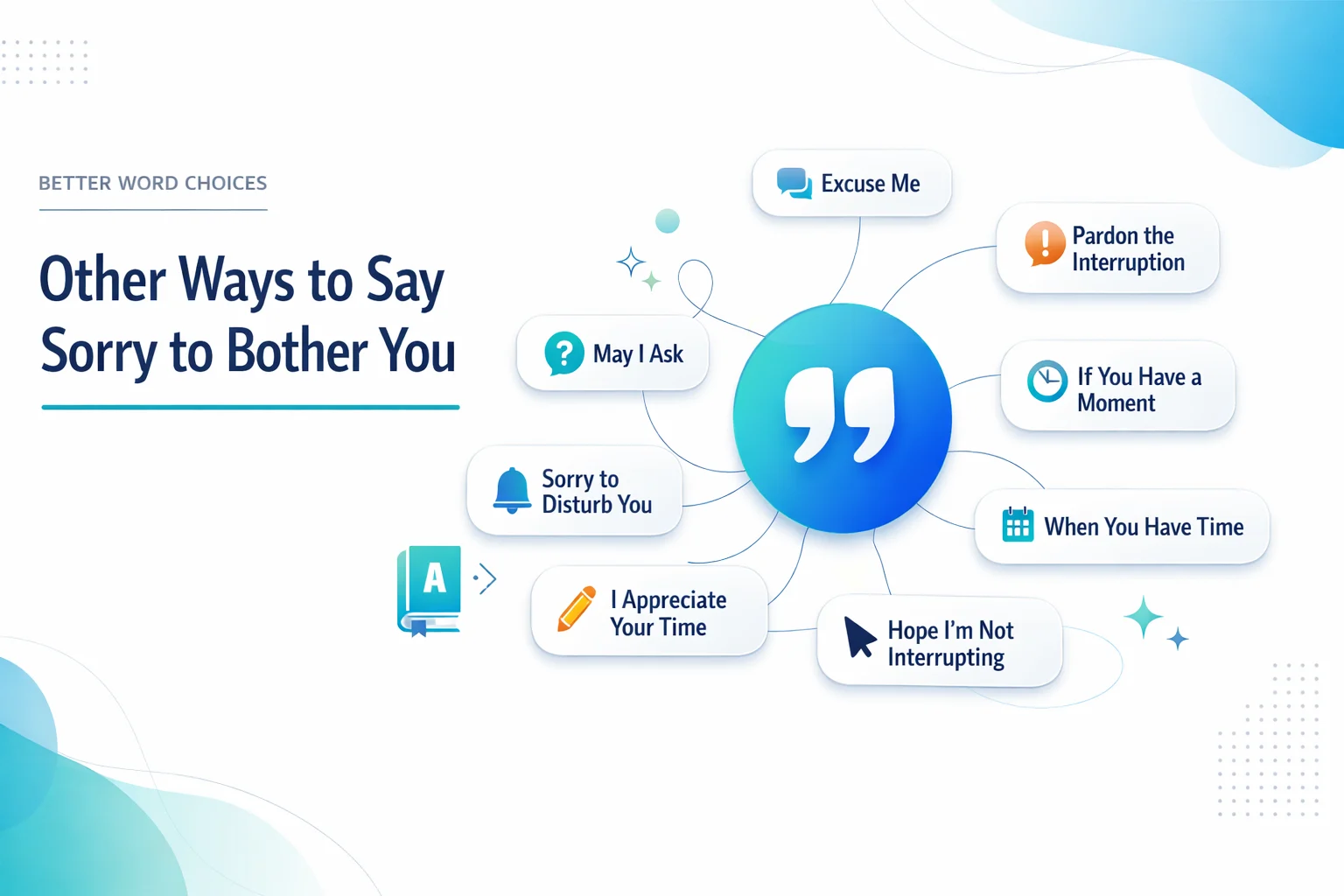
If you want to sound polite without repeating the same phrase, try alternatives like sorry to interrupt, excuse me for a moment, do you have a minute, pardon the intrusion, or I hate to bother you. Each version carries a slightly different tone, so choosing the right one depends on whether you are speaking casually, professionally, or in writing.Top 5 alternatives: sorry to interrupt, excuse me for a moment, do you have a minute, pardon the intrusion, I hate to bother you.
“Sorry to bother you” is one of the most common polite openers in English. People use it before asking a question, requesting help, or interrupting someone who looks busy. It softens the request and shows respect for the other person’s time.
Learning alternatives to sorry to bother you helps you avoid sounding repetitive and lets you match your tone to the situation, whether you are emailing a manager or texting a friend. It also helps you express excitement in English when you are eager to share something but still want to be polite about the interruption.
Mastering these variations makes your spoken and written English sound more natural, confident, and situationally aware, which is a small but powerful fluency skill.
Quick Categories
Formal alternatives to “sorry to bother you”
- Pardon the interruption
- I apologize for the intrusion
- Forgive me for interrupting
- I apologize for taking up your time
Pro Tip: Use formal alternatives in emails, meetings, and written requests to superiors or clients.
Casual alternatives
- Got a sec?
- Hey, quick thing
- Mind if I ask you something?
- Just a quick one
Pro Tip: Save casual phrases for friends, close coworkers, or informal chats, not client-facing conversations.
Professional alternatives
- I know you’re busy, but…
- Could I steal a minute of your time?
- I hope I’m not catching you at a bad time
- Quick question, if you don’t mind
Pro Tip: Pair professional alternatives with a clear, short reason for the interruption to keep communication efficient.
Informal expressions
- My bad for jumping in
- Sorry to bug you
- Not to be a pain, but…
- Hate to be that person, but…
Pro Tip: Informal expressions work well in texting or casual office banter, but avoid them in formal emails.
The right tone makes your English sound professional and confident.”
Common Mistakes
- Overusing “sorry” in every sentence. Example: “Sorry, sorry to bother you, sorry, can I ask something?”
- Using casual phrases in formal emails. Example: “Hey, got a sec?” written to a company director.
- Skipping the reason for interrupting. Example: “Sorry to bother you.” (with no follow-up question)
- Using overly formal phrasing in casual chats. Example: “I apologize for the intrusion” texted to a close friend.
- Repeating the same phrase throughout a conversation. Example: Saying “sorry to bother you” three times in one meeting.
What Does “Sorry to Bother You” Mean?
Sorry to bother you” is a polite expression used to soften an interruption or request. Grammatically, it combines an apology (“sorry”) with an infinitive verb phrase (“to bother you”), functioning as a courteous introduction before a question or favor.
Example Sentence: Sorry to bother you, but could you send me that file when you get a chance?
When to Use “Sorry to Bother You”
- Before asking a colleague a question during work hours
- When interrupting someone who is visibly busy or focused
- In customer service or support conversations
- When sending a follow-up message after no response
Spoken vs Written
- Spoken: Common in face-to-face or phone conversations, often shortened to “sorry to bug you”
- Written: Appears in emails, chat messages, and customer service tickets
Formal vs Informal
- Formal: Used with clients, managers, or unfamiliar contacts
- Informal: Used with friends, family, or close coworkers
Is It Professional or Polite to Say “Sorry to Bother You”?
“Sorry to bother you” is polite, but it is not always the most professional choice. In business communication, over-apologizing can make you sound unsure of yourself or unnecessarily deferential.
Business Example: Instead of “Sorry to bother you, but I need the report,” a more professional version is “Could you share the report when convenient?”
Polite? Yes Professional? No (in most formal business contexts)
Pros and Cons of Using “Sorry to Bother You”
Pros
- Simple and natural to say
- Friendly tone that softens requests
- Common usage across many contexts
- Easy to understand for all English levels
Cons
- Too informal for formal work emails
- Overused, which reduces its impact
- Limited emotional range for varied situations
- Not suitable for confident, assertive communication
Alternatives to sorry to bother you help you sound polite without sounding unsure.
Other Ways to Say Sorry to Bother You
These alternatives will help you sound more fluent, confident, and natural in different situations. Use them according to tone, context, and audience to express excitement, admiration, or approval when appropriate, or simply to soften an interruption politely.
1. Phrase: Sorry to Interrupt
Meaning: A polite way to briefly interrupt someone during a conversation or task.
Explanation: A common expression used before asking a question or sharing important information without sounding rude.
Example Sentence: Sorry to interrupt, but the client is on the phone.
Best Use: Meetings, discussions
Worst Use: Casual texting
Tone: Polite, neutral, professional
Context Variability: Professional, spoken
2. Phrase: Excuse Me for Interrupting
Meaning: A courteous way to apologize before interrupting someone.
Explanation: Slightly more formal than sorry to interrupt, making it suitable for professional environments.
Example Sentence: Excuse me for interrupting, but we need your signature.
Best Use: Formal meetings
Worst Use: Casual conversations
Tone: Formal, respectful, considerate
Context Variability: Professional, spoken
3. Phrase: Pardon the Interruption
Meaning: A formal apology for interrupting an ongoing conversation or activity.
Explanation: Frequently used in business emails, presentations, and announcements.
Example Sentence: Pardon the interruption, but I just need one quick approval.
Best Use: Formal emails, announcements
Worst Use: Informal conversations
Tone: Formal, polished, respectful
Context Variability: Professional, written
4. Phrase: I Apologize for the Intrusion
Meaning: A formal expression of regret for disturbing someone.
Explanation: Best suited for official or high-stakes situations where courtesy is important.
Example Sentence: I apologize for the intrusion, but this matter requires your immediate attention.
Best Use: Official correspondence
Worst Use: Casual conversations
Tone: Formal, serious, courteous
Context Variability: Professional, written
5. Phrase: Forgive Me for Bothering You
Meaning: A respectful apology before asking for someone’s time or assistance.
Explanation: A humble expression that works well in polite or formal communication.
Example Sentence: Forgive me for bothering you, but I need your advice.
Best Use: Formal letters, polite requests
Worst Use: Everyday texting
Tone: Gentle, formal, humble
Context Variability: Professional, written
6. Phrase: I Hate to Bother You, But…
Meaning: An informal way to apologize before making a request.
Explanation: Shows consideration while softening the interruption.
Example Sentence: I hate to bother you, but do you have the updated file?
Best Use: Office conversations
Worst Use: Formal reports
Tone: Casual, considerate, friendly
Context Variability: Professional, spoken
7. Phrase: I Know You’re Busy, But…
Meaning: Acknowledges the other person’s schedule before making a request.
Explanation: Demonstrates respect for someone’s time while introducing your question.
Example Sentence: I know you’re busy, but could you review this quickly?
Best Use: Workplace requests
Worst Use: Emergency situations
Tone: Considerate, respectful, warm
Context Variability: Professional, spoken
8. Phrase: Do You Have a Moment?
Meaning: A polite request for a brief amount of someone’s time.
Explanation: A simple and widely accepted way to begin a conversation.
Example Sentence: Do you have a moment to discuss the project?
Best Use: Office settings
Worst Use: Written apologies
Tone: Neutral, polite
Context Variability: Professional, spoken
9. Phrase: Could I Steal a Minute of Your Time?
Meaning: A friendly request for a brief conversation.
Explanation: Uses lighthearted language to make the interruption feel less intrusive.
Example Sentence: Could I steal a minute of your time before the meeting?
Best Use: Casual workplace conversations
Worst Use: Formal documents
Tone: Friendly, warm
Context Variability: Casual, professional, spoken
10. Phrase: Mind If I Ask You Something?
Meaning: A casual way to ask permission before asking a question.
Explanation: Common among coworkers, friends, and acquaintances.
Example Sentence: Mind if I ask you something about the report?
Best Use: Casual conversations
Worst Use: Formal emails
Tone: Casual, friendly
Context Variability: Casual, spoken
11. Phrase: Quick Question, If You Don’t Mind
Meaning: Introduces a brief request or question politely.
Explanation: Lets the listener know the interruption will only take a moment.
Example Sentence: Quick question, if you don’t mind—where’s the file saved?
Best Use: Workplace chats
Worst Use: Lengthy discussions
Tone: Efficient, polite
Context Variability: Professional, spoken
12. Phrase: I Don’t Mean to Interrupt, But…
Meaning: Acknowledges that the interruption is necessary.
Explanation: Softens the interruption by expressing consideration first.
Example Sentence: I don’t mean to interrupt, but we’re running out of time.
Best Use: Meetings
Worst Use: Text messages
Tone: Polite, cautious, respectful
Context Variability: Professional, spoken
13. Phrase: Sorry to Disturb You
Meaning: A polite apology for interrupting someone’s work or personal time.
Explanation: Slightly more personal than sorry to bother you.
Example Sentence: Sorry to disturb you. Is now a good time to talk?
Best Use: Workplace visits, personal conversations
Worst Use: Group emails
Tone: Polite, gentle
Context Variability: Casual, professional, spoken
14. Phrase: My Apologies for the Interruption
Meaning: A formal apology for interrupting.
Explanation: A polished expression commonly used in professional communication.
Example Sentence: My apologies for the interruption. Please continue.
Best Use: Formal meetings
Worst Use: Informal texts
Tone: Formal, respectful
Context Variability: Professional, written
15. Phrase: I Hope I’m Not Catching You at a Bad Time
Meaning: Checks whether it’s a convenient moment before continuing.
Explanation: Shows respect for the listener’s schedule and availability.
Example Sentence: I hope I’m not catching you at a bad time to discuss this.
Best Use: Phone calls
Worst Use: Urgent requests
Tone: Considerate, warm
Context Variability: Professional, spoken
16. Phrase: Sorry to Pop In Like This
Meaning: A casual apology for arriving or interrupting unexpectedly.
Explanation: Often used during unplanned office or home visits.
Example Sentence: Sorry to pop in like this, but I had a quick question.
Best Use: In-person visits
Worst Use: Formal writing
Tone: Casual, friendly
Context Variability: Casual, spoken
17. Phrase: If You Have a Second…
Meaning: A casual request for a brief moment of someone’s time.
Explanation: Suggests the request will be quick and easy.
Example Sentence: If you have a second, could you check this email?
Best Use: Quick workplace requests
Worst Use: Serious discussions
Tone: Casual, friendly
Context Variability: Casual, professional, spoken
18. Phrase: I Apologize for Taking Up Your Time
Meaning: A formal acknowledgment that you’re asking for someone’s valuable time.
Explanation: Suitable when the discussion may require more than a few moments.
Example Sentence: I apologize for taking up your time with this issue.
Best Use: Formal discussions
Worst Use: Brief questions
Tone: Formal, respectful
Context Variability: Professional, written
19. Phrase: Thanks for Your Patience, Sorry to Bother You
Meaning: Combines appreciation with an apology for interrupting.
Explanation: Particularly useful when sending reminders or repeated follow-ups.
Example Sentence: Thanks for your patience, and sorry to bother you again about this.
Best Use: Follow-up emails
Worst Use: First-time requests
Tone: Grateful, polite
Context Variability: Professional, written
20. Phrase: I Realize You’re in the Middle of Something
Meaning: Recognizes that the timing may not be ideal.
Explanation: Shows empathy before making an urgent request.
Example Sentence: I realize you’re in the middle of something, but this is urgent.
Best Use: Urgent workplace interruptions
Worst Use: Casual chats
Tone: Empathetic, respectful
Context Variability: Professional, spoken
21. Phrase: Not to Be a Pain, But…
Meaning: A casual, humorous way to soften a request.
Explanation: Often used among friends or relaxed coworkers.
Example Sentence: Not to be a pain, but could you resend that link?
Best Use: Casual conversations
Worst Use: Formal emails
Tone: Casual, lighthearted
Context Variability: Casual, spoken
22. Phrase: Excuse the Intrusion
Meaning: A brief, formal apology for interrupting.
Explanation: Common in official announcements and professional writing.
Example Sentence: Excuse the intrusion—I only need a moment.
Best Use: Formal announcements
Worst Use: Text messages
Tone: Formal, respectful
Context Variability: Professional, written
23. Phrase: I Don’t Want to Be a Nuisance, But…
Meaning: Expresses concern about inconveniencing someone.
Explanation: A humble way to introduce a request.
Example Sentence: I don’t want to be a nuisance, but I need this by Friday.
Best Use: Polite requests
Worst Use: Casual banter
Tone: Humble, courteous
Context Variability: Professional, spoken
24. Phrase: Got a Sec?
Meaning: A very casual request for a brief moment.
Explanation: Common in fast-paced workplaces and friendly conversations.
Example Sentence: Got a sec? I need your opinion on something.
Best Use: Casual office conversations
Worst Use: Formal writing
Tone: Casual, friendly
Context Variability: Casual, spoken
25. Phrase: Hey, Quick Thing
Meaning: An informal opener before asking a short question.
Explanation: Frequently used in chats and messaging apps.
Example Sentence: Hey, quick thing—did you send the invoice?
Best Use: Chat messages
Worst Use: Client emails
Tone: Casual, direct
Context Variability: Casual, spoken
26. Phrase: My Bad for Jumping In
Meaning: A casual apology for interrupting a discussion.
Explanation: Admits the interruption in a relaxed, conversational way.
Example Sentence: My bad for jumping in, but I wanted to add something.
Best Use: Casual group discussions
Worst Use: Formal meetings
Tone: Casual, friendly
Context Variability: Casual, spoken
27. Phrase: Sorry to Bug You
Meaning: A friendly apology before asking for help.
Explanation: Frequently used among coworkers and friends.
Example Sentence: Sorry to bug you, but could you check my code?
Best Use: Informal workplace conversations
Worst Use: Client communication
Tone: Casual, lighthearted
Context Variability: Casual, spoken
28. Phrase: Hate to Be That Person, But…
Meaning: A humorous way to acknowledge you’re making another request.
Explanation: Often used when sending reminders or repeated follow-ups.
Example Sentence: Hate to be that person, but I still haven’t received the file.
Best Use: Friendly follow-ups
Worst Use: Formal reports
Tone: Humorous, self-aware
Context Variability: Casual, spoken
29. Phrase: Sorry to Jump In
Meaning: A quick apology for interrupting a conversation.
Explanation: Commonly used in meetings and group discussions.
Example Sentence: Sorry to jump in, but I think we missed an important point.
Best Use: Discussions, meetings
Worst Use: Written reports
Tone: Polite, brief
Context Variability: Professional, spoken
30. Phrase: Just a Heads Up, Sorry to Bug You Again
Meaning: Combines a reminder with a polite apology for repeated contact.
Explanation: Useful for follow-up messages and gentle reminders.
Example Sentence: Just a heads up—sorry to bug you again about the deadline.
Best Use: Follow-ups, reminders
Worst Use: Initial contact
Tone: Casual, considerate
Context Variability: Casual, professional, written
“Choosing the right alternative shows emotional intelligence, not just vocabulary.”
Mini Quiz / Self-Check
1. Which phrase is most appropriate in a formal business email?
a) Got a sec?
b) Pardon the interruption
c) Hey, quick thing
Answer: b) Pardon the interruption
2. You are texting a close friend to ask a quick favor. Which phrase fits best?
a) I apologize for the intrusion
b) Sorry to bug you
c) Excuse the intrusion
Answer: b) Sorry to bug you
3. In a meeting, you need to add a point while someone is speaking. Which phrase works best?
a) Sorry to jump in
b) My bad for jumping in
c) Hey, quick thing
Answer: a) Sorry to jump in
4. Which phrase shows the most empathy for someone’s timing?
a) Got a sec?
b) I realize you’re in the middle of something
c) Not to be a pain, but…
Answer: b) I realize you’re in the middle of something
“Practicing tone shifts daily builds real fluency, not just vocabulary.”
Comparison Table: Top Alternatives
| Phrase | Tone | Best Use |
|---|---|---|
| Sorry to interrupt | Polite, neutral | Meetings |
| Pardon the interruption | Formal | Written messages |
| I apologize for the intrusion | Formal, serious | Official correspondence |
| Do you have a moment? | Neutral, direct | Office settings |
| Could I steal a minute of your time? | Friendly | Casual professional talk |
| Quick question, if you don’t mind | Efficient | Work chats |
| Sorry to disturb you | Gentle | Personal or work visits |
| Got a sec? | Casual | Casual office talk |
| Sorry to bug you | Friendly | Informal work chats |
| Sorry to jump in | Polite, brief | Discussions |
FAQs
Is “sorry to bother you” grammatically correct?
Yes, it is a standard, correct English expression used before making a request.
What is a more professional way to say “sorry to bother you”?
Try “Could I steal a minute of your time?” or “Pardon the interruption” for a more professional tone.
Can I use “sorry to bother you” in an email?
Yes, but pair it with a clear, specific request to keep the email efficient.
Is it okay to avoid apologizing entirely?
In confident professional writing, phrases like “Do you have a moment?” work without over-apologizing.
Why should I learn alternatives to sorry to bother you?
Alternatives help you sound fluent, match tone to context, and avoid sounding repetitive in conversations.
Conclusion
Learning multiple ways to say sorry to bother you helps you sound more polished in both spoken and written English. From formal alternatives like “pardon the interruption” to casual ones like “got a sec,” each phrase lets you match your tone precisely to the situation.
Practice using a few new alternatives every day, paying attention to whether the setting calls for formal, professional, or casual language. Over time, this awareness of tone will make your English sound more natural, confident, and fluent.
Read More Related Articles:
- Other Ways to Say “The Author Says” | Like a Skilled Academic Writer In 2026
- Other Ways to Say “In Summary” | Clearer and Stronger Conclusions In 2026
- Other Ways to Say “Similarly” | Smart Synonyms You’ll Use Every Day In 2026

Daniel Murphy is a professional writer and blogger specializing in digital communication and messaging trends. As a contributor to TextsResponse.com, he creates reader-focused content designed to help people find the right words at the right time.