Quick Answer
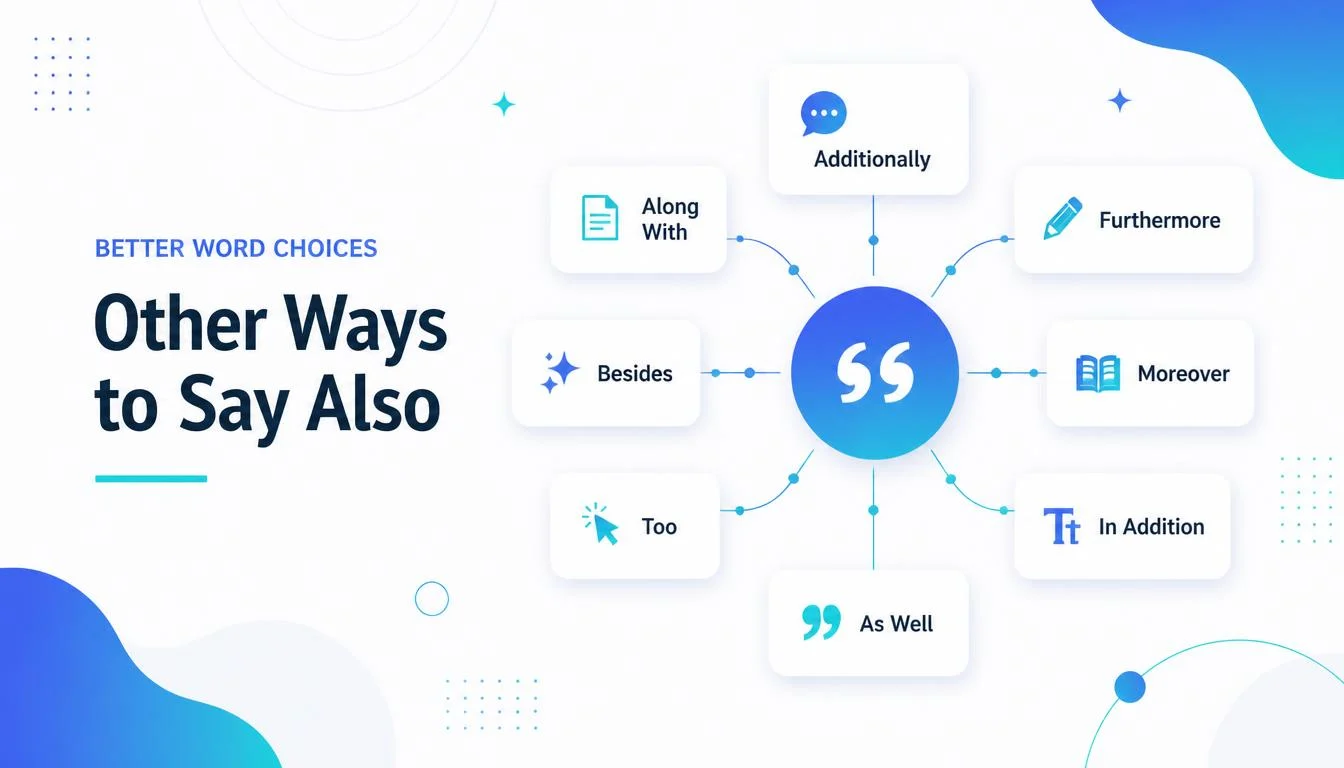
Other ways to say also include in addition, furthermore, moreover, as well, too, additionally, and besides. These alternatives help you express extra information clearly and naturally.
Knowing other ways to say also can help you make your writing more engaging and avoid repeating the same word. Whether you’re writing an email, preparing an essay, or having a conversation, using different expressions for addition can make your English sound more fluent and natural.
What Is “Also”? (Meaning, Grammar & Real Use)
Imagine writing a professional email where you need to share several updates. You might write, “I also reviewed the report. I also contacted the client. I also prepared the presentation.” Although each sentence is grammatically correct, repeating the same word makes your writing sound less polished. Choosing different expressions can improve clarity and make your communication more engaging.
The word “also” is one of the most common ways to add information in English. You can use it in conversations, emails, essays, presentations, and reports. However, alternatives to “also” allow you to adjust your tone, connect ideas more smoothly, and emphasize additional information without repeating the same expression.
Learning other ways to say also can help English learners develop more natural sentence patterns and stronger professional communication skills. While expressions such as “in addition” and “furthermore” are useful for structured writing, “too” and “as well” often sound more natural in everyday conversation. These expressions also help you distinguish between adding facts, extending an argument, and sharing personal experiences. Although some vocabulary is used to express excitement in English, the main purpose of these alternatives is to make your ideas flow clearly and naturally.
Definition
“Also” is an adverb that means “in addition” or “as well.” It introduces another fact, action, quality, or idea related to what has already been mentioned.
Grammar Note
“Also” is commonly placed before the main verb, after the verb “be,” or after an auxiliary verb. Its position depends on the sentence structure.
Example: She also speaks French.
Register: Neutral and suitable for both formal and informal English.
Real-World Use
- Spoken English: Adding another thought during a conversation.
- Written English: Connecting related points in an essay or email.
- Professional English: Introducing an additional responsibility, result, or recommendation.
- Academic English: Extending an argument or adding supporting information.
When Should You Use “Also”?
The word is useful whenever you want to add information without starting an entirely new topic.
Common Contexts
- Adding information: “She also speaks Spanish.”
- Expanding an idea: “The proposal is affordable and also practical.”
- Sharing responsibilities: “I also manage the company’s social media accounts.”
- Making recommendations: “You should also consider the long-term costs.”
- Continuing a conversation: “I also wanted to ask you about the meeting.”
Spoken vs. Written English
Spoken: “I enjoyed the movie, and I also liked the soundtrack.”
Written: “The report also highlights several areas for improvement.”
In conversation, “too” and “as well” are often natural choices. In formal writing, “furthermore,” “additionally,” and “in addition” can help organize ideas.
Formal vs. Informal English
Formal: “Furthermore, the findings indicate a significant improvement.”
Informal: “I liked the food, too.”
Use the expression that fits the purpose of your sentence rather than choosing a longer phrase simply to sound more sophisticated.
Is It Professional or Just Polite?
“Also” is both polite and professional. It is a neutral word that works well in business emails, reports, meetings, and presentations.
However, repeatedly using it in the same paragraph can make professional writing sound monotonous. Alternatives such as “additionally,” “in addition,” and “furthermore” can create variety when you are introducing related points.
Business-Style Example
“I have completed the initial analysis. I also prepared a summary of the key findings for the team.”
Polite? ✔️ Yes
Professional? ✔️ Yes
Pros and Cons of Using “Also”
Pros
- Simple and natural: Easy to use in everyday English.
- Friendly tone: Works naturally in conversations and informal writing.
- Common usage: Widely understood by English speakers.
- Easy to understand: Clearly signals that more information is coming.
Cons
- Repetitive in writing: Frequent use can make paragraphs monotonous.
- Limited stylistic variety: Does not offer the same range of emphasis as other connectors.
- Less structured in formal writing: Repeated use may weaken the flow of an academic or business argument.
- Position-sensitive: Incorrect placement can make a sentence sound awkward or change its emphasis.
Common Mistakes People Make
Understanding how to use this word correctly can help you avoid awkward sentence structures and improve your writing.
1. Placing “Also” in an Awkward Position
Incorrect: She speaks also English.
Correct: She also speaks English.
2. Using “Also” and “Too” Redundantly
Incorrect: I also enjoyed the movie too.
Correct: I also enjoyed the movie.
3. Confusing “Also” With “Although”
Incorrect: Also it was raining, we went outside.
Correct: Although it was raining, we went outside.
4. Using “Also” Instead of “In Addition To”
Incorrect: In addition to, she manages the team.
Correct: In addition to managing the team, she prepares reports.
5. Using “Also” Repeatedly in Formal Writing
Incorrect: The report also explains the results. It also discusses the costs. It also provides recommendations.
Correct: The report explains the results, discusses the costs, and provides recommendations.
“Small tone mistakes can make confident English sound careless.”
Alternatives by Category
The following categories provide a curated preview of useful expressions. Every phrase listed here also appears in the full list below.
Formal alternatives to “Also”
- Furthermore
- Moreover
- Additionally
- In addition
Pro Tip Box: Use these expressions to introduce supporting points in reports, essays, and formal presentations. Avoid stacking several connectors in one paragraph.
Casual alternatives
- Too
- As well
- On top of that
- Besides
Pro Tip Box: Use “too” and “as well” in everyday conversations. Choose “on top of that” when you want to emphasize an additional point.
Professional alternatives
- Additionally
- In addition
- Along with that
- Equally important
Pro Tip Box: Use “additionally” for a concise business tone and “equally important” when the next point deserves similar emphasis.
Informal expressions
- Plus
- What’s more
- Not to mention
- And another thing
Pro Tip Box: Use informal expressions in friendly conversations and casual messages. In professional documents, prefer precise connectors that clearly show how the ideas relate.
“Formal and informal English aren’t about correctness. They’re about context.”
Other Ways to Say “Also” (Full List With Examples)
These 30 alternatives help you build fluency and vary your sentence structure in different situations. Choose each expression according to tone, context, and audience to add information clearly and naturally.
1. Phrase: In Addition
Meaning: Introduces another related point.
Explanation: A versatile expression for adding information.
Example Sentence: In addition, the company offers flexible working hours.
Best Use: Formal writing
Worst Use: Casual chat
Tone: Neutral, professional
Context Variability: Casual: In addition, we need snacks. Professional: In addition, the report includes recommendations. Spoken: In addition, we should invite Sara.
2. Phrase: Additionally
Meaning: Introduces an extra fact or detail.
Explanation: Common in professional and academic writing.
Example Sentence: Additionally, the team will provide weekly updates.
Best Use: Business writing
Worst Use: Casual banter
Tone: Formal, concise
Context Variability: Casual: Additionally, we need drinks. Professional: Additionally, the proposal includes a budget. Spoken: Additionally, we can discuss the timeline.
3. Phrase: Furthermore
Meaning: Adds another supporting point.
Explanation: Often strengthens a formal argument.
Example Sentence: Furthermore, the results support the proposed strategy.
Best Use: Academic writing
Worst Use: Casual chat
Tone: Formal, persuasive
Context Variability: Casual: Furthermore, the food was excellent. Professional: Furthermore, the data confirms our findings. Spoken: Furthermore, we need more time.
4. Phrase: Moreover
Meaning: Adds another important or supporting point.
Explanation: Often introduces information that reinforces a previous statement.
Example Sentence: Moreover, the new system reduces operating costs.
Best Use: Formal arguments
Worst Use: Casual conversation
Tone: Formal, emphatic
Context Variability: Casual: Moreover, the place is nearby. Professional: Moreover, the system improves efficiency. Spoken: Moreover, the results were consistent.
5. Phrase: Too
Meaning: Means “also” or “in addition.”
Explanation: Usually appears at the end of a sentence.
Example Sentence: I would like to join the meeting too.
Best Use: Casual conversation
Worst Use: Formal reports
Tone: Friendly, natural
Context Variability: Casual: I want one too. Professional: I can attend too. Spoken: She is coming too.
6. Phrase: As Well
Meaning: Indicates that something is included in addition to another thing.
Explanation: Commonly placed at the end of a sentence.
Example Sentence: She will attend the workshop as well.
Best Use: Everyday conversation
Worst Use: Formal arguments
Tone: Neutral, conversational
Context Variability: Casual: Bring your notebook as well. Professional: We will review the budget as well. Spoken: I would like to participate as well.
7. Phrase: Plus
Meaning: Introduces an additional point or benefit.
Explanation: Often used in casual conversation to add emphasis.
Example Sentence: The hotel is affordable, plus it is close to the station.
Best Use: Casual discussion
Worst Use: Academic essays
Tone: Friendly, informal
Context Variability: Casual: Plus, the food is great. Professional: The plan saves time, plus it reduces costs. Spoken: Plus, we have extra seats.
8. Phrase: What’s More
Meaning: Introduces an additional point that strengthens the previous one.
Explanation: Often emphasizes an extra benefit or important detail.
Example Sentence: The course is affordable. What’s more, it includes practical exercises.
Best Use: Persuasive writing
Worst Use: Technical reports
Tone: Engaging, emphatic
Context Variability: Casual: What’s more, the café is nearby. Professional: What’s more, the plan reduces expenses. Spoken: What’s more, we can finish today.
9. Phrase: On Top of That
Meaning: Adds another point, often one that reinforces or intensifies the previous idea.
Explanation: Common in informal conversations and storytelling.
Example Sentence: The traffic was terrible, and on top of that, it started raining.
Best Use: Casual storytelling
Worst Use: Formal reports
Tone: Informal, expressive
Context Variability: Casual: On top of that, the food was cold. Professional: The project is delayed, and on top of that, costs have increased. Spoken: On top of that, we missed the bus.
10. Phrase: Besides
Meaning: Introduces an additional reason, point, or consideration.
Explanation: Can add information or support an argument.
Example Sentence: Besides being affordable, the course offers flexible schedules.
Best Use: Giving reasons
Worst Use: Precise citations
Tone: Conversational, persuasive
Context Variability: Casual: Besides, we have plenty of time. Professional: Besides reducing costs, the change improves efficiency. Spoken: Besides, we already have the materials.
11. Phrase: Not to Mention
Meaning: Adds another relevant point, often an especially noticeable one.
Explanation: Emphasizes an extra detail that deserves attention.
Example Sentence: The apartment is spacious, not to mention conveniently located.
Best Use: Emphasizing details
Worst Use: Formal research
Tone: Conversational, emphatic
Context Variability: Casual: It’s cheap, not to mention comfortable. Professional: The service is reliable, not to mention cost-effective. Spoken: The restaurant is popular, not to mention affordable.
12. Phrase: Along With That
Meaning: Introduces something additional that accompanies another thing.
Explanation: Connects related tasks, features, or details.
Example Sentence: Along with that, the team will prepare a presentation.
Best Use: Adding details
Worst Use: Direct quotations
Tone: Neutral, conversational
Context Variability: Casual: Along with that, bring your jacket. Professional: Along with that, we will submit a revised budget. Spoken: Along with that, we need a projector.
13. Phrase: Equally Important
Meaning: Introduces another point with similar importance.
Explanation: Highlights the significance of the next idea.
Example Sentence: Equally important, the project must meet safety standards.
Best Use: Balanced arguments
Worst Use: Minor details
Tone: Formal, emphatic
Context Variability: Casual: Equally important, everyone should have fun. Professional: Equally important, we must protect customer data. Spoken: Equally important, we need clear communication.
14. Phrase: In the Same Way
Meaning: Introduces a similar action, idea, or situation.
Explanation: Connects information by showing similarity rather than simply adding a new fact.
Example Sentence: The first department improved efficiency. In the same way, the second department reduced delays.
Best Use: Comparisons
Worst Use: Unrelated ideas
Tone: Neutral, explanatory
Context Variability: Casual: In the same way, I prefer tea. Professional: In the same way, the second team improved performance. Spoken: In the same way, we can solve this problem.
15. Phrase: Likewise
Meaning: Indicates similarity or a corresponding point.
Explanation: Useful when adding a related idea or showing a parallel.
Example Sentence: The first proposal is practical. Likewise, the second option is affordable.
Best Use: Comparisons
Worst Use: Unrelated points
Tone: Formal, neutral
Context Variability: Casual: I enjoyed the trip. Likewise, my sister loved it. Professional: The first branch improved sales. Likewise, the second branch performed well. Spoken: She agreed, and likewise, I supported the idea.
16. Phrase: Similarly
Meaning: Introduces an idea that resembles a previous one.
Explanation: Emphasizes a relationship between two related points.
Example Sentence: The first study found positive results. Similarly, the second study reported improvements.
Best Use: Comparative writing
Worst Use: Contrasting ideas
Tone: Analytical, neutral
Context Variability: Casual: Similarly, I prefer the blue one. Professional: Similarly, the second department adopted the policy. Spoken: Similarly, we can apply the same method.
17. Phrase: Also Included
Meaning: Indicates that something is part of a larger set or package.
Explanation: Useful for listing features, services, or items.
Example Sentence: Breakfast is also included in the package.
Best Use: Feature descriptions
Worst Use: Argument transitions
Tone: Neutral, informative
Context Variability: Casual: Snacks are also included. Professional: Technical support is also included in the contract. Spoken: A notebook is also included.
18. Phrase: Added To That
Meaning: Introduces another point that builds on the previous one.
Explanation: A conversational way to extend an explanation.
Example Sentence: Added to that, the new policy will improve workplace safety.
Best Use: Spoken explanations
Worst Use: Formal academic prose
Tone: Conversational, explanatory
Context Variability: Casual: Added to that, the weather is perfect. Professional: Added to that, the plan reduces waste. Spoken: Added to that, we need more staff.
19. Phrase: Coupled With
Meaning: Indicates that one factor is combined with another.
Explanation: Often connects two related conditions, features, or developments.
Example Sentence: Strong leadership, coupled with teamwork, improved the results.
Best Use: Analytical writing
Worst Use: Casual chat
Tone: Formal, analytical
Context Variability: Casual: Good food, coupled with music, made the night special. Professional: Lower costs, coupled with better service, improved customer satisfaction. Spoken: Experience, coupled with practice, builds confidence.
20. Phrase: Together With
Meaning: Indicates that something is accompanied by another thing.
Explanation: Connects related people, actions, or items.
Example Sentence: The manager, together with the team, reviewed the proposal.
Best Use: Combined activities
Worst Use: Unrelated ideas
Tone: Neutral, professional
Context Variability: Casual: Bring your book together with your notes. Professional: The report, together with the presentation, was submitted. Spoken: She arrived together with her colleagues.
21. Phrase: As Well As
Meaning: Adds another related person, action, or thing.
Explanation: Connects two elements within the same sentence.
Example Sentence: She manages the budget as well as the marketing team.
Best Use: Connected details
Worst Use: Unrelated points
Tone: Neutral, professional
Context Variability: Casual: I like coffee as well as tea. Professional: The role requires writing as well as editing. Spoken: He teaches English as well as history.
22. Phrase: Not Only That
Meaning: Introduces another point, often one that adds emphasis.
Explanation: Commonly used to extend a statement in conversation.
Example Sentence: The course is affordable. Not only that, it includes personal feedback.
Best Use: Emphatic speech
Worst Use: Formal reports
Tone: Conversational, emphatic
Context Variability: Casual: Not only that, the place is nearby. Professional: Not only that, the plan reduces costs. Spoken: Not only that, we can finish early.
23. Phrase: Beyond That
Meaning: Introduces information that goes further than a previous point.
Explanation: Often signals an additional consideration or a broader issue.
Example Sentence: Beyond that, the proposal offers long-term benefits.
Best Use: Broader discussion
Worst Use: Simple lists
Tone: Thoughtful, neutral
Context Variability: Casual: Beyond that, I have no concerns. Professional: Beyond that, the project supports long-term growth. Spoken: Beyond that, we need to consider the budget.
24. Phrase: On a Related Note
Meaning: Introduces another point connected to the current topic.
Explanation: Helps transition smoothly to a related subject.
Example Sentence: On a related note, we should discuss next month’s schedule.
Best Use: Topic transitions
Worst Use: Unrelated subjects
Tone: Conversational, polished
Context Variability: Casual: On a related note, have you seen the new café? Professional: On a related note, the team needs updated guidelines. Spoken: On a related note, we should review the deadline.
25. Phrase: Another Point Is
Meaning: Introduces an additional idea or argument.
Explanation: Clearly signals that another consideration follows.
Example Sentence: Another point is that the project requires additional funding.
Best Use: Structured discussions
Worst Use: Casual banter
Tone: Direct, neutral
Context Variability: Casual: Another point is that we need snacks. Professional: Another point is that the budget needs approval. Spoken: Another point is that we should start early.
26. Phrase: Additionally To That
Meaning: Intended to introduce something further in addition to a previous point.
Explanation: This wording is generally unnatural in standard English. Use “in addition to that” instead.
Example Sentence: In addition to that, we need to update the records.
Best Use: Adding information
Worst Use: Standard phrasing
Tone: Formal, explanatory
Context Variability: Casual: In addition to that, bring your notebook. Professional: In addition to that, the team must submit the report. Spoken: In addition to that, we need more time.
27. Phrase: And Another Thing
Meaning: Introduces an additional point in a conversation.
Explanation: Often used when continuing a discussion or raising another issue.
Example Sentence: And another thing, we need to confirm the venue.
Best Use: Casual discussions
Worst Use: Formal reports
Tone: Informal, direct
Context Variability: Casual: And another thing, bring your camera. Professional: And another thing, we need to review the timeline. Spoken: And another thing, don’t forget the keys.
28. Phrase: To Add To That
Meaning: Introduces information that expands on a previous statement.
Explanation: Useful when contributing another idea to a discussion.
Example Sentence: To add to that, the new system is easier to maintain.
Best Use: Group discussions
Worst Use: Direct quotations
Tone: Conversational, collaborative
Context Variability: Casual: To add to that, the food was excellent. Professional: To add to that, the policy reduces administrative work. Spoken: To add to that, we should involve the team.
29. Phrase: Over and Above That
Meaning: Introduces something additional to what has already been mentioned.
Explanation: Often emphasizes an extra benefit, cost, or requirement.
Example Sentence: Over and above that, the company provides training opportunities.
Best Use: Extra benefits
Worst Use: Simple statements
Tone: Formal, emphatic
Context Variability: Casual: Over and above that, the hotel has a pool. Professional: Over and above that, the package includes support. Spoken: Over and above that, we need approval.
30. Phrase: Alongside
Meaning: Indicates that something exists or happens together with something else.
Explanation: A concise way to connect related activities, features, or developments.
Example Sentence: The company offers training alongside career development support.
Best Use: Related activities
Worst Use: Unrelated facts
Tone: Neutral, professional
Context Variability: Casual: We had tea alongside lunch. Professional: The team provides guidance alongside technical support. Spoken: She works alongside her colleagues.
Comparison Table: Top 10 Alternatives at a Glance
| Phrase | Tone | Best Use |
|---|---|---|
| In addition | Formal, neutral | Reports and essays |
| Additionally | Professional, concise | Business writing |
| Furthermore | Formal, persuasive | Supporting arguments |
| Moreover | Formal, emphatic | Academic writing |
| Too | Casual, natural | Everyday conversation |
| As well | Neutral, friendly | Spoken English |
| Plus | Informal, conversational | Casual discussions |
| What’s more | Engaging, emphatic | Persuasive writing |
| Besides | Conversational, persuasive | Giving reasons |
| Along with that | Neutral, conversational | Adding details |
Quick Self-Check (Mini Quiz)
Test your understanding by choosing the most appropriate expression for each situation.
Question 1
You are writing a formal report and want to introduce another supporting point.
Which phrase fits best?FurthermorePlusAnd another thing
Question 2
You want to say that you enjoyed a movie and another person enjoyed it too.
Which phrase sounds most natural?Pursuant toAs wellIn accordance with
Question 3
You want to emphasize an additional benefit in a casual conversation.
Which expression works best?On top of thatAs documented byIn accordance with
Question 4
You are adding another related point in a professional presentation.
Which phrase is appropriate?AdditionallyAnd another thingNot to mention
FAQs
1. What are the most common alternatives to “also”?
Common alternatives include “in addition,” “as well,” “too,” “furthermore,” and “additionally.” Choose according to the formality and purpose of your sentence.
2. What is a formal alternative to “also”?
“Furthermore,” “moreover,” “additionally,” and “in addition” are useful formal alternatives for academic writing, reports, and professional presentations.
3. How can I avoid repeating “also” in an essay?
Use a mix of connectors such as “in addition,” “furthermore,” and “similarly.” You can also combine related ideas into one clear sentence.
4. Is “as well” the same as “also”?
They have similar meanings, but “as well” usually appears at the end of a sentence, while “also” commonly appears before the main verb.
5. What is the difference between “also,” “too,” and “as well”?
All three add information. “Also” usually appears within a sentence, while “too” and “as well” commonly appear at the end.
conclusion
Learning alternatives to “also” helps you communicate more naturally, avoid repetitive writing, and choose expressions that fit different situations. Formal connectors such as “furthermore” and “additionally” are useful in professional writing, while “too” and “as well” work naturally in everyday conversations.
Practice using these expressions in emails, essays, and conversations. Pay attention to tone, sentence structure, and the relationship between ideas to make your English clearer and more confident.
Read More Related Articles:
- Other Ways to Say “From” in a Letter | For a More Professional Sign-Off In 2026
- Other Ways to Say Be Safe | Upgrade Your Farewells In 2026
- Other Ways to Say Feel Free | Formal Writing and Business Communication In 2026

Victoria Hughes is a content writer dedicated to making communication clearer and more effective. Through TextsResponse.com, she shares practical insights and thoughtfully crafted response ideas that help readers express themselves with confidence.