Quick Answer
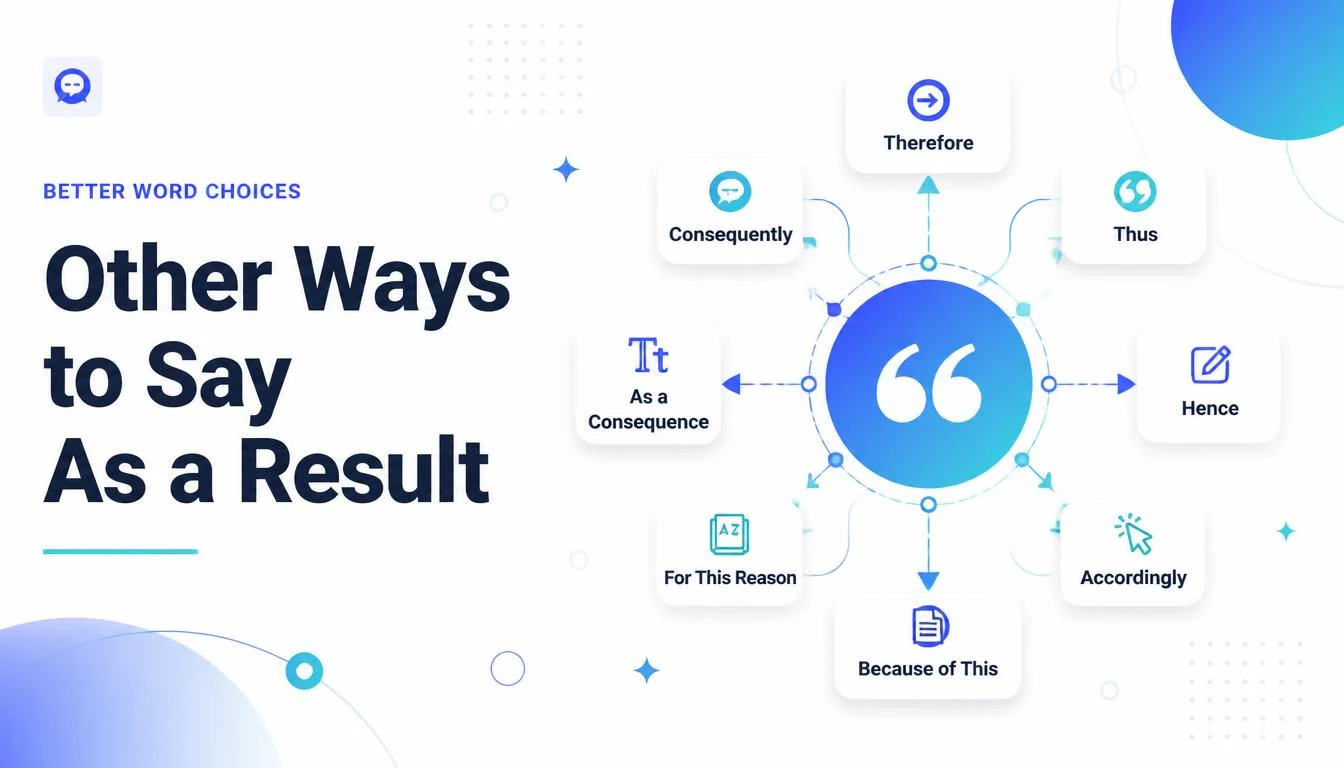
Other ways to say as a result include consequently, therefore, thus, hence, accordingly, for this reason, because of this, and as a consequence.
Knowing other ways to say as a result can make your writing more engaging, professional, and natural. Whether you’re writing an essay, preparing a business report, or improving everyday communication, using different expressions helps you explain consequences clearly and avoid repetition.
In this guide, you’ll discover 30 other ways to say as a result, along with their meanings, example sentences, and usage tips. These alternatives will help you connect ideas smoothly and choose the right expression for academic, professional, and casual situations.
What Is “As a Result”? Meaning, Grammar & Real Use
Imagine you are writing a work report and need to explain why a project finished late. You could simply state that the deadline changed, but professional English becomes clearer when you show the connection between the two events: the supplier delivered the materials late, and as a result, the project was delayed. This small linking phrase helps readers understand cause and effect without requiring a long explanation.
“As a result” is a useful transition for showing that something happens because of a previous event, action, decision, or condition. It appears frequently in business writing, academic essays, news reports, presentations, and everyday speech.
For English learners, studying alternatives to as a result provides more flexibility. You can choose “therefore” for a formal conclusion, “because of this” for natural conversation, or “consequently” for a formal cause and effect relationship. These choices are different from phrases used to express excitement in English, because their main purpose is logical connection.
Definition
As a result means because of this, therefore, or consequently. It introduces an outcome caused by something mentioned previously.
Example: The roads were flooded. As a result, several schools closed.
Grammar Note
“As a result” is a prepositional transition phrase commonly used to connect two ideas. It can appear at the beginning of a sentence, after a semicolon, or within a larger sentence structure.
Example: The company reduced costs. As a result, profits increased.
It is generally neutral and professional, so it works in both spoken and written English.
Where and Why People Use It
People use this expression when they want to:
- Explain cause and effect
- Connect evidence to an outcome
- Describe the consequence of an action
- Make writing more logical
- Explain changes in business or academic contexts
- Link events naturally in conversation
It is especially common in written English, but it is also natural in presentations and formal speech.
When Should You Use “As a Result”?
Use the phrase when the second idea is an outcome of the first idea.
Common Contexts
- Academic writing: explaining research results or consequences
- Business reports: describing the effects of decisions
- News writing: connecting events and outcomes
- Presentations: explaining why a change occurred
- Everyday speech: describing a simple consequence
- Problem solving: connecting an action with its result
Spoken vs Written
In conversation, “as a result” sounds clear and slightly formal.
Spoken: The traffic was terrible, so we arrived late.
Written: Traffic congestion increased significantly. As a result, average journey times were longer.
Formal vs Informal
For formal writing, you can use consequently, therefore, thus, or as a consequence.
For casual conversation, so, because of this, that’s why, and because of that often sound more natural.
Is It Professional or Just Polite?
“As a result” is both professional and neutral. It does not simply show politeness. Its main function is to establish a clear relationship between a cause and its outcome.
Business Example
“The supplier experienced a delay. As a result, the delivery schedule has been revised.”
Polite? ✔️ Yes
Professional? ✔️ Yes
The phrase is appropriate for emails, reports, presentations, proposals, and workplace discussions.
Pros and Cons of Using “As a Result”
Pros
- Clear: It immediately signals a consequence.
- Professional: It works well in business and academic writing.
- Versatile: It can be used in speech and writing.
- Easy to understand: Most English speakers recognize its meaning immediately.
Cons
- Can become repetitive: Frequent use may make writing sound mechanical.
- Sometimes overly formal in conversation: “So” may sound more natural in casual speech.
- Limited stylistic variety: Repeated use can weaken sentence rhythm.
- Requires a clear cause: It can sound confusing when the previous idea does not logically produce the stated outcome.
Writing tip: Use a cause and effect transition only when the relationship between the two ideas is genuinely clear.
Common Mistakes People Make
1. Using It Without a Clear Cause
Incorrect: The meeting was interesting. As a result, the office is on the third floor.
Correct: The meeting ran late. As a result, we missed the scheduled lunch.
2. Confusing It With “Because”
“As a result” introduces the outcome, while “because” introduces the reason.
Incorrect: As a result the weather was bad, the event was canceled.
Correct: Because the weather was bad, the event was canceled.
3. Using It for Simple Addition
Incorrect: Sarah joined the team. As a result, she also speaks French.
Correct: Sarah joined the team. In addition, she speaks French.
4. Forgetting Punctuation
When “as a result” begins a sentence, it is usually followed by a comma.
Incorrect: As a result the company changed its policy.
Correct: As a result, the company changed its policy.
5. Using “Therefore” and “As a Result” as If They Always Mean Exactly the Same Thing
They often overlap, but “therefore” can emphasize a logical conclusion, while “as a result” more directly highlights a consequence.
Example: The evidence was incomplete. Therefore, the researchers requested more data.
“Small tone mistakes can make confident English sound careless.”
Alternatives by Category
Formal alternatives to “As a Result”
- Consequently
- Therefore
- Thus
- As a consequence
Pro Tip: Choose “consequently” or “therefore” when writing formal reports, essays, or analytical explanations.
Casual alternatives
- So
- Because of this
- That’s why
- Because of that
Pro Tip: In everyday conversation, shorter expressions such as “so” often sound more natural than formal connectors.
Professional alternatives
- As a consequence
- For this reason
- Accordingly
- As such
Pro Tip: Match the connector to your intended relationship. Use “for this reason” when emphasizing why a decision follows.
Informal expressions
- So
- That’s why
- Because of that
- This meant that
Pro Tip: Informal expressions in English can make spoken explanations sound smoother, but use more precise connectors in formal documents.
“Formal and informal English aren’t about correctness. They’re about context.”
Other Ways to Say “As a Result”
These other ways to say as a result help you vary sentence structure while making cause and effect easier to understand.
The alternatives below can also support professional reaction phrases and help you communicate outcomes clearly in different situations.
1. Phrase: Consequently
Meaning: Because of something previously mentioned.
Explanation: A formal connector that clearly signals a consequence.
Example Sentence: Sales declined; consequently, the company reduced expenses.
Best Use: Formal writing
Worst Use: Casual chat
Tone: Formal, analytical
Context Variability: Casual: uncommon; professional: reports; spoken: formal presentations.
2. Phrase: Therefore
Meaning: For that reason.
Explanation: Shows that a conclusion or action logically follows from previous information.
Example Sentence: The data was incomplete; therefore, we repeated the analysis.
Best Use: Logical conclusions
Worst Use: Casual conversation
Tone: Formal, logical
Context Variability: Casual: uncommon; professional: reports; spoken: presentations.
3. Phrase: Thus
Meaning: In this way or as a consequence.
Explanation: A concise formal connector frequently used in academic and professional writing.
Example Sentence: The team improved its process, thus reducing production time.
Best Use: Academic writing
Worst Use: Casual speech
Tone: Formal, concise
Context Variability: Casual: uncommon; professional: reports; spoken: formal speech.
4. Phrase: As a Consequence
Meaning: Because of what happened previously.
Explanation: Very close in meaning to “as a result” but slightly more formal.
Example Sentence: The company lost a major client. As a consequence, several projects were postponed.
Best Use: Formal explanations
Worst Use: Casual chat
Tone: Formal, neutral
Context Variability: Casual: possible; professional: reports; spoken: presentations.
5. Phrase: Because of This
Meaning: Due to the previously mentioned situation.
Explanation: A natural alternative that works well when the cause has just been explained.
Example Sentence: The roads were closed. Because of this, employees worked remotely.
Best Use: Clear explanations
Worst Use: Formal analysis
Tone: Natural, neutral
Context Variability: Casual: common; professional: emails; spoken: common.
6. Phrase: For This Reason
Meaning: Because of this particular reason.
Explanation: Emphasizes the reason behind a decision or outcome.
Example Sentence: The software is outdated. For this reason, we recommend replacing it.
Best Use: Business explanations
Worst Use: Casual storytelling
Tone: Professional, clear
Context Variability: Casual: possible; professional: common; spoken: natural.
7. Phrase: As Such
Meaning: Because of the situation just described.
Explanation: Often introduces an action or conclusion that follows from the preceding circumstances.
Example Sentence: The position requires frequent travel. As such, flexibility is essential.
Best Use: Professional writing
Worst Use: Simple conversation
Tone: Formal, polished
Context Variability: Casual: uncommon; professional: common; spoken: formal.
8. Phrase: Accordingly
Meaning: In a way that follows from the situation.
Explanation: Shows that an action or decision has been adjusted because of previous information.
Example Sentence: Demand has increased. Accordingly, production will be expanded.
Best Use: Business writing
Worst Use: Casual chat
Tone: Formal, professional
Context Variability: Casual: rare; professional: common; spoken: formal.
9. Phrase: So
Meaning: For that reason or because of that.
Explanation: The simplest and most natural conversational alternative.
Example Sentence: The store was closed, so we went somewhere else.
Best Use: Everyday speech
Worst Use: Formal reports
Tone: Casual, natural
Context Variability: Casual: very common; professional: possible; spoken: very common.
10. Phrase: That’s Why
Meaning: This explains the reason for the outcome.
Explanation: A highly natural spoken expression used to connect a cause with a consequence.
Example Sentence: I had an early meeting. That’s why I left the party early.
Best Use: Everyday conversation
Worst Use: Academic essays
Tone: Casual, conversational
Context Variability: Casual: common; professional: possible; spoken: very common.
11. Phrase: Because of That
Meaning: Due to the situation previously mentioned.
Explanation: A conversational connector that clearly refers back to an earlier cause.
Example Sentence: The train was delayed. Because of that, I arrived twenty minutes late.
Best Use: Spoken English
Worst Use: Formal reports
Tone: Casual, direct
Context Variability: Casual: common; professional: limited; spoken: common.
12. Phrase: As a Consequence of This
Meaning: As an outcome of the situation just described.
Explanation: Provides an explicit and formal cause and effect connection.
Example Sentence: Costs increased significantly. As a consequence of this, prices were adjusted.
Best Use: Formal analysis
Worst Use: Casual chat
Tone: Formal, explicit
Context Variability: Casual: uncommon; professional: common; spoken: formal.
13. Phrase: Due to This
Meaning: Because of this situation.
Explanation: A concise phrase that attributes an outcome to a previously mentioned condition.
Example Sentence: Due to this, the launch was moved to Friday.
Best Use: Brief explanations
Worst Use: Personal opinions
Tone: Neutral, professional
Context Variability: Casual: possible; professional: common; spoken: possible.
14. Phrase: Owing to This
Meaning: Because of this situation.
Explanation: A more formal alternative to “because of this.”
Example Sentence: Owing to this, the project required additional funding.
Best Use: Formal writing
Worst Use: Casual conversation
Tone: Formal, polished
Context Variability: Casual: uncommon; professional: common; spoken: formal.
15. Phrase: This Led to
Meaning: This caused a particular outcome.
Explanation: Directly emphasizes the connection between an event and its consequence.
Example Sentence: Poor planning led to several scheduling problems.
Best Use: Cause analysis
Worst Use: Simple opinions
Tone: Clear, analytical
Context Variability: Casual: common; professional: common; spoken: natural.
16. Phrase: This Resulted in
Meaning: This caused something to happen.
Explanation: A professional phrase that focuses strongly on the resulting outcome.
Example Sentence: The new policy resulted in fewer customer complaints.
Best Use: Business reports
Worst Use: Casual chat
Tone: Professional, factual
Context Variability: Casual: possible; professional: very common; spoken: formal.
17. Phrase: This Caused
Meaning: This directly produced an outcome.
Explanation: A straightforward verb phrase for explaining clear causation.
Example Sentence: The technical issue caused a two-hour delay.
Best Use: Direct explanations
Worst Use: Weak evidence
Tone: Direct, factual
Context Variability: Casual: common; professional: common; spoken: natural.
18. Phrase: This Meant That
Meaning: This situation produced a particular implication or outcome.
Explanation: Useful when explaining what a previous fact meant in practical terms.
Example Sentence: The deadline was moved forward. This meant that we had less preparation time.
Best Use: Clear explanations
Worst Use: Highly formal reports
Tone: Natural, explanatory
Context Variability: Casual: common; professional: common; spoken: common.
19. Phrase: In Consequence
Meaning: As a consequence of something.
Explanation: A formal expression that is less common in everyday modern English.
Example Sentence: The rules were repeatedly ignored and, in consequence, the agreement was revised.
Best Use: Formal prose
Worst Use: Casual speech
Tone: Formal, literary
Context Variability: Casual: rare; professional: possible; spoken: uncommon.
20. Phrase: In Turn
Meaning: As a consequence of the preceding event, often leading to another event.
Explanation: Useful for describing a chain of connected effects.
Example Sentence: Higher demand increased production, which in turn created more jobs.
Best Use: Connected outcomes
Worst Use: Single events
Tone: Analytical, neutral
Context Variability: Casual: possible; professional: common; spoken: natural.
21. Phrase: Thereby
Meaning: By that action or as a consequence of it.
Explanation: A formal adverb commonly used to connect an action directly with its effect.
Example Sentence: The company automated the process, thereby reducing processing time.
Best Use: Formal writing
Worst Use: Casual speech
Tone: Formal, concise
Context Variability: Casual: rare; professional: common; spoken: formal.
22. Phrase: For That Reason
Meaning: Because of that particular circumstance.
Explanation: Clearly connects a previous fact with the decision or outcome that follows.
Example Sentence: The product was unavailable. For that reason, we selected another supplier.
Best Use: Decision explanations
Worst Use: Casual storytelling
Tone: Neutral, professional
Context Variability: Casual: common; professional: common; spoken: common.
23. Phrase: Following This
Meaning: After this event or development.
Explanation: Often introduces an action or development that occurs afterward.
Example Sentence: Following this, the team reviewed the entire process.
Best Use: Event sequences
Worst Use: Direct causation
Tone: Formal, neutral
Context Variability: Casual: possible; professional: common; spoken: formal.
24. Phrase: Subsequently
Meaning: Afterward or after the event mentioned.
Explanation: Focuses more on sequence than direct causation, so it should not replace “as a result” in every sentence.
Example Sentence: The proposal was approved. Subsequently, implementation began.
Best Use: Event sequence
Worst Use: Clear causation
Tone: Formal, precise
Context Variability: Casual: uncommon; professional: common; spoken: formal.
25. Phrase: Hence
Meaning: For this reason or as a result.
Explanation: A concise formal connector commonly found in academic, technical, and analytical writing.
Example Sentence: The evidence was insufficient; hence, further research was required.
Best Use: Formal analysis
Worst Use: Casual conversation
Tone: Formal, concise
Context Variability: Casual: rare; professional: common; spoken: formal.
26. Phrase: Ergo
Meaning: Therefore or consequently.
Explanation: A very formal and uncommon term that can sound rhetorical or deliberately stylized.
Example Sentence: The evidence was incomplete; ergo, the conclusion remained uncertain.
Best Use: Rhetorical writing
Worst Use: Everyday speech
Tone: Formal, rhetorical
Context Variability: Casual: rare; professional: limited; spoken: unusual.
27. Phrase: As a Direct Result
Meaning: As an immediate consequence of something.
Explanation: Emphasizes a particularly clear or direct causal relationship.
Example Sentence: As a direct result of the training, employee errors decreased.
Best Use: Causal analysis
Worst Use: Weak connections
Tone: Precise, analytical
Context Variability: Casual: possible; professional: common; spoken: formal.
28. Phrase: As a Consequence of
Meaning: Because something produced a particular effect.
Explanation: This phrase introduces the cause rather than functioning only as a sentence transition.
Example Sentence: As a consequence of the delay, the meeting was rescheduled.
Best Use: Formal explanations
Worst Use: Casual chat
Tone: Formal, precise
Context Variability: Casual: possible; professional: common; spoken: formal.
29. Phrase: As a Result of
Meaning: Because of a particular event or condition.
Explanation: This form is followed by a noun or noun phrase and directly identifies the cause.
Example Sentence: As a result of heavy rainfall, several roads were closed.
Best Use: Cause identification
Worst Use: Unsupported claims
Tone: Neutral, formal
Context Variability: Casual: possible; professional: common; spoken: natural.
30. Phrase: On That Account
Meaning: For that reason.
Explanation: A formal expression that indicates a decision or outcome follows from a previously stated circumstance.
Example Sentence: The evidence was incomplete; on that account, the conclusion remained tentative.
Best Use: Formal prose
Worst Use: Casual speech
Tone: Formal, measured
Context Variability: Casual: rare; professional: limited; spoken: uncommon.
Comparison Table: Top 10 Alternatives at a Glance
| Phrase | Tone | Best Use |
|---|---|---|
| Consequently | Formal | Reports and essays |
| Therefore | Formal | Logical conclusions |
| Thus | Formal | Academic writing |
| As a consequence | Formal | Cause and effect |
| Because of this | Neutral | Clear explanations |
| For this reason | Professional | Business decisions |
| As such | Professional | Workplace writing |
| Accordingly | Formal | Business decisions |
| So | Casual | Everyday speech |
| That’s why | Casual | Conversation |
Quick Self-Check
Question 1
You are writing a research report and need to introduce a logical conclusion. Which phrase fits best?
A. That’s why
B. Therefore
C. Because of that
Answer: B. Therefore
Question 2
You are explaining a simple everyday situation to a friend. Which sounds most natural?
A. Consequently
B. Thereby
C. So
Answer: C. So
Question 3
A business report explains that a new policy caused fewer complaints. Which sentence is most appropriate?
A. The new policy resulted in fewer complaints.
B. The new policy, that’s why, fewer complaints.
C. The new policy was in consequence fewer complaints.
Answer: A. The new policy resulted in fewer complaints.
Question 4
You want to explain why you made a particular decision in a professional email. Which connector is useful?
A. For this reason
B. Ergo
C. That’s why
Answer: A. For this reason
FAQs
1. What are the best alternatives to “as a result”?
Common alternatives include consequently, therefore, thus, as a consequence, for this reason, because of this, and accordingly. The best choice depends on your tone and sentence structure.
2. What is a formal alternative to “as a result”?
“Consequently,” “therefore,” “thus,” and “as a consequence” are strong formal choices for academic, professional, and analytical writing.
3. What is a casual way to say “as a result”?
In everyday conversation, “so,” “that’s why,” and “because of that” are usually more natural than highly formal connectors.
4. Is “therefore” the same as “as a result”?
They often overlap, but “therefore” commonly emphasizes a logical conclusion, while “as a result” more directly highlights an outcome caused by a previous event.
5. How can I avoid repeating “as a result” in an essay?
Vary your transitions according to meaning. Use “therefore” for conclusions, “consequently” for consequences, “based on this” for evidence, and “for this reason” when explaining a decision.
conclusion
Learning other ways to say as a result gives you more control over cause and effect in English. Words such as “therefore,” “consequently,” and “thus” work especially well in formal writing, while “so,” “that’s why,” and “because of this” are useful in everyday communication.
The goal is not to replace the original phrase every time. Instead, choose a connector that matches your audience, purpose, and level of formality. Daily practice with short examples can make these transitions feel automatic and improve your overall fluency.
Read More Related Articles:
- Other Ways to Say Also in an Essay | Make Your Writing Shine In 2026
- Other Ways to Say “This Shows That” | Express Your Ideas with Confidence In 2026
- Other Ways to Say “Which” in English | Beyond the Common Choices In 2026

Daniel Murphy is a professional writer and blogger specializing in digital communication and messaging trends. As a contributor to TextsResponse.com, he creates reader-focused content designed to help people find the right words at the right time.