Quick Answer
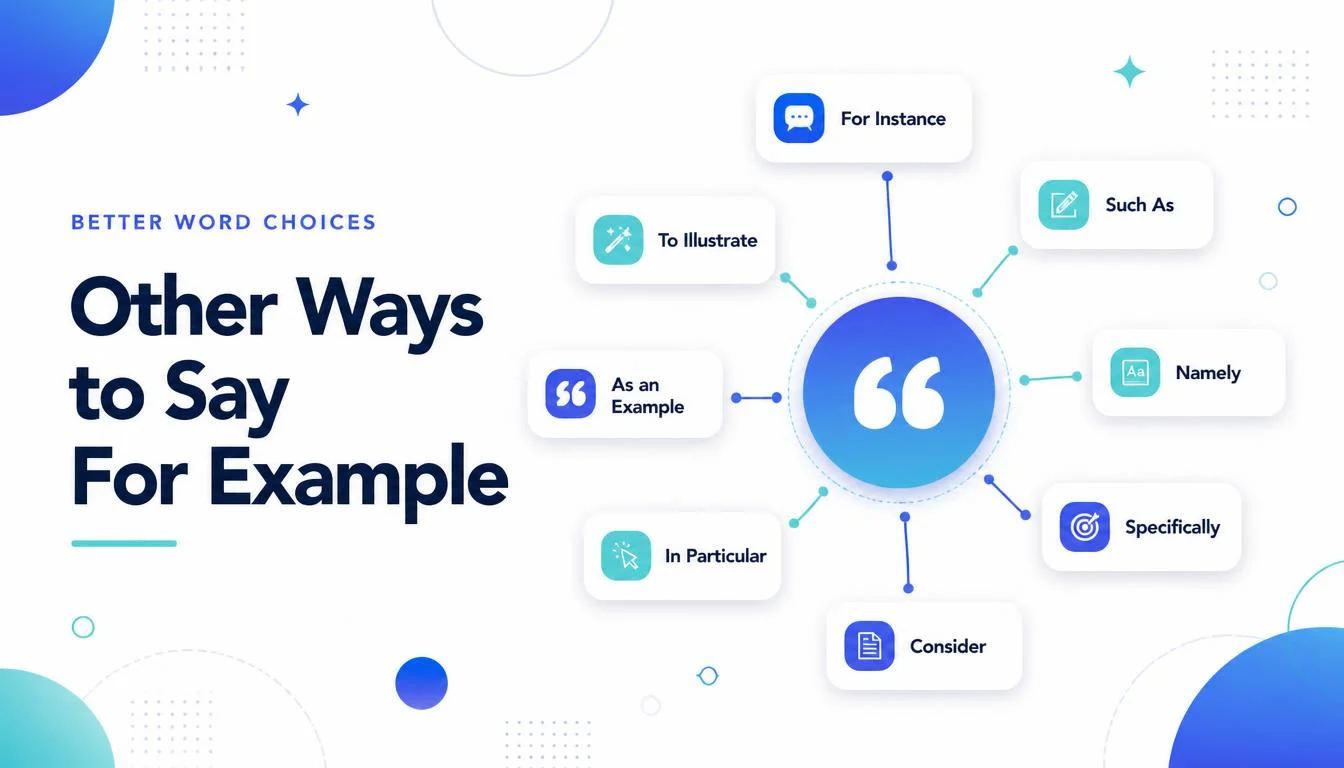
Other ways to say for example include for instance, such as, to illustrate, namely, specifically, and as an example. These alternatives make your writing and speech clearer and more engaging.
Looking for other ways to say for example? Whether you’re writing an essay, preparing a professional email, or having a casual conversation, using different expressions can make your communication more natural and effective.
In this guide, you’ll discover 30 other ways to say for example, with simple explanations and practical examples. These alternatives will help you express ideas clearly, avoid repetition, and choose the right phrase for formal and informal situations.
Quick Categories: Alternatives at a Glance
Formal alternatives to “for example”
- To illustrate
- As an illustration
- By way of illustration
- To exemplify
Pro Tip: Use these expressions in academic essays, formal reports, and structured presentations when introducing supporting evidence.
Casual alternatives
- For instance
- Say
- Like
- To give you an example
Pro Tip: Choose familiar expressions such as “for instance” or “to give you an example” when speaking naturally with friends or colleagues.
Professional alternatives
- To demonstrate
- A case in point
- Consider
- As demonstrated by
Pro Tip: Use these phrases to support recommendations, clarify business concepts, and make presentations more convincing without sounding repetitive.
Informal expressions
- Just imagine
- Take … for example
- Here’s one example
- Think of
Pro Tip: These informal expressions in English work well in conversations, brainstorming sessions, and friendly explanations.
“A well-chosen example can turn a complicated idea into something instantly understandable.”
What Does “For Example” Mean?
“For example” is a common English expression used to introduce a particular instance of a broader idea, statement, or category.
It helps explain what you mean by providing a concrete illustration or supporting detail.
Grammar explanation: “For example” is an introductory phrase that often appears at the beginning or within a sentence. It is commonly followed by a comma when it introduces a complete illustrative statement.
Example: Many fruits are rich in vitamins. For example, oranges contain vitamin C.
When to Use “For Example”
The phrase is useful in a variety of communication settings.
Common contexts
- Academic writing: To support an argument with evidence or illustrations.
- Business communication: To clarify a recommendation or explain a process.
- Presentations: To make abstract concepts easier to understand.
- Everyday conversations: To share relatable experiences or specific details.
- Teaching and learning: To explain concepts through practical examples.
Spoken vs. written English
| Context | Typical usage |
|---|---|
| Spoken English | “For example,” “say,” and “like” |
| Academic writing | “For instance,” “to illustrate,” and “as an illustration” |
| Business writing | “To demonstrate,” “consider,” and “a case in point” |
| Casual conversations | “Think of,” “just imagine,” and “here’s one example” |
Formal vs. informal usage
“For example” is suitable for both formal and informal English. The alternatives you choose should match the setting and the level of detail you want to provide.
Is It Professional or Polite to Say “For Example”?
Polite? Yes.
Professional? Yes.
“For example” is a neutral, widely accepted expression in professional communication. It is appropriate for business emails, reports, presentations, and workplace discussions.
Although the phrase is professional, varying your wording can make longer documents more engaging and prevent repetitive sentence structures.
Business-style example:
“Our team can improve customer satisfaction through several initiatives. For example, we can introduce a faster response system and provide personalized support.”
Pros and Cons of Using “For Example”
Pros
- Simple and natural: Easy to use in everyday and professional communication.
- Friendly tone: Makes explanations approachable and clear.
- Common usage: Widely understood by English speakers.
- Easy to understand: Connects general statements with specific examples.
Cons
- Can become repetitive: Frequent use may make writing monotonous.
- Limited stylistic variety: Does not always convey the precise relationship between an idea and its illustration.
- May lack specificity: Sometimes a more descriptive expression is more suitable.
- Not always the most precise choice: Formal or technical writing may require a phrase that explains the purpose of the example more clearly.
“Variety improves your writing, but clarity should always come first.”
Other Ways to Say “For Example” (With 30 Examples)
These alternatives will help you sound more fluent, confident, and natural in different situations.
Use them according to tone, context, and audience to introduce examples, clarify ideas, and make your explanations more engaging.
1. Phrase: For Instance
- Meaning: Introduces a specific example that supports a general statement.
- Explanation: This is one of the closest and most versatile alternatives to “for example.”
- Example Sentence: Many people enjoy outdoor activities. For instance, hiking and cycling are popular weekend hobbies.
- Best Use: Everyday explanations
- Worst Use: Highly technical definitions
- Tone: Neutral, natural, versatile
- Context Variability: Casual: “For instance, try walking.” Professional: “For instance, our sales increased.” Spoken: “For instance, you could call her.”
2. Phrase: To Illustrate
- Meaning: Introduces an example that makes an idea easier to understand.
- Explanation: This phrase is especially useful when explaining a concept or supporting an argument.
- Example Sentence: To illustrate the benefits of teamwork, consider how our department completed the project ahead of schedule.
- Best Use: Academic explanations
- Worst Use: Casual small talk
- Tone: Formal, explanatory, clear
- Context Variability: Casual: “To illustrate, imagine this.” Professional: “To illustrate the process, review the diagram.” Spoken: “To illustrate my point, look at this example.”
3. Phrase: Such As
- Meaning: Introduces specific items belonging to a broader category.
- Explanation: It is commonly used before examples within a sentence rather than as a standalone introductory phrase.
- Example Sentence: Many renewable energy sources, such as solar and wind power, are becoming more widely used.
- Best Use: Lists and descriptions
- Worst Use: Complete example clauses
- Tone: Neutral, concise, descriptive
- Context Variability: Casual: “I like fruits such as mangoes.” Professional: “We use tools such as spreadsheets.” Spoken: “Try activities such as swimming.”
4. Phrase: As an Illustration
- Meaning: Introduces an example that clarifies a statement.
- Explanation: This expression is appropriate for formal explanations and structured writing.
- Example Sentence: As an illustration, the latest report shows how customer feedback can improve product design.
- Best Use: Formal writing
- Worst Use: Quick casual replies
- Tone: Formal, informative, polished
- Context Variability: Casual: “As an illustration, think of a garden.” Professional: “As an illustration, consider the following case.” Spoken: “As an illustration, let me explain.”
5. Phrase: To Give You an Example
- Meaning: Introduces a specific example for the listener or reader.
- Explanation: This conversational phrase makes explanations feel direct and approachable.
- Example Sentence: To give you an example, our team reduced response times by introducing automated support.
- Best Use: Spoken explanations
- Worst Use: Highly formal reports
- Tone: Friendly, conversational, clear
- Context Variability: Casual: “To give you an example, I tried it yesterday.” Professional: “To give you an example, our team changed the process.” Spoken: “To give you an example, look at this.”
6. Phrase: As an Example
- Meaning: Introduces a particular case that illustrates a general point.
- Explanation: It works naturally within sentences and in explanatory discussions.
- Example Sentence: As an example, our company offers flexible working hours to support employees.
- Best Use: General explanations
- Worst Use: Repetitive writing
- Tone: Neutral, direct, informative
- Context Variability: Casual: “As an example, take my brother.” Professional: “As an example, consider our latest campaign.” Spoken: “As an example, here’s what happened.”
7. Phrase: To Demonstrate
- Meaning: Introduces evidence or an example that shows how something works.
- Explanation: It emphasizes showing a process, result, or principle rather than simply listing an instance.
- Example Sentence: To demonstrate the effectiveness of the strategy, the company presented its quarterly performance figures.
- Best Use: Presentations and reports
- Worst Use: Unrelated examples
- Tone: Professional, explanatory, confident
- Context Variability: Casual: “To demonstrate, watch this trick.” Professional: “To demonstrate the results, review the data.” Spoken: “To demonstrate what I mean, try this.”
8. Phrase: A Case in Point
- Meaning: Refers to a particular example that clearly supports a statement.
- Explanation: This phrase is often used when the example strongly illustrates the point being made.
- Example Sentence: The benefits of consistent practice are clear. A case in point is her improvement in public speaking.
- Best Use: Supporting arguments
- Worst Use: Unrelated illustrations
- Tone: Formal, confident, persuasive
- Context Variability: Casual: “A case in point is my neighbor.” Professional: “A case in point is our recent project.” Spoken: “A case in point is what happened yesterday.”
9. Phrase: Consider
- Meaning: Directs the reader or listener to think about a specific example.
- Explanation: It introduces a case for reflection and is particularly useful in persuasive or analytical writing.
- Example Sentence: Consider a small business that increases customer retention through personalized service.
- Best Use: Analytical writing
- Worst Use: Informal lists
- Tone: Thoughtful, professional, direct
- Context Variability: Casual: “Consider my last trip.” Professional: “Consider the following scenario.” Spoken: “Consider what happened at the meeting.”
10. Phrase: Take … for Example
- Meaning: Introduces a specific person, thing, or situation as an illustration.
- Explanation: It places emphasis on the selected example and works well in both speech and writing.
- Example Sentence: Take our customer service team, for example. They resolved the issue within minutes.
- Best Use: Specific illustrations
- Worst Use: Unclear references
- Tone: Conversational, explanatory, natural
- Context Variability: Casual: “Take my friend, for example.” Professional: “Take our latest project, for example.” Spoken: “Take this situation, for example.”
11. Phrase: By Way of Illustration
- Meaning: Introduces an example intended to clarify a point.
- Explanation: This formal expression is often used in academic, legal, or carefully structured writing.
- Example Sentence: By way of illustration, the following case shows how effective planning can reduce costs.
- Best Use: Formal documents
- Worst Use: Casual conversation
- Tone: Formal, polished, analytical
- Context Variability: Casual: “Here’s one example.” Professional: “By way of illustration, consider this case.” Spoken: “By way of illustration, let me explain.”
12. Phrase: To Exemplify
- Meaning: Introduces something that serves as a clear example of a particular quality or idea.
- Explanation: This formal verb emphasizes how a specific case represents a broader concept.
- Example Sentence: To exemplify effective leadership, the manager encouraged collaboration and open communication.
- Best Use: Academic writing
- Worst Use: Casual conversation
- Tone: Formal, academic, precise
- Context Variability: Casual: “This shows what I mean.” Professional: “The project exemplifies innovation.” Spoken: “Let me show you what I mean.”
13. Phrase: One Example Is
- Meaning: Introduces a particular instance of a broader idea.
- Explanation: This straightforward expression is useful when presenting one item from a larger group.
- Example Sentence: There are several ways to improve productivity. One example is setting clear daily priorities.
- Best Use: Simple explanations
- Worst Use: Highly formal prose
- Tone: Clear, neutral, straightforward
- Context Variability: Casual: “One example is my old laptop.” Professional: “One example is our revised workflow.” Spoken: “One example is what we discussed earlier.”
14. Phrase: Here’s an Example
- Meaning: Introduces a specific instance to make a point clearer.
- Explanation: This expression is especially natural in conversation, teaching, and presentations.
- Example Sentence: Here’s an example of how small changes can improve your daily routine.
- Best Use: Spoken explanations
- Worst Use: Formal academic prose
- Tone: Friendly, direct, accessible
- Context Variability: Casual: “Here’s an example from my day.” Professional: “Here’s an example from our latest report.” Spoken: “Here’s an example of what I mean.”
15. Phrase: To Name One
- Meaning: Identifies one example from a larger set of possibilities.
- Explanation: It is useful when several examples exist but you want to mention only one.
- Example Sentence: Several platforms offer online learning opportunities, Coursera, to name one.
- Best Use: Brief illustrative lists
- Worst Use: Detailed explanations
- Tone: Neutral, concise, conversational
- Context Variability: Casual: “There are many cafés, this one to name one.” Professional: “Several tools are available, Excel to name one.” Spoken: “We have several options, to name one.”
16. Phrase: Among Others
- Meaning: Indicates that the examples mentioned are part of a larger group.
- Explanation: It is useful when you want to show that your list is not exhaustive.
- Example Sentence: The workshop covered communication, leadership, and time management, among others.
- Best Use: Nonexhaustive lists
- Worst Use: Single examples
- Tone: Neutral, concise, informative
- Context Variability: Casual: “We bought apples and oranges, among others.” Professional: “The report covers costs and risks, among others.” Spoken: “We discussed several topics, among others.”
17. Phrase: Including
- Meaning: Introduces one or more specific items within a broader category.
- Explanation: This concise word works naturally when listing examples as part of a sentence.
- Example Sentence: The company offers several employee benefits, including health insurance and flexible schedules.
- Best Use: Lists and descriptions
- Worst Use: Standalone explanations
- Tone: Neutral, concise, professional
- Context Variability: Casual: “I enjoy sports, including tennis.” Professional: “We offer services including consulting.” Spoken: “I bought some snacks, including fruit.”
18. Phrase: Particularly
- Meaning: Highlights a specific example or item as especially relevant.
- Explanation: It emphasizes a particular case rather than simply introducing a neutral example.
- Example Sentence: Several strategies can improve concentration, particularly taking regular breaks.
- Best Use: Emphasizing examples
- Worst Use: Neutral lists
- Tone: Emphatic, polished, informative
- Context Variability: Casual: “I enjoy music, particularly jazz.” Professional: “We focus on several areas, particularly customer retention.” Spoken: “I like many subjects, particularly history.”
19. Phrase: Specifically
- Meaning: Introduces a precise detail or particular instance.
- Explanation: It narrows a broad statement by identifying exactly what you mean.
- Example Sentence: We need to improve our communication process, specifically the way project updates are shared.
- Best Use: Precise explanations
- Worst Use: Broad generalizations
- Tone: Direct, precise, professional
- Context Variability: Casual: “I want something sweet, specifically chocolate.” Professional: “We need to improve one area, specifically response time.” Spoken: “I mean one thing specifically, the deadline.”
20. Phrase: In Particular
- Meaning: Highlights one specific item or instance within a larger group.
- Explanation: It draws attention to a detail that is especially relevant to the discussion.
- Example Sentence: Several skills are important for managers, communication in particular.
- Best Use: Highlighting details
- Worst Use: Introducing long lists
- Tone: Neutral, focused, polished
- Context Variability: Casual: “I like many desserts, ice cream in particular.” Professional: “We need to improve several areas, customer service in particular.” Spoken: “I enjoy many activities, reading in particular.”
21. Phrase: Think of
- Meaning: Invites someone to consider a specific example or familiar situation.
- Explanation: It is a natural conversational phrase that helps explain abstract ideas through relatable references.
- Example Sentence: Think of a calendar as a simple tool for organizing your daily responsibilities.
- Best Use: Casual explanations
- Worst Use: Formal reports
- Tone: Friendly, conversational, engaging
- Context Variability: Casual: “Think of your favorite teacher.” Professional: “Think of a typical customer journey.” Spoken: “Think of how you learned to drive.”
22. Phrase: Say
- Meaning: Introduces a hypothetical example or possible situation.
- Explanation: It is a concise, informal expression commonly used in spoken English.
- Example Sentence: Say you have only 20 minutes to prepare for a meeting. What would you prioritize?
- Best Use: Hypothetical situations
- Worst Use: Formal academic writing
- Tone: Casual, conversational, direct
- Context Variability: Casual: “Say we go tomorrow.” Professional: “Say the budget increases by 10%.” Spoken: “Say you miss the bus.”
23. Phrase: Like
- Meaning: Introduces examples of a category in casual speech.
- Explanation: It is common in conversation, though “such as” is often more appropriate in formal writing.
- Example Sentence: I enjoy creative hobbies like painting and photography.
- Best Use: Casual conversations
- Worst Use: Formal academic prose
- Tone: Informal, relaxed, natural
- Context Variability: Casual: “I like fruits like mangoes.” Professional: “We use tools such as Excel.” Spoken: “Try hobbies like drawing.”
24. Phrase: Just Imagine
- Meaning: Invites someone to picture a specific situation or example.
- Explanation: It is useful when you want to make an explanation more vivid or engaging.
- Example Sentence: Just imagine arriving at the airport with your boarding pass already on your phone.
- Best Use: Engaging explanations
- Worst Use: Technical definitions
- Tone: Imaginative, conversational, engaging
- Context Variability: Casual: “Just imagine living by the sea.” Professional: “Just imagine a customer completing the process in seconds.” Spoken: “Just imagine what could happen next.”
25. Phrase: For One
- Meaning: Introduces one reason or example among several possibilities.
- Explanation: It is often used to highlight one item while implying that others also exist.
- Example Sentence: I prefer working from home. For one, it saves commuting time.
- Best Use: Supporting reasons
- Worst Use: Formal evidence
- Tone: Conversational, direct, explanatory
- Context Variability: Casual: “For one, it’s convenient.” Professional: “For one, it reduces travel costs.” Spoken: “For one, we can finish earlier.”
26. Phrase: As Seen in
- Meaning: Refers to an example or evidence visible in a particular source or situation.
- Explanation: This phrase is useful when connecting a claim to a report, case, or observable outcome.
- Example Sentence: As seen in the latest customer survey, satisfaction levels improved after the policy change.
- Best Use: Evidence-based writing
- Worst Use: Unsupported claims
- Tone: Professional, factual, analytical
- Context Variability: Casual: “As seen in this photo, the room is bright.” Professional: “As seen in the report, revenue increased.” Spoken: “As seen in the chart, sales have improved.”
27. Phrase: As Demonstrated By
- Meaning: Introduces evidence that illustrates or supports a statement.
- Explanation: It is especially useful in professional and academic contexts where an example is supported by observable results.
- Example Sentence: The new training program improved performance, as demonstrated by the team’s assessment results.
- Best Use: Evidence-based arguments
- Worst Use: Unsupported opinions
- Tone: Formal, analytical, authoritative
- Context Variability: Casual: “You can see it in the results.” Professional: “As demonstrated by the data, productivity increased.” Spoken: “As demonstrated by this example, the method works.”
28. Phrase: To Make This Clear
- Meaning: Introduces an explanation or example intended to clarify a point.
- Explanation: It signals that you are about to simplify or clarify an idea for your audience.
- Example Sentence: To make this clear, imagine a project with three deadlines and a limited budget.
- Best Use: Clarifying concepts
- Worst Use: Already-clear statements
- Tone: Direct, explanatory, reassuring
- Context Variability: Casual: “To make this clear, I need help.” Professional: “To make this clear, let’s review the process.” Spoken: “To make this clear, here’s what I mean.”
29. Phrase: Here’s What I Mean
- Meaning: Introduces a specific explanation that clarifies a previous statement.
- Explanation: This conversational phrase is helpful when someone may need a more concrete illustration of your point.
- Example Sentence: We need to make our service more accessible. Here’s what I mean: customers should be able to contact us through multiple channels.
- Best Use: Clarifying conversations
- Worst Use: Formal reports
- Tone: Friendly, explanatory, conversational
- Context Variability: Casual: “Here’s what I mean: try this.” Professional: “Here’s what I mean: we need a clearer process.” Spoken: “Here’s what I mean. Let me explain.”
30. Phrase: Take the Case of
- Meaning: Introduces a particular situation as an example of a broader point.
- Explanation: This phrase is suitable for analytical discussions and formal explanations involving a specific case.
- Example Sentence: Take the case of a small business that expanded its customer base through social media marketing.
- Best Use: Case-based analysis
- Worst Use: Quick casual replies
- Tone: Formal, analytical, explanatory
- Context Variability: Casual: “Think about my friend.” Professional: “Take the case of a growing company.” Spoken: “Take the case of someone starting a new job.”
Common Mistakes When Using “For Example”
Even a simple expression can be misused. Here are five common mistakes and how to correct them.
1. Using “For Example” Without a Relevant Example
Mistake: Introducing a phrase that does not actually support the preceding statement.
Incorrect: “Exercise improves health. For example, people enjoy watching movies.”
Correct: “Exercise improves health. For example, walking can strengthen cardiovascular fitness.”
2. Repeating “For Example” Too Frequently
Mistake: Using the same phrase repeatedly in a paragraph.
Incorrect: “For example, reading helps. For example, it improves vocabulary. For example, it builds focus.”
Correct: “Reading helps improve vocabulary. It also builds focus. One example is reading for 20 minutes each day.”
3. Using “Such As” to Introduce a Complete Sentence
Mistake: Treating “such as” as a standalone introductory phrase.
Incorrect: “Such as, many people prefer online learning.”
Correct: “Many people prefer online learning, such as video-based courses.”
4. Using “Like” in Formal Writing When Precision Matters
Mistake: Using a casual expression in a context that requires a more formal tone.
Incorrect: “The company uses tools like data analytics.”
Correct: “The company uses tools such as data analytics.”
5. Confusing an Example With Evidence
Mistake: Assuming that one example automatically proves a broad claim.
Incorrect: “One person succeeded with this method. For example, the method works for everyone.”
Correct: “One person succeeded with this method. This example suggests it may be useful, but further evidence is needed.”
“An example illustrates an idea; evidence helps establish whether the idea is supported.”
Mini Quiz: Test Your Understanding
1. Which phrase is most suitable for introducing examples in a formal academic essay?LikeBy way of illustrationSay
2. Which phrase is best for introducing examples within a list of items?Such asHere’s what I meanJust imagine
3. Which phrase is most natural for a casual hypothetical situation?To exemplifySayAs demonstrated by
4. Which sentence uses “for example” correctly?For example, such as apples are healthy.Many fruits contain vitamins. For example, oranges contain vitamin C.Such as, oranges contain vitamin C.Check AnswersReset
Comparison Table: Top 10 Alternatives
Here is a quick comparison of frequently used alternatives and the situations in which they fit naturally.
| Phrase | Tone | Best Use |
|---|---|---|
| For instance | Neutral | General explanations |
| To illustrate | Formal | Academic writing |
| Such as | Neutral | Lists and descriptions |
| As an illustration | Formal | Reports and essays |
| To give you an example | Conversational | Spoken explanations |
| To demonstrate | Professional | Presentations |
| A case in point | Formal | Supporting arguments |
| Consider | Professional | Analytical writing |
| Here’s an example | Friendly | Everyday explanations |
| Specifically | Precise | Clarifying details |
FAQs
1. What are the most common alternatives to “for example”?
“For instance,” “such as,” “to illustrate,” “as an illustration,” and “to give you an example” are widely used alternatives. The best choice depends on the sentence structure and context.
2. What is a formal alternative to “for example”?
“To illustrate,” “as an illustration,” and “by way of illustration” are suitable for formal writing, academic essays, and professional reports.
3. How can I say “for example” in professional communication?
You can use “to demonstrate,” “consider,” “a case in point,” or “as demonstrated by” when introducing examples in meetings, reports, and presentations.
4. Is “such as” the same as “for example”?
They have similar meanings, but their grammar differs. “Such as” usually introduces examples within a sentence, while “for example” can introduce a separate illustrative statement.
5. How do I avoid repeating “for example” in an essay?
Alternate between expressions such as “for instance,” “to illustrate,” and “a case in point.” You can also restructure sentences using “including” or “such as” when appropriate.
Conclusion
Learning other ways to say for example helps you improve your vocabulary, avoid repetition, and communicate ideas more clearly. From everyday expressions such as “for instance” to formal phrases like “by way of illustration,” each alternative serves a slightly different purpose.
Read More Related Articles:
- Other Ways to Say You’re Beautiful | Beyond the Ordinary Compliment In 2026
- Other Ways to Say I Love You in Spanish | Beyond the Usual Phrase In 2026
- Other Ways to Say I Love You in Other Languages | Beyond the Classic Three Words In 2026

Henry Walker is an American writer and blogger with a keen interest in communication, language and digital content. At TextsResponse.com, he creates informative and reader-focused resources designed to help people communicate with clarity, confidence and authenticity.