Quick Answer
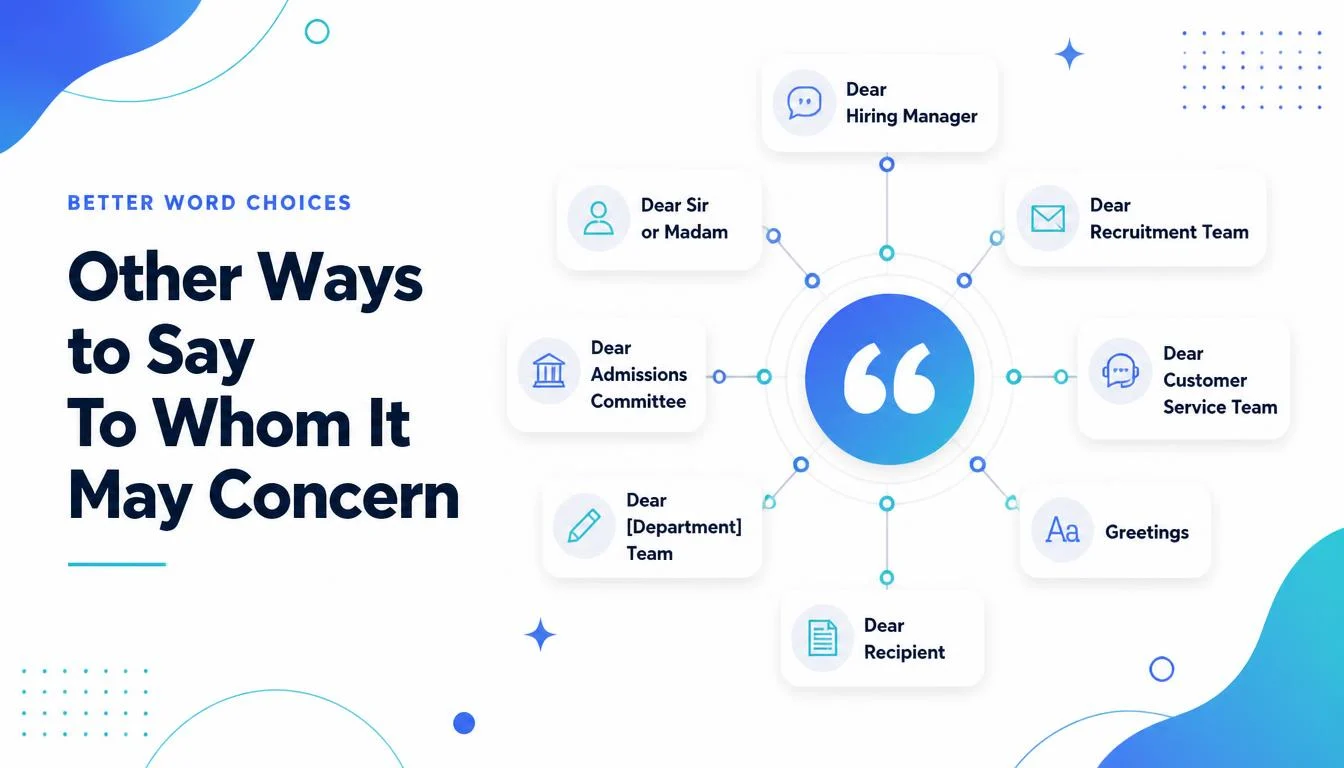
Instead of “To Whom It May Concern,” use Dear Hiring Manager, Dear Sir or Madam, Dear [Department] Team, or Dear [Recipient’s Name].
“To Whom It May Concern” is a traditional formal greeting used when the recipient’s name is unknown. However, other ways to say To Whom It May Concern can make your emails, cover letters, and business correspondence sound more personal and professional.
Choosing the right alternative depends on your situation. If you know the recipient’s role, department, or name, using that information can create a more direct and polished opening.
What Is “To Whom It May Concern”? Meaning, Grammar & Real Use
Imagine sending a reference letter, employment verification, complaint, or formal inquiry when you know the organization but not the person who will read your message. “To Whom It May Concern” has traditionally solved this problem by addressing an unspecified recipient. However, modern professional communication often favors a more specific greeting whenever one is available.
Understanding alternatives to “To Whom It May Concern” can help you make emails, letters, applications, and business documents sound more targeted. A greeting such as “Dear Hiring Manager” immediately identifies the intended audience, while “Dear Customer Service Team” works well when contacting a department.
The phrase is especially useful for English learners because professional greetings depend heavily on context. Just as you may need different expressions to express excitement in English, you should adapt your greeting according to the recipient, purpose, and level of formality.
“To Whom It May Concern” means that the document is intended for any appropriate person who receives or reviews it.
Grammatically, it is a fixed formal salutation rather than a complete conversational sentence. It is most common in formal written English, especially letters, certificates, reference documents, and official correspondence.
Example: “To Whom It May Concern: This letter confirms that Ms. Khan worked with our company.”
The phrase is primarily written, not spoken. It is formal and polite, but it can sound impersonal when a specific recipient is known.
When Should You Use “To Whom It May Concern”?
Use the traditional greeting when:
- You genuinely do not know who will read the document.
- You are preparing a general reference or recommendation letter.
- You are writing an official verification document.
- The recipient may change depending on who processes the request.
- You are addressing an organization rather than an individual.
- The document may be submitted to multiple institutions.
Spoken vs Written
“To Whom It May Concern” is overwhelmingly a written expression. It is suitable for formal letters, certificates, reference letters, and official documents.
In spoken English, directly asking for the appropriate person is usually more natural.
Written: “To Whom It May Concern: This letter verifies the employee’s position.”
Spoken: “Could you tell me who handles employment verification?”
Formal vs Informal
The phrase belongs to formal English. It is generally unsuitable for casual messages, friendly emails, or everyday conversations.
For informal communication, use the person’s name whenever possible.
Is It Professional or Just Polite?
“To Whom It May Concern” is both polite and formally acceptable, but it may feel impersonal when a specific recipient can be identified.
Business example: “Dear Hiring Manager, I am writing to apply for the Marketing Coordinator position.”
Polite? ✔️ Yes
Professional? ✔️ Yes, especially when the recipient is genuinely unknown
For modern business communication, a targeted greeting is often more useful because it immediately identifies the intended audience.
Pros and Cons of Using “To Whom It May Concern”
Pros
- Formal and respectful: Appropriate for official documents.
- Widely understood: Familiar to professional English readers.
- Useful when the recipient is unknown: Avoids guessing a person’s name.
- Suitable for general documents: Works for references and verification letters.
Cons
- Can sound impersonal: It does not address a specific person.
- May feel outdated: Some modern workplaces prefer targeted greetings.
- Less engaging: It creates less personal connection than a named greeting.
- Not ideal for ordinary emails: A department or role-based greeting is often clearer.
Common Mistakes People Make
1. Using It When the Recipient’s Name Is Available
Incorrect: “To Whom It May Concern” when the hiring manager’s name is clearly listed.
Correct: “Dear Ms. Ahmed,”
2. Treating It Like an Informal Greeting
Incorrect: “Hey, To Whom It May Concern!”
Correct: “To Whom It May Concern:”
3. Using the Wrong Capitalization
Incorrect: “To whom it may concern”
Correct: “To Whom It May Concern”
4. Using It for a Known Department
Incorrect: “To Whom It May Concern” when contacting a named customer service department.
Correct: “Dear Customer Service Team,”
5. Using It in a Casual Email
Incorrect: “To Whom It May Concern, can you send me the file?”
Correct: “Hello, could you please send me the file?”
“Small tone mistakes can make confident English sound careless.”
Alternatives by Category
Formal alternatives to “To Whom It May Concern”
- Dear Sir or Madam
- Dear Hiring Manager
- Dear Admissions Committee
- Dear Selection Committee
Pro Tip: Use the most specific formal greeting available. A role, department, or committee name is usually more informative than a completely general salutation.
Casual alternatives
- Hello
- Hi there
- Hello there
- Greetings
Pro Tip: Reserve casual greetings for situations where the organization and communication channel allow a relaxed tone.
Professional alternatives
- Dear Recruitment Team
- Dear Customer Service Team
- Dear Human Resources Team
- Dear [Department] Team
Pro Tip: Department-based greetings work especially well when you know the function responsible for your request but not an individual employee.
Informal expressions
- Hi
- Hello
- Hi Team
- Hello Everyone
Pro Tip: Match informal expressions in English to the relationship and workplace culture. Avoid casual greetings in official applications and legal-style documents.
“Formal and informal English aren’t about correctness. They’re about context.”
Other Ways to Say “To Whom It May Concern”
These 30 alternatives build fluency and help you choose greetings that express professionalism, respect, and appropriate warmth depending on the situation.
1. Phrase: Dear Hiring Manager
Meaning: Addresses the person responsible for hiring.
Explanation: Ideal when applying for a job without knowing the manager’s name.
Example Sentence: “Dear Hiring Manager, I am writing to apply for this position.”
Best Use: Job applications
Worst Use: Personal letters
Tone: Formal, professional
Context Variability: professional / written / recruitment
2. Phrase: Dear Sir or Madam
Meaning: Formally addresses an unknown individual.
Explanation: Traditional wording for situations where the recipient’s identity is unknown.
Example Sentence: “Dear Sir or Madam, I am requesting further information.”
Best Use: Formal letters
Worst Use: Casual emails
Tone: Formal, traditional
Context Variability: formal / written / official
3. Phrase: Dear Admissions Committee
Meaning: Addresses a group reviewing applications.
Explanation: Appropriate for university or educational applications.
Example Sentence: “Dear Admissions Committee, I am pleased to submit my application.”
Best Use: University applications
Worst Use: Business inquiries
Tone: Formal, respectful
Context Variability: formal / written / academic
4. Phrase: Dear Selection Committee
Meaning: Addresses people responsible for evaluating candidates.
Explanation: Useful for awards, scholarships, grants, and competitive programs.
Example Sentence: “Dear Selection Committee, please find my application attached.”
Best Use: Selection processes
Worst Use: Casual requests
Tone: Formal, respectful
Context Variability: professional / written / academic
5. Phrase: Dear Recruitment Team
Meaning: Addresses employees handling recruitment.
Explanation: A modern alternative for employment-related correspondence.
Example Sentence: “Dear Recruitment Team, I am following up on my application.”
Best Use: Recruitment emails
Worst Use: Personal messages
Tone: Professional, direct
Context Variability: professional / written / recruitment
6. Phrase: Dear Human Resources Team
Meaning: Addresses an organization’s HR department.
Explanation: Useful for employment verification, workplace questions, or HR requests.
Example Sentence: “Dear Human Resources Team, I am requesting confirmation of employment.”
Best Use: HR correspondence
Worst Use: Job applications
Tone: Formal, professional
Context Variability: professional / written / workplace
7. Phrase: Dear Customer Service Team
Meaning: Addresses customer support staff collectively.
Explanation: Suitable for complaints, questions, refunds, and service requests.
Example Sentence: “Dear Customer Service Team, I am contacting you regarding my recent order.”
Best Use: Service inquiries
Worst Use: Job applications
Tone: Polite, professional
Context Variability: professional / written / customer service
8. Phrase: Dear Support Team
Meaning: Addresses a technical or customer support department.
Explanation: Works well when the specific support representative is unknown.
Example Sentence: “Dear Support Team, I need assistance accessing my account.”
Best Use: Support requests
Worst Use: Formal references
Tone: Professional, direct
Context Variability: professional / written / technical
9. Phrase: Dear Accounts Department
Meaning: Addresses the department handling financial matters.
Explanation: Appropriate for invoices, payments, and account-related correspondence.
Example Sentence: “Dear Accounts Department, please find the requested invoice attached.”
Best Use: Financial correspondence
Worst Use: Personal emails
Tone: Formal, businesslike
Context Variability: professional / written / financial
10. Phrase: Dear Recruitment Department
Meaning: Addresses the recruitment function within an organization.
Explanation: Useful when contacting a company about vacancies or applications.
Example Sentence: “Dear Recruitment Department, I am writing regarding the advertised position.”
Best Use: Hiring inquiries
Worst Use: Customer complaints
Tone: Formal, professional
Context Variability: professional / written / recruitment
11. Phrase: Dear Admissions Office
Meaning: Addresses university admissions staff.
Explanation: Suitable for questions about applications, enrollment, and admission requirements.
Example Sentence: “Dear Admissions Office, I would like to ask about the application deadline.”
Best Use: Admissions inquiries
Worst Use: Job applications
Tone: Formal, courteous
Context Variability: formal / written / academic
12. Phrase: Dear Registrar
Meaning: Addresses the official responsible for academic records.
Explanation: Useful for university records, enrollment, transcripts, and administrative requests.
Example Sentence: “Dear Registrar, I am requesting a copy of my academic transcript.”
Best Use: Academic records
Worst Use: Casual questions
Tone: Formal, respectful
Context Variability: formal / written / academic
13. Phrase: Dear Scholarship Committee
Meaning: Addresses people evaluating scholarship applications.
Explanation: More specific than a general formal salutation.
Example Sentence: “Dear Scholarship Committee, I am submitting my application for consideration.”
Best Use: Scholarship applications
Worst Use: Business emails
Tone: Formal, respectful
Context Variability: formal / written / academic
14. Phrase: Dear Review Committee
Meaning: Addresses people responsible for reviewing material.
Explanation: Suitable for applications, proposals, research, and formal submissions.
Example Sentence: “Dear Review Committee, I appreciate your consideration of my proposal.”
Best Use: Formal reviews
Worst Use: Casual messages
Tone: Formal, courteous
Context Variability: professional / written / academic
15. Phrase: Dear Editorial Team
Meaning: Addresses people responsible for editorial work.
Explanation: Useful when submitting articles, manuscripts, or content inquiries.
Example Sentence: “Dear Editorial Team, please find my manuscript attached.”
Best Use: Publishing inquiries
Worst Use: Personal correspondence
Tone: Professional, polished
Context Variability: professional / written / publishing
16. Phrase: Dear Program Coordinator
Meaning: Addresses the person coordinating a program.
Explanation: Useful when the coordinator’s name is unavailable.
Example Sentence: “Dear Program Coordinator, I would like to request additional information.”
Best Use: Program inquiries
Worst Use: Casual messages
Tone: Formal, courteous
Context Variability: professional / written / academic
17. Phrase: Dear Department Head
Meaning: Addresses the leader of a department.
Explanation: Suitable when you know the recipient’s position but not their name.
Example Sentence: “Dear Department Head, I am writing to discuss the proposed changes.”
Best Use: Department matters
Worst Use: Casual emails
Tone: Formal, respectful
Context Variability: professional / written / organizational
18. Phrase: Dear Office Manager
Meaning: Addresses the person managing an office.
Explanation: Useful for administrative requests when the individual’s name is unknown.
Example Sentence: “Dear Office Manager, I am writing regarding the requested documents.”
Best Use: Administrative requests
Worst Use: Friendly messages
Tone: Professional, formal
Context Variability: professional / written / administrative
19. Phrase: Dear Admissions Team
Meaning: Addresses a group working in admissions.
Explanation: A natural modern alternative for educational inquiries.
Example Sentence: “Dear Admissions Team, could you clarify the application requirements?”
Best Use: Admissions questions
Worst Use: Business complaints
Tone: Polite, professional
Context Variability: professional / written / academic
20. Phrase: Dear Service Team
Meaning: Addresses staff responsible for providing a service.
Explanation: Useful when the exact department or representative is unclear.
Example Sentence: “Dear Service Team, I am contacting you about my recent request.”
Best Use: Service inquiries
Worst Use: Formal applications
Tone: Polite, neutral
Context Variability: professional / written / customer service
21. Phrase: Dear [Department] Team
Meaning: Addresses a specific organizational department.
Explanation: Replace the bracketed word with the relevant department.
Example Sentence: “Dear Marketing Team, I am sharing the updated proposal.”
Best Use: Internal communication
Worst Use: Personal letters
Tone: Professional, friendly
Context Variability: professional / written / workplace
22. Phrase: Hello [Department] Team
Meaning: A friendly greeting for a department.
Explanation: Less formal than “Dear” while remaining professional.
Example Sentence: “Hello Marketing Team, I am following up on yesterday’s discussion.”
Best Use: Workplace emails
Worst Use: Legal documents
Tone: Friendly, professional
Context Variability: professional / written / workplace
23. Phrase: Hello
Meaning: A simple general greeting.
Explanation: Useful when you want a neutral opening without identifying a recipient.
Example Sentence: “Hello, I am writing to ask about your application process.”
Best Use: General emails
Worst Use: Formal certificates
Tone: Neutral, friendly
Context Variability: casual / professional / written
24. Phrase: Hi Team
Meaning: A friendly greeting for a group.
Explanation: Common in workplace communication with an established team.
Example Sentence: “Hi Team, I have attached the revised schedule.”
Best Use: Team emails
Worst Use: Official letters
Tone: Friendly, professional
Context Variability: casual / professional / written
25. Phrase: Hello Everyone
Meaning: Addresses everyone in a group.
Explanation: Useful when communicating with multiple recipients.
Example Sentence: “Hello Everyone, thank you for joining the meeting.”
Best Use: Group communication
Worst Use: Formal applications
Tone: Friendly, inclusive
Context Variability: casual / spoken / written
26. Phrase: Greetings
Meaning: A neutral general salutation.
Explanation: Can be used when the recipient is unknown, although it is less personal than a name.
Example Sentence: “Greetings, I am contacting you regarding the attached document.”
Best Use: General correspondence
Worst Use: Personal emails
Tone: Neutral, formal
Context Variability: professional / written / general
27. Phrase: Dear Colleagues
Meaning: Addresses professional peers.
Explanation: Appropriate when writing to a group of colleagues rather than an unknown public recipient.
Example Sentence: “Dear Colleagues, I would like to share an important update.”
Best Use: Workplace communication
Worst Use: Customer emails
Tone: Professional, respectful
Context Variability: professional / written / workplace
28. Phrase: Dear Members of the Committee
Meaning: Directly addresses a committee collectively.
Explanation: Useful when the committee members’ individual names are unknown.
Example Sentence: “Dear Members of the Committee, thank you for reviewing my proposal.”
Best Use: Committee correspondence
Worst Use: Casual messages
Tone: Formal, respectful
Context Variability: formal / written / official
29. Phrase: Dear Hiring Team
Meaning: Addresses employees involved in hiring.
Explanation: A concise alternative for employment-related correspondence.
Example Sentence: “Dear Hiring Team, I am following up on my recent application.”
Best Use: Recruitment follow-up
Worst Use: Personal letters
Tone: Professional, direct
Context Variability: professional / written / recruitment
30. Phrase: Dear Recipient
Meaning: Directly refers to the person receiving a document.
Explanation: It can be used in limited formal contexts, although a role-based greeting is usually more natural.
Example Sentence: “Dear Recipient, please retain this document for your records.”
Best Use: Official documents
Worst Use: Friendly emails
Tone: Formal, impersonal
Context Variability: formal / written / administrative
Comparison Table: Top 10 Alternatives at a Glance
| Phrase | Tone | Best Use |
|---|---|---|
| Dear Hiring Manager | Formal, professional | Job applications |
| Dear Sir or Madam | Formal, traditional | Unknown recipients |
| Dear Admissions Committee | Formal, academic | University applications |
| Dear Recruitment Team | Professional, direct | Recruitment emails |
| Dear Customer Service Team | Polite, professional | Service inquiries |
| Dear Human Resources Team | Formal, professional | HR correspondence |
| Dear Support Team | Professional, direct | Support requests |
| Dear Selection Committee | Formal, respectful | Applications |
| Dear Admissions Team | Polite, professional | Admissions questions |
| Dear [Department] Team | Professional, friendly | Workplace emails |
Quick Self-Check
1. You are applying for a job and know the position but not the hiring manager’s name. Which greeting fits best?
A. Hi Everyone
B. Dear Hiring Manager
C. Hey there
D. Dear Customer Service Team
Answer: B. Dear Hiring Manager
2. You are contacting a university about an application but do not know the individual staff member.
A. Dear Admissions Team
B. Hi Buddy
C. Dear Customer
D. Hey Manager
Answer: A. Dear Admissions Team
3. You are writing an official reference letter and genuinely do not know who will receive it. Which option can work?
A. Hi Team
B. Hello Everyone
C. To Whom It May Concern
D. Hey there
Answer: C. To Whom It May Concern
4. You are emailing your established workplace team about tomorrow’s meeting. Which greeting is most natural?
A. To Whom It May Concern
B. Dear Sir or Madam
C. Hi Team
D. Dear Recipient
Answer: C. Hi Team
FAQs
1. What are the best alternatives to “To Whom It May Concern”?
Useful alternatives include “Dear Hiring Manager,” “Dear Admissions Team,” “Dear Customer Service Team,” and “Dear Recruitment Team.” The best choice depends on the recipient and purpose.
2. Is “To Whom It May Concern” still professional?
Yes. It remains formal and acceptable when the recipient is genuinely unknown. However, a specific role or department can make modern business communication more targeted.
3. What can I use instead of “To Whom It May Concern” in a cover letter?
“Dear Hiring Manager” is a common choice when the hiring manager’s name is unavailable. If you can identify the person, using their name is more direct.
4. Is “Dear Sir or Madam” better than “To Whom It May Concern”?
Both are formal greetings for unknown recipients, but their suitability depends on context. “Dear Sir or Madam” addresses an unspecified individual, while “To Whom It May Concern” can function as a general formal salutation.
5. What is a modern professional alternative to “To Whom It May Concern”?
A role-based or department-based greeting is often a practical modern option, such as “Dear Hiring Manager,” “Dear Recruitment Team,” or “Dear Customer Service Team.”
conclusion
Choosing an appropriate greeting helps your English sound purposeful, polished, and audience-aware. While “To Whom It May Concern” remains useful for genuinely general documents, specific alternatives can make professional communication feel more direct and relevant.
Practice replacing general greetings with role-based or department-based options when the context gives you enough information. Developing this habit will improve your professional vocabulary and help you select the right level of formality.
Read More Related Articles:
- Other Ways to Say Circle Back | Improve Your Workplace Communication In 2026
- Other Ways to Say Welcome to the Team | Warm First Impression In 2026
- Other Ways to Say I Hope All Is Well | Make a Better First Impression In 2026

Henry Walker is an American writer and blogger with a keen interest in communication, language and digital content. At TextsResponse.com, he creates informative and reader-focused resources designed to help people communicate with clarity, confidence and authenticity.