Quick Answer 🔥
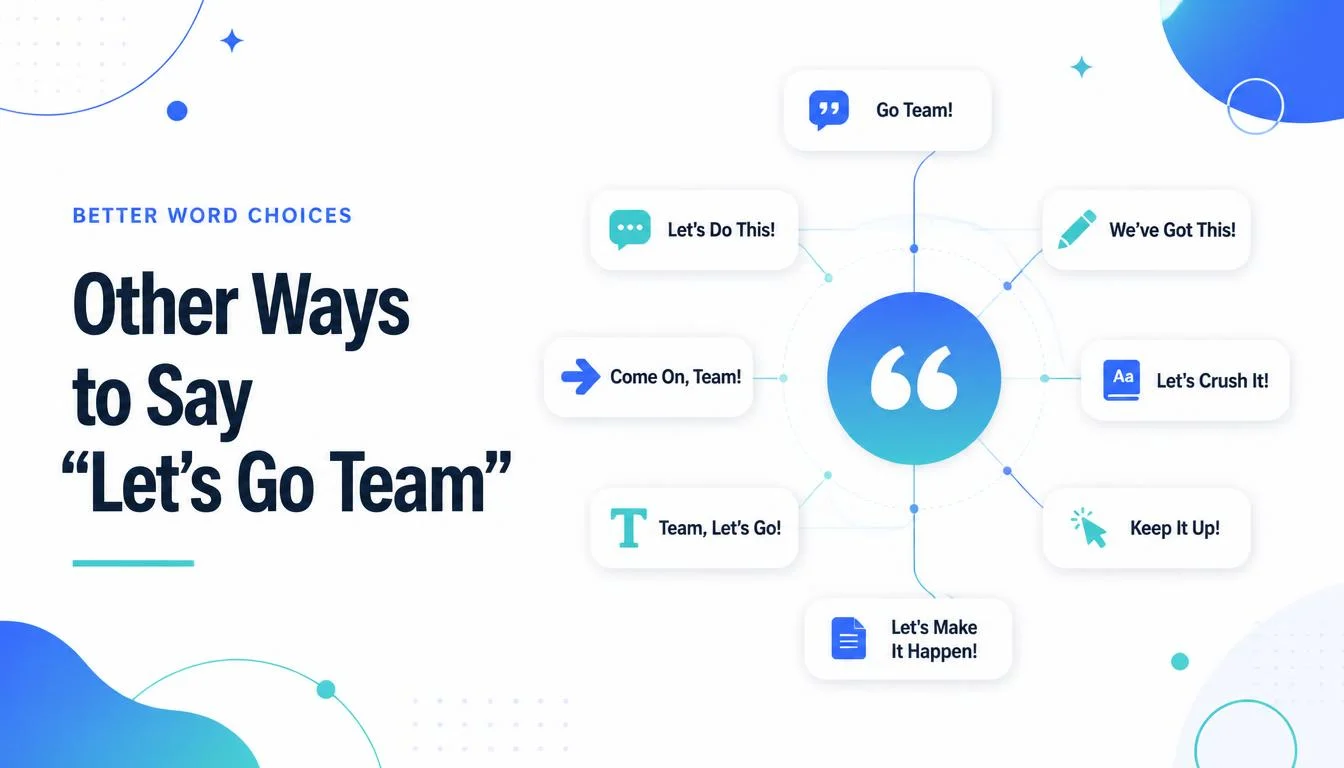
Looking for alternatives to “Let’s Go Team”? Try these top 5: “Let’s do this, team,” “We’ve got this, everyone,” “Time to shine, team,” “All hands on deck,” and “Let’s make it happen, team.”
“Let’s go team” is one of the most common phrases used to rally a group. Whether you’re on a sports field, in a meeting room, or sending a Slack message, this expression signals action, energy, and unity. It’s short, punchy, and instantly recognizable.
But here’s the challenge: repeating the same phrase over and over can make your English sound repetitive and limited. Learning alternatives to “Let’s Go Team” will help you express excitement in English with more precision, adapt to different audiences, and sound more fluent and professional. The right phrase at the right moment can transform how your message lands and how people perceive you as a leader or teammate.
“The right tone makes your English sound professional and confident.”
Quick Categories
Formal Alternatives to “Let’s Go Team”
- Let us proceed as a team
- Let’s move forward together
- Let’s commence our efforts
- Let’s advance collectively
- Let us begin the work
Casual Alternatives
- Let’s do this, team
- Time to shine
- Let’s get after it
- Let’s roll, team
- Here we go, everyone
Professional Alternatives
- Let’s tackle this together
- Let’s drive this forward
- Let’s get to work, team
- Let’s execute the plan
- Let’s push ahead
Informal Expressions
- Let’s crush it
- Let’s bring it home
- Let’s get this show on the road
- Let’s go get ’em
- Let’s bring the energy
Pro Tip: Match your phrase to your audience. Formal settings demand structure; casual settings reward energy and personality.
Common Mistakes to Avoid
- Using “Let’s go team” in a formal written report.
❌ “The quarterly results are in. Let’s go team!” → Too informal for documentation. - Shouting it in a one-on-one conversation.
❌ “Let’s go team!” to a single colleague → The word “team” doesn’t fit. - Using it when no action is required.
❌ “Let’s go team” during a passive presentation → It implies movement or action. - Overusing it in every situation.
❌ Saying it five times in one meeting → Loses impact and sounds repetitive. - Using it with a flat, unenthusiastic tone.
❌ Monotone delivery → The phrase loses its motivational power.
What Does “Let’s Go Team” Mean?
“Let’s go team” is a motivational expression used to encourage a group to take action, perform well, or move forward together. It combines the invitation “let’s go” (meaning “we should start or proceed”) with the collective noun “team” to address the group directly.
Grammar note: “Let’s” is a contraction of “let us,” making it a first-person plural imperative. It includes the speaker as part of the group.
Example: “Alright everyone, let’s go team we have five minutes to finish this.”
When to Use “Let’s Go Team”
- Sports events cheering from the sidelines
- Team meetings kicking off a session with energy
- Workplace huddles before a presentation or deadline push
- Group activities starting a collaborative task
- Casual team chats Slack, WhatsApp, or in-person gatherings
Spoken vs Written: Primarily spoken. In writing, it works in informal emails or messages but is rarely used in formal documents.
Formal vs Informal: Decidedly informal. Use with colleagues you know well or in casual team environments.
Is It Professional or Polite to Say “Let’s Go Team”?
Polite? ✔️ Yes it’s inclusive and encouraging.
Professional? ❌ No in most formal business contexts, it’s too casual.
Business-style alternative: “Let’s move forward together and deliver this project on time.”
“In professional settings, clarity and structure often beat hype and energy.”
Pros and Cons of Using “Let’s Go Team”
Pros
- Simple and instantly understood
- Friendly and inclusive tone
- Widely used across English-speaking cultures
- Easy to remember and repeat
Cons
- Too informal for most professional writing
- Overused in casual settings
- Limited emotional range doesn’t convey nuance
- Not suitable for formal speeches or reports
Other Ways to Say “Let’s Go Team”
These 30 alternatives to “Let’s Go Team” will help you sound more fluent, confident, and natural in different situations. Use them according to tone, context, and audience to express excitement in English, admiration, or approval.
Formal & Professional Alternatives
1. Phrase: Let us proceed as a team
Meaning: Suggest moving forward together in a structured way.
Explanation: Formal version that replaces “let’s” with “let us” for a more dignified tone.
Example: “Let us proceed as a team and address each agenda item systematically.”
Best Use: Board meetings
Worst Use: Sports events
Tone: Formal, respectful
Context Variability: Professional only
2. Phrase: Let’s move forward together
Meaning: Encourage collective progress toward a goal.
Explanation: Emphasizes unity and forward momentum in a professional way.
Example: “Let’s move forward together and finalize the proposal by Friday.”
Best Use: Project kickoffs
Worst Use: Cheering at a game
Tone: Professional, collaborative
Context Variability: Professional / spoken
3. Phrase: Let’s tackle this together
Meaning: Approach a challenge as a united group.
Explanation: Suggests teamwork and shared responsibility for solving a problem.
Example: “Let’s tackle this together. I know we can find a solution.”
Best Use: Problem solving meetings
Worst Use: Celebrating a win
Tone: Determined, supportive
Context Variability: Professional / casual
4. Phrase: Let’s drive this forward
Meaning: Take active steps to advance a project or initiative.
Explanation: Uses “drive” to convey energy and purposeful action.
Example: “Let’s drive this forward and hit our Q4 targets.”
Best Use: Strategy sessions
Worst Use: Social gatherings
Tone: Ambitious, professional
Context Variability: Professional
5. Phrase: Let’s execute the plan
Meaning: Move from discussion to action.
Explanation: Direct and results oriented, suitable for implementation phases.
Example: “Let’s execute the plan. Everyone knows their role.”
Best Use: Implementation meetings
Worst Use: Casual hangouts
Tone: Action oriented, precise
Context Variability: Professional
6. Phrase: Let’s push ahead
Meaning: Continue moving forward despite challenges.
Explanation: Conveys resilience and determination.
Example: “Let’s push ahead. We’re almost there.”
Best Use: Overcoming obstacles
Worst Use: Celebratory moments
Tone: Resilient, professional
Context Variability: Professional / spoken
7. Phrase: Let’s get to work, team
Meaning: Begin the task at hand.
Explanation: Direct and professional, suitable for starting a work session.
Example: “Let’s get to work, team. We have a lot to accomplish today.”
Best Use: Starting a workday
Worst Use: Sports events
Tone: Professional, focused
Context Variability: Professional
8. Phrase: Let’s advance collectively
Meaning: Make progress as one unit.
Explanation: Formal phrasing that emphasizes group unity.
Example: “Let’s advance collectively toward our shared objective.”
Best Use: Formal presentations
Worst Use: Text messages
Tone: Formal, collective
Context Variability: Professional only
9. Phrase: Let’s commence our efforts
Meaning: Begin working together.
Explanation: Very formal, suitable for official openings or ceremonies.
Example: “Let’s commence our efforts on this important initiative.”
Best Use: Official launches
Worst Use: Everyday conversation
Tone: Formal, ceremonial
Context Variability: Professional only
10. Phrase: Let us begin the work
Meaning: Start the task as a group.
Explanation: Traditional and respectful phrasing.
Example: “Let us begin the work. We have a shared vision to realize.”
Best Use: Formal team gatherings
Worst Use: Casual chats
Tone: Formal, earnest
Context Variability: Professional
Casual & Motivational Alternatives
11. Phrase: Let’s do this, team
Meaning: Commit to taking action together.
Explanation: High energy alternative that builds anticipation.
Example: “Alright everyone, let’s do this, team. We’re ready!”
Best Use: Pre game huddles
Worst Use: Formal reports
Tone: Energetic, motivational
Context Variability: Casual / professional spoken
12. Phrase: We’ve got this, everyone
Meaning: Express confidence in the team’s ability.
Explanation: Reassuring and inclusive, builds collective confidence.
Example: “We’ve got this, everyone. Stay focused and trust each other.”
Best Use: Before a challenge
Worst Use: Formal writing
Tone: Reassuring, confident
Context Variability: Casual / spoken
13. Phrase: Time to shine, team
Meaning: It’s the team’s moment to perform well.
Explanation: Encourages excellence and highlights opportunity.
Example: “Time to shine, team. Show them what we can do.”
Best Use: Before a presentation
Worst Use: Routine tasks
Tone: Inspiring, upbeat
Context Variability: Casual / professional spoken
14. Phrase: Let’s get after it
Meaning: Pursue the goal with energy and determination.
Explanation: Informal and action focused, common in sports and business.
Example: “Let’s get after it. We’ve got work to do.”
Best Use: Sports / active work
Worst Use: Formal settings
Tone: Energetic, informal
Context Variability: Casual
15. Phrase: Let’s roll, team
Meaning: Start moving or take action.
Explanation: Friendly and casual, suggests readiness.
Example: “Let’s roll, team. The bus is waiting.”
Best Use: Group departures
Worst Use: Professional emails
Tone: Casual, friendly
Context Variability: Casual
16. Phrase: Here we go, everyone
Meaning: Signal that an activity is about to start.
Explanation: Builds anticipation and includes everyone.
Example: “Here we go, everyone. The presentation starts now.”
Best Use: Starting an event
Worst Use: Formal documentation
Tone: Anticipatory, inclusive
Context Variability: Casual / spoken
17. Phrase: Let’s bring it home
Meaning: Finish strong and achieve the goal.
Explanation: Often used near the end of a project or game.
Example: “Let’s bring it home, team. We’re so close.”
Best Use: Final push
Worst Use: Starting a project
Tone: Determined, motivational
Context Variability: Casual / spoken
18. Phrase: Let’s go get ’em
Meaning: Go out and achieve victory or success.
Explanation: Competitive and spirited, common in sports.
Example: “Let’s go get ’em, team. They don’t know what’s coming.”
Best Use: Competitive events
Worst Use: Professional settings
Tone: Spirited, competitive
Context Variability: Casual
19. Phrase: Let’s bring the energy
Meaning: Show enthusiasm and high spirits.
Explanation: Encourages the team to be lively and engaged.
Example: “Let’s bring the energy. This is our moment.”
Best Use: Events / performances
Worst Use: Serious meetings
Tone: Energetic, vibrant
Context Variability: Casual / spoken
20. Phrase: Let’s crush it
Meaning: Do something exceptionally well.
Explanation: Informal and confident, expresses high ambition.
Example: “Let’s crush it, team. We’ve prepared for this.”
Best Use: High stakes tasks
Worst Use: Formal contexts
Tone: Confident, informal
Context Variability: Casual
Supportive & Encouraging Alternatives
21. Phrase: All hands on deck
Meaning: Everyone needs to contribute and help.
Explanation: Nautical origin, now used to call for full team participation.
Example: “All hands on deck, team. We need everyone’s input on this.”
Best Use: Urgent situations
Worst Use: Routine tasks
Tone: Urgent, collaborative
Context Variability: Professional / casual
22. Phrase: Let’s give it our all
Meaning: Put in maximum effort.
Explanation: Encourages full commitment from the team.
Example: “Let’s give it our all. This is what we’ve been working for.”
Best Use: Final efforts
Worst Use: Low stakes tasks
Tone: Committed, heartfelt
Context Variability: Casual / spoken
23. Phrase: Let’s show them what we’re made of
Meaning: Demonstrate the team’s true abilities.
Explanation: Confident and bold, often used before a challenge.
Example: “Let’s show them what we’re made of. We’ve got the talent.”
Best Use: Competitions / pitches
Worst Use: Internal meetings
Tone: Bold, confident
Context Variability: Casual / spoken
24. Phrase: Together, we’ve got this
Meaning: Unity ensures success.
Explanation: Emphasizes collective strength and reassurance.
Example: “Together, we’ve got this. No challenge is too big for us.”
Best Use: Difficult projects
Worst Use: Formal writing
Tone: Reassuring, unified
Context Variability: Casual / spoken
25. Phrase: Let’s make it happen, team
Meaning: Turn plans into reality through action.
Explanation: Action oriented and empowering.
Example: “Let’s make it happen, team. The opportunity is ours.”
Best Use: Goal setting meetings
Worst Use: Sports events
Tone: Empowering, action oriented
Context Variability: Professional / casual
26. Phrase: Let’s get this done
Meaning: Complete the task at hand.
Explanation: Direct and focused on results.
Example: “Let’s get this done. We’re the right people for it.”
Best Use: Task completion
Worst Use: Celebratory moments
Tone: Focused, direct
Context Variability: Professional / casual
Playful & Creative Alternatives
27. Phrase: Let’s get this show on the road
Meaning: Start the activity or event.
Explanation: Idiomatic and playful, suggests a performance or production.
Example: “Let’s get this show on the road, team. The audience is waiting.”
Best Use: Events / presentations
Worst Use: Serious formal settings
Tone: Playful, idiomatic
Context Variability: Casual
28. Phrase: Let’s rock and roll
Meaning: Start with energy and enthusiasm.
Explanation: Classic informal expression suggesting fun and action.
Example: “Let’s rock and roll, team. We’ve got a busy day ahead.”
Best Use: Starting active work
Worst Use: Formal meetings
Tone: Energetic, fun
Context Variability: Casual
29. Phrase: Let’s fire it up
Meaning: Ignite energy and get started.
Explanation: Suggests lighting a fire of motivation.
Example: “Let’s fire it up, team. Time to get excited!”
Best Use: Motivational kickoffs
Worst Use: Professional writing
Tone: Fiery, motivational
Context Variability: Casual
30. Phrase: Let’s go, team. No looking back
Meaning: Move forward without hesitation.
Explanation: Adds determination and commitment to the classic phrase.
Example: “Let’s go, team. No looking back. Full speed ahead.”
Best Use: Decisive moments
Worst Use: Cautious planning
Tone: Determined, bold
Context Variability: Casual / spoken
“Variety in your vocabulary shows mastery. Repeating the same phrase makes you sound like a broken record.”
Mini Quiz / Self Check
1. Which phrase is most appropriate for a formal board meeting?
A) Let’s crush it
B) Let us proceed as a team
C) Let’s roll
D) Let’s go get ’em
Answer: B
2. You’re about to start a sports match with your teammates. Which is the best choice?
A) Let’s drive this forward
B) Let’s execute the plan
C) Let’s do this, team
D) Let us commence our efforts
Answer: C
3. Which phrase would be inappropriate in a professional email?
A) Let’s tackle this together
B) Let’s move forward together
C) Let’s bring it home
D) Let’s get to work, team
Answer: C
4. You want to reassure your team before a difficult presentation. What do you say?
A) Let’s go get ’em
B) We’ve got this, everyone
C) Let’s rock and roll
D) Let’s fire it up
Answer: B
Comparison Table: Top 10 Alternatives
| Phrase | Tone | Best Use |
|---|---|---|
| Let us proceed as a team | Formal | Board meetings |
| Let’s move forward together | Professional | Project kickoffs |
| Let’s tackle this together | Collaborative | Problem-solving |
| Let’s do this, team | Energetic | Pre-game huddles |
| We’ve got this, everyone | Reassuring | Before challenges |
| Let’s get after it | Informal | Active work |
| All hands on deck | Urgent | Crisis situations |
| Let’s make it happen | Empowering | Goal-setting |
| Let’s get this show on the road | Playful | Events / presentations |
| Let’s crush it | Confident | High-stakes tasks |
FAQs
1. Is “Let’s go team” grammatically correct?
Yes, it’s grammatically correct. “Let’s” is a contraction of “let us,” and “team” is the direct address. It’s an imperative sentence inviting the group to take action.
2. Can I use “Let’s go team” in a professional email?
Generally, no. It’s too informal for most professional emails. Use “Let’s move forward together” or “Let’s tackle this together” instead.
3. What’s the difference between “Let’s go team” and “Go team”?
“Let’s go team” includes the speaker in the action (“let us go”), while “Go team” is a direct cheer directed at the team from an outside supporter.
4. Is “Let’s go team” only used in sports?
No, it’s used in sports, workplace settings, group activities, and any situation where a team needs motivation or encouragement to take action.
5. What are some formal ways to say “Let’s go team”?
Formal alternatives include “Let us proceed as a team,” “Let’s move forward together,” and “Let’s advance collectively.”
Conclusion
Learning alternatives to “Let’s Go Team” is about more than just building vocabulary it’s about becoming a more versatile and confident communicator. The ability to choose the right phrase for the right moment shows emotional intelligence, cultural awareness, and linguistic fluency. Whether you’re leading a boardroom presentation, cheering from the stands, or sending a quick team message, the words you choose shape how others perceive you and respond to your message.
Start incorporating these 30 alternatives into your daily conversations. Pay attention to tone, context, and audience. With practice, you’ll naturally reach for the perfect phrase every time and your English will sound more polished, professional, and powerful.
Read More Related Articles:
- Other Ways to Say “From” in a Letter | For a More Professional Sign-Off In 2026
- Other Ways to Say Be Safe | Upgrade Your Farewells In 2026
- Other Ways to Say Feel Free | Formal Writing and Business Communication In 2026

Henry Walker is an American writer and blogger with a keen interest in communication, language and digital content. At TextsResponse.com, he creates informative and reader-focused resources designed to help people communicate with clarity, confidence and authenticity.