Quick Answer
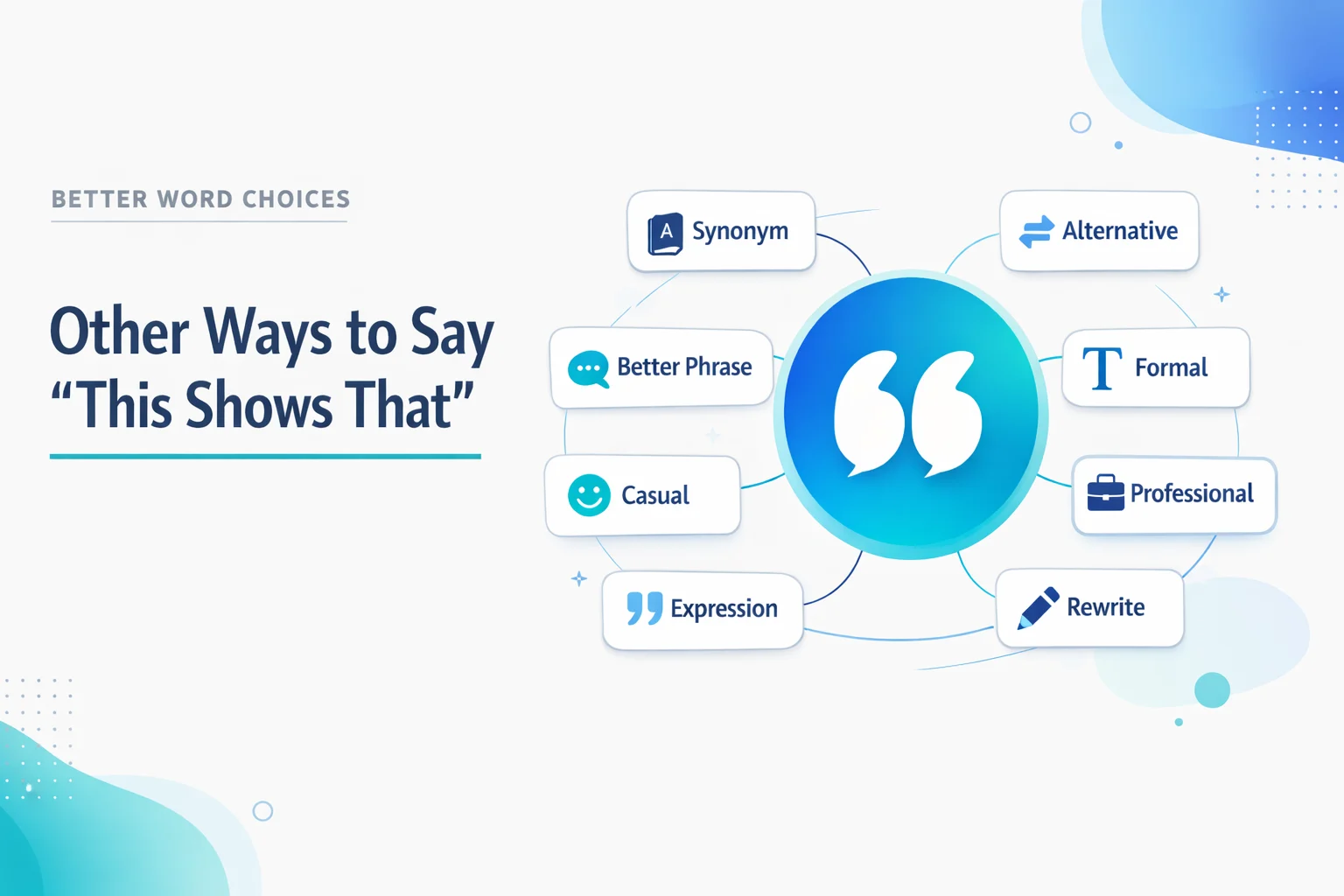
Looking for alternatives to “this shows that”?The best substitutes include: this demonstrates that, this indicates that, this proves that, this suggests that, and this reveals that.
“This shows that” is a transitional phrase used to connect evidence with a conclusion. It appears constantly in essays, business reports, presentations, and everyday conversation whenever someone wants to explain what a fact, result, or observation means.
People rely on this phrase because it is simple and universally understood. However, repeating it again and again can make your writing or speech sound repetitive and uninspired. Learning alternatives to “this shows that” helps you sound more precise, more fluent, and more credible, especially in academic or professional settings.
Beyond written English, knowing multiple ways to introduce a conclusion also helps you express excitement in English when a result is impressive, or express caution when a finding is only partial. Mastering these variations is a small change that makes a big difference in how polished your English sounds.
Quick Categories
Formal Alternatives to “This Shows That”
- This demonstrates that
- This indicates that
- This substantiates the claim that
- This confirms that
Pro Tip: Use formal alternatives in essays, reports, and research papers where precision and objectivity matter most.
Casual Alternatives
- This tells us that
- This basically means
- So this means
- This kind of proves that
Pro Tip: Save casual alternatives for conversations, chats, or informal emails with people you know well.
Professional Alternatives
- This data indicates that
- This finding suggests that
- These results confirm that
- This evidence points to
Pro Tip: In business writing, pair a professional alternative with a specific number or data point to sound more credible.
Informal Expressions
- This pretty much shows
- You can tell from this that
- This is proof that
- This goes to show that
Pro Tip: Informal expressions work well in blog posts or casual speech, but avoid them in formal reports.
“Precision in language builds trust in your ideas.”
Common Mistakes
- Overusing “this shows that” repeatedly in one paragraph. Example: “This shows that sales grew. This shows that customers are happy. This shows that the strategy worked.”
- Using it without stating what “this” refers to. Example: “This shows that it works.” (Unclear what “it” is.)
- Confusing “shows” with “proves” when evidence is not conclusive. Example: “This shows that the theory is completely true.” (Too strong a claim.)
- Using overly casual alternatives in formal writing. Example: “This kind of proves that the plan failed” in a business report.
- Forgetting subject-verb agreement in longer sentences. Example: “This show that the results are accurate.” (Should be “shows.”)
What Does “This Shows That” Mean?
“This shows that” is used to introduce a conclusion drawn from evidence, data, or an observation. Grammatically, “this” acts as the subject, “shows” is the verb, and “that” introduces a subordinate clause containing the conclusion.
Example Sentence: The survey results show that most employees prefer remote work.
When to Use “This Shows That”
- Presenting data or research findings
- Explaining cause and effect in an essay
- Summarizing evidence during a presentation
- Drawing conclusions in everyday conversation
Spoken vs Written: In speech, it often appears as a quick summary phrase. In writing, it is more structured and usually followed by supporting detail.
Formal vs Informal: The base phrase itself is neutral, but its alternatives shift the tone up or down depending on word choice.
Is It Professional or Polite to Say “This Shows That”?
“This shows that” is polite and neutral, but it is not always the most professional choice for formal documents, since stronger alternatives like “this demonstrates” or “this indicates” sound more analytical.
Business Example: “This shows that the campaign increased engagement by 20 percent” is acceptable, but “This demonstrates that the campaign increased engagement by 20 percent” sounds more polished in a report.
Polite? Yes Professional? No, in most formal cases
Pros and Cons of Using “This Shows That”
Pros:
- Simple and natural
- Friendly tone
- Common usage
- Easy to understand
Cons:
- Too informal for work
- Overused
- Limited emotional range
- Not suitable for formal writing
“Fluency is not about big words. It is about the right word at the right time.”
Other Ways to Say “This Shows That”
These alternatives will help you sound more fluent, confident, and natural in different situations.
Use them according to tone, context, and audience to express excitement, admiration, or approval, or to stay neutral and analytical.
1. This demonstrates that
Meaning: Clearly proves or illustrates a point.
Explanation: A strong alternative commonly used in academic, business, and professional writing to present evidence-based conclusions.
Example Sentence: The report demonstrates that revenue increased steadily over the past year.
Best Use: Essays, research papers, business reports
Worst Use: Casual conversations
Tone: Formal, analytical
Context Variability:
- Academic: “The findings demonstrate that the proposed method improves accuracy.”
- Professional: “The quarterly report demonstrates that customer satisfaction has increased.”
2. This indicates that
Meaning: Points toward a likely conclusion without complete certainty.
Explanation: Ideal when evidence is persuasive but not entirely conclusive.
Example Sentence: The test results indicate that the product is safe for public use.
Best Use: Scientific writing, research, business reports
Worst Use: Informal conversations
Tone: Formal, cautious
Context Variability:
- Research: “The survey indicates that remote work improves productivity.”
- Professional: “Customer feedback indicates that additional training is needed.”
3. This suggests that
Meaning: Hints at a possible conclusion.
Explanation: Best used when evidence supports an idea but does not prove it completely.
Example Sentence: The data suggests that customer loyalty is increasing.
Best Use: Analysis, forecasts, research
Worst Use: Statements requiring absolute certainty
Tone: Cautious, thoughtful
Context Variability:
- Academic: “The evidence suggests that climate patterns are changing.”
- Professional: “Recent trends suggest that demand will continue to grow.”
4. This proves that
Meaning: Confirms something beyond reasonable doubt.
Explanation: Use this phrase only when the evidence is conclusive and unquestionable.
Example Sentence: The experiment proves that the hypothesis was correct.
Best Use: Strong evidence, scientific conclusions
Worst Use: Weak or incomplete evidence
Tone: Confident, assertive
Context Variability:
- Academic: “The findings prove that the treatment is effective.”
- Professional: “The audit proves that all regulations were followed.”
5. This reveals that
Meaning: Uncovers previously unknown information.
Explanation: Useful for emphasizing discoveries or important findings.
Example Sentence: The audit reveals that operational costs were higher than expected.
Best Use: Investigations, reports, research
Worst Use: Obvious or already known facts
Tone: Insightful, formal
Context Variability:
- Professional: “The survey reveals that customer expectations have changed.”
- Academic: “The analysis reveals that several variables influenced the outcome.”
6. This confirms that
Meaning: Verifies an existing assumption or belief.
Explanation: Used when new evidence supports something already suspected.
Example Sentence: The second test confirms that the results are accurate.
Best Use: Verification, testing, research
Worst Use: Introducing brand-new claims
Tone: Formal, certain
Context Variability:
- Scientific: “The follow-up experiment confirms that the theory is valid.”
- Professional: “Customer surveys confirm that service quality has improved.”
7. This implies that
Meaning: Suggests an indirect conclusion.
Explanation: Appropriate when the conclusion is inferred rather than explicitly stated.
Example Sentence: Her silence implies that she disagrees.
Best Use: Analytical writing, discussions
Worst Use: Direct factual evidence
Tone: Formal, subtle
Context Variability:
- Academic: “The findings imply that additional research is necessary.”
- Professional: “The decline in sales implies that market conditions have changed.”
8. This tells us that
Meaning: Draws a clear conclusion from the available information.
Explanation: Slightly conversational while remaining suitable for presentations and discussions.
Example Sentence: This tells us that the current plan needs adjustment.
Best Use: Presentations, meetings, explanations
Worst Use: Highly formal academic writing
Tone: Neutral, friendly
Context Variability:
- Professional: “The survey tells us that employees value flexible schedules.”
- Spoken: “This tells us that we’re heading in the right direction.”
9. This points to
Meaning: Directs attention toward a likely conclusion.
Explanation: Frequently used in business analysis and forecasting.
Example Sentence: The trend points to higher demand next quarter.
Best Use: Forecasts, analytical reports
Worst Use: Emotional discussions
Tone: Analytical, neutral
Context Variability:
- Business: “The data points to continued market growth.”
- Research: “The evidence points to a strong correlation.”
10. This is evidence that
Meaning: Serves as supporting proof for a claim.
Explanation: Emphasizes the evidentiary value of an observation.
Example Sentence: The results are evidence that the new process is effective.
Best Use: Formal arguments, research papers
Worst Use: Casual conversations
Tone: Formal, serious
Context Variability:
- Academic: “The findings are evidence that early intervention improves outcomes.”
- Professional: “The audit is evidence that compliance standards were met.”
11. This goes to show that
Meaning: Illustrates a broader lesson or truth.
Explanation: A slightly informal expression often used to summarize an observation.
Example Sentence: This goes to show that hard work eventually pays off.
Best Use: Storytelling, blogs, speeches
Worst Use: Technical reports
Tone: Casual, reflective
Context Variability:
- Casual: “This goes to show that practice really makes a difference.”
- Spoken: “This goes to show that preparation matters.”
12. This means that
Meaning: Explains the consequence or result of a fact.
Explanation: One of the most flexible and commonly used expressions in English.
Example Sentence: The battery is low, which means that it needs charging.
Best Use: Everyday explanations, professional writing
Worst Use: None
Tone: Neutral, clear
Context Variability:
- Professional: “The budget was approved. This means that the project can begin.”
- Casual: “The store is closed. This means we’ll have to come back tomorrow.”
13. This is proof that
Meaning: Offers strong confirmation of a claim.
Explanation: More emphatic than “this shows that” and best reserved for convincing evidence.
Example Sentence: Winning the award is proof that the team’s hard work paid off.
Best Use: Motivational or persuasive writing
Worst Use: Uncertain findings
Tone: Confident, encouraging
Context Variability:
- Professional: “The certification is proof that our standards are improving.”
- Casual: “That’s proof that persistence pays off.”
14. This highlights that
Meaning: Draws attention to an important point.
Explanation: Useful when emphasizing key findings or significant information.
Example Sentence: The report highlights that employee training reduced errors.
Best Use: Reports, summaries, presentations
Worst Use: Minor details
Tone: Formal, emphatic
Context Variability:
- Academic: “The research highlights that nutrition affects learning.”
- Professional: “The review highlights that customer service remains our strength.”
15. This illustrates that
Meaning: Uses an example to support a point.
Explanation: Common in case studies, reports, and educational writing.
Example Sentence: This case illustrates that flexibility improves outcomes.
Best Use: Examples, case studies
Worst Use: Unsupported abstract claims
Tone: Formal, explanatory
Context Variability:
- Academic: “The experiment illustrates that consistent practice improves performance.”
- Professional: “The project illustrates that collaboration increases efficiency.”
16. This underscores that
Meaning: Strongly emphasizes an important conclusion.
Explanation: Adds weight and significance to your statement.
Example Sentence: The delay underscores that better planning is essential.
Best Use: Reports, persuasive writing
Worst Use: Casual conversation
Tone: Formal, serious
Context Variability:
- Business: “The findings underscore that customer retention is a priority.”
- Academic: “The evidence underscores that early intervention matters.”
17. This signals that
Meaning: Acts as an early indicator of something.
Explanation: Frequently used when discussing trends or warning signs.
Example Sentence: Rising prices signal that inflation is increasing.
Best Use: Market analysis, forecasting
Worst Use: Proven facts
Tone: Analytical, alert
Context Variability:
- Business: “The decline signals that consumer confidence is weakening.”
- Research: “The results signal that further testing is required.”
18. This makes it clear that
Meaning: Removes doubt about a conclusion.
Explanation: A direct expression used when the evidence leaves little room for uncertainty.
Example Sentence: The feedback makes it clear that changes are needed.
Best Use: Reports, presentations
Worst Use: Tentative conclusions
Tone: Confident, direct
Context Variability:
- Professional: “The audit makes it clear that additional controls are necessary.”
- Spoken: “This makes it clear that we’re moving in the right direction.”
19. This validates that
Meaning: Confirms the accuracy or effectiveness of something.
Explanation: Frequently used in testing, research, and technical writing.
Example Sentence: The trial validates that the method is effective.
Best Use: Research, testing
Worst Use: Everyday conversations
Tone: Formal, technical
Context Variability:
- Academic: “The results validate that the proposed model is reliable.”
- Professional: “Customer feedback validates that the new feature adds value.”
20. This establishes that
Meaning: Formally confirms a fact or conclusion.
Explanation: Often found in legal, academic, and official documents.
Example Sentence: The document establishes that the contract is valid.
Best Use: Legal documents, academic writing
Worst Use: Casual conversations
Tone: Formal, authoritative
Context Variability:
- Legal: “The evidence establishes that the agreement was lawful.”
- Academic: “The research establishes that the method is effective.”
21. This backs up the idea that
Meaning: Supports an existing claim with evidence.
Explanation: A conversational alternative that still works well in presentations and discussions.
Example Sentence: The numbers back up the idea that sales are improving.
Best Use: Discussions, presentations
Worst Use: Highly formal academic writing
Tone: Neutral, persuasive
Context Variability:
- Professional: “The survey backs up the idea that customers value faster delivery.”
- Spoken: “These results back up the idea that practice makes a difference.”
22. This is a sign that
Meaning: Suggests that something is likely true.
Explanation: Common in everyday English when describing observations.
Example Sentence: Her smile is a sign that she is pleased with the results.
Best Use: Everyday conversations
Worst Use: Technical evidence
Tone: Warm, conversational
Context Variability:
- Casual: “That’s a sign that things are improving.”
- Spoken: “His confidence is a sign that he’s well prepared.”
23. This shows evidence of
Meaning: Presents visible proof of a condition or change.
Explanation: Common in medical, scientific, and technical contexts.
Example Sentence: The scan shows evidence of significant improvement.
Best Use: Medical and technical reports
Worst Use: Personal opinions
Tone: Formal, clinical
Context Variability:
- Medical: “The test shows evidence of recovery.”
- Scientific: “The sample shows evidence of contamination.”
24. This confirms the idea that
Meaning: Strengthens an existing belief or theory.
Explanation: A clear and formal phrase for reinforcing conclusions.
Example Sentence: The results confirm the idea that teamwork improves productivity.
Best Use: Presentations, academic writing
Worst Use: Very brief statements
Tone: Formal, assured
Context Variability:
- Professional: “The survey confirms the idea that flexibility boosts morale.”
- Academic: “The experiment confirms the idea that repetition improves learning.”
25. This makes the case that
Meaning: Builds a persuasive argument supporting a conclusion.
Explanation: Common in persuasive essays and analytical writing.
Example Sentence: The report makes the case that policy reform is necessary.
Best Use: Persuasive writing
Worst Use: Neutral reporting
Tone: Assertive, formal
Context Variability:
- Academic: “The study makes the case that renewable energy is cost-effective.”
- Professional: “The proposal makes the case that automation will reduce costs.”
26. This is telling of
Meaning: Indirectly reveals something meaningful.
Explanation: A slightly literary expression often used in reflective writing.
Example Sentence: His reaction is telling of how deeply he cares.
Best Use: Narrative and reflective writing
Worst Use: Technical reports
Tone: Reflective, subtle
Context Variability:
- Creative: “Her response is telling of her determination.
- Casual: “That’s telling of how much the project means to them.”
27. This supports the view that
Meaning: Reinforces an existing opinion or theory.
Explanation: Frequently used in academic and evidence-based writing.
Example Sentence: The findings support the view that exercise reduces stress.
Best Use: Academic essays, research papers
Worst Use: Casual conversations
Tone: Formal, analytical
Context Variability:
- Academic: “The evidence supports the view that early education improves outcomes.”
- Professional: “The data supports the view that customer loyalty is increasing.”
28. This points out that
Meaning: Draws attention to a specific fact.
Explanation: A direct phrase often used in presentations and reports.
Example Sentence: The chart points out that operating costs rose sharply.
Best Use: Reports, presentations
Worst Use: Emotional discussions
Tone: Neutral, direct
Context Variability:
- Professional: “The report points out that employee turnover has decreased.”
- Spoken: “The results point out that we need a different approach.”
29. This is a clear indication that
Meaning: Strongly signals a particular conclusion.
Explanation: A more emphatic alternative to “this indicates that.”
Example Sentence: The applause is a clear indication that the presentation was successful.
Best Use: Strong evidence, formal writing
Worst Use: Weak or uncertain findings
Tone: Formal, confident
Context Variability:
- Professional: “The survey is a clear indication that customer satisfaction has improved.”
- Academic: “The findings are a clear indication that further investment is worthwhile.”
30. This basically means
Meaning: Explains a conclusion in simple language.
Explanation: A very conversational phrase used to simplify complex ideas.
Example Sentence: This basically means we need more time to finish the project.
Best Use: Casual conversations, informal presentations
Worst Use: Academic papers and formal reports
Tone: Casual, simple
Context Variability:
Spoken: “This basically means the update fixed the problem.”
Casual: “This basically means we’re starting over.”
“Alternatives to a phrase are not just synonyms, they are tools for tone control.”
Mini Quiz
1. Which alternative is most appropriate for a formal research paper?
A) This kind of proves that
B) This demonstrates that
C) This basically means
D) This goes to show that
Correct Answer: B) This demonstrates that
2. Which phrase fits best in a casual conversation with a friend?
A) This validates that
B) This establishes that
C) This tells us that
D) This substantiates the claim that
Correct Answer: C) This tells us that
3. Which phrase is most appropriate when the evidence is suggestive but not conclusive?
A) This proves that
B) This suggests that
C) This confirms that
D) This establishes that
Correct Answer: B) This suggests that
4. Which phrase sounds most professional in a business report?
A) This kind of shows
B) This indicates that
C) This is proof that
D) You can tell from this
Correct Answer: B) This indicates that
Comparison Table: Top Alternatives
| Phrase | Tone | Best Use |
|---|---|---|
| This demonstrates that | Formal, analytical | Essays, reports |
| This indicates that | Formal, cautious | Research, science |
| This suggests that | Cautious, thoughtful | Analysis, forecasts |
| This proves that | Confident, assertive | Strong evidence |
| This reveals that | Insightful, formal | Investigations |
| This confirms that | Formal, certain | Verification |
| This tells us that | Neutral, friendly | Presentations |
| This points to | Analytical, neutral | Forecasting |
| This goes to show that | Casual, reflective | Storytelling |
| This means that | Neutral, clear | Everyday explanation |
FAQs
Is “this shows that” grammatically correct?
Yes, it is correct when “this” refers to a singular subject, matching the verb “shows.”
What is a more academic alternative to “this shows that”?
This demonstrates that” or “this indicates that” are stronger choices for academic and research writing.
Can I use “this shows that” in a formal email?
Yes, but for a more professional English tone, consider “this indicates that” or “this confirms that.”
What is the difference between “this shows that” and “this proves that”?
“Shows” suggests supporting evidence, while “proves” implies conclusive certainty.
Are there informal expressions in English for “this shows that”?
Yes, phrases like “this basically means” or “this goes to show that” work well in casual conversation.
Conclusion
Learning alternatives to “this shows that” gives your English more range, precision, and confidence. Instead of repeating the same phrase, you can choose words that match your tone, whether formal, professional, or casual, and communicate your point more effectively.
Practice using these alternatives daily in your writing and conversations. Paying attention to tone awareness, not just vocabulary, is what truly separates fluent English speakers from beginners.
Read More Related Articles:
- Other Ways to Say “First of All” | Make You Sound More Fluent In 2026
- Other Ways to Say That Being Said | Smarter & More Fluent Alternatives In 2026
- Other Ways to Say “In This Article” | That Instantly Elevate Your Writing In 2026

Daniel Murphy is a professional writer and blogger specializing in digital communication and messaging trends. As a contributor to TextsResponse.com, he creates reader-focused content designed to help people find the right words at the right time.