Quick Answer 🔥
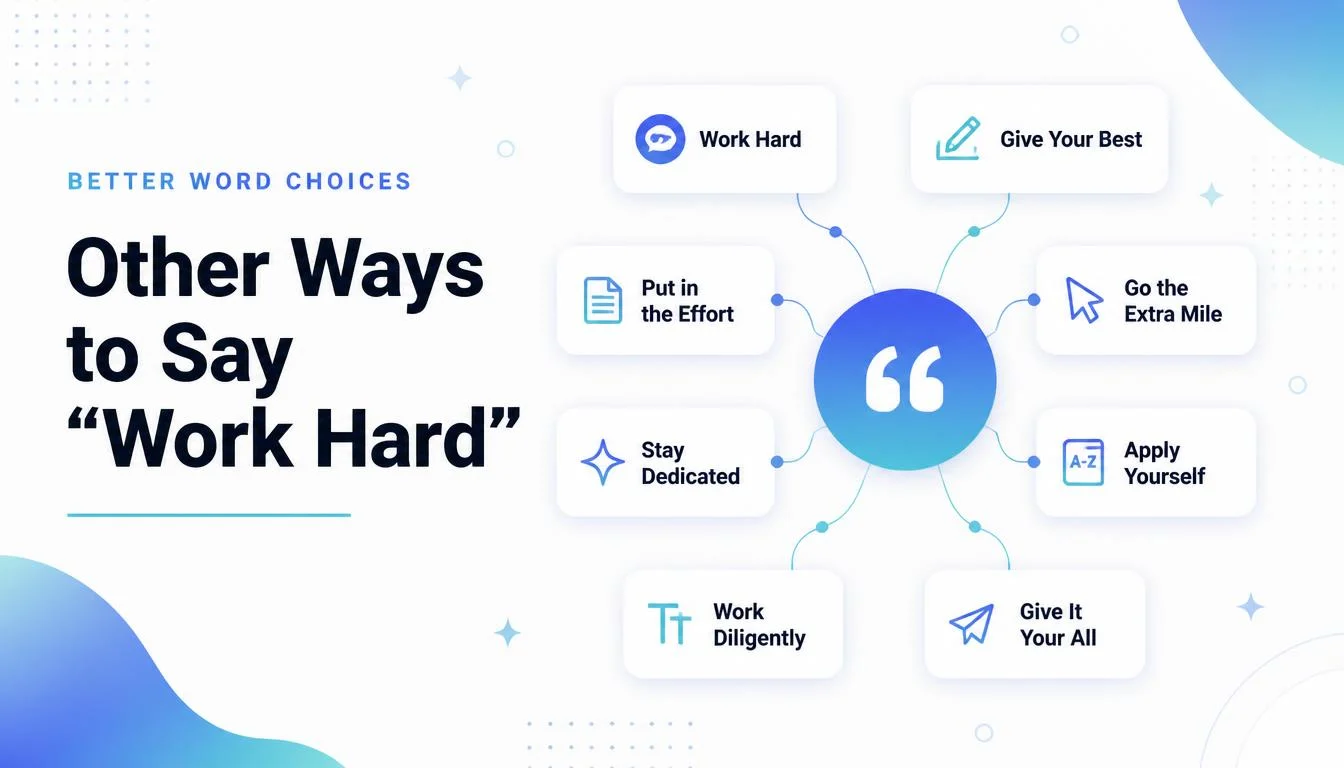
Looking for alternatives to “work hard”? Here are five top options: strive, toil, apply yourself, dedicate yourself, and put in the effort. Each suits a different tone and context from casual conversations to formal business writing.
The phrase “work hard” is one of the most common expressions in English. It simply means putting significant effort, time, or energy into a task or goal. We use it at work, in school, during personal projects, and even when talking about hobbies or fitness.
But here’s the thing: repeating “work hard” over and over makes your English sound repetitive and limited. Learning alternatives to “work hard” expands your vocabulary, helps you express excitement in English more naturally, and allows you to match your language to the right situation whether you’re writing a cover letter, giving a presentation, or chatting with friends.
“The right tone makes your English sound professional and confident.”
Quick Categories
Formal Alternatives to “Work Hard”
- Strive
- Toil
- Apply yourself
- Dedicate yourself
- Labor
- Exert yourself
- Persevere
- Be diligent
Casual Alternatives
- Give it your all
- Go the extra mile
- Put in the hours
- Grind
- Hustle
- Sweat it out
Professional Alternatives
- Commit yourself
- Devote time and energy
- Put forth effort
- Make every effort
- Invest effort
- Work tirelessly
- Remain steadfast
Informal Expressions
- Work your fingers to the bone
- Work like a dog
- Burn the candle at both ends
- Pull out all the stops
- Leave it all on the field
- Bust your hump
- Knock yourself out
What Does “Work Hard” Mean?
Definition: To expend significant physical or mental effort toward completing a task, achieving a goal, or fulfilling a responsibility.
Grammar note: “Work hard” is a verb phrase where “work” functions as the main verb and “hard” acts as an adverb modifying it. It is used intransitively (without a direct object).
Example sentence:
“I need to work hard if I want to finish this project by Friday.”
When to Use “Work Hard”
Use “work hard” in these common contexts:
- Everyday conversation – talking about your job, studies, or personal goals
- Encouraging others – motivating a colleague, friend, or team member
- Self-description – explaining your work ethic or effort level
- Informal writing – emails to friends, personal journals, social media
Spoken vs Written: More common in spoken English. In formal writing, stronger alternatives are preferred.
Formal vs Informal: Generally informal. Avoid in resumes, cover letters, academic papers, or professional reports.
Is It Professional or Polite to Say “Work Hard”?
Polite? ✔️ Yes – it is courteous and non-offensive.
Professional? ❌ No – in most professional contexts, it is considered too vague, overused, and lacking in sophistication.
Business-style example (what NOT to say):
❌ “I work hard and I’m a good team player.”
Better professional alternative:
✔️ “I am committed to delivering high-quality results and consistently meet project deadlines.”
Pros and Cons of Using “Work Hard”
Pros ✅
- Simple and natural – easy for any English speaker to understand
- Friendly tone – approachable and warm
- Common usage – universally recognized
- Easy to understand – no confusion about meaning
Cons ❌
- Too informal for work – lacks professionalism
- Overused – sounds cliché and unoriginal
- Limited emotional range – doesn’t convey passion or dedication
- Not suitable for formal writing – weakens resumes and reports
Other Ways to Say “Work Hard”
These 30 alternatives will help you sound more fluent, confident, and natural in different situations. Use them according to tone, context, and audience to express effort, dedication, perseverance, or determination.
1. Phrase: Strive
Meaning: To make great efforts to achieve something.
Explanation: Implies continuous, determined effort toward a goal.
Example Sentence: “Our team strives to deliver exceptional service to every client.”
Best Use: Professional writing
Worst Use: Casual texting
Tone: Ambitious, determined
Context Variability: Professional: “We strive for excellence.” / Casual: “I strive to get better every day.”
2. Phrase: Toil
Meaning: To work extremely hard, often over a long period.
Explanation: Suggests sustained, exhausting effort, often involving physical or demanding work.
Example Sentence: “The researchers toiled for years before making their breakthrough.”
Best Use: Formal narratives
Worst Use: Everyday conversation
Tone: Laborious, persistent
Context Variability: Professional: “He toiled away on the report.” / Literary: “She toiled in the fields.”
3. Phrase: Apply Yourself
Meaning: To direct your full attention and effort to a task.
Explanation: Emphasizes focus and dedication rather than simply the number of hours spent working.
Example Sentence: “If you apply yourself to your studies, you will see real progress.”
Best Use: Encouragement
Worst Use: Describing physical labor
Tone: Focused, intentional
Context Variability: Professional: “Apply yourself to this project.” / Casual: “Just apply yourself and you’ll get it.”
4. Phrase: Dedicate Yourself
Meaning: To commit wholly to a purpose or cause.
Explanation: Implies deep personal investment and long-term commitment.
Example Sentence: “She dedicated herself to improving healthcare in rural areas.”
Best Use: Mission-driven contexts
Worst Use: Small, routine tasks
Tone: Passionate, committed
Context Variability: Professional: “Dedicate yourself to your craft.” / Personal: “I dedicate myself to my family.”
5. Phrase: Labor
Meaning: To work hard, especially while doing physical or demanding work.
Explanation: Often used in formal or historical contexts and can also suggest struggle.
Example Sentence: “The team labored through the night to meet the deadline.”
Best Use: Formal writing
Worst Use: Casual chat
Tone: Strenuous, earnest
Context Variability: Professional: “We labored over the details.” / Literary: “He labored in the mines.”
6. Phrase: Exert Yourself
Meaning: To put forth physical or mental effort.
Explanation: Highlights the personal energy and force you invest in a task.
Example Sentence: “You must exert yourself if you want to see meaningful results.”
Best Use: Formal advice
Worst Use: Informal banter
Tone: Effortful, deliberate
Context Variability: Professional: “Exert yourself in every task.” / Casual: “Don’t exert yourself too much.”
7. Phrase: Persevere
Meaning: To continue working hard despite difficulties.
Explanation: Emphasizes resilience, persistence, and refusing to give up.
Example Sentence: “Despite setbacks, the team persevered and delivered the project on time.”
Best Use: Overcoming challenges
Worst Use: Routine tasks
Tone: Resilient, steadfast
Context Variability: Professional: “Persevere through challenges.” / Personal: “Persevere and you’ll succeed.”
8. Phrase: Be Diligent
Meaning: To show careful, steady, and persistent effort.
Explanation: Suggests attention to detail, responsibility, and consistency.
Example Sentence: “Our staff are diligent in maintaining quality standards.”
Best Use: Performance reviews
Worst Use: Quick, casual tasks
Tone: Meticulous, responsible
Context Variability: Professional: “Be diligent with your work.” / Casual: “She’s a diligent student.”
“Precision in language is the hallmark of a confident English speaker.”
9. Phrase: Commit Yourself
Meaning: To pledge your time and energy to a task or role.
Explanation: Suggests a serious, long-term promise to achieve a goal.
Example Sentence: “I commit myself to delivering this project on schedule.”
Best Use: Resumes, interviews
Worst Use: Casual conversations
Tone: Reliable, devoted
Context Variability: Professional: “Commit yourself to excellence.” / Personal: “I commit to this relationship.”
10. Phrase: Devote Time and Energy
Meaning: To allocate significant personal resources to something.
Explanation: Emphasizes the time, attention, and effort invested in an activity.
Example Sentence: “She devotes time and energy to mentoring junior staff.”
Best Use: Professional bios
Worst Use: Quick tasks
Tone: Generous, dedicated
Context Variability: Professional: “Devote time to professional development.” / Casual: “I devote time to my hobbies.”
11. Phrase: Put Forth Effort
Meaning: To make a conscious, visible attempt.
Explanation: Focuses on the action of trying rather than the final result.
Example Sentence: “Every employee is expected to put forth effort toward team goals.”
Best Use: Team communication
Worst Use: Emotional contexts
Tone: Purposeful, active
Context Variability: Professional: “Put forth effort in all you do.” / Casual: “I put forth effort at the gym.”
12. Phrase: Make Every Effort
Meaning: To try as hard as possible.
Explanation: Conveys maximum commitment, sincerity, and determination.
Example Sentence: “We will make every effort to resolve this issue promptly.”
Best Use: Customer service
Worst Use: Personal chats
Tone: Sincere, reassuring
Context Variability: Professional: “Make every effort to meet deadlines.” / Casual: “I’ll make every effort to be there.”
13. Phrase: Invest Effort
Meaning: To treat effort as a valuable resource worth spending.
Explanation: Suggests a strategic and thoughtful approach to using your energy and time.
Example Sentence: “We need to invest effort in building stronger client relationships.”
Best Use: Strategic planning
Worst Use: Mundane tasks
Tone: Strategic, intentional
Context Variability: Professional: “Invest effort in skill development.” / Casual: “Invest effort in your friendships.”
14. Phrase: Work Tirelessly
Meaning: To work with unending energy and determination.
Explanation: Implies dedication that remains strong despite challenges or fatigue.
Example Sentence: “The team worked tirelessly to complete the merger ahead of schedule.”
Best Use: Highlighting achievements
Worst Use: Casual settings
Tone: Relentless, passionate
Context Variability: Professional: “Work tirelessly toward your goals.” / Literary: “She worked tirelessly for justice.”
15. Phrase: Remain Steadfast
Meaning: To stay firm and determined in your efforts.
Explanation: Emphasizes loyalty, consistency, and unwavering dedication.
Example Sentence: “Our founder remained steadfast in his vision despite early failures.”
Best Use: Inspirational contexts
Worst Use: Everyday talk
Tone: Loyal, unwavering
Context Variability: Professional: “Remain steadfast in your mission.” / Personal: “He remained steadfast in his beliefs.”
16. Phrase: Give It Your All
Meaning: To put maximum effort into something.
Explanation: Friendly, encouraging, and energetic, making it useful for motivation.
Example Sentence: “Just give it your all in the presentation you’ve got this!”
Best Use: Encouragement
Worst Use: Formal reports
Tone: Energetic, supportive
Context Variability: Casual: “Give it your all at the game.” / Professional (rare): “Give it your all on this project.”
17. Phrase: Go the Extra Mile
Meaning: To do more than what is expected or required.
Explanation: Highlights effort that goes beyond basic expectations.
Example Sentence: “Our customer support team always goes the extra mile for clients.”
Best Use: Praising effort
Worst Use: Describing routine work
Tone: Above-and-beyond
Context Variability: Professional: “Go the extra mile for customers.” / Casual: “I went the extra mile for my friend.”
18. Phrase: Put in the Hours
Meaning: To spend a lot of time working.
Explanation: Focuses on time commitment rather than the intensity or difficulty of the work.
Example Sentence: “She put in the hours and earned that promotion.”
Best Use: Describing dedication
Worst Use: Quality-focused contexts
Tone: Hardworking, dedicated
Context Variability: Professional: “Put in the hours to succeed.” / Casual: “I put in the hours at the gym.”
19. Phrase: Grind
Meaning: To work hard and persistently, often while handling repetitive or difficult tasks.
Explanation: This slang term has become mainstream and implies daily, consistent effort.
Example Sentence: “Every morning, I grind to build my business from the ground up.”
Best Use: Social media, self-talk
Worst Use: Formal communication
Tone: Gritty, determined
Context Variability: Casual: “The daily grind.” / Professional (limited): “Grind it out.”
20. Phrase: Hustle
Meaning: To work energetically and with urgency, often to achieve financial or professional success.
Explanation: Implies ambition, entrepreneurship, and proactive effort.
Example Sentence: “She hustles every day to grow her freelance career.”
Best Use: Entrepreneurial contexts
Worst Use: Corporate formal settings
Tone: Ambitious, driven
Context Variability: Casual: “Side hustle.” / Professional (limited): “Hustle culture.”
21. Phrase: Sweat It Out
Meaning: To work through something difficult with great effort.
Explanation: Often used for physical or mental challenges that require persistence.
Example Sentence: “We had to sweat it out in the final weeks of the project.”
Best Use: Overcoming difficulties
Worst Use: Formal writing
Tone: Grueling, determined
Context Variability: Casual: “Sweat it out at the gym.” / Professional (rare): “Sweat it out on the deadline.”
“The words you choose reveal not just what you mean, but who you are.”
22. Phrase: Work Your Fingers to the Bone
Meaning: To work extremely hard, almost to the point of exhaustion.
Explanation: A vivid idiom emphasizing physical toll, sacrifice, and extreme effort.
Example Sentence: “My mother worked her fingers to the bone to raise us.”
Best Use: Storytelling
Worst Use: Professional writing
Tone: Sacrificial, intense
Context Variability: Casual: “I worked my fingers to the bone on that project.” / Literary: “He worked to the bone.”
23. Phrase: Work Like a Dog
Meaning: To work very hard, often without rest.
Explanation: An informal expression that suggests relentless effort and hard work.
Example Sentence: “I’ve been working like a dog all week to finish this report.”
Best Use: Complaining or venting
Worst Use: Formal contexts
Tone: Exhausted, hardworking
Context Variability: Casual: “Work like a dog every day.” / Professional: Avoid.
24. Phrase: Burn the Candle at Both Ends
Meaning: To work excessively while sacrificing rest or sleep.
Explanation: Implies overwork and may suggest an unhealthy or unsustainable pace.
Example Sentence: “He’s been burning the candle at both ends to meet all his deadlines.”
Best Use: Describing overwork
Worst Use: Encouraging effort
Tone: Exhausted, unsustainable
Context Variability: Casual: “Stop burning the candle at both ends.” / Professional (rare): Mentioning burnout.
25. Phrase: Pull Out All the Stops
Meaning: To make every possible effort to achieve something.
Explanation: Originally associated with organ music, the expression now means using every available effort or resource.
Example Sentence: “We pulled out all the stops to make the event unforgettable.”
Best Use: Special efforts
Worst Use: Routine tasks
Tone: Maximum effort, impressive
Context Variability: Professional: “Pull out all the stops for the launch.” / Casual: “I pulled out all the stops for the party.”
26. Phrase: Leave It All on the Field
Meaning: To give maximum effort and leave nothing in reserve.
Explanation: Originally a sports expression, it is now used for any high-stakes effort.
Example Sentence: “In that final presentation, I left it all on the field.”
Best Use: High-stakes situations
Worst Use: Low-effort tasks
Tone: Courageous, all-in
Context Variability: Casual: “Leave it all on the field.” / Professional (limited): For intense projects.
27. Phrase: Bust Your Hump
Meaning: To work very hard, often physically.
Explanation: An informal and slightly crude American expression for working extremely hard.
Example Sentence: “I’ve been busting my hump to get this done on time.”
Best Use: Informal venting
Worst Use: Any formal setting
Tone: Exhausted, hardworking
Context Variability: Casual only.
28. Phrase: Knock Yourself Out
Meaning: To work as hard as you want or need to.
Explanation: Can be encouraging or sarcastic depending on tone and context.
Example Sentence: “If you want to perfect this design, knock yourself out.”
Best Use: Giving permission
Worst Use: Formal instructions
Tone: Encouraging, free
Context Variability: Casual: “Knock yourself out.” / Professional (rare): Informal team settings.
29. Phrase: Work Around the Clock
Meaning: To work continuously, day and night.
Explanation: Emphasizes nonstop effort over an extended period.
Example Sentence: “Our team worked around the clock to launch the new platform.”
Best Use: Describing intense periods
Worst Use: Routine work
Tone: Relentless, urgent
Context Variability: Professional: “Work around the clock on critical projects.” / Casual: “I worked around the clock to finish.”
30. Phrase: Put Your Shoulder to the Wheel
Meaning: To apply yourself vigorously to a task.
Explanation: A classic idiom suggesting physical effort, determination, and willingness to work hard.
Example Sentence: “If we all put our shoulders to the wheel, we can finish this renovation by summer.”
Best Use: Team motivation
Worst Use: Casual small talk
Tone: Collaborative, determined
Context Variability: Professional: “Put your shoulder to the wheel.” / Literary: Classic expression.
“Fluency isn’t about knowing every word it’s about knowing the right word for every moment.”
Common Mistakes to Avoid
1. Overusing “work hard” in professional documents
❌ “I work hard and learn quickly.”
✔️ “I am diligent and adapt quickly to new challenges.”
2. Using informal idioms in formal settings
❌ “I bust my hump every day at work.”
✔️ “I consistently put forth strong effort in my role.”
3. Confusing “hard” with “hardly”
❌ “I hardly work on weekends.” (means almost never)
✔️ “I work hard on weekends.” (means with effort)
4. Using “work hard” when you mean “work efficiently”
❌ “We need to work harder on this task.” (implies more effort)
✔️ “We need to work more efficiently on this task.” (implies smarter approach)
5. Forgetting context and audience
❌ “I’ll work like a dog to get this done.” (in a client email)
✔️ “I will make every effort to complete this promptly.” (professional)
Mini Quiz / Self-Check
1. Which alternative is most appropriate for a cover letter?
- A) Bust your hump
- B) Grind
- C) Strive
- D) Work like a dog
Answer: C) Strive – formal and professional.
2. You’re encouraging a friend before a big exam. Which phrase fits best?
- A) Exert yourself
- B) Give it your all
- C) Toil
- D) Labor
Answer: B) Give it your all – friendly and encouraging.
3. You want to describe working non-stop for a week. Which is best?
- A) Put your shoulder to the wheel
- B) Work around the clock
- C) Be diligent
- D) Commit yourself
Answer: B) Work around the clock – emphasizes continuous effort.
4. Which phrase would you avoid in an email to your boss?
- A) Make every effort
- B) Devote time and energy
- C) Work like a dog
- D) Remain steadfast
Answer: C) Work like a dog – too informal for professional communication.
Comparison Table: Top 10 Alternatives
| Phrase | Tone | Best Use |
|---|---|---|
| Strive | Ambitious, determined | Professional writing, goals |
| Toil | Laborious, persistent | Formal narratives, long-term effort |
| Apply yourself | Focused, intentional | Encouragement, study contexts |
| Dedicate yourself | Passionate, committed | Mission-driven work |
| Make every effort | Sincere, reassuring | Customer service, promises |
| Work tirelessly | Relentless, passionate | Highlighting achievements |
| Give it your all | Energetic, supportive | Encouraging others |
| Go the extra mile | Above-and-beyond | Praising exceptional effort |
| Grind | Gritty, determined | Social media, self-talk |
| Pull out all the stops | Maximum effort, impressive | Special projects, events |
FAQs
1. What is a more professional way to say “work hard”?
Use formal alternatives like strive, apply yourself, dedicate yourself, or make every effort. These convey dedication without sounding informal or overused.
2. Is “work hard” grammatically correct?
Yes, “work hard” is grammatically correct. “Hard” functions as an adverb modifying the verb “work.” However, it is informal and often too vague for professional contexts.
3. What are some idioms for working hard?
Common idioms include work your fingers to the bone, work like a dog, burn the candle at both ends, pull out all the stops, and put your shoulder to the wheel. These are informal and best used in casual conversation.
4. How can I say “I work hard” on a resume?
Instead of “I work hard,” use phrases like diligent, committed, dedicated, industrious, persevering, or results-driven. These sound more professional and impactful.
5. What does “strive” mean compared to “work hard”?
“Strive” means to make great, continuous efforts toward a goal. It implies ambition and persistence, while “work hard” is more general. “Strive” is also more formal and suitable for professional writing.
Conclusion
Learning alternatives to “work hard” is one of the simplest ways to elevate your English. Each alternative carries a unique tone from the formality of “strive” to the energy of “hustle” and the vividness of “work your fingers to the bone.” The key is choosing the right phrase for the right audience.
Practice using these alternatives daily. Pay attention to context, tone, and who you’re speaking to. Over time, you’ll naturally reach for the perfect phrase and your English will sound more fluent, confident, and professional.
“Mastering tone is the final frontier of fluency.”
Read More Related Articles:
- Other Ways to Say You’re Beautiful | Beyond the Ordinary Compliment In 2026
- Other Ways to Say I Love You in Spanish | Beyond the Usual Phrase In 2026
- Other Ways to Say I Love You in Other Languages | Beyond the Classic Three Words In 2026

Henry Walker is an American writer and blogger with a keen interest in communication, language and digital content. At TextsResponse.com, he creates informative and reader-focused resources designed to help people communicate with clarity, confidence and authenticity.