Quick Answer
Congratulations is a warm way to celebrate someone’s success, but repeating it can sound flat. Choose a phrase that matches your relationship, your setting, and the size of the achievement.Top 5 alternatives: Well done, Kudos to you, Outstanding work, Hats off to you, Wishing you all the best
Knowing other ways to say congratulations can help you celebrate someone’s success in a more personal and memorable way. Whether they got a new job, graduated, reached a milestone, or achieved a personal goal, the right words can make your message feel more meaningful.
In this guide, you’ll find natural alternatives to “congratulations” for different situations and tones. From friendly expressions to professional phrases, these options can help you show genuine happiness and appreciation for someone’s achievement.
Why Learn Alternatives to Congratulations
Congratulations is the standard phrase for celebrating a win, a milestone, or good news. People use it for promotions, graduations, weddings, new jobs, and personal goals. It works almost everywhere, which is also why it can feel repetitive.
Learning alternatives to congratulations helps you sound more natural in both speech and writing. A message to a manager needs a different tone than a text to a friend. Knowing several options lets you express excitement in English without repeating yourself.
Strong vocabulary also builds confidence. When you can choose the right phrase quickly, you communicate warmth and professionalism at the same time.
The right tone makes your English sound professional and confident.”
Other Ways to Say “Congratulations”
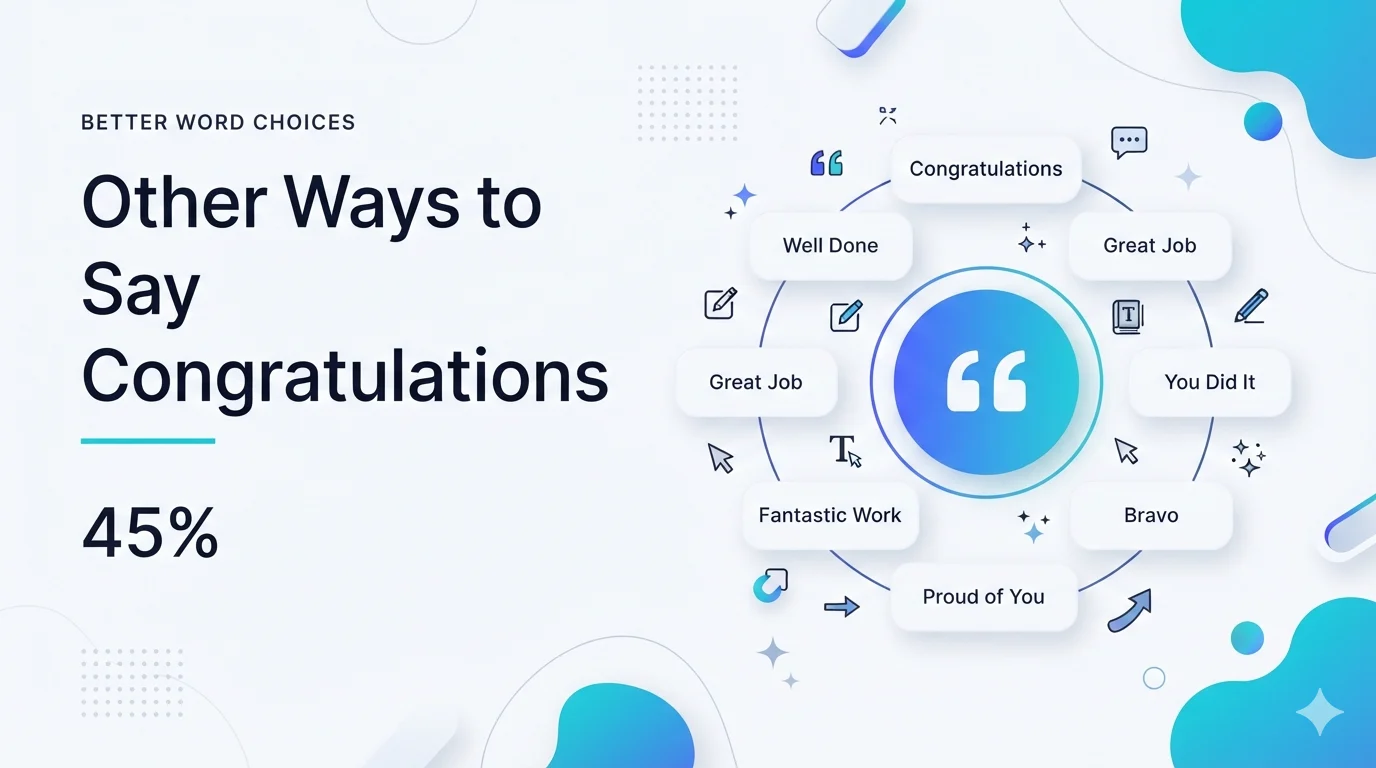
These 30 alternatives will help you sound more fluent, confident, and natural in different situations.
Quick Categories
Formal Alternatives to “Congratulations”
- Sincere congratulations
- Warmest congratulations
- Please accept my congratulations
- Best wishes on your achievement
Pro Tip: Use these in emails, letters, and speeches. Add the specific achievement to make the message feel personal.
Casual Alternatives
- Well done
- Nice one
- Good for you
- You did it
Pro Tip: Save these for friends, family, and close colleagues. Add their name to keep the tone friendly.
Professional Alternatives
- Kudos to you
- Outstanding work
- Impressive achievement
- Excellent result
Pro Tip: Mention the result or effort in the same sentence. Specific praise sounds more sincere than general praise.
Informal Expressions
- Congrats
- Way to go
- You nailed it
- Take a bow
Pro Tip: Use these in chats, texts, and social media comments. Avoid them in formal emails.
“Specific praise is always stronger than generic praise.”
Common Mistakes
Here are five common errors people make with “congratulations.”
1. Using the singular form.
Congratulations is always plural.
Incorrect: “Congratulation on your new job!”
Correct: “Congratulations on your new job!”
2. Using the wrong preposition.
Use “on,” not “for.”
Incorrect: “Congratulations for your promotion.”
Correct: “Congratulations on your promotion.”
3. Congratulating someone on bad news.
Check the context before using it.
Incorrect: “Congratulations on failing the exam.”
4. Overusing it in one message.
Repeating the word makes writing sound robotic.
Incorrect: “Congratulations! Congratulations again on this big day!”
5. Using casual shortcuts in formal writing.
“Congrats” does not suit a formal letter.
Incorrect: “Dear Director, congrats on the appointment.”
What Does “Congratulations” Mean?
Congratulations is an expression of joy, praise, and good wishes for someone’s success or good fortune. It is a plural noun used as an interjection, so it never takes a singular form. It is usually followed by “on” and the achievement.
Example: Congratulations on completing your degree.
When to Use “Congratulations”
Use it in these common situations:
- Job offers, promotions, and work anniversaries
- Graduations and exam results
- Weddings, engagements, and new babies
- Business wins and project launches
- Personal goals such as fitness or savings milestones
Spoken vs written: In speech, people often shorten it to “congrats.” In writing, use the full word.
Formal vs informal: The full word suits emails, cards, and speeches. Casual shortcuts suit texts and friendly conversation.
Is It Professional or Polite to Say “Congratulations”?
Congratulations is always polite, and it is usually safe at work. It can still sound generic when used alone, so it works best with a detail about the achievement.
Business example: “Congratulations on closing the Henderson account. Your persistence made the difference.”
Polite? ✔️ Yes
Professional? ❌ No (in most cases, when used alone without detail)
Pros and Cons of Using “Congratulations”
Pros
- Simple and natural
- Friendly tone
- Common usage
- Easy to understand
Cons
- Too informal for work when shortened to “congrats”
- Overused
- Limited emotional range
- Not suitable for formal writing when used without detail
One phrase cannot fit every celebration. Flexible vocabulary is a real communication skill.”
Other Ways to Say “Congratulations” (With Examples)
These alternatives will help you sound more fluent, confident, and natural in different situations.
Use them according to tone, context, and audience to express excitement, admiration, or approval.
1. Phrase: Well done
Meaning: You did something successfully.
Explanation: A short, classic way to praise effort and results.
Example Sentence: Well done on finishing the report ahead of schedule.
Best Use: Team praise
Worst Use: Formal letters
Tone: Warm, encouraging
Context Variability:
- Casual: Well done, mate!
- Professional: Well done on meeting the deadline.
- Spoken: “Well done! That was tough.”
2. Phrase: Great job
Meaning: Your work was very good.
Explanation: A friendly phrase for effort and quality.
Example Sentence: Great job on the presentation today.
Best Use: Everyday workplace
Worst Use: Formal speeches
Tone: Positive, supportive
Context Variability:
- Casual: Great job today!
- Professional: Great job leading the workshop.
- Spoken: “Great job, everyone.”
3. Phrase: Nicely done
Meaning: You handled it skillfully.
Explanation: A polished and slightly refined form of praise.
Example Sentence: Nicely done on resolving the client’s complaint.
Best Use: Skill recognition
Worst Use: Big milestones
Tone: Polite, appreciative
Context Variability:
- Casual: Nicely done, you two!
- Professional: Nicely done on the budget review.
- Spoken: “Nicely done. That was smooth.”
4. Phrase: Good for you
Meaning: I am glad things went well for you.
Explanation: Shows support for a personal success.
Example Sentence: You passed your driving test? Good for you!
Best Use: Personal wins
Worst Use: Formal emails
Tone: Friendly, upbeat
Context Variability:
- Casual: Good for you, you earned it.
- Professional: Good for you for taking the certification.
- Spoken: “Good for you! I knew you could.”
5. Phrase: Way to go
Meaning: You did excellent work.
Explanation: An energetic phrase for cheering someone on.
Example Sentence: Way to go, team. We hit our target.
Best Use: Team cheers
Worst Use: Formal writing
Tone: Energetic, cheerful
Context Variability:
- Casual: Way to go, champ!
- Professional: Way to go, everyone, on a strong quarter.
- Spoken: “Way to go! That was brilliant.”
6. Phrase: Bravo
Meaning: I applaud your excellent performance.
Explanation: A dramatic expression of admiration.
Example Sentence: Bravo on a flawless performance tonight.
Best Use: Performances
Worst Use: Routine tasks
Tone: Expressive, theatrical
Context Variability:
- Casual: Bravo, that was amazing!
- Professional: Bravo to the design team for the launch.
- Spoken: “Bravo! Encore!”
7. Phrase: Kudos to you
Meaning: You deserve praise and recognition.
Explanation: A popular phrase in workplaces for public recognition.
Example Sentence: Kudos to you for handling the crisis so calmly.
Best Use: Workplace recognition
Worst Use: Sad occasions
Tone: Respectful, approving
Context Variability:
- Casual: Kudos to you, friend.
- Professional: Kudos to Sara for leading the migration.
- Spoken: “Kudos, that was impressive.”
8. Phrase: Hats off to you
Meaning: I deeply respect what you achieved.
Explanation: An idiom that shows strong admiration.
Example Sentence: Hats off to you for finishing the marathon.
Best Use: Big efforts
Worst Use: Small tasks
Tone: Admiring, respectful
Context Variability:
- Casual: Hats off to you, seriously.
- Professional: Hats off to the team for the record sales.
- Spoken: “Hats off! That took courage.”
9. Phrase: Hearty congratulations
Meaning: I offer you warm and sincere celebration.
Explanation: A formal upgrade of the standard phrase.
Example Sentence: Hearty congratulations on your appointment as director.
Best Use: Formal cards
Worst Use: Quick texts
Tone: Warm, formal
Context Variability:
- Casual: Hearty congratulations, dear friend.
- Professional: Hearty congratulations on your promotion.
- Spoken: “Please accept my hearty congratulations.”
10. Phrase: Warmest congratulations
Meaning: I share your joy with deep sincerity.
Explanation: Adds emotional warmth to a formal message.
Example Sentence: Warmest congratulations on your wedding.
Best Use: Cards, letters
Worst Use: Casual chats
Tone: Gentle, heartfelt
Context Variability:
- Casual: Warmest congratulations, you two.
- Professional: Warmest congratulations on your retirement.
- Spoken: “Warmest congratulations to you both.”
11. Phrase: Best wishes on your success
Meaning: I hope your success continues.
Explanation: Celebrates the win while looking forward.
Example Sentence: Best wishes on your success in the new role.
Best Use: Career moves
Worst Use: Casual banter
Tone: Polite, hopeful
Context Variability:
- Casual: Best wishes on your big win.
- Professional: Best wishes on your success with the new venture.
- Spoken: “Best wishes for everything ahead.”
12. Phrase: Wishing you all the best
Meaning: I hope good things continue for you.
Explanation: A gentle, general phrase for new chapters.
Example Sentence: Wishing you all the best in your new position.
Best Use: New beginnings
Worst Use: Specific praise
Tone: Kind, supportive
Context Variability:
- Casual: Wishing you all the best, buddy.
- Professional: Wishing you all the best in your next chapter.
- Spoken: “Wishing you all the best.”
13. Phrase: I am so proud of you
Meaning: Your success makes me feel proud.
Explanation: A personal and emotional expression of support.
Example Sentence: I am so proud of you for finishing your degree.
Best Use: Close relationships
Worst Use: Distant colleagues
Tone: Emotional, sincere
Context Variability:
- Casual: I am so proud of you, kiddo.
- Professional: I am proud of how far you have come.
- Spoken: “I am so proud of you.”
14. Phrase: You deserve it
Meaning: Your success is earned.
Explanation: Recognizes effort behind the result.
Example Sentence: You deserve it after all those late nights.
Best Use: Hard work
Worst Use: Luck based wins
Tone: Affirming, warm
Context Variability:
- Casual: You deserve it, no doubt.
- Professional: You deserve this promotion.
- Spoken: “You totally deserve it.”
15. Phrase: Well deserved
Meaning: The success is fair and earned.
Explanation: A concise phrase for awards and promotions.
Example Sentence: Well deserved recognition, Amir.
Best Use: Awards
Worst Use: Surprise events
Tone: Respectful, fair
Context Variability:
- Casual: Well deserved, my friend.
- Professional: A well deserved promotion.
- Spoken: “Well deserved, honestly.”
16. Phrase: What an achievement
Meaning: This is a remarkable accomplishment.
Explanation: Highlights the scale of the success.
Example Sentence: What an achievement to publish your first book.
Best Use: Major milestones
Worst Use: Small tasks
Tone: Impressed, sincere
Context Variability:
- Casual: What an achievement, wow!
- Professional: What an achievement for the entire department.
- Spoken: “What an achievement!”
17. Phrase: Outstanding work
Meaning: Your work was exceptional.
Explanation: Common in reviews and team messages.
Example Sentence: Outstanding work on the client proposal.
Best Use: Performance reviews
Worst Use: Personal events
Tone: Formal, approving
Context Variability:
- Casual: Outstanding work, folks.
- Professional: Outstanding work throughout this project.
- Spoken: “Outstanding work today.”
18. Phrase: Excellent result
Meaning: The outcome is very good.
Explanation: Focuses on measurable success.
Example Sentence: Excellent result on the quarterly audit.
Best Use: Business results
Worst Use: Emotional events
Tone: Analytical, positive
Context Variability:
- Casual: Excellent result, well played.
- Professional: Excellent result across all metrics.
- Spoken: “That is an excellent result.”
19. Phrase: Impressive achievement
Meaning: Your accomplishment deserves admiration.
Explanation: Suits reports and public recognition.
Example Sentence: Reaching this milestone is an impressive achievement.
Best Use: Official recognition
Worst Use: Casual chats
Tone: Formal, admiring
Context Variability:
- Casual: That is impressive, truly.
- Professional: An impressive achievement for a first year manager.
- Spoken: “That is truly impressive.”
20. Phrase: Congrats
Meaning: Short form of congratulations.
Explanation: A quick, friendly reaction in digital messages.
Example Sentence: Congrats on the new apartment!
Best Use: Texts, chats
Worst Use: Formal letters
Tone: Casual, quick
Context Variability:
- Casual: Congrats, you legend!
- Professional: Congrats on the launch (internal chat only).
- Spoken: “Congrats! Let us celebrate.”
21. Phrase: Cheers to you
Meaning: I raise a toast to your success.
Explanation: Fits celebrations and social gatherings.
Example Sentence: Cheers to you on a fantastic year.
Best Use: Celebrations
Worst Use: Serious emails
Tone: Festive, friendly
Context Variability:
- Casual: Cheers to you, my friend!
- Professional: Cheers to the team on a great launch.
- Spoken: “Cheers to you!”
22. Phrase: You nailed it
Meaning: You did it perfectly.
Explanation: A lively phrase for precise success.
Example Sentence: You nailed it in that interview.
Best Use: Presentations
Worst Use: Formal reports
Tone: Lively, confident
Context Variability:
- Casual: You nailed it, seriously.
- Professional: You nailed the client pitch.
- Spoken: “You nailed it!”
23. Phrase: You did it
Meaning: You reached your goal.
Explanation: Celebrates the moment of achievement.
Example Sentence: You did it! The certification is yours.
Best Use: Goal completion
Worst Use: Formal writing
Tone: Joyful, direct
Context Variability:
- Casual: You did it, finally!
- Professional: You did it. The project is complete.
- Spoken: “You did it! I knew it.”
24. Phrase: Big congratulations
Meaning: I offer you strong congratulations.
Explanation: Adds emphasis without becoming formal.
Example Sentence: Big congratulations on the new baby.
Best Use: Personal news
Worst Use: Legal letters
Tone: Cheerful, warm
Context Variability:
- Casual: Big congratulations, you two!
- Professional: Big congratulations to our sales team.
- Spoken: “Big congratulations to you!”
25. Phrase: I am delighted for you
Meaning: Your good news makes me happy.
Explanation: A polite way to share someone’s joy.
Example Sentence: I am delighted for you on your new appointment.
Best Use: Polite messages
Worst Use: Slang settings
Tone: Gracious, warm
Context Variability:
- Casual: I am so delighted for you!
- Professional: I am delighted for you and your family.
- Spoken: “I am delighted for you.”
26. Phrase: Happy for you
Meaning: I feel glad about your good news.
Explanation: A simple and sincere reaction.
Example Sentence: I am really happy for you about the job offer.
Best Use: Friendly chats
Worst Use: Formal notices
Tone: Sincere, gentle
Context Variability:
- Casual: Happy for you, truly.
- Professional: We are all happy for you.
- Spoken: “I am so happy for you.”
27. Phrase: Massive respect
Meaning: I admire what you accomplished.
Explanation: A modern phrase for strong admiration.
Example Sentence: Massive respect for launching your own business.
Best Use: Bold achievements
Worst Use: Formal letters
Tone: Admiring, modern
Context Variability:
- Casual: Massive respect, my friend.
- Professional: Massive respect for leading this turnaround.
- Spoken: “Massive respect to you.”
28. Phrase: Take a bow
Meaning: You deserve public praise.
Explanation: A playful phrase for standout performance.
Example Sentence: Take a bow, the event was flawless.
Best Use: Standout success
Worst Use: Serious notices
Tone: Playful, admiring
Context Variability:
- Casual: Take a bow, superstar.
- Professional: Take a bow, Nadia, on a great pitch.
- Spoken: “Take a bow!”
29. Phrase: That is fantastic news
Meaning: Your news makes me very happy.
Explanation: Reacts to the news itself, not only the effort.
Example Sentence: That is fantastic news about your promotion.
Best Use: Receiving news
Worst Use: Formal speeches
Tone: Excited, positive
Context Variability:
- Casual: That is fantastic news!
- Professional: That is fantastic news for the department.
- Spoken: “Fantastic news! Tell me more.”
30. Phrase: Congratulations are in order
Meaning: This success deserves celebration.
Explanation: A slightly formal, elegant way to acknowledge good news.
Example Sentence: Congratulations are in order for our newest partner.
Best Use: Announcements
Worst Use: Quick texts
Tone: Formal, elegant
Context Variability:
- Casual: Looks like congratulations are in order!
- Professional: Congratulations are in order for the winning team.
- Spoken: “I think congratulations are in order.”
“Great communicators do not just repeat praise. They match it to the moment.”
Mini Quiz
1. Which sentence is correct?
A) Congratulation for your promotion.
B) Congratulations on your promotion.
C) Congratulations to your promotion.
2. You are writing to a senior director about her appointment. Which phrase fits best?
A) Nice one
B) Congrats
C) Warmest congratulations
3. Which phrase suits a quick text to a close friend who passed a driving test?
A) Please accept my congratulations
B) Way to go
C) Hearty congratulations
4. Which phrase highlights hard work behind a success?
A) You deserve it
B) Take a bow
C) Cheers to you
Answers
- A
- B
- C
- B
Comparison Table: Top Alternatives
| Phrase | Tone | Best Use |
|---|---|---|
| Well done | Warm | Team praise |
| Kudos to you | Respectful | Workplace recognition |
| Outstanding work | Formal | Performance reviews |
| Hats off to you | Admiring | Big efforts |
| Warmest congratulations | Heartfelt | Cards and letters |
| Wishing you all the best | Supportive | New beginnings |
| Way to go | Energetic | Team cheers |
| You nailed it | Confident | Presentations |
| Well deserved | Fair | Awards |
| Congrats | Casual | Texts and chats |
FAQs
What is a professional way to say congratulations?
Phrases such as “Kudos to you,” “Outstanding work,” and “Warmest congratulations” suit professional settings. Add a detail about the achievement for extra impact.
Is “congrats” acceptable in emails?
It is fine for friendly, internal messages. For clients, senior leaders, or formal letters, use the full word or a formal alternative.
Should I say “congratulation” or “congratulations”?
Use “congratulations.” The plural form is standard when you are expressing good wishes.
How can I make my congratulations sound more sincere?
Mention the specific achievement and the effort behind it. For example, “Well done on landing the contract after months of hard work.”
What can I say instead of congratulations at work?
You can say “Great job,” “Impressive achievement,” or “Excellent result.” These professional reaction phrases fit team chats, emails, and meetings.
Conclusion
Learning other ways to say congratulations gives you more control over tone, warmth, and clarity. You can celebrate a colleague, a friend, or a client in a way that fits the moment. This also strengthens your knowledge of informal expressions in English and formal alternatives alike.
Practice a few phrases each day, and use them in real messages or conversations. Always check the tone before you send or speak, because the right words for a friend may not suit a manager. Try one new phrase from this list today and share your favorite in the comments.
Read More Related Articles:
- Other Ways to Say Circle Back | Improve Your Workplace Communication In 2026
- Other Ways to Say Welcome to the Team | Warm First Impression In 2026
- Other Ways to Say I Hope All Is Well | Make a Better First Impression In 2026

Victoria Hughes is a content writer dedicated to making communication clearer and more effective. Through TextsResponse.com, she shares practical insights and thoughtfully crafted response ideas that help readers express themselves with confidence.