Quick Answer
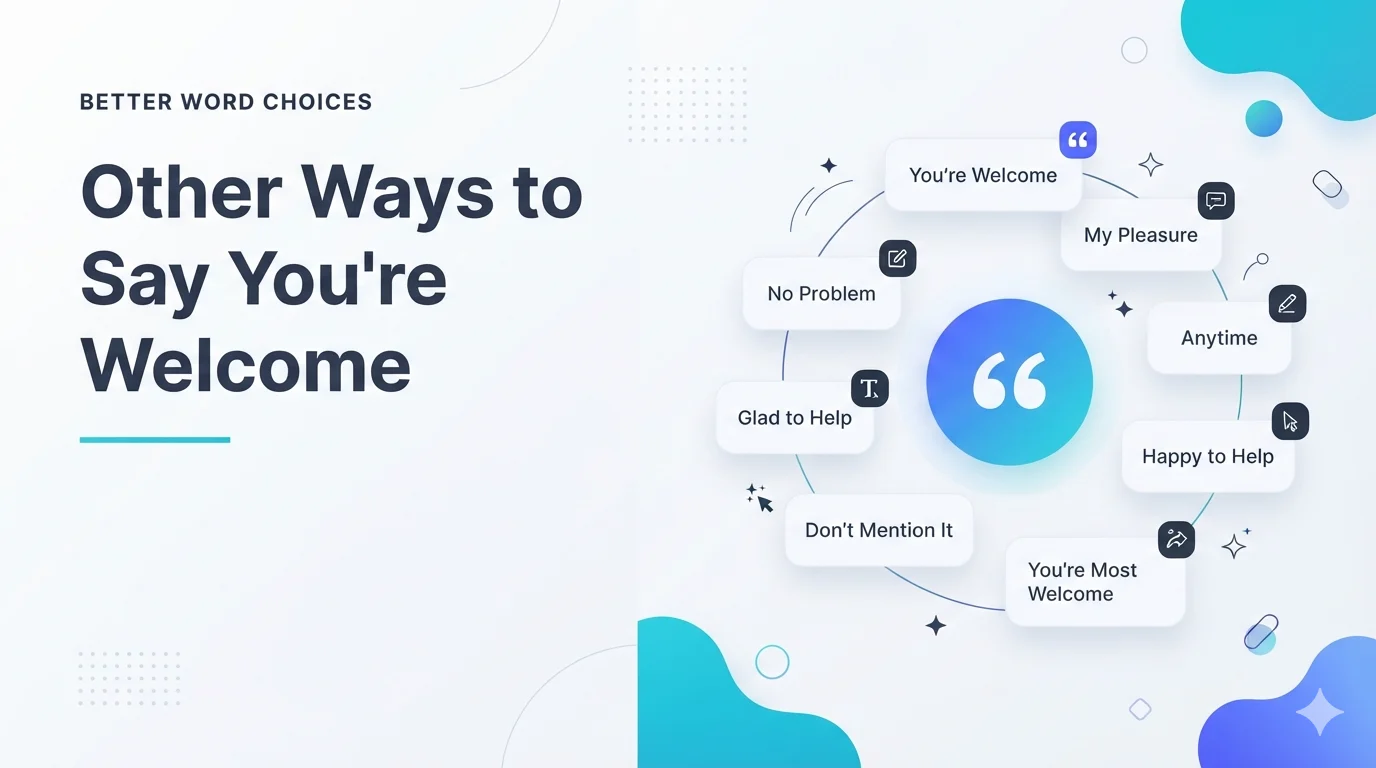
“You’re welcome” is a polite response to “thank you,” but it is not the only option. Try “My pleasure,” “No problem,” “Anytime,” “Happy to help,” or “Of course.”
“You’re welcome” is the standard English reply when someone thanks you. It signals that you were happy to help and that no debt remains. You will hear it in shops, offices, classrooms, and homes every day.
However, saying the same phrase again and again can make your English sound flat and robotic. Learning alternatives to “you’re welcome” helps you match your reply to the situation, whether you are speaking to a boss, a friend, or a stranger. It also gives you the tools to express excitement in English when someone thanks you for something special.
This guide offers 30 practical alternatives, organised by tone and context, so you can choose the right phrase every time.
Quick Categories
Formal alternatives to “You’re Welcome”
- My pleasure.
- It was my pleasure to assist you.
- You’re most welcome.
- I’m glad I could be of assistance.
Pro Tips Box: Use formal alternatives in emails to clients, in meetings with senior colleagues, and in any written communication where professionalism matters.
Casual alternatives
- No problem.
- No worries.
- Anytime.
- Sure thing.
Pro Tips Box: These work best with friends, family, and people your own age. Avoid them in formal business writing.
Professional alternatives
- Happy to help.
- I’m happy to support the team.
- Let me know anytime I can help.
- Glad I could assist.
Pro Tips Box: Professional phrases should sound warm but measured. They confirm your willingness to help without sounding too casual.
Informal expressions
- No biggie.
- You got it.
- No sweat.
- It’s all good.
Pro Tips Box: Reserve informal expressions for text messages, close friends, and relaxed spoken conversations.
Common Mistakes
- Using “No problem” in formal emails. “No problem” can sound dismissive to senior clients. Example: “No problem, sir” may come across as too casual.
- Saying “You’re welcome” with a flat tone. A flat delivery can sound sarcastic or unwilling. Example: “You’re welcome” said with a sigh suggests you did not want to help.
- Overusing the same phrase. Repeating “You’re welcome” in every conversation makes your English sound limited. Example: “You’re welcome. You’re welcome. You’re welcome.”
- Mixing informal phrases into professional writing. “No worries” in a client proposal reduces your credibility. Example: “No worries, we will deliver the report.”
- Using “It was nothing” when the favour was significant. This can sound dismissive of the other person’s gratitude. Example: “It was nothing” after helping someone move house may seem insincere.
What Does “You’re Welcome” Mean?
You’re welcome” is a fixed expression used as a polite response to “thank you.” It means that you were glad to help and that the other person does not owe you anything.
Grammatically, it is a shortened form of “You are welcome to my help.” The phrase functions as a formulaic politeness marker, not a literal statement about permission.
Example: “Thank you for the lift.” “You’re welcome.”
When to Use “You’re Welcome”
- Spoken contexts: Everyday conversations, customer service, casual exchanges with acquaintances.
- Written contexts: Emails, messages, and notes, though less common in highly formal reports.
- Formal situations: Acceptable but can feel routine. My pleasure” often sounds warmer in formal settings.
- Informal situations: Perfectly fine, but native speakers often choose “No problem” or “Anytime” instead.
Is It Professional or Polite to Say “You’re Welcome”?
You’re welcome” is polite in almost every situation. It is neutral, respectful, and widely understood.
However, professionalism depends on context. In a business email to a client, “You’re welcome” is acceptable but slightly generic. A phrase like “It was my pleasure to assist you” carries more weight and shows deliberate courtesy.
Business-style example: “Thank you for your prompt response.” “You’re most welcome. Please let me know if you need any further assistance.”
Polite? Yes.
Professional? Not always. In most business contexts, a more specific alternative sounds stronger.
Pros and Cons of Using “You’re Welcome”
Pros:
- Simple and natural.
- Friendly tone.
- Common usage everywhere.
- Easy to understand for all levels.
Cons:
- Too informal for some high-stakes professional settings.
- Overused.
- Limited emotional range.
- Not suitable for formal writing where variety is valued.
“The right tone makes your English sound professional and confident.”
Other Ways to Say You’re Welcome
These alternatives will help you sound more fluent, confident, and natural in different situations. Use them according to tone, context, and audience to express excitement, admiration, or approval.
1. My pleasure
Meaning: It was a joy to help you.
Explanation: A warm, polished phrase suitable for both professional and personal contexts.
Example Sentence: “Thank you for organising the meeting.” “My pleasure.”
Best Use: Professional and warm.
Worst Use: Very casual chat.
Tone: Polite, gracious, friendly.
Context Variability: Professional, spoken, formal.
2. No problem
Meaning: Helping you was not an inconvenience.
Explanation: One of the most common casual alternatives in modern English.
Example Sentence: “Thanks for the ride.” “No problem.”
Best Use: Casual conversation.
Worst Use: Formal writing.
Tone: Relaxed, friendly, easygoing.
Context Variability: Casual, spoken, informal.
3. Anytime
Meaning: I am always available to help you.
Explanation: Short, warm, and reassuring. It implies ongoing willingness.
Example Sentence: “Thanks for covering for me.” “Anytime.”
Best Use: Friendly support.
Worst Use: Client emails.
Tone: Warm, open, generous.
Context Variability: Casual, spoken, semi-professional.
4. Happy to help
Meaning: I was glad to assist you.
Explanation: A professional phrase that shows genuine willingness without sounding stiff.
Example Sentence: “Thank you for the introduction.” “Happy to help.”
Best Use: Workplace settings.
Worst Use: Very informal texts.
Tone: Warm, professional, sincere.
Context Variability: Professional, spoken, written.
5. Of course
Meaning: Helping you was natural and expected.
Explanation: This phrase suggests that helping you was not a favour but a normal part of your relationship.
Example Sentence: “Thanks for grabbing my coffee.” “Of course.”
Best Use: Casual and friendly.
Worst Use: Formal client emails.
Tone: Friendly, assured, natural.
Context Variability: Casual, spoken, semi-formal.
6. No worries
Meaning: Do not worry about it.
Explanation: Very common in British and Australian English. It is relaxed and kind.
Example Sentence: “Sorry I’m late, thanks for waiting.” “No worries.
Best Use: Everyday conversation.
Worst Use: Formal business writing.
Tone: Relaxed, kind, easygoing.
Context Variability: Casual, spoken, informal.
7. You’re very welcome
Meaning: You are most certainly welcome.
Explanation: A warmer, more enthusiastic version of the standard phrase.
Example Sentence: “Thank you so much for your help.” “You’re very welcome.”
Best Use: Matching enthusiasm.
Worst Use: Quick casual replies.
Tone: Warm, sincere, polite.
Context Variability: Semi-formal, spoken, written.
8. Don’t mention it
Meaning: There is no need to thank me.
Explanation: A modest phrase that downplays the favour. Common in British English.
Example Sentence: “Thanks for the lift.” “Don’t mention it.”
Best Use: Modest response.
Worst Use: Enthusiastic contexts.
Tone: Humble, understated, polite.
Context Variability: Semi-formal, spoken, written.
9. It was nothing
Meaning: The help I gave was insignificant.
Explanation: A humble phrase that minimises your effort. Use only for small favours.
Example Sentence: “Thanks for the advice.” “It was nothing.”
Best Use: Small favours.
Worst Use: Major assistance.
Tone: Humble, modest, self-effacing.
Context Variability: Casual, spoken, semi-formal.
10. Sure thing
Meaning: Certainly, no problem.
Explanation: A casual American phrase that sounds friendly and uncomplicated.
Example Sentence: “Thanks for lending me your notes.” “Sure thing.”
Best Use: Casual American English.
Worst Use: Formal writing.
Tone: Casual, friendly, relaxed.
Context Variability: Casual, spoken, informal.
11. Glad I could assist
Meaning: I am pleased that I was able to help you.
Explanation: A professional alternative that sounds competent and warm.
Example Sentence: “Thank you for resolving the issue.” “Glad I could assist.”
Best Use: Professional support.
Worst Use: Casual chats.
Tone: Professional, helpful, warm.
Context Variability: Professional, written, spoken.
12. You got it
Meaning: Consider it done, no problem.
Explanation: Very casual and energetic. Common in American English.
Example Sentence: “Thanks for grabbing the tickets.” “You got it.”
Best Use: Close friends.
Worst Use: Formal emails.
Tone: Casual, energetic, friendly.
Context Variability: Informal, spoken.
13. No big deal
Meaning: It was not important or difficult.
Explanation: Downplays the favour in a friendly way. Very casual.
Example Sentence: “Thanks for covering my shift.” “No big deal.”
Best Use: Friends and peers.
Worst Use: Professional settings.
Tone: Casual, laid-back, friendly.
Context Variability: Informal, spoken.
14. It’s all good
Meaning: Everything is fine, no problem.
Explanation: A relaxed phrase that reassures the other person.
Example Sentence: “Sorry for the confusion, thanks for fixing it.” “It’s all good.”
Best Use: Casual reassurance.
Worst Use: Formal writing.
Tone: Relaxed, reassuring, friendly.
Context Variability: Informal, spoken.
15. Not at all
Meaning: It was no trouble whatsoever.
Explanation: A polite and slightly formal phrase. Common in British English.
Example Sentence: “Thank you for your patience.” “Not at all.
Best Use: Polite responses.
Worst Use: Very casual chats.
Tone: Polite, modest, reserved.
Context Variability: Semi-formal, spoken, written.
16. Certainly
Meaning: Of course, with pleasure.
Explanation: A formal and confident response. Sounds efficient and professional.
Example Sentence: “Thank you for your assistance.” “Certainly.”
Best Use: Professional settings.
Worst Use: Friendly casual chat.
Tone: Formal, efficient, polite.
Context Variability: Professional, written, spoken.
17. I’m happy to support the team
Meaning: Helping the team is something I am glad to do.
Explanation: A team-oriented professional phrase. Shows commitment and collaboration.
Example Sentence: “Thanks for staying late to help.” “I’m happy to support the team.”
Best Use: Workplace teamwork.
Worst Use: Personal favours.
Tone: Professional, team-focused, warm.
Context Variability: Professional, written.
18. Let me know anytime I can help
Meaning: I am available for future help.
Explanation: A forward-looking phrase that opens the door for future assistance.
Example Sentence: “Thank you for your help today.” “Let me know anytime I can help.
Best Use: Professional networking.
Worst Use: Casual quick replies.
Tone: Professional, generous, forward-looking.
Context Variability: Professional, written, spoken.
19. The pleasure is all mine
Meaning: I received more joy from helping than you did from receiving help.
Explanation: A heartfelt, slightly formal phrase. Often used in warm personal exchanges.
Example Sentence: “Thank you for a wonderful evening.” “The pleasure is all mine.”
Best Use: Heartfelt gratitude.
Worst Use: Quick casual replies.
Tone: Warm, gracious, sincere.
Context Variability: Semi-formal, spoken, written.
20. No sweat
Meaning: It was no effort at all.
Explanation: A very casual phrase, similar to “no problem” but more informal.
Example Sentence: “Thanks for the help with moving.” “No sweat.”
Best Use: Close friends.
Worst Use: Any professional context.
Tone: Casual, cool, relaxed.
Context Variability: Informal, spoken.
21. That’s all right
Meaning: It is fine, no need to thank me.
Explanation: A gentle British alternative that is polite and understated.
Example Sentence: “Thanks for waiting.” “That’s all right.”
Best Use: Polite casual.
Worst Use: Enthusiastic contexts.
Tone: Gentle, polite, reserved.
Context Variability: Semi-formal, spoken.
22. No thanks necessary
Meaning: You do not need to thank me.
Explanation: A warm phrase that dismisses the need for gratitude.
Example Sentence: “Thank you so much.” “No thanks necessary.”
Best Use: Warm dismissal.
Worst Use: Formal writing.
Tone: Warm, humble, friendly.
Context Variability: Semi-formal, spoken.
23. I’m glad I could be of assistance
Meaning: I am pleased that I was able to help.
Explanation: A formal and professional alternative. Sounds competent and courteous.
Example Sentence: “Thank you for your guidance.” “I’m glad I could be of assistance.”
Best Use: Client communication.
Worst Use: Casual conversation.
Tone: Formal, professional, courteous.
Context Variability: Professional, written.
24. You’re most welcome
Meaning: You are very welcome indeed.
Explanation: A more formal and emphatic version of the standard phrase.
Example Sentence: “Thank you for your hospitality.” “You’re most welcome.”
Best Use: Formal politeness.
Worst Use: Quick casual replies.
Tone: Formal, gracious, warm.
Context Variability: Formal, written, spoken.
25. Just returning the favour
Meaning: I am simply repaying a kindness you showed me.
Explanation: Useful in reciprocal relationships. Acknowledges mutual support.
Example Sentence: “Thanks for helping with my project.” “Just returning the favour.”
Best Use: Reciprocal help.
Worst Use: Strangers.
Tone: Friendly, reciprocal, warm.
Context Variability: Semi-formal, spoken.
26. Absolutely
Meaning: Certainly, without a doubt.
Explanation: A short, confident, and friendly response. Common in American English.
Example Sentence: “Thanks for the recommendation.” “Absolutely.”
Best Use: Confident casual.
Worst Use: Formal writing.
Tone: Confident, friendly, upbeat.
Context Variability: Casual, spoken.
27. It’s no trouble at all
Meaning: Helping you caused me no difficulty.
Explanation: A warm and reassuring phrase. More formal than “no problem.”
Example Sentence: “Thank you for your time.” “It’s no trouble at all.”
Best Use: Warm reassurance.
Worst Use: Very casual chats.
Tone: Warm, reassuring, polite.
Context Variability: Semi-formal, spoken.
28. I’m here to serve
Meaning: My role is to help you.
Explanation: A service-oriented phrase. Common in hospitality and customer service.
Example Sentence: “Thank you for your help.” “I’m here to serve.”
Best Use: Customer service.
Worst Use: Personal relationships.
Tone: Professional, service-oriented, formal.
Context Variability: Professional, spoken.
29. That’s what I’m here for
Meaning: Helping you is my purpose.
Explanation: A friendly and reassuring phrase. Shows commitment to your role.
Example Sentence: “Thanks for sorting that out.” “That’s what I’m here for.”
Best Use: Workplace support.
Worst Use: Formal writing.
Tone: Friendly, committed, warm.
Context Variability: Semi-formal, spoken.
30. Consider it done
Meaning: The task is already taken care of.
Explanation: A proactive and confident phrase. Suggests efficiency and reliability.
Example Sentence: “Thank you for handling the booking.” “Consider it done.”
Best Use: Professional efficiency.
Worst Use: Emotional contexts.
Tone: Confident, efficient, proactive.
Context Variability: Professional, spoken, written.
“Small changes in your reply can transform how professional and fluent you sound.”
Mini Quiz / Self-Check
1. You are replying to a client’s thank-you email. Which phrase is most appropriate?
A) No biggie.
B) It was my pleasure to assist you.
C) You got it.
D) No sweat.
2. A close friend thanks you for helping them move. Which is the most natural reply?
A) You’re most welcome.
B) I’m glad I could be of assistance.
C) No problem.
D) Certainly.
3. You want to signal that you are open to helping again in the future. Which phrase works best?
A) It was nothing.
B) Anytime.
C) Don’t mention it.
D) That’s all right.
4. Which phrase is least suitable for a formal business email?
A) Happy to help.
B) My pleasure.
C) No worries.
D) Glad I could assist.
Answers: 1-B, 2-C, 3-B, 4-C.
“Tone awareness is the difference between sounding polite and sounding careless.”
Comparison Table: Top Alternatives
| Phrase | Tone | Best Use |
|---|---|---|
| My pleasure | Polite, warm | Professional and formal |
| No problem | Casual, friendly | Everyday conversation |
| Anytime | Warm, open | Friendly support |
| Happy to help | Professional, sincere | Workplace settings |
| Of course | Friendly, assured | Casual and semi-formal |
| No worries | Relaxed, kind | British and Australian English |
| Don’t mention it | Humble, understated | Modest responses |
| Glad I could assist | Professional, warm | Client communication |
| You’re very welcome | Warm, sincere | Matching enthusiasm |
| Certainly | Formal, efficient | Professional settings |
FAQs
1. What is the most professional way to say “you’re welcome”?
“My pleasure” and “It was my pleasure to assist you” are the most professional alternatives. They sound warm, competent, and courteous.
2. Is “no problem” rude to older people?
Some older speakers may perceive “no problem” as dismissive. When in doubt, use “My pleasure” or “You’re welcome” with older or more formal audiences.
3. Can I say “you’re welcome” in a business email?
Yes, it is acceptable. However, adding a specific professional phrase such as “Happy to help” or “Let me know if you need further assistance” makes your email sound more polished.
4. What is the difference between “you’re welcome” and “my pleasure”?
“You’re welcome” is neutral and routine. “My pleasure” is warmer and implies that helping you was genuinely enjoyable.
5. What are some informal expressions in English for responding to thanks?
“No biggie,” “You got it,” “No sweat,” and “It’s all good” are common informal expressions in English. Use them with friends and close colleagues only.
“Choose your reply based on the person, the place, and the moment.”
Conclusion
Learning other ways to say “you’re welcome” gives you control over your tone and register. You can sound formal with a client, warm with a friend, and professional with a colleague, all without repeating the same phrase. These alternatives to “you’re welcome” are small tools with a large impact on how fluent and confident you sound.
Practice one new phrase each day. Say it aloud, use it in a message, and notice how it changes the mood of the conversation. Over time, these professional reaction phrases will become natural, and your English will sound more varied, more appropriate, and more human.
Read More Related Articles:
- Other Ways to Say Circle Back | Improve Your Workplace Communication In 2026
- Other Ways to Say Welcome to the Team | Warm First Impression In 2026
- Other Ways to Say I Hope All Is Well | Make a Better First Impression In 2026

Henry Walker is an American writer and blogger with a keen interest in communication, language and digital content. At TextsResponse.com, he creates informative and reader-focused resources designed to help people communicate with clarity, confidence and authenticity.