Quick Answer
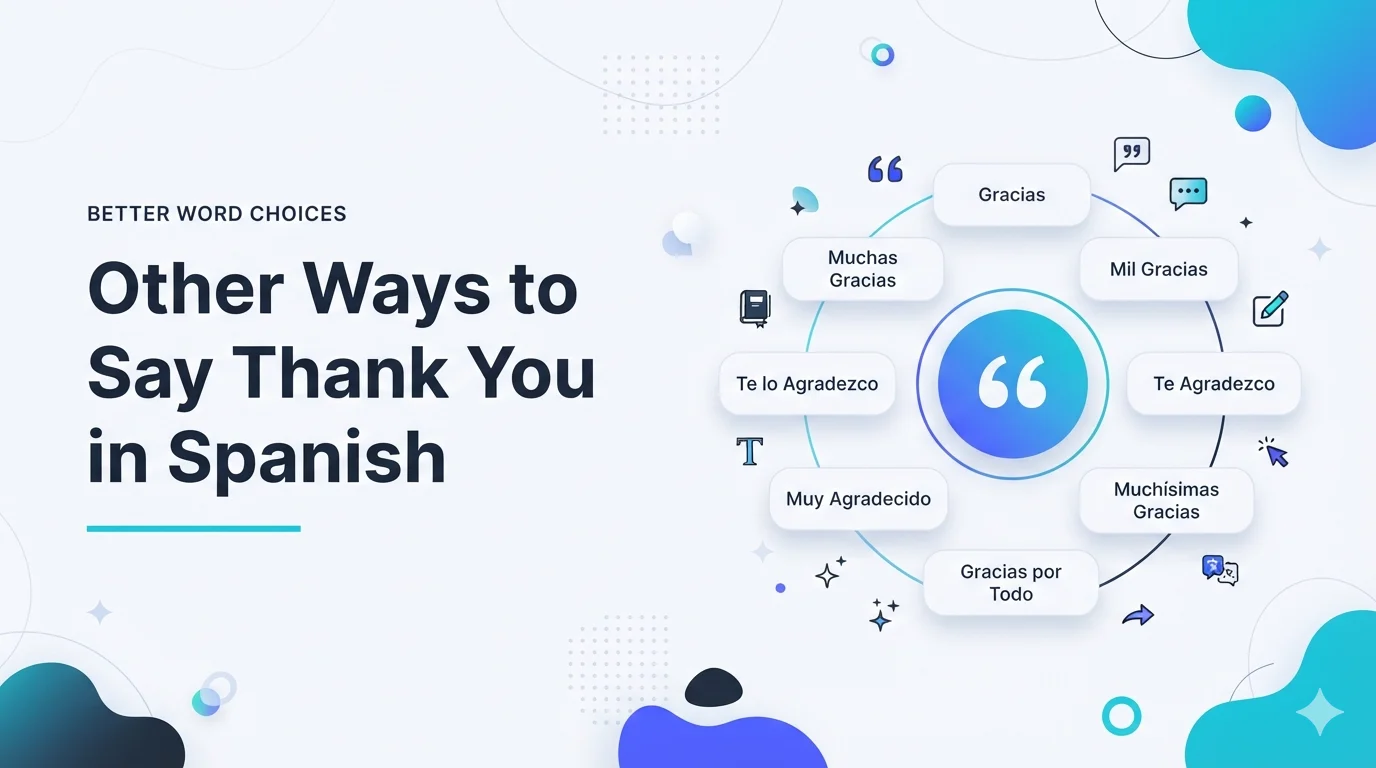
The most common way to say thank you in Spanish is gracias. For stronger gratitude, use muchas gracias, mil gracias, te lo agradezco, se lo agradezco, or gracias de todo corazón. Each phrase carries a different level of warmth and formality.
Saying thank you is one of the first phrases every Spanish learner masters. But relying only on gracias limits your ability to express genuine appreciation, respect, or heartfelt emotion. Native speakers use dozens of alternatives to thank you in Spanish depending on the situation.
Whether you are thanking a colleague, a close friend, or a stranger, choosing the right phrase shows cultural awareness and fluency. This guide covers 30 alternatives to thank you in Spanish, from casual to formal, with clear examples and usage notes.
Learning these phrases helps you express excitement in English and Spanish more naturally. It also builds confidence in professional and social settings where the right tone matters.
Pull Quote: “Gracias is only the beginning. The right phrase transforms a simple thank you into genuine connection.
Quick Categories
Formal Alternatives to Thank You in Spanish
- Se lo agradezco – I appreciate it (formal)
- Le agradezco – I thank you (formal, singular)
- Les agradezco – I thank you (formal, plural)
- Estoy muy agradecido/a – I am very grateful
- Muy amable – Very kind of you
Pro Tip: Always use usted forms with strangers, elders, or superiors. Switching to tú without invitation can sound disrespectful.
Casual Alternatives
- Mil gracias – A thousand thanks
- Un millón de gracias – A million thanks
- Gracias por todo – Thanks for everything
- Te debo una – I owe you one
- Me alegraste el día – You made my day
Pro Tip: Casual phrases work best with friends and family. Avoid using them in formal emails or with new acquaintances.
Professional Alternatives
- Gracias por su tiempo – Thank you for your time
- Gracias de antemano – Thanks in advance
- Le agradezco su consideración – I thank you for your consideration
- Agradezco su ayuda – I appreciate your help
Pro Tip: In business Spanish, agradecer sounds more polished than gracias alone. Use it in emails and meetings.
Informal Expressions
- ¡Te pasaste! – You shouldn’t have!
- Eres muy amable – You’re very kind
- Qué detalle – What a nice gesture
- Gracias, ¿qué haría sin ti? – Thanks, what would I do without you?
Pro Tip: Informal expressions in English and Spanish often rely on tone. A warm voice matters more than perfect grammar.
Pull Quote: “Formality is not about complexity. It is about respect. Choose your phrase based on who is listening.”
Common Mistakes
- Using gracias para instead of gracias por
- Wrong: Gracias para tu ayuda.
- Correct: Gracias por tu ayuda.
- Mixing tú and usted forms in the same sentence
- Wrong: Te lo agradezco, señor.
- Correct: Se lo agradezco, señor.
- Overusing mil gracias in formal contexts
- Wrong: Mil gracias por su respuesta, estimado cliente.
- Correct: Le agradezco su respuesta, estimado cliente.
- Forgetting gender agreement with agradecido
- Wrong: Estoy muy agradecido (said by a woman).
- Correct: Estoy muy agradecida.
- Using gracias alone for deep gratitude
- Wrong: Gracias after someone saves your life.
- Correct: No tengo palabras para agradecerte.
What Does “Thank You in Spanish” Mean?
Gracias is the direct translation of “thank you” and “thanks.” It comes from the Latin gratia, meaning grace or favor. The word works in every Spanish-speaking country and in almost every context.
Grammar note: Gracias is a plural noun. When you thank someone for something specific, use gracias por plus a noun or infinitive verb. For example: Gracias por venir (Thank you for coming).
Example: Gracias por tu ayuda. Sin ti no lo habría logrado. (Thank you for your help. Without you I would not have succeeded.)
When to Use Thank You in Spanish
- Spoken contexts: Shops, restaurants, taxis, family gatherings, casual conversations
- Written contexts: Emails, thank-you notes, text messages, formal letters
- Formal settings: Job interviews, business meetings, speaking with authorities
- Informal settings: Friends, peers, siblings, close colleagues
- Neutral settings: Strangers, service workers, brief interactions
Gracias works in all of them. The alternatives in this guide help you match the moment.
Is It Professional or Polite to Say Thank You in Spanish?
Polite? Yes, always.
Professional? Only with the right variant.
In most business contexts, a simple gracias is acceptable but minimal. For professional communication, use se lo agradezco, le agradezco, or agradezco su tiempo.
Business example: Le agradezco su pronta respuesta. Quedo atento a sus comentarios. (I thank you for your prompt response. I look forward to your comments.)
A plain gracias in a formal email can feel abrupt. Adding muy amable or agradecido softens the tone instantly.
Pros and Cons of Using “Gracias”
Pros
- Simple and natural
- Friendly tone
- Universally understood
- Easy to pronounce
Cons
- Too informal for high-stakes professional writing
- Overused in everyday speech
- Limited emotional range
- Not suitable for expressing deep or formal gratitude
Pull Quote: “The right tone makes your English and Spanish sound professional and confident. Tone is the difference between polite and powerful.”
Other Ways to Say Thank You in Spanish
These alternatives will help you sound more fluent, confident, and natural in different situations. Use them according to tone, context, and audience to express excitement, admiration, or approval.
1. Muchas gracias
Meaning: Thank you very much.
Explanation: The most common upgrade from gracias. Works in almost every context.
Example Sentence: Muchas gracias por tu ayuda con el proyecto.
Best Use: Daily gratitude
Worst Use: Extreme formality
Tone: Warm, standard, versatile
Context Variability: Casual, professional, spoken
2. Muchísimas gracias
Meaning: Thank you so, so much.
Explanation: The suffix -ísimas intensifies the gratitude far beyond muchas gracias.
Example Sentence: Muchísimas gracias por venir desde tan lejos.
Best Use: Deep gratitude
Worst Use: Minor favors
Tone: Emphatic, heartfelt, expressive
Context Variability: Casual, spoken
3. Mil gracias
Meaning: A thousand thanks.
Explanation: A warm, slightly poetic way to thank someone. Very common in Latin America.
Example Sentence: Mil gracias por el regalo, me encantó.
Best Use: Friends and family
Worst Use: Formal business letters
Tone: Warm, expressive, friendly
Context Variability: Casual, spoken
4. Un millón de gracias
Meaning: A million thanks.
Explanation: Playful and exaggerated. Used when mil gracias does not feel like enough.
Example Sentence: Un millón de gracias por toda tu paciencia.
Best Use: Close relationships
Worst Use: Professional emails
Tone: Playful, affectionate, warm
Context Variability: Casual, spoken
5. Gracias por todo
Meaning: Thanks for everything.
Explanation: A broad, heartfelt thank you when listing specifics would be impossible.
Example Sentence: Gracias por todo lo que has hecho por mí.
Best Use: Hosts and helpers
Worst Use: Brief transactions
Tone: Warm, sincere, general
Context Variability: Casual, professional, spoken
6. Gracias de todo corazón
Meaning: Thanks from the bottom of my heart.
Explanation: Deeply emotional and sincere. Reserved for moments that truly matter.
Example Sentence: Gracias de todo corazón por acompañarme en este momento.
Best Use: Emotional moments
Worst Use: Casual chat
Tone: Heartfelt, sincere, deep
Context Variability: Formal, spoken, written
7. Te lo agradezco
Meaning: I appreciate it (informal).
Explanation: Uses the tú form. Warmer and more grown-up than plain gracias.
Example Sentence: Gracias por venir, te lo agradezco mucho.
Best Use: Friends and peers
Worst Use: Formal strangers
Tone: Warm, sincere, informal
Context Variability: Casual, spoken
8. Se lo agradezco
Meaning: I appreciate it (formal).
Explanation: The usted version of te lo agradezco. Essential for professional Spanish.
Example Sentence: Se lo agradezco enormemente, señor García.
Best Use: Business and authority
Worst Use: Close friends
Tone: Respectful, polished, formal
Context Variability: Professional, written, spoken
9. Estoy muy agradecido / agradecida
Meaning: I am very grateful.
Explanation: Uses the adjective agradecido. Men say agradecido, women say agradecida.
Example Sentence: Estoy muy agradecida por su apoyo durante este proceso.
Best Use: Formal gratitude
Worst Use: Quick casual thanks
Tone: Sincere, respectful, formal
Context Variability: Professional, written
10. Muy amable
Meaning: Very kind of you.
Explanation: A polite phrase used when someone has been especially helpful or courteous.
Example Sentence: Gracias, muy amable por su ayuda.
Best Use: Service and strangers
Worst Use: Very close friends
Tone: Polite, courteous, formal
Context Variability: Professional, spoken
11. Gracias a ti
Meaning: Thanks to you (informal).
Explanation: Returns gratitude to the person who thanked you, or emphasizes their role.
Example Sentence: Gracias a ti, la fiesta fue un éxito.
Best Use: Reciprocal thanks
Worst Use: Strangers
Tone: Friendly, warm, casual
Context Variability: Casual, spoken
12. Gracias a usted
Meaning: Thanks to you (formal).
Explanation: The formal version of gracias a ti. Shows respect and appreciation.
Example Sentence: Gracias a usted pude terminar el proyecto a tiempo.
Best Use: Professional settings
Worst Use: Close friends
Tone: Respectful, formal, polite
Context Variability: Professional, written
13. Te debo una
Meaning: I owe you one.
Explanation: Used when someone does you a significant favor. Implies future reciprocity.
Example Sentence: Gracias por cubrir mi turno. Te debo una.
Best Use: Friends and colleagues
Worst Use: Formal superiors
Tone: Casual, friendly, grateful
Context Variability: Casual, spoken
14. Me alegraste el día
Meaning: You made my day.
Explanation: Expresses how someone’s kindness lifted your mood.
Example Sentence: Gracias por las flores. Me alegraste el día.
Best Use: Heartfelt casual thanks
Worst Use: Formal emails
Tone: Warm, emotional, friendly
Context Variability: Casual, spoken
15. No tengo palabras para agradecerte
Meaning: I have no words to thank you.
Explanation: Used when gratitude is too deep for simple words.
Example Sentence: No tengo palabras para agradecerte todo lo que has hecho.
Best Use: Deep emotional thanks
Worst Use: Minor favors
Tone: Emotional, profound, sincere
Context Variability: Formal, spoken, written
16. No sé cómo agradecerte
Meaning: I don’t know how to thank you.
Explanation: Similar to the previous phrase. Expresses overwhelming gratitude.
Example Sentence: No sé cómo agradecerte tu generosidad.
Best Use: Major favors
Worst Use: Everyday thanks
Tone: Grateful, humble, emotional
Context Variability: Casual, spoken
17. Le agradezco
Meaning: I thank you (formal, singular).
Explanation: Uses the verb agradecer with formal le. Very professional.
Example Sentence: Le agradezco su paciencia y comprensión.
Best Use: Business correspondence
Worst Use: Informal chats
Tone: Formal, respectful, polished
Context Variability: Professional, written
18. Les agradezco
Meaning: I thank you (formal, plural).
Explanation: The plural form of le agradezco. Used when addressing a group formally.
Example Sentence: Les agradezco su excelente presentación.
Best Use: Group business settings
Worst Use: Friends
Tone: Formal, respectful, professional
Context Variability: Professional, written
19. Agradecido / Agradecida
Meaning: Grateful.
Explanation: A shorter, elegant way to express gratitude. Gender-dependent.
Example Sentence: Muy agradecido por su consideración.
Best Use: Formal sign-offs
Worst Use: Casual conversation
Tone: Formal, concise, respectful
Context Variability: Professional, written
20. Gracias por su tiempo
Meaning: Thank you for your time.
Explanation: A staple of professional Spanish. Shows respect for someone’s schedule.
Example Sentence: Gracias por su tiempo. Quedo a su disposición.
Best Use: Meetings and emails
Worst Use: Casual friends
Tone: Professional, respectful, polite
Context Variability: Professional, written
21. Gracias de antemano
Meaning: Thanks in advance.
Explanation: Used when requesting something and thanking before the favor is done.
Example Sentence: Gracias de antemano por su respuesta.
Best Use: Formal requests
Worst Use: Casual favors
Tone: Polite, formal, forward-looking
Context Variability: Professional, written
22. Gracias igual / Gracias de todos modos
Meaning: Thanks anyway.
Explanation: Used when someone cannot help but you appreciate the attempt.
Example Sentence: No pudiste venir, pero gracias de todos modos.
Best Use: Polite acknowledgment
Worst Use: Deep gratitude
Tone: Neutral, polite, accepting
Context Variability: Casual, spoken
23. Gracias a Dios
Meaning: Thank God.
Explanation: A religious or relief-based expression of gratitude. Common in daily speech.
Example Sentence: Llegamos sanos y salvos, gracias a Dios.
Best Use: Relief and religion
Worst Use: Secular business
Tone: Relieved, faithful, expressive
Context Variability: Casual, spoken
24. Te doy las gracias
Meaning: I give you thanks (informal).
Explanation: A slightly more formal way to say gracias. Literally “I give you thanks.”
Example Sentence: Te doy las gracias por tu sinceridad.
Best Use: Sincere casual thanks
Worst Use: Quick transactions
Tone: Sincere, warm, personal
Context Variability: Casual, spoken
25. Le doy las gracias
Meaning: I give you thanks (formal).
Explanation: The formal version of te doy las gracias. Respectful and clear.
Example Sentence: Le doy las gracias por su valiosa colaboración.
Best Use: Formal appreciation
Worst Use: Friends
Tone: Respectful, formal, sincere
Context Variability: Professional, written
26. Es muy amable de tu parte
Meaning: That’s very kind of you (informal).
Explanation: Acknowledges kindness with the informal tu.
Example Sentence: Es muy amable de tu parte ayudarme con esto.
Best Use: Friends and peers
Worst Use: Strangers
Tone: Warm, polite, friendly
Context Variability: Casual, spoken
27. Te estoy eternamente agradecido
Meaning: I am eternally grateful to you.
Explanation: A dramatic, formal expression for life-changing help.
Example Sentence: Te estoy eternamente agradecido por lo que hiciste.
Best Use: Life-changing favors
Worst Use: Small gestures
Tone: Deep, eternal, formal
Context Variability: Formal, written, spoken
28. Se agradece
Meaning: It is appreciated.
Explanation: Uses the passive voice. Common in signs and general statements.
Example Sentence: Se agradece su cooperación.
Best Use: Public notices
Worst Use: Personal thanks
Tone: Neutral, impersonal, formal
Context Variability: Professional, written
29. ¡Te pasaste!
Meaning: You shouldn’t have! / You went above and beyond!
Explanation: Informal and expressive. Can be positive or negative depending on tone.
Example Sentence: ¡Te pasaste con el regalo! Gracias.
Best Use: Close friends
Worst Use: Formal settings
Tone: Playful, expressive, informal
Context Variability: Casual, spoken
30. Qué detalle
Meaning: What a nice gesture.
Explanation: Acknowledges a thoughtful act. Often paired with gracias.
Example Sentence: Qué detalle, gracias por acordarte de mí.
Best Use: Thoughtful gestures
Worst Use: Large favors
Tone: Appreciative, warm, polite
Context Variability: Casual, spoken
Pull Quote: “Fluent speakers do not just know more words. They know which words fit the moment.”
Mini Quiz / Self-Check
1. You are writing a formal email to a client. Which phrase is most appropriate?
A) Mil gracias
B) Se lo agradezco
C) Te debo una
D) ¡Te pasaste!
Answer: B) Se lo agradezco
2. A close friend helps you move apartments. What is the best response?
A) Se agradece
B) Gracias de antemano
C) Te debo una
D) Muy amable
Answer: C) Te debo una
3. You are a woman expressing deep gratitude formally. Which is correct?
A) Estoy muy agradecido
B) Estoy muy agradecida
C) Agradecido
D) Te lo agradezco
Answer: B) Estoy muy agradecida
4. Someone cannot help you but tried their best. What do you say?
A) Gracias de todo corazón
B) Gracias igual
C) No tengo palabras
D) Mil gracias
Answer: B) Gracias igual
Pull Quote: “Tone awareness is the final step from intermediate to advanced. Master it, and you master the language.”
Comparison Table: Top Alternatives
| Phrase | Tone | Best Use |
|---|---|---|
| Gracias | Neutral | Everyday thanks |
| Muchas gracias | Warm | Daily gratitude |
| Muchísimas gracias | Emphatic | Deep gratitude |
| Mil gracias | Warm | Friends and family |
| Te lo agradezco | Warm | Informal appreciation |
| Se lo agradezco | Formal | Business and authority |
| Muy amable | Polite | Service and strangers |
| Gracias por todo | Sincere | Hosts and helpers |
| Estoy muy agradecido/a | Formal | Professional gratitude |
| Gracias de todo corazón | Heartfelt | Emotional moments |
FAQs
1. What is the most common way to say thank you in Spanish?
Gracias is the most common and universal way. It works in every Spanish-speaking country and in almost every situation.
2. What is the difference between te lo agradezco and se lo agradezco?
Te lo agradezco uses the informal tú form. Se lo agradezco uses the formal usted form. Use se with strangers, elders, and superiors.
3. Can I use mil gracias in a formal email?
Mil gracias is warm and expressive but too casual for formal business writing. Use le agradezco or se lo agradezco instead.
4. How do I thank someone for a specific thing in Spanish?
Use gracias por plus a noun or infinitive. For example: Gracias por tu ayuda (Thanks for your help) or Gracias por venir (Thanks for coming).
5. What is the best response when someone thanks me in Spanish?
The most common replies are de nada, no hay de qué, and con gusto. Choose based on formality and region.
Conclusion
Learning alternatives to thank you in Spanish transforms your communication from basic to fluent. Each phrase carries a unique tone, from the warmth of mil gracias to the polished respect of se lo agradezco. Knowing when to use each one shows true cultural and linguistic awareness.
Practice one new phrase each day. Start with the ones that match your daily life. Pay attention to tone, context, and audience. Over time, these expressions will become natural, and your Spanish will sound more confident and authentic.
Read More Related Articles:
- Other Ways to Say “From” in a Letter | For a More Professional Sign-Off In 2026
- Other Ways to Say Be Safe | Upgrade Your Farewells In 2026
- Other Ways to Say Feel Free | Formal Writing and Business Communication In 2026

Victoria Hughes is a content writer dedicated to making communication clearer and more effective. Through TextsResponse.com, she shares practical insights and thoughtfully crafted response ideas that help readers express themselves with confidence.