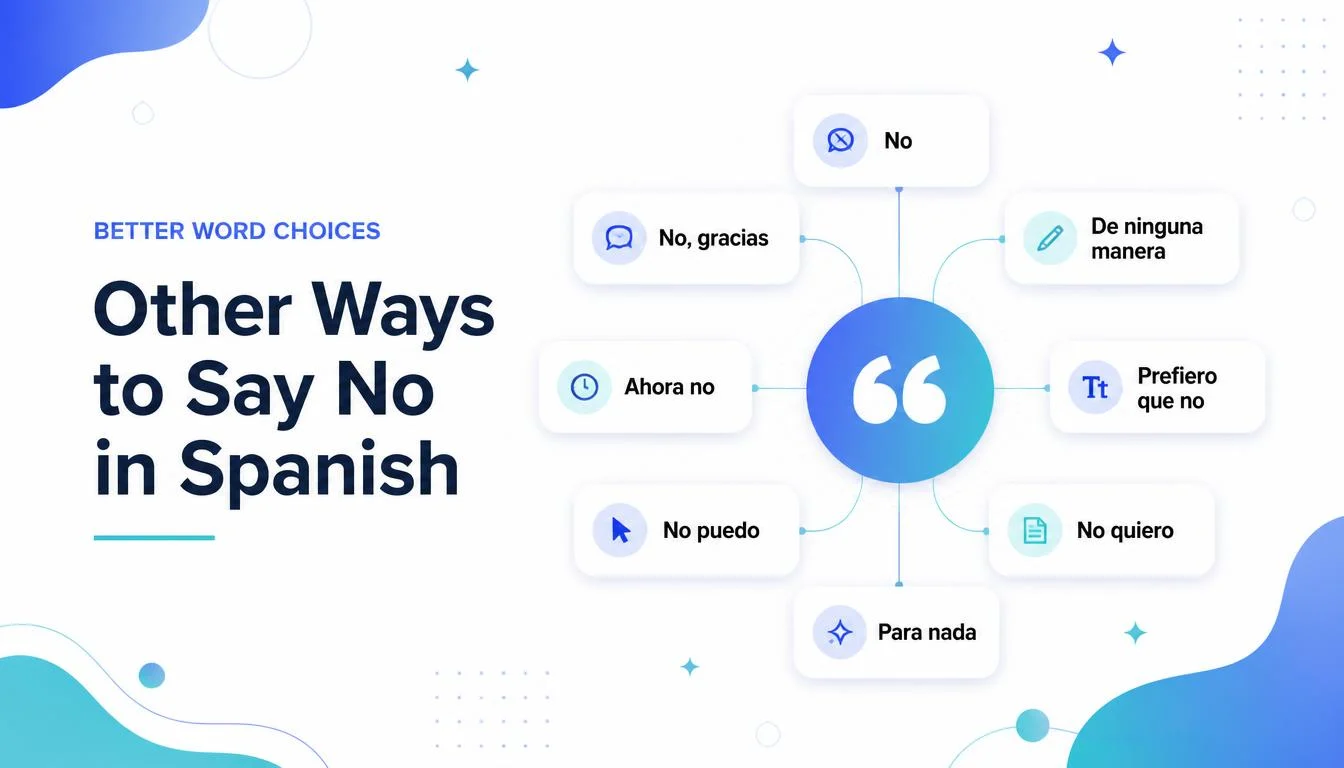
Quick Answer
Learning other ways to say no in Spanish helps you communicate clearly without sounding rude. Five top alternatives are: No, gracias (No, thank you), Lo siento, no puedo (Sorry, I can’t), Para nada (Not at all), and Me temo que no (I’m afraid not).
Knowing how to say no in Spanish is one of the most practical skills for any English speaker learning the language. Whether you are declining an invitation, turning down a request at work, or simply expressing disagreement, the word no is a starting point but not the whole story. Native speakers use a wide range of alternatives to no in Spanish depending on context, tone, and relationship.
The ability to express excitement in English and navigate social nuances translates directly to Spanish communication. Just as English has dozens of ways to soften or strengthen a refusal, Spanish offers a rich variety of phrases for every situation. From formal business settings to casual conversations among friends, the right phrase makes all the difference.
This guide provides 30 alternatives to no in Spanish with clear meanings, examples, and usage tips. By the end, you will sound more fluent, confident, and culturally aware in any Spanish-speaking environment.
Quick Categories
Formal Alternatives to “No” in Spanish
- No, gracias (No, thank you): Polite and universally acceptable.
- Lo siento, no puedo (I’m sorry, I can’t): Respectful and clear.
- Me temo que no (I’m afraid not): Adds a gentle tone.
- Lamentablemente, no (Regrettably, no): Formal and empathetic.
Pro Tip: In formal settings, always pair your refusal with a brief reason or a thank you to maintain goodwill.
Casual Alternatives
- Nop (Nope): Quick and friendly.
- Nel (Nah): Very casual, common in Mexico.
- Para nada (Not at all): Emphatic and relaxed.
- Ni de broma (Not even joking): Playful refusal.
Pro Tip: Casual alternatives work best with friends or peers. Avoid them in professional emails or with elders.
Professional Alternatives
- No en este momento (Not at this time): Polite and business-appropriate.
- No puedo comprometerme a eso (I can’t commit to that): Clear boundary-setting.
- Prefiero declinar (I’d rather decline): Formal and respectful.
- No es viable en este momento (It’s not feasible right now): Professional and objective.
Pro Tip: In business Spanish, use “no” with a softer phrase like “en este momento” to keep the door open for future opportunities.
Informal Expressions
- Qué va (No way): Common in Spain.
- Ni loco / Ni loca (Not a chance): Emphatic and humorous.
- Nanay (No way): Very colloquial, used in some Latin American countries.
- Paso (I’ll pass): Casual and brief.
Pro Tip: Informal expressions build rapport with native speakers but can sound out of place in formal writing.
Common Mistakes
- Using “no” alone in formal contexts.
Example: Saying just “No” to a business partner can seem abrupt. Add “gracias” or “lo siento.” - Confusing “no” with “no quiero.”
Example: “No quiero” means “I don’t want to,” which can sound harsh. Use “prefiero no” instead. - Overusing “no” in casual conversation.
Example: Constantly saying “No, no, no” can sound dismissive. Try “Para nada” or “Qué va.” - Forgetting regional variations.
Example: “Nel” is common in Mexico but may confuse speakers in Spain. Know your audience. - Neglecting tone when saying no.
Example: A flat “No” can sound angry. Soften with “Lo siento” or “Me temo que no.”
What Does “No” Mean?
In Spanish, no is a direct negation, meaning “no” or “not.” It is one of the simplest and most powerful words in the language. Grammatically, it functions as an adverb and can stand alone or precede a verb.
Example: ¿Quieres ir? No, gracias. (Do you want to go? No, thank you.)
When to Use “No”
- Declining invitations: When you don’t want to attend an event.
- Refusing requests: When someone asks for a favor.
- Disagreeing politely: In discussions or debates.
- Setting boundaries: In personal or professional relationships.
Spoken vs Written: “No” is common in both, but written forms often require more context or softening phrases.
Formal vs Informal: In formal situations, pair “no” with polite phrases. In informal settings, “no” alone or with casual alternatives works fine.
Is It Professional or Polite to Say “No”?
Polite? Yes, when used with courtesy.
Professional? No, in most cases. A bare “No” can seem blunt in business contexts.
Business-style example: “Agradezco la invitación, pero no me es posible asistir.” (I appreciate the invitation, but it’s not possible for me to attend.)
Pros and Cons of Using “No”
Pros:
- Simple and natural
- Friendly tone when softened
- Common usage across all Spanish-speaking regions
- Easy to understand
Cons:
- Too informal for work without modifiers
- Overused in casual speech
- Limited emotional range
- Not suitable for formal writing alone
Other Ways to Say No in Spanish
1. Phrase: Lo siento, no puedo
Meaning: I’m sorry, I can’t.
Explanation: Expresses regret while declining.
Example Sentence: Lo siento, no puedo asistir a la reunión. (I’m sorry, I can’t attend the meeting.)
Best Use: Professional and personal
Worst Use: Casual chat
Tone: Apologetic, respectful
Context Variability: Spoken and written, formal
2. Phrase: Me temo que no
Meaning: I’m afraid not.
Explanation: Softens the refusal with a polite tone.
Example Sentence: Me temo que no podré ayudarte esta vez. (I’m afraid I won’t be able to help you this time.)
Best Use: Formal apologies
Worst Use: Casual slang
Tone: Gentle, formal
Context Variability: Spoken and written, formal
3. Phrase: Para nada
Meaning: Not at all.
Explanation: Emphatic and casual refusal.
Example Sentence: ¿Te molesta? Para nada. (Does it bother you? Not at all.)
Best Use: Casual conversation
Worst Use: Formal writing
Tone: Relaxed, emphatic
Context Variability: Spoken, informal
4. Phrase: Nop
Meaning: Nope.
Explanation: Very casual and quick.
Example Sentence: ¿Vienes a la fiesta? Nop. (Are you coming to the party? Nope.)
Best Use: Friends
Worst Use: Business
Tone: Casual, brief
Context Variability: Spoken, informal
5. Phrase: Nel
Meaning: Nah.
Explanation: Colloquial, common in Mexico.
Example Sentence: ¿Me prestas tu coche? Nel. (Can you lend me your car? Nah.)
Best Use: Close friends
Worst Use: Strangers
Tone: Very casual
Context Variability: Spoken, informal
6. Phrase: Ni de broma
Meaning: Not even joking.
Explanation: Playful and emphatic.
Example Sentence: ¿Ir a ese lugar? Ni de broma. (Go to that place? Not even joking.)
Best Use: Humorous refusal
Worst Use: Serious settings
Tone: Playful, strong
Context Variability: Spoken, informal
7. Phrase: No en este momento
Meaning: Not at this time.
Explanation: Professional and polite.
Example Sentence: No en este momento, gracias. (Not at this time, thank you.)
Best Use: Business
Worst Use: Close friends
Tone: Formal, respectful
Context Variability: Spoken and written, professional
8. Phrase: No puedo comprometerme a eso
Meaning: I can’t commit to that.
Explanation: Sets a clear boundary.
Example Sentence: Lo siento, no puedo comprometerme a eso ahora. (Sorry, I can’t commit to that right now.)
Best Use: Professional
Worst Use: Casual chat
Tone: Firm, polite
Context Variability: Spoken and written, professional
9. Phrase: Prefiero declinar
Meaning: I’d rather decline.
Explanation: Formal and respectful.
Example Sentence: Prefiero declinar la oferta, gracias. (I’d rather decline the offer, thank you.)
Best Use: Formal events
Worst Use: Friends
Tone: Polite, formal
Context Variability: Spoken and written, formal
10. Phrase: No es viable en este momento
Meaning: It’s not feasible right now.
Explanation: Objective and professional.
Example Sentence: No es viable en este momento, pero lo reconsideraremos. (It’s not feasible right now, but we’ll reconsider.)
Best Use: Business
Worst Use: Personal
Tone: Professional, neutral
Context Variability: Written, professional
11. Phrase: Qué va
Meaning: No way.
Explanation: Common in Spain, casual.
Example Sentence: ¿Crees que lo hará? Qué va. (Do you think he’ll do it? No way.)
Best Use: Casual talk
Worst Use: Formal writing
Tone: Informal, dismissive
Context Variability: Spoken, informal
12. Phrase: Ni loco / Ni loca
Meaning: Not a chance.
Explanation: Emphatic and humorous.
Example Sentence: ¿Saltar en paracaídas? Ni loco. (Skydiving? Not a chance.)
Best Use: Friends
Worst Use: Professional
Tone: Emphatic, playful
Context Variability: Spoken, informal
13. Phrase: Nanay
Meaning: No way.
Explanation: Very colloquial, Latin America.
Example Sentence: ¿Pagar eso? Nanay. (Pay that? No way.)
Best Use: Casual
Worst Use: Formal
Tone: Informal, brief
Context Variability: Spoken, informal
14. Phrase: Paso
Meaning: I’ll pass.
Explanation: Casual and brief.
Example Sentence: ¿Jugar otro juego? Paso. (Play another game? I’ll pass.)
Best Use: Friends
Worst Use: Business
Tone: Casual, quick
Context Variability: Spoken, informal
15. Phrase: No quiero
Meaning: I don’t want to.
Explanation: Direct but can sound harsh.
Example Sentence: No quiero ir, gracias. (I don’t want to go, thank you.)
Best Use: Honest refusal
Worst Use: Polite settings
Tone: Direct, blunt
Context Variability: Spoken, casual
16. Phrase: Prefiero no
Meaning: I’d prefer not to.
Explanation: Softer than “No quiero.”
Example Sentence: Prefiero no opinar sobre eso. (I’d prefer not to comment on that.)
Best Use: Polite decline
Worst Use: Casual chat
Tone: Polite, neutral
Context Variability: Spoken and written, formal
17. Phrase: No me es posible
Meaning: It’s not possible for me.
Explanation: Formal and respectful.
Example Sentence: No me es posible asistir, lo siento. (It’s not possible for me to attend, I’m sorry.)
Best Use: Formal events
Worst Use: Friends
Tone: Formal, apologetic
Context Variability: Spoken and written, formal
18. Phrase: Lamentablemente, no
Meaning: Regrettably, no.
Explanation: Empathetic and formal.
Example Sentence: Lamentablemente, no podré colaborar. (Regrettably, I won’t be able to collaborate.)
Best Use: Professional
Worst Use: Casual
Tone: Formal, regretful
Context Variability: Written, formal
19. Phrase: No, de ninguna manera
Meaning: No, by no means.
Explanation: Strong and emphatic.
Example Sentence: No, de ninguna manera aceptaré eso. (No, by no means will I accept that.)
Best Use: Strong refusal
Worst Use: Soft decline
Tone: Firm, emphatic
Context Variability: Spoken and written, formal
20. Phrase: Claro que no
Meaning: Of course not.
Explanation: Emphatic and slightly defensive.
Example Sentence: ¿Estás enojado? Claro que no. (Are you angry? Of course not.)
Best Use: Casual defense
Worst Use: Formal apology
Tone: Emphatic, direct
Context Variability: Spoken, casual
21. Phrase: Por supuesto que no
Meaning: Of course not.
Explanation: More formal than “Claro que no.”
Example Sentence: Por supuesto que no estoy de acuerdo. (Of course I don’t agree.)
Best Use: Formal disagreement
Worst Use: Friendly chat
Tone: Formal, firm
Context Variability: Spoken and written, formal
22. Phrase: No, para nada
Meaning: No, not at all.
Explanation: Emphatic and friendly.
Example Sentence: ¿Te importa? No, para nada. (Do you mind? No, not at all.)
Best Use: Casual
Worst Use: Formal
Tone: Friendly, emphatic
Context Variability: Spoken, informal
23. Phrase: Ni hablar
Meaning: No way / Absolutely not.
Explanation: Common in Mexico, emphatic.
Example Sentence: ¿Prestar dinero? Ni hablar. (Lend money? No way.)
Best Use: Casual refusal
Worst Use: Formal
Tone: Emphatic, informal
Context Variability: Spoken, informal
24. Phrase: No estoy interesado / interesada
Meaning: I’m not interested.
Explanation: Direct and clear.
Example Sentence: No estoy interesado en esa oferta. (I’m not interested in that offer.)
Best Use: Business
Worst Use: Friends
Tone: Direct, polite
Context Variability: Spoken and written, professional
25. Phrase: Mejor no
Meaning: Better not.
Explanation: Soft and casual.
Example Sentence: Mejor no salgamos hoy. (Better not go out today.)
Best Use: Casual suggestions
Worst Use: Formal writing
Tone: Soft, casual
Context Variability: Spoken, informal
26. Phrase: No gracias, estoy bien
Meaning: No thanks, I’m fine.
Explanation: Polite and complete.
Example Sentence: ¿Otro café? No gracias, estoy bien. (Another coffee? No thanks, I’m fine.)
Best Use: Social settings
Worst Use: Business
Tone: Polite, friendly
Context Variability: Spoken, casual
27. Phrase: No puedo aceptar
Meaning: I can’t accept.
Explanation: Formal and respectful.
Example Sentence: No puedo aceptar su invitación, gracias. (I can’t accept your invitation, thank you.)
Best Use: Formal events
Worst Use: Friends
Tone: Formal, polite
Context Variability: Spoken and written, formal
28. Phrase: No, lo siento mucho
Meaning: No, I’m very sorry.
Explanation: Empathetic and polite.
Example Sentence: No, lo siento mucho, no puedo ayudar. (No, I’m very sorry, I can’t help.)
Best Use: Apologetic refusal
Worst Use: Casual chat
Tone: Apologetic, warm
Context Variability: Spoken, formal
29. Phrase: No, gracias, quizás otro día
Meaning: No, thanks, maybe another day.
Explanation: Soft and future-oriented.
Example Sentence: No, gracias, quizás otro día. (No, thanks, maybe another day.)
Best Use: Social invitations
Worst Use: Business
Tone: Polite, friendly
Context Variability: Spoken, casual
“The right tone makes your Spanish sound professional and confident.”
Mini Quiz / Self-Check
- Which phrase is best for declining a business meeting politely?
a) Nel
b) No me es posible
c) Ni loco
Answer: b) No me es posible - What does “Para nada” mean?
a) Not at all
b) No way
c) I’m sorry
Answer: a) Not at all - Which phrase is informal and common in Mexico?
a) Lamentablemente, no
b) Nel
c) Prefiero declinar
Answer: b) Nel - How do you soften a “No” in a formal email?
a) Just write “No”
b) Add “gracias” or “lo siento”
c) Use “Nop”
Answer: b) Add “gracias” or “lo siento”
Comparison Table: Top Alternatives
| Phrase | Tone | Best Use |
| No, gracias | Polite | Formal and casual |
| Lo siento, no puedo | Apologetic | Professional |
| Me temo que no | Gentle | Formal |
| Para nada | Casual | Friends |
| Nop | Very casual | Peers |
| No en este momento | Professional | Business |
| Prefiero declinar | Formal | Events |
| Qué va | Informal | Casual talk |
| Ni loco | Emphatic | Humor |
| No me es posible | Formal | Written requests |
FAQs
1. What is the most polite way to say no in Spanish?
“Lo siento, no puedo” or “Me temo que no” are among the most polite options.
2. Can I just say “No” in Spanish?
Yes, but it can sound abrupt. Add “gracias” or a softener for politeness.
3. Are there regional differences in saying no?
Yes. “Nel” is common in Mexico, while “Qué va” is typical in Spain.
4. How do I say no professionally in Spanish?
Use “No en este momento” or “No me es posible” in business settings.
5. What is the difference between “No quiero” and “Prefiero no”?
“No quiero” is direct and can sound harsh. “Prefiero no” is softer and more polite.
Conclusion
Mastering other ways to say no in Spanish gives you greater control over your tone and helps you navigate both casual and professional conversations with confidence. Whether you are declining an invitation or setting boundaries at work, the right phrase makes you sound fluent and respectful.
Practice these alternatives daily and pay attention to context. The more you use them, the more natural they will feel. Remember: tone awareness is the key to effective communication in any language.
Read More Related Articles:
- Other Ways to Say You’re Beautiful | Beyond the Ordinary Compliment In 2026
- Other Ways to Say I Love You in Spanish | Beyond the Usual Phrase In 2026
- Other Ways to Say I Love You in Other Languages | Beyond the Classic Three Words In 2026

Henry Walker is an American writer and blogger with a keen interest in communication, language and digital content. At TextsResponse.com, he creates informative and reader-focused resources designed to help people communicate with clarity, confidence and authenticity.