Quick Answer
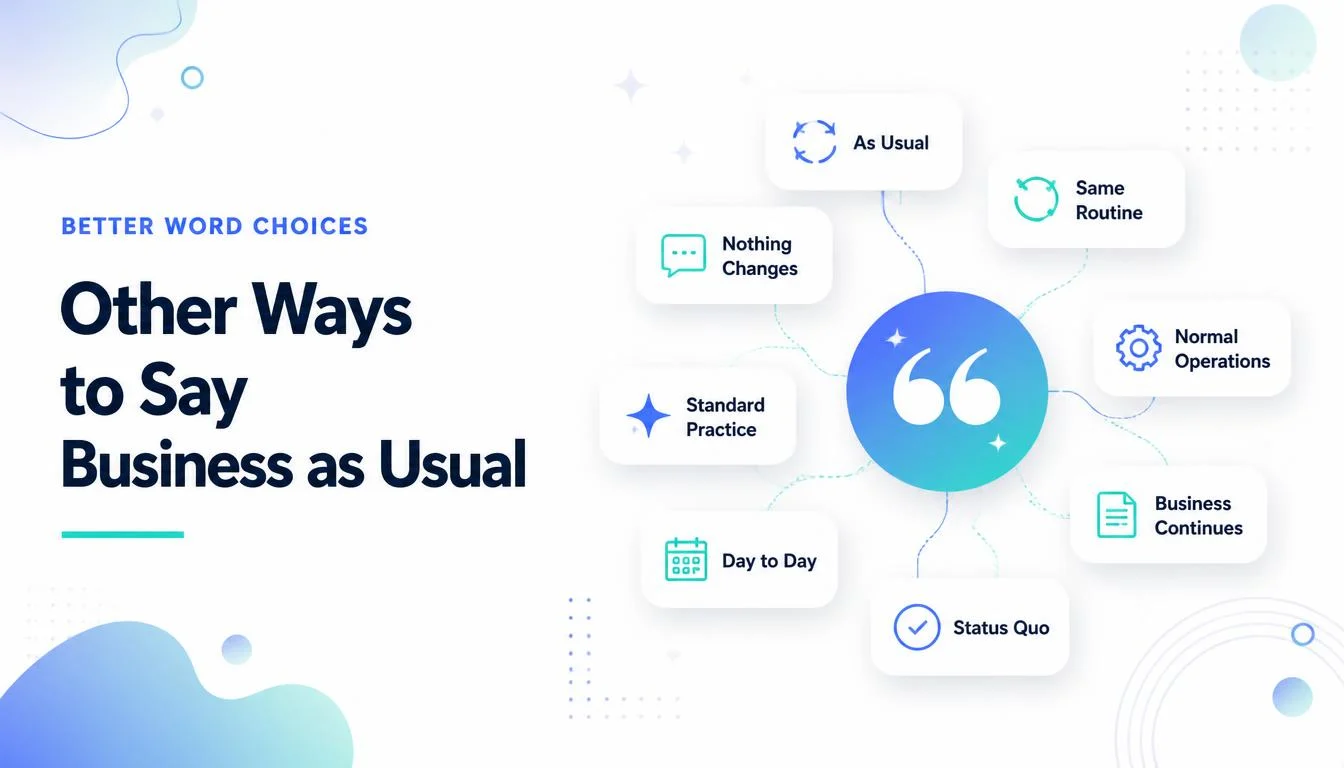
Other ways to say business as usual include normal operations, the usual routine, status quo, as usual, and things are running normally. These alternatives help you describe familiar situations naturally and professionally.
Learning other ways to say business as usual can make your English more flexible and effective in both professional and everyday situations. This phrase describes a situation in which activities continue normally without significant changes or interruptions. It is commonly used in workplaces, businesses, and daily conversations.
Whether you are writing a professional email, discussing workplace activities, or describing a regular routine, choosing the right alternative can improve your communication. Expressions such as “normal operations,” “back to normal,” and “business continues as usual” help you explain that everything is proceeding as expected while matching the tone and context of your message.
What Is “Business as Usual”? (Meaning, Grammar & Real Use)
Imagine arriving at work after a busy week, a system outage, or an unexpected company announcement. A colleague asks whether everything is running smoothly. You might reply, “It’s business as usual.” This familiar expression reassures people that regular activities are continuing despite recent events or possible disruptions.
The phrase appears frequently in offices, customer service conversations, news reports, and everyday discussions. However, repeating the same expression can make your English sound less varied. Learning alternatives to business as usual helps you communicate more precisely, whether you are writing a client update, describing a company’s operations, or speaking with coworkers.
Choosing the right expression also improves your ability to express excitement in English when circumstances change, or to communicate calmness when nothing unusual is happening. Some alternatives sound formal and suitable for reports, while others feel relaxed and conversational.
Definition: “Business as usual” means normal activities, routines, or operations continue without significant change or interruption.
Grammar note: This is a fixed idiomatic expression that functions as a noun phrase. It is neutral in tone and works in both professional and informal English.
Example: Despite the temporary technical issue, it was business as usual by lunchtime.
People use this expression in spoken conversations, business emails, progress reports, public announcements, and news coverage. Its meaning depends on context: it can communicate stability, reassure others, or sometimes suggest that people are ignoring a serious problem.
When Should You Use “Business as Usual”?
Use this phrase when you want to explain that normal activities are continuing, even when circumstances might suggest otherwise.
- Workplace updates: Tell colleagues that regular operations are continuing.
- Customer communication: Reassure customers that services remain available.
- After disruptions: Explain that activities have returned to their normal pattern.
- Daily conversations: Describe a familiar routine that has not changed.
- News and public statements: Explain that an organization continues operating despite external events.
- Project management: Indicate that a team is following its regular schedule.
Spoken vs. Written English
Spoken: “Everything is business as usual around here.”
Written: “Despite the recent changes, daily operations continue as usual.”
In conversation, the expression sounds natural and relaxed. In formal writing, a more specific phrase can clarify whether you mean operations, schedules, services, or employee routines.
Formal vs. Informal English
Formal: “All operations are proceeding according to the established schedule.”
Informal: “It’s the same old routine.”
Choose the formal version for reports and client communications. Use the informal version when speaking casually with friends or familiar colleagues.
Is It Professional or Just Polite?
“Business as usual” is both professional and polite in many workplace contexts. It communicates continuity without unnecessary detail, making it useful in status updates, team meetings, and customer communications.
However, the phrase may sound dismissive if a serious incident has occurred. When employees or customers are affected by a problem, acknowledge the situation before explaining that operations are continuing.
Business-style example: “Following the scheduled maintenance, our team has resumed normal operations, and all customer services remain available.”
- Polite? ✔️ Yes
- Professional? ✔️ Yes
The key is to match the expression to the seriousness of the situation. Clear, specific language is often better than a vague reassurance.
Pros and Cons of Using “Business as Usual”
Pros
- Simple and familiar: Most fluent English speakers understand it immediately.
- Professional tone: It fits many workplace conversations and updates.
- Reassuring message: It communicates stability when routines remain unchanged.
- Versatile usage: It works in speech, emails, reports, and announcements.
Cons
- Can sound dismissive: It may minimize a serious problem or someone’s concerns.
- Sometimes vague: Readers may not know which activities are continuing normally.
- Can become repetitive: Frequent use makes business communication less varied.
- Limited emotional range: It does not explain whether circumstances are positive, negative, or simply unchanged.
Use a more precise alternative when your audience needs details about service availability, project progress, or the effects of an unexpected event.
Common Mistakes People Make
1. Using the Phrase When Operations Have Stopped
❌ Incorrect: “The office is closed for repairs, so it’s business as usual.”
✔️ Correct: “The office is closed for repairs, but remote operations continue as usual.”
The expression should accurately reflect which activities are still happening.
2. Confusing Normal Operations With Returning to Normal
❌ Incorrect: “The system is still down, and everything is back to normal.”
✔️ Correct: “The system is still down, but the support team is following its usual procedures.”
Use “back to normal” when a previous disruption has ended and normal conditions have returned.
3. Using Vague Language in Formal Reports
❌ Incorrect: “Business as usual is happening at the company.”
✔️ Correct: “The company’s daily operations are proceeding according to schedule.”
Choose direct, specific wording when writing reports or formal updates.
4. Ignoring a Serious Incident
❌ Incorrect: “Several customers lost access to their accounts, but it’s business as usual.”
✔️ Correct: “We are investigating the access issue while maintaining unaffected services.”
Acknowledge the problem before describing the activities that continue.
5. Using an Informal Expression in a Formal Client Email
❌ Incorrect: “It’s the same old routine, and we’re getting everything done.”
✔️ Correct: “Our team continues to meet its regular deadlines.”
Casual expressions can build rapport, but formal client communication usually benefits from precise wording.
Small tone mistakes can make confident English sound careless.
Alternatives by Category
The following preview introduces useful expressions for different audiences and situations. Each phrase also appears in the full list below.
Formal alternatives to “Business as Usual”
- Operations continue as scheduled
- Normal operations are ongoing
- Activities proceed without interruption
Pro Tip: Use operational language in reports, official announcements, and communications with external stakeholders.
Casual alternatives
- Things are normal
- Nothing has changed
- Back to normal
Pro Tip: Choose short, familiar expressions when talking with friends or coworkers you know well.
Professional alternatives
- Operations continue as usual
- Work is proceeding as planned
- Services remain operational
Pro Tip: Specify the activity that continues so clients and colleagues understand exactly what to expect.
Informal expressions
- Same old routine
- Same as always
- Nothing out of the ordinary
Pro Tip: Save relaxed expressions for everyday conversations rather than formal reports or sensitive announcements.
“Formal and informal English aren’t about correctness. They’re about context.”
Other Ways to Say “Business as Usual” (Full List with Examples)
These 30 alternatives help you communicate routine activities, stable conditions, and uninterrupted work with greater precision. Choose each phrase according to its tone, audience, and purpose.
1. Phrase: Operations Continue as Usual
Meaning: Regular business activities continue.
Explanation: A clear, professional alternative that emphasizes continuity.
Example Sentence: Our support team is available, and operations continue as usual.
Best Use: Workplace updates
Worst Use: Casual banter
Tone: Neutral professional
Context Variability: casual / professional / spoken
2. Phrase: Things Are Proceeding Normally
Meaning: Events are developing as expected.
Explanation: A versatile expression suitable for routine progress updates.
Example Sentence: The project is on schedule, and things are proceeding normally.
Best Use: Progress reports
Worst Use: Urgent warnings
Tone: Calm neutral
Context Variability: casual / professional / spoken
3. Phrase: Back to Normal
Meaning: Normal conditions have returned.
Explanation: Best after a disruption has ended, rather than when nothing has changed.
Example Sentence: After the network repair, our services are back to normal.
Best Use: Recovery updates
Worst Use: Ongoing crises
Tone: Reassuring conversational
Context Variability: casual / professional / spoken
4. Phrase: Nothing Has Changed
Meaning: The situation remains the same.
Explanation: Direct wording that can sound reassuring or negative depending on context.
Example Sentence: Nothing has changed regarding our regular office hours.
Best Use: Routine clarification
Worst Use: Sensitive negotiations
Tone: Direct neutral
Context Variability: casual / professional / spoken
5. Phrase: Normal Operations Are Ongoing
Meaning: Standard activities are continuing.
Explanation: A formal option for organizational announcements and reports.
Example Sentence: Normal operations are ongoing following the scheduled inspection.
Best Use: Official updates
Worst Use: Friendly chats
Tone: Formal objective
Context Variability: professional / written / spoken
6. Phrase: Work Is Proceeding as Planned
Meaning: Tasks are progressing according to expectations.
Explanation: Emphasizes that a project or work schedule remains on track.
Example Sentence: Work is proceeding as planned, with no delays reported.
Best Use: Project updates
Worst Use: Unrelated routines
Tone: Professional reassuring
Context Variability: casual / professional / spoken
7. Phrase: Everything Is Running Smoothly
Meaning: Activities are functioning without problems.
Explanation: Suggests not only normality but also effective performance.
Example Sentence: The new system is installed, and everything is running smoothly.
Best Use: Client reassurance
Worst Use: Unverified claims
Tone: Positive confident
Context Variability: casual / professional / spoken
8. Phrase: The Usual Routine Continues
Meaning: Familiar daily activities carry on.
Explanation: Highlights consistency in schedules or habits.
Example Sentence: Even during the busy season, the usual routine continues.
Best Use: Daily schedules
Worst Use: Formal notices
Tone: Neutral conversational
Context Variability: casual / professional / spoken
9. Phrase: Activities Proceed Without Interruption
Meaning: Tasks continue without being stopped.
Explanation: Appropriate when uninterrupted progress is important to communicate.
Example Sentence: Essential activities proceed without interruption during maintenance.
Best Use: Operational reports
Worst Use: Unrelated discussions
Tone: Formal factual
Context Variability: professional / written / spoken
10. Phrase: Services Remain Operational
Meaning: Services are still functioning.
Explanation: Particularly useful for customer service, technology, and public utilities.
Example Sentence: Our online services remain operational throughout the upgrade.
Best Use: Service announcements
Worst Use: Personal routines
Tone: Professional reassuring
Context Variability: professional / written / spoken
11. Phrase: Things Are Running as Expected
Meaning: Events match expectations.
Explanation: A practical phrase for communicating steady progress.
Example Sentence: The launch is underway, and things are running as expected.
Best Use: Status updates
Worst Use: Major setbacks
Tone: Neutral professional
Context Variability: casual / professional / spoken
12. Phrase: Business Continues as Normal
Meaning: Commercial activities continue without significant change.
Explanation: A close alternative that emphasizes continued business activity.
Example Sentence: Despite the renovation, business continues as normal at our other locations.
Best Use: Business announcements
Worst Use: Closed premises
Tone: Neutral formal
Context Variability: casual / professional / spoken
13. Phrase: The Status Quo Remains
Meaning: The existing situation stays unchanged.
Explanation: A more formal expression often used in analysis, policy, or negotiations.
Example Sentence: Until the review is complete, the status quo remains.
Best Use: Strategic discussions
Worst Use: Casual updates
Tone: Formal analytical
Context Variability: professional / written / spoken
14. Phrase: Operations Continue as Scheduled
Meaning: Activities follow the established timetable.
Explanation: Focuses on scheduling rather than the overall condition of a business.
Example Sentence: Deliveries and appointments continue as scheduled.
Best Use: Schedule confirmations
Worst Use: Unplanned changes
Tone: Professional precise
Context Variability: professional / written / spoken
15. Phrase: Everything Is on Track
Meaning: Progress meets the expected plan.
Explanation: A concise alternative for projects, targets, and deadlines.
Example Sentence: Everything is on track for Friday’s product release.
Best Use: Project meetings
Worst Use: Failed targets
Tone: Positive professional
Context Variability: casual / professional / spoken
16. Phrase: The Routine Remains Unchanged
Meaning: Established habits or procedures continue.
Explanation: Suitable when emphasizing consistency in regular practices.
Example Sentence: During the review period, the routine remains unchanged.
Best Use: Policy updates
Worst Use: Casual banter
Tone: Formal neutral
Context Variability: professional / written / spoken
17. Phrase: Daily Activities Continue
Meaning: Everyday tasks are still taking place.
Explanation: A straightforward phrase that identifies ongoing activity without suggesting everything is problem-free.
Example Sentence: Daily activities continue while the office undergoes minor repairs.
Best Use: General announcements
Worst Use: Detailed analysis
Tone: Neutral factual
Context Variability: casual / professional / written
18. Phrase: The Usual Business Continues
Meaning: Regular business activities carry on.
Explanation: Emphasizes continuity, though “business continues as usual” is generally more idiomatic.
Example Sentence: The usual business continues while management reviews the proposal.
Best Use: Informal updates
Worst Use: Formal reports
Tone: Neutral conversational
Context Variability: casual / professional / spoken
19. Phrase: No Major Changes Have Occurred
Meaning: The situation has remained largely stable.
Explanation: Useful for measured updates where small changes may still exist.
Example Sentence: No major changes have occurred since the previous review.
Best Use: Progress summaries
Worst Use: Minor details
Tone: Formal objective
Context Variability: professional / written / spoken
20. Phrase: Everything Is Going According to Plan
Meaning: Events are following the intended course.
Explanation: Reassures an audience that planned activities remain on schedule.
Example Sentence: Everything is going according to plan ahead of the opening.
Best Use: Team briefings
Worst Use: Uncertain outcomes
Tone: Confident reassuring
Context Variability: casual / professional / spoken
21. Phrase: Same as Always
Meaning: The situation remains familiar.
Explanation: A short, informal expression for unchanged routines.
Example Sentence: How is work? Same as always, just keeping busy.
Best Use: Friendly conversations
Worst Use: Formal correspondence
Tone: Casual familiar
Context Variability: casual / spoken / informal
22. Phrase: Same Old Routine
Meaning: The usual activities continue.
Explanation: Often conversational and sometimes suggests boredom or predictability.
Example Sentence: It’s the same old routine at the office this week.
Best Use: Casual chats
Worst Use: Client updates
Tone: Informal familiar
Context Variability: casual / spoken / informal
23. Phrase: Nothing Out of the Ordinary
Meaning: Nothing unusual is happening.
Explanation: Useful when describing an uneventful day or situation.
Example Sentence: Nothing out of the ordinary happened during the shift.
Best Use: Daily conversations
Worst Use: Major incidents
Tone: Relaxed neutral
Context Variability: casual / professional / spoken
24. Phrase: The Usual Things Are Happening
Meaning: Familiar activities are taking place.
Explanation: A simple, conversational way to describe an unchanged routine.
Example Sentence: The usual things are happening at work, and everyone is busy.
Best Use: Casual updates
Worst Use: Executive reports
Tone: Informal neutral
Context Variability: casual / spoken / informal
25. Phrase: It’s All Business as Normal
Meaning: Work activities continue in their usual manner.
Explanation: Understandable wording, although “business as usual” or “business continues as normal” is more natural.
Example Sentence: At the second branch, it’s business as normal despite the repairs elsewhere.
Best Use: Casual explanations
Worst Use: Polished reports
Tone: Informal neutral
Context Variability: casual / spoken / informal
26. Phrase: Things Haven’t Skipped a Beat
Meaning: Activities have continued smoothly without disruption.
Explanation: An idiomatic expression that suggests impressive continuity.
Example Sentence: After the manager’s departure, the team hasn’t skipped a beat.
Best Use: Team conversations
Worst Use: Serious losses
Tone: Casual positive
Context Variability: casual / professional / spoken
27. Phrase: The Show Goes On
Meaning: Activities continue despite difficulties.
Explanation: Expresses determination to carry on, sometimes with a dramatic or upbeat tone.
Example Sentence: We faced a delay, but the show goes on.
Best Use: Motivational remarks
Worst Use: Sensitive crises
Tone: Upbeat informal
Context Variability: casual / professional / spoken
28. Phrase: The Day-to-Day Continues
Meaning: Everyday operations carry on.
Explanation: Highlights routine work while other matters may be changing.
Example Sentence: The leadership team is changing, but the day-to-day continues.
Best Use: Workplace updates
Worst Use: Formal legal notices
Tone: Neutral conversational
Context Variability: casual / professional / spoken
29. Phrase: Business Proceeds Without Disruption
Meaning: Commercial activities continue uninterrupted.
Explanation: A precise, formal choice for operations, logistics, and service updates.
Example Sentence: Business proceeds without disruption while the new facility is prepared.
Best Use: Formal reports
Worst Use: Friendly chats
Tone: Formal objective
Context Variability: professional / written / spoken
30. Phrase: Normal Service Has Resumed
Meaning: Services have returned after an interruption.
Explanation: Best for communicating recovery, not merely an unchanged routine.
Example Sentence: Following the brief outage, normal service has resumed.
Best Use: Service notifications
Worst Use: Ongoing outages
Tone: Professional reassuring
Context Variability: professional / written / spoken
Comparison Table: Top 10 Alternatives at a Glance
| Phrase | Tone | Best Use |
|---|---|---|
| Operations continue as usual | Professional | Workplace updates |
| Things are proceeding normally | Neutral | Progress reports |
| Back to normal | Reassuring | Recovery updates |
| Nothing has changed | Direct | Routine clarification |
| Normal operations are ongoing | Formal | Official announcements |
| Work is proceeding as planned | Professional | Project updates |
| Everything is running smoothly | Positive | Client reassurance |
| Services remain operational | Formal | Service announcements |
| Everything is on track | Confident | Project meetings |
| Business proceeds without disruption | Formal | Operational reports |
Quick Self-Check (Mini Quiz)
Test your understanding of these expressions by choosing the most appropriate phrase for each situation.
1. A client asks whether your company is still operating during scheduled maintenance. Which phrase is most professional?
A. Same old routine
B. Services remain operational
C. Nothing out of the ordinary
Correct answer: B. Services remain operational.
2. Your computer system was unavailable, but it is now working again. Which phrase fits best?
A. Back to normal
B. The status quo remains
C. Same as always
Correct answer: A. Back to normal.
3. You want to tell your manager that a project is meeting its deadlines. Which phrase should you use?
A. The usual things are happening
B. Everything is on track
C. Same old routine
Correct answer: B. Everything is on track.
4. A friend asks whether anything unusual happened at work today. Which response sounds natural?
A. Activities proceed without interruption.
B. Business proceeds without disruption.
C. Nothing out of the ordinary.
Correct answer: C. Nothing out of the ordinary.
FAQs
1. What are the best other ways to say business as usual?
Some of the best alternatives are “operations continue as usual,” “things are proceeding normally,” “back to normal,” “nothing has changed,” and “everything is running smoothly.”
2. What is a formal alternative to business as usual?
Normal operations are ongoing” and “business proceeds without disruption” are formal alternatives suitable for reports, official announcements, and professional communication.
3. How can I say business as usual in a professional email?
You can write, “Our operations continue as scheduled,” or “All services remain operational.” These expressions provide clear, professional updates to colleagues and clients.
4. Is business as usual formal or informal?
“Business as usual” is a neutral idiom that works in both formal and informal situations. Its suitability depends on the audience and the seriousness of the circumstances.
5. What is the difference between business as usual and back to normal?
“Business as usual” describes activities that continue in their normal pattern. “Back to normal” indicates that a disruption or unusual situation has ended and normal conditions have returned.
Conclusion
Learning different ways to describe normal activities helps you communicate with greater accuracy and confidence. Whether you are updating a client, writing a workplace report, or chatting with a friend, the best expression depends on your audience and the situation. Practicing professional reaction phrases alongside informal expressions in English can make your vocabulary more flexible and natural.
Read More Related Articles:
- Other Ways to Say You’re Beautiful | Beyond the Ordinary Compliment In 2026
- Other Ways to Say I Love You in Spanish | Beyond the Usual Phrase In 2026
- Other Ways to Say I Love You in Other Languages | Beyond the Classic Three Words In 2026

Victoria Hughes is a content writer dedicated to making communication clearer and more effective. Through TextsResponse.com, she shares practical insights and thoughtfully crafted response ideas that help readers express themselves with confidence.