Quick Answer
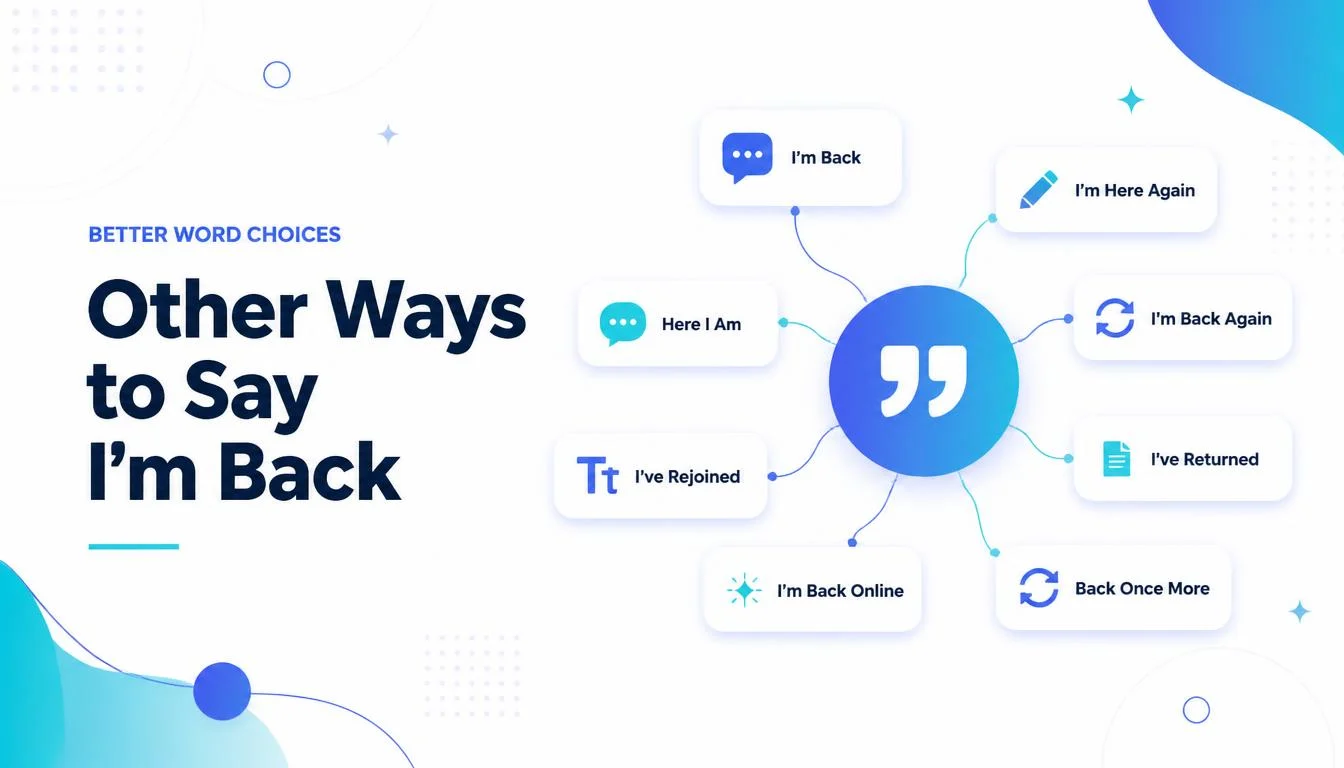
Other ways to say I’m back include “I’m back again,” “I’m here,” “I’m back in action,” “I’ve returned,” and “I’m back on track.” Choose an expression that matches your situation and tone.
Learning other ways to say I’m back can make your everyday conversations more interesting and expressive. Whether you’re returning home, rejoining a conversation, coming back to work, or reconnecting with friends online, the right phrase helps you communicate naturally.
There are many alternatives to “I’m back” for different situations. You can use casual expressions like “I’m back again” with friends, playful phrases like “Guess who’s back!” in informal conversations, or professional alternatives like “I’ve returned” in more formal settings. Understanding these expressions will help you choose the best words for every occasion.
What Is “Other Ways to Say I’m Back”? (Meaning, Grammar & Real Use)
Imagine stepping away from your desk during a busy workday, leaving a group chat for a few hours, or returning home after a long trip. When you reappear, you might say, “I’m back.” This short phrase tells others that you have returned and are ready to reconnect. However, the best wording depends on your situation, your relationship with the listener, and the impression you want to create.
Learning alternatives to this expression helps you communicate more naturally in everyday conversations, professional meetings, emails, and online discussions. Some phrases sound warm and friendly, while others communicate your return in a more formal or specific way. These options also help you express excitement in English when you return to friends, colleagues, or a community that has been waiting for you.
The expression “I’m back” is a contraction of “I am back.” Here, back functions as an adverb indicating a return to a previous place, activity, or state. The phrase is grammatically correct and usually informal or neutral.
For example: “I’m back from lunch and ready to continue the meeting.”
People commonly use it in spoken English, text messages, workplace chats, and social media posts. Understanding its alternatives helps you choose language that fits your audience instead of repeating the same expression in every situation.
When Should You Use “I’m Back”?
The phrase works in many situations, but choosing a more specific alternative can make your message clearer and more appropriate.
Common contexts
- Returning home: Say “I’m home” or “I’ve made it back” when you arrive.
- Resuming work: Use “I’m back at work” or “I’m ready to continue.”
- Rejoining a conversation: Say “I’m back” or “I’m here again.”
- Returning online: Use “I’m back online” after reconnecting to the internet or a meeting.
- Coming back after an absence: Say “I’ve returned” in more formal situations.
- Reappearing in a community: Use “I’m back again” or “It’s good to be back.”
Spoken vs. written English
In spoken English, short expressions such as “I’m back” and “Here I am again” sound natural. In written messages, “I’m back online” or “I’ve returned to the discussion” provides more context.
Formal vs. informal English
Formal situations often call for “I’ve returned” or “I’m available again.” Friends and family usually prefer conversational options such as “I’m back!” or “Guess who’s back?”
Is It Professional or Just Polite?
“I’m back” is both polite and acceptable in professional communication, especially when colleagues already know where you have been. However, a more specific expression may communicate your availability or next step more clearly.
Business-style example: “I’m back from lunch and available to continue reviewing the proposal.”
- Polite? ✔️ Yes
- Professional? ✔️ Yes, in the right context
Politeness vs. professionalism
Politeness concerns how respectfully you communicate. Professionalism also involves clarity, relevance, and awareness of your audience. Saying “I’m back online and ready to resume the meeting” is often more useful than simply announcing your return.
For more workplace-ready wording, see the Professional English Communication Guide.
Pros and Cons of Using “I’m Back”
Pros
- Simple and direct: The phrase communicates your return immediately.
- Friendly tone: It sounds natural with friends, relatives, and familiar colleagues.
- Common usage: Most English speakers understand it without additional explanation.
- Easy to adapt: You can add context, such as “I’m back from lunch.”
Cons
- Limited formality: It may sound too casual in official correspondence.
- Potential repetition: Using it repeatedly can make conversations feel predictable.
- Limited emotional range: It does not necessarily communicate excitement, relief, or gratitude.
- Lacks specific context: Listeners may not know where you have returned from or what you plan to do next.
Common Mistakes People Make
Choosing the right alternative involves more than finding a synonym. You also need to consider tense, context, and the message you want to convey.
1. Using the wrong tense
❌ Incorrect: “I return now from lunch.”
✔️ Correct: “I’m back from lunch.”
Use the present form when announcing that you have returned and are available now.
2. Using overly formal language with friends
❌ Incorrect: “I have resumed my presence at your house.”
✔️ Correct: “I’m back at your place!”
Keep everyday conversations natural rather than unnecessarily complicated.
3. Confusing arrival with availability
❌ Incorrect: “I’m back online,” when you have not reconnected to the internet.
✔️ Correct: “I’m back at my desk.”
Choose a phrase that accurately describes your situation.
4. Forgetting the context in professional messages
❌ Incorrect: “I’m back,” when colleagues need to know whether a meeting can resume.
✔️ Correct: “I’m back from my break and ready to continue the meeting.”
Adding a brief detail makes workplace communication more useful.
5. Using an unnatural expression
❌ Incorrect: “I am returned to home.”
✔️ Correct: “I’ve returned home.”
Use natural verb patterns. “Return home” does not require the preposition to before home.
Small tone mistakes can make confident English sound careless.
Alternatives by Category
These selected phrases offer a preview of the full list below. Each works in a different setting, so choose according to your audience and purpose.
Formal alternatives to “I’m back”
- I’ve returned
- I have returned to the office
- I’m available again
Pro Tip
Use a formal alternative when communicating with unfamiliar clients, senior colleagues, or people who expect a professional tone.
Casual alternatives
- I’m back again
- I’m here again
- I’ve made it back
Pro Tip
Add a short explanation, such as “I’m back from lunch,” when the listener might not know where you went.
Professional alternatives
- I’m back online
- I’m ready to continue
- I’m available again
Pro Tip
Pair your return announcement with your next action to help colleagues understand what happens next.
Informal expressions
- Guess who’s back?
- Look who’s back!
- I’m back in action
Pro Tip
Save playful expressions for friends, familiar coworkers, and social groups where a relaxed tone feels natural.
“Formal and informal English aren’t about correctness. They’re about context.”
Other Ways to Say “I’m Back” (Full List with Examples)
The following 30 alternatives help you communicate your return with greater variety. Some emphasize availability or location, while others express enthusiasm, familiarity, or readiness to resume an activity.
1. I’ve Returned
Meaning: I have come back.
Explanation: A formal, straightforward way to announce your return.
Example Sentence: I’ve returned to the office after my appointment.
Best Use: Formal announcements
Worst Use: Playful chats
Tone: Formal and neutral
Context Variability: professional / written / spoken
2. I’m Back Again
Meaning: I have returned once more.
Explanation: A friendly expression suitable when you have been away briefly or returned after a previous visit.
Example Sentence: I’m back again to finish the book we started.
Best Use: Everyday conversations
Worst Use: Official letters
Tone: Casual and friendly
Context Variability: casual / spoken / social
3. I’m Here Again
Meaning: I have returned to this place or conversation.
Explanation: Emphasizes your presence rather than the journey you took.
Example Sentence: I’m here again if you need any help.
Best Use: Friendly check-ins
Worst Use: Formal reports
Tone: Warm and neutral
Context Variability: casual / spoken / social
4. I’ve Made It Back
Meaning: I have successfully returned.
Explanation: Often suggests that the journey or return required some effort.
Example Sentence: I’ve made it back home despite the heavy rain.
Best Use: Travel updates
Worst Use: Formal correspondence
Tone: Conversational and relieved
Context Variability: casual / spoken / social
5. I’m Back Online
Meaning: I am connected or available online again.
Explanation: Useful after an internet outage, technical issue, or temporary absence from a virtual meeting.
Example Sentence: I’m back online and can join the call now.
Best Use: Virtual meetings
Worst Use: Face-to-face arrivals
Tone: Neutral and professional
Context Variability: professional / written / spoken
6. I’m Back at Work
Meaning: I have returned to work.
Explanation: Clearly communicates that you have resumed your workplace routine after time away.
Example Sentence: I’m back at work after a short vacation.
Best Use: Workplace updates
Worst Use: Casual greetings
Tone: Neutral and direct
Context Variability: professional / written / spoken
7. I’m Back Home
Meaning: I have returned to my home.
Explanation: A natural expression for updating family or friends after traveling or going out.
Example Sentence: I’m back home, and everything went well.
Best Use: Family updates
Worst Use: Office announcements
Tone: Casual and reassuring
Context Variability: casual / written / spoken
8. I’m Back in Action
Meaning: I have resumed an activity.
Explanation: Suggests renewed energy, participation, or readiness after a break.
Example Sentence: After a relaxing weekend, I’m back in action.
Best Use: Motivational updates
Worst Use: Serious apologies
Tone: Energetic and confident
Context Variability: casual / social / spoken
9. I’m Available Again
Meaning: I can respond or participate now.
Explanation: A useful professional alternative when you have finished an appointment, break, or other commitment.
Example Sentence: I’m available again if you’d like to discuss the proposal.
Best Use: Workplace communication
Worst Use: Playful banter
Tone: Professional and courteous
Context Variability: professional / written / spoken
10. I’m Back on Track
Meaning: I have resumed progress toward a goal.
Explanation: Focuses on recovering momentum rather than simply returning to a place.
Example Sentence: After resolving the technical issue, I’m back on track.
Best Use: Progress updates
Worst Use: Simple arrivals
Tone: Positive and purposeful
Context Variability: professional / casual / written
11. Guess Who’s Back?
Meaning: I have returned, and I want to make it playful.
Explanation: A lighthearted way to announce your arrival to people who know you.
Example Sentence: Guess who’s back? I finally finished my exams!
Best Use: Friendly reunions
Worst Use: Formal meetings
Tone: Playful and enthusiastic
Context Variability: casual / spoken / social
12. Look Who’s Back!
Meaning: Someone has returned, usually unexpectedly.
Explanation: Often used by another person to welcome or tease someone who has reappeared.
Example Sentence: Look who’s back! We missed having you around.
Best Use: Friendly greetings
Worst Use: Business emails
Tone: Playful and warm
Context Variability: casual / spoken / social
13. I’m Back on My Feet
Meaning: I have recovered or regained stability.
Explanation: Usually refers to recovering from illness, difficulty, or a challenging period, rather than an ordinary return.
Example Sentence: After a difficult month, I’m finally back on my feet.
Best Use: Recovery updates
Worst Use: Routine arrivals
Tone: Hopeful and resilient
Context Variability: casual / professional / spoken
14. I’ve Returned to the Office
Meaning: I have come back to my workplace.
Explanation: A specific, polished statement suitable for workplace messages and status updates.
Example Sentence: I’ve returned to the office and can review the documents.
Best Use: Workplace announcements
Worst Use: Casual greetings
Tone: Formal and clear
Context Variability: professional / written / spoken
15. I’m Back from My Break
Meaning: My break has ended, and I have returned.
Explanation: Clearly tells colleagues that you are ready to resume work after a short pause.
Example Sentence: I’m back from my break and ready to help.
Best Use: Work updates
Worst Use: Formal invitations
Tone: Neutral and friendly
Context Variability: professional / casual / spoken
16. I’m Ready to Continue
Meaning: I am prepared to resume an activity.
Explanation: Focuses on your next step rather than the fact that you have returned.
Example Sentence: I’m ready to continue with the second part of the presentation.
Best Use: Meeting resumption
Worst Use: Social reunions
Tone: Professional and purposeful
Context Variability: professional / written / spoken
17. I’ve Rejoined the Conversation
Meaning: I have returned to a discussion.
Explanation: Suitable for group chats, online discussions, and meetings after a temporary absence.
Example Sentence: I’ve rejoined the conversation and caught up on the main points.
Best Use: Group discussions
Worst Use: Home arrivals
Tone: Neutral and professional
Context Variability: professional / written / spoken
18. I’m Here Now
Meaning: I have arrived and am present.
Explanation: A direct, natural statement that can reassure someone who has been waiting.
Example Sentence: I’m here now, so we can start whenever you’re ready.
Best Use: Arrival updates
Worst Use: Formal reports
Tone: Simple and reassuring
Context Variability: casual / spoken / social
19. I’m Back in the Game
Meaning: I am participating again after an absence.
Explanation: Often used for returning to competition, work, or an activity after a setback.
Example Sentence: After recovering from the injury, she’s back in the game.
Best Use: Competitive settings
Worst Use: Formal notices
Tone: Energetic and confident
Context Variability: casual / professional / spoken
20. I’m Back at It
Meaning: I have resumed what I was doing.
Explanation: A conversational phrase for returning to a task, hobby, or routine.
Example Sentence: The break is over, and I’m back at it.
Best Use: Task updates
Worst Use: Official correspondence
Tone: Casual and focused
Context Variability: casual / spoken / social
21. I’m Back in Business
Meaning: I can operate or function successfully again.
Explanation: Common after resolving a problem that temporarily stopped work or normal activity.
Example Sentence: The system is working again, so we’re back in business.
Best Use: Operational updates
Worst Use: Emotional reunions
Tone: Positive and confident
Context Variability: professional / casual / spoken
22. I’ve Returned to the Discussion
Meaning: I am participating in the discussion again.
Explanation: A more formal way to rejoin a professional conversation or written exchange.
Example Sentence: I’ve returned to the discussion and would like to address the final question.
Best Use: Formal discussions
Worst Use: Friendly greetings
Tone: Formal and measured
Context Variability: professional / written / spoken
23. I’m Back on the Scene
Meaning: I have returned to a particular social or professional environment.
Explanation: Suggests renewed visibility or involvement in an activity or community.
Example Sentence: After a year abroad, she’s back on the scene.
Best Use: Social updates
Worst Use: Formal reports
Tone: Confident and casual
Context Variability: casual / social / spoken
24. I’m Back Where I Belong
Meaning: I have returned to a place or situation where I feel comfortable.
Explanation: Expresses a sense of belonging, familiarity, or emotional connection.
Example Sentence: After months away, I’m back where I belong.
Best Use: Emotional reunions
Worst Use: Routine updates
Tone: Warm and expressive
Context Variability: casual / social / written
25. It’s Good to Be Back
Meaning: I am happy to have returned.
Explanation: A warm phrase for welcoming your return to a workplace, community, school, or familiar place.
Example Sentence: It’s good to be back with the team after my leave.
Best Use: Return greetings
Worst Use: Urgent alerts
Tone: Warm and positive
Context Variability: professional / casual / spoken
26. I’ve Come Back
Meaning: I have returned to a place or situation.
Explanation: A straightforward expression that can sound more deliberate than “I’m back.”
Example Sentence: I’ve come back to finish the project we started.
Best Use: Personal explanations
Worst Use: Brief status updates
Tone: Neutral and conversational
Context Variability: casual / written / spoken
27. I’m Back in Town
Meaning: I have returned to a town or city.
Explanation: Commonly used to tell friends or contacts that you are available to meet locally again.
Example Sentence: I’m back in town this weekend. Would you like to catch up?
Best Use: Social planning
Worst Use: Office status
Tone: Friendly and casual
Context Variability: casual / written / spoken
28. I’ve Reappeared
Meaning: I have become visible or present again.
Explanation: Often playful or humorous when someone has been absent from a group or online community.
Example Sentence: I’ve reappeared after a busy week away from social media.
Best Use: Online communities
Worst Use: Formal announcements
Tone: Playful and informal
Context Variability: casual / social / written
29. I’m Back in the Loop
Meaning: I am informed and involved again.
Explanation: Useful after catching up on missed messages, updates, or developments.
Example Sentence: I’ve read the latest emails, and I’m back in the loop.
Best Use: Team updates
Worst Use: Physical arrivals
Tone: Conversational and professional
Context Variability: professional / casual / written
30. I’m Back and Ready to Go
Meaning: I have returned and am prepared to begin.
Explanation: Combines an announcement of your return with a clear statement of readiness.
Example Sentence: I’m back and ready to go whenever the team is.
Best Use: Work resumption
Worst Use: Formal apologies
Tone: Positive and energetic
Context Variability: professional / casual / spoken
Comparison Table: Top 10 Alternatives at a Glance
Use this table to choose an expression quickly based on tone and purpose.
| Phrase | Tone | Best Use |
|---|---|---|
| I’ve returned | Formal | Official updates |
| I’m back again | Friendly | Everyday conversations |
| I’ve made it back | Conversational | Travel updates |
| I’m back online | Professional | Virtual meetings |
| I’m available again | Courteous | Workplace communication |
| I’m ready to continue | Purposeful | Resuming meetings |
| It’s good to be back | Warm | Reunions |
| I’m back in action | Energetic | Returning to activities |
| I’m back from my break | Neutral | Workplace updates |
| I’m back in the loop | Professional and casual | Catching up on updates |
Quick Self-Check (Mini Quiz)
Test your understanding of tone and context with these short scenarios.
1. You have returned from lunch and want to update your manager. Which phrase is most appropriate?
- A. Guess who’s back?
- B. I’m back from lunch and ready to continue.
- C. Look who’s back!
Correct answer: B. It is clear, polite, and appropriate for a workplace.
2. You have reconnected to an online meeting after a connection problem. What should you say?
- A. I’m back online.
- B. I’m back home.
- C. I’m back where I belong.
Correct answer: A. It describes your restored online connection.
3. You return to a group of close friends after a long absence. Which phrase sounds playful?
- A. I’ve returned to the discussion.
- B. I have resumed my presence.
- C. Guess who’s back?
Correct answer: C. It creates a friendly, playful atmosphere.
4. You want to tell your colleagues that you have caught up on missed updates. Which phrase fits best?
- A. I’m back in the loop.
- B. I’m back in town.
- C. I’ve made it back home.
Correct answer: A. It indicates that you are informed and involved again.
FAQs
1. What are the best alternatives to “I’m back”?
Some useful options are “I’ve returned,” “I’m back online,” “I’m here again,” “I’ve made it back,” and “It’s good to be back.” The best choice depends on the situation.
2. How do you say “I’m back” professionally?
Use “I’ve returned to the office,” “I’m available again,” or “I’m ready to continue.” These expressions communicate your status clearly in workplace settings.
3. What is a casual way to say “I’m back”?
You can say “I’m back again,” “I’m here now,” or “Guess who’s back?” The last option is more playful and suits familiar audiences.
4. How do you announce that you are back online?
Say “I’m back online” or “I’ve reconnected and am ready to join.” Both options work well in virtual meetings and workplace chats.
5. How can I make “I’m back” sound more enthusiastic?
Try “It’s great to be back,” “I’m back in action,” or “I’m back and ready to go.” These expressions add warmth or energy to your message.
For more vocabulary ideas, explore Other Ways to Say “Amazing” to learn how to express positive reactions more naturally.
Conclusion
Learning different ways to announce your return helps you sound more fluent, confident, and appropriate in everyday and professional English. Instead of relying on one phrase, choose expressions that communicate your location, availability, feelings, or readiness to continue.
Practice one or two alternatives each day in messages, conversations, and workplace situations. Pay attention to the relationship between speaker and listener, because the most effective expression is the one that fits the context.
Read More Related Articles:
- Other Ways to Say You’re Beautiful | Beyond the Ordinary Compliment In 2026
- Other Ways to Say I Love You in Spanish | Beyond the Usual Phrase In 2026
- Other Ways to Say I Love You in Other Languages | Beyond the Classic Three Words In 2026

Daniel Murphy is a professional writer and blogger specializing in digital communication and messaging trends. As a contributor to TextsResponse.com, he creates reader-focused content designed to help people find the right words at the right time.