Quick Answer:
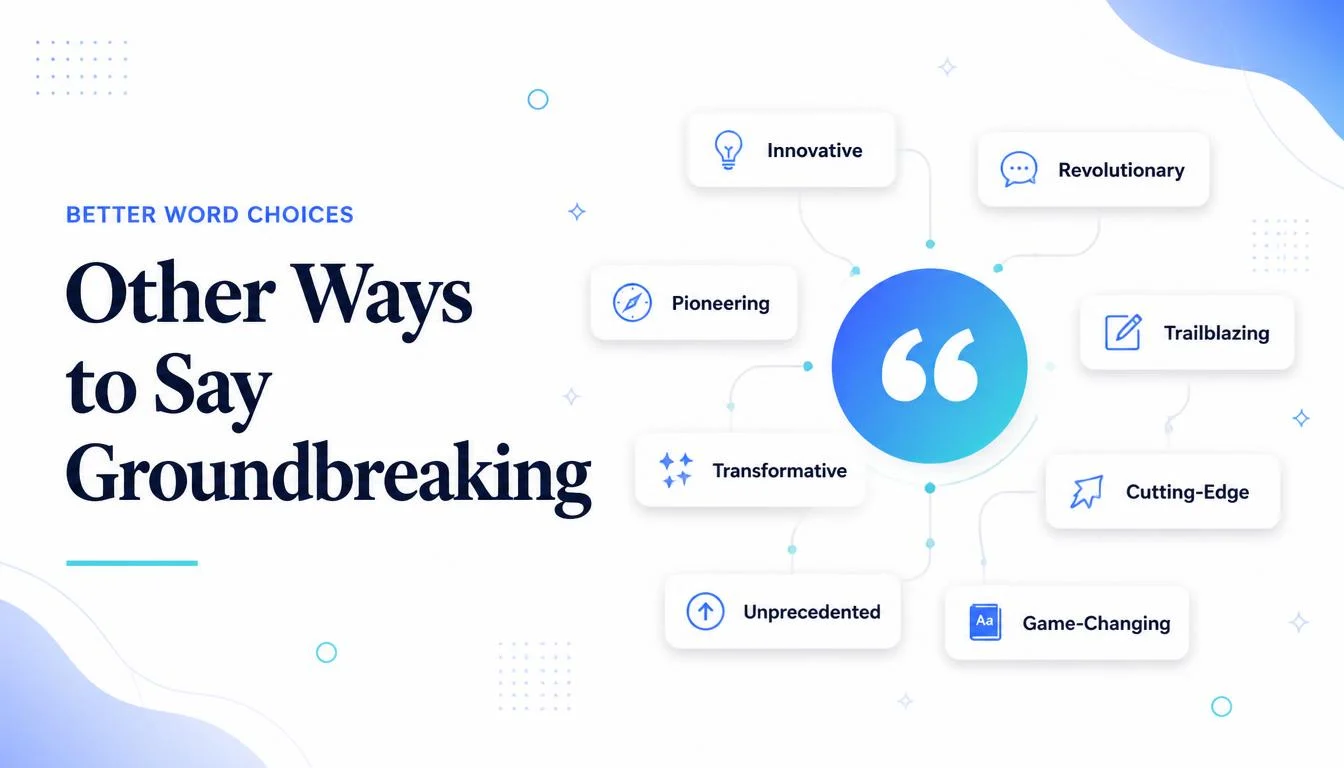
Other ways to say groundbreaking include innovative, revolutionary, pioneering, game-changing, trailblazing, and transformative. The best alternative depends on whether you want to emphasize originality, major progress, or a significant impact.
Finding the right other ways to say groundbreaking can make your writing more engaging, precise, and impactful. Whether you are describing a major discovery, a creative idea, a scientific breakthrough, or a remarkable achievement, choosing the right synonym helps communicate the importance of the moment.
In this guide, you’ll discover other ways to say groundbreaking for academic, professional, and everyday contexts. From powerful alternatives like “revolutionary” to more specific terms like “pioneering” and “transformative,” these expressions will help you describe new ideas and meaningful progress with greater confidence.
What Is “Groundbreaking”? (Meaning, Grammar & Real Use)
Imagine your company introduces a technology that makes a complicated task faster, cheaper, and easier. You might describe it as groundbreaking because it changes how people approach the task. Similarly, a researcher may publish groundbreaking findings, or an artist may create groundbreaking work that challenges traditional expectations.
The word is useful when ordinary praise does not fully capture the importance of an achievement. However, repeating the same adjective in presentations, reports, emails, or conversations can make your vocabulary sound predictable. Learning alternatives to groundbreaking helps you describe innovation with greater precision and express excitement in English without relying on the same expression every time.
Meaning: Groundbreaking describes something original, innovative, or influential that introduces a significant change in a field or challenges established practices.
Grammar: It is an adjective, commonly placed before nouns such as research, discovery, technology, and achievement. It is suitable for formal, professional, and casual communication.
Example: “The team developed a groundbreaking solution to a long-standing problem.”
People use the word in business, science, education, technology, medicine, literature, and the arts. Its strength comes from suggesting more than simple newness: it implies meaningful progress or a lasting influence.
When Should You Use “Groundbreaking”?
The word works best when an achievement introduces a meaningful change, rather than simply offering a small improvement. Consider the audience, the importance of the achievement, and whether your description is supported by evidence.
Common contexts
- Technology: Describe new tools, systems, or inventions that change existing practices.
- Science and research: Highlight discoveries that significantly advance understanding.
- Business: Discuss products, strategies, or business models that transform an industry.
- Education: Praise teaching methods that challenge traditional approaches.
- Arts and culture: Describe original works that influence creative trends.
- Social progress: Discuss ideas or initiatives that challenge established norms.
Spoken vs. written English
In conversation, groundbreaking communicates enthusiasm quickly. You might say, “That is a groundbreaking idea!” during a discussion.
In written English, it suits articles, presentations, research summaries, and professional reports. When accuracy matters, explain what makes the work significant instead of relying on praise alone.
Formal vs. informal English
For formal writing, consider pioneering, innovative, or transformative, depending on the intended meaning. In informal conversations, game-changing or next-level may sound more natural.
Remember that these alternatives are not always interchangeable. A new feature can be innovative without transforming an entire industry.
Is It Professional or Just Polite?
Groundbreaking is both professional and appropriate in polite communication. It is an evaluative adjective, not a politeness formula, so its purpose is to describe the significance of an achievement rather than soften a request or show courtesy.
Politeness vs. professionalism
- Politeness involves respect, consideration, and appropriate language.
- Professionalism involves clarity, accuracy, credibility, and suitability for the workplace.
Business example: “Your team has developed a groundbreaking approach that could significantly improve customer onboarding.”
This sentence sounds professional because it identifies the achievement and explains its potential value. However, calling every new proposal groundbreaking can weaken your credibility.
Verdict
- Polite? ✔️ Yes, when used respectfully.
- Professional? ✔️ Yes, when the claim is justified.
Pros and Cons of Using “Groundbreaking”
Pros
- Communicates significance: Suggests an achievement goes beyond routine progress.
- Creates a strong impression: Makes important discoveries and innovations stand out.
- Works across industries: Fits scientific, creative, educational, and business contexts.
- Easy to understand: Most fluent English speakers recognize its positive meaning.
Cons
- Can exaggerate an achievement: A minor improvement rarely deserves such a strong label.
- May become repetitive: Overuse makes descriptions less distinctive.
- Offers limited precision: It does not explain whether something is original, influential, or disruptive.
- Can sound promotional: Unsupported claims may undermine credibility in reports and research.
The solution is to choose language that matches the evidence. Use innovative for a new approach, transformative for substantial change, and pioneering when someone is among the first to explore an area.
Common Mistakes People Make
Understanding the word is only part of using it well. These five errors can make your writing less accurate or less natural.
1. Calling every new idea groundbreaking
Incorrect: “We changed the button color. It was a groundbreaking development.”
Correct: “We updated the interface to improve readability.”
A routine adjustment does not automatically represent a major innovation.
2. Confusing groundbreaking with ground-breaking grammar
Incorrect: “The report describes a ground breaking discovery.”
Correct: “The report describes a groundbreaking discovery.”
Groundbreaking is conventionally written as one word. The hyphenated form also appears in some publications, but consistency is important.
3. Using it as a noun
Incorrect: “The groundbreaking of the project impressed everyone.”
Correct: “The groundbreaking research impressed everyone.”
As an adjective, the word describes a noun. In construction, groundbreaking can also refer to the ceremony that marks the beginning of building work, so context matters.
4. Treating every synonym as identical
Incorrect: “The artist’s game-changing painting introduced a completely new style.” (when no meaningful change is established)
Correct: “The artist’s innovative painting introduced an original visual style.”
Game-changing suggests substantial consequences, while innovative can simply describe originality.
5. Making exaggerated claims in professional writing
Incorrect: “Our groundbreaking software will revolutionize every business.”
Correct: “Our new software introduces an approach that may improve workflow efficiency.”
Specific, supportable claims are more persuasive than unsupported superlatives.
Small tone mistakes can make confident English sound careless.
Alternatives by Category
These selected phrases offer a preview of the full list below. Each category emphasizes a different level of formality or a particular communication goal.
Formal alternatives to “Groundbreaking”
- Pioneering: Appropriate for early work that opens a new field or direction.
- Transformative: Best when something produces substantial change.
- Innovative: Useful for original ideas, methods, or technologies.
Pro Tip: In formal reports, pair the adjective with a specific result to make your claim more credible.
Casual alternatives
- Game-changing: Useful when something makes a major practical difference.
- Next-level: Suitable for enthusiastic, informal praise.
- A whole new ball game: Best for describing a situation that has changed dramatically.
Pro Tip: Match casual expressions to your audience, especially when speaking with clients or senior colleagues.
Professional alternatives
- Industry-leading: Appropriate when a product or organization is among the leaders in its field.
- State-of-the-art: Best for technology or methods that use the most advanced available developments.
- Forward-thinking: Suitable for people, policies, or organizations that anticipate future needs.
Pro Tip: Use industry-leading only when you can support the leadership claim with relevant evidence.
Informal expressions
- Ahead of its time: Describes something that introduces ideas before they become widely accepted.
- Revolutionary: Works in enthusiastic conversation when the impact is genuinely substantial.
- Cutting-edge: Often used to praise highly advanced ideas, methods, or technology.
Pro Tip: Reserve the strongest expressions for achievements that genuinely stand out, rather than using them as routine compliments.
“Formal and informal English aren’t about correctness. They’re about context.”
Other Ways to Say “Groundbreaking” (Full List with Examples)
These 30 alternatives build fluency and help you express excitement, admiration, or approval depending on tone and context. Use the explanations to choose language that fits your audience and the achievement you are describing.
1. Phrase: Innovative
Meaning: Introducing new ideas or methods.
Explanation: A versatile choice for original solutions and improvements.
Example Sentence: “The company introduced an innovative payment system.
Best Use: New solutions
Worst Use: Routine changes
Tone: Neutral professional
Context Variability: casual / professional / spoken
2. Phrase: Revolutionary
Meaning: Causing a dramatic, fundamental change.
Explanation: Stronger than innovative because it suggests a major departure from existing practices.
Example Sentence: “The discovery revolutionized modern medical treatment.”
Best Use: Major breakthroughs
Worst Use: Minor updates
Tone: Strong emphatic
Context Variability: casual / professional / spoken
3. Phrase: Pioneering
Meaning: Being among the first to develop or explore something.
Explanation: Highlights leadership in opening a new area of research, technology, or creative work.
Example Sentence: “Her pioneering research changed how scientists understood the disease.”
Best Use: First achievements
Worst Use: Imitative work
Tone: Respectful formal
Context Variability: casual / professional / spoken
4. Phrase: Trailblazing
Meaning: Creating a path for others to follow.
Explanation: Emphasizes courage, originality, and leadership in an emerging field.
Example Sentence: “The trailblazing entrepreneur created opportunities for women in technology.”
Best Use: Leadership achievements
Worst Use: Routine procedures
Tone: Admiring energetic
Context Variability: casual / professional / spoken
5. Phrase: Game-changing
Meaning: Significantly changing how something works.
Explanation: A popular expression for innovations with substantial practical consequences.
Example Sentence: “The new scheduling tool was game-changing for our team.”
Best Use: Practical improvements
Worst Use: Minor refinements
Tone: Enthusiastic conversational
Context Variability: casual / professional / spoken
6. Phrase: Transformative
Meaning: Producing a substantial change.
Explanation: Focuses on the scale of an effect rather than simply the novelty of an idea.
Example Sentence: “Digital learning has had a transformative effect on education.”
Best Use: Lasting change
Worst Use: Small adjustments
Tone: Formal confident
Context Variability: casual / professional / spoken
7. Phrase: Cutting-edge
Meaning: At the most advanced stage of development.
Explanation: Particularly effective for modern technologies, scientific methods, and advanced equipment.
Example Sentence: “The laboratory uses cutting-edge imaging technology.”
Best Use: Advanced technology
Worst Use: Outdated equipment
Tone: Modern professional
Context Variability: casual / professional / spoken
8. Phrase: State-of-the-art
Meaning: Using the most advanced available technology or methods.
Explanation: Often describes facilities, equipment, and systems rather than the historical importance of a discovery.
Example Sentence: “The hospital opened a state-of-the-art diagnostic center.”
Best Use: Advanced facilities
Worst Use: Basic equipment
Tone: Technical formal
Context Variability: casual / professional / spoken
9. Phrase: Unprecedented
Meaning: Never experienced or done before.
Explanation: Emphasizes the absence of a comparable precedent, not necessarily positive impact.
Example Sentence: “The project achieved unprecedented levels of international collaboration.”
Best Use: Unique developments
Worst Use: Familiar practices
Tone: Formal emphatic
Context Variability: casual / professional / spoken
10. Phrase: Innovative in Its Approach
Meaning: Using a new or original method.
Explanation: A measured, professional alternative that draws attention to how a problem is addressed.
Example Sentence: “The research team took an innovative approach to waste reduction.”
Best Use: Method descriptions
Worst Use: Conventional methods
Tone: Analytical professional
Context Variability: casual / professional / spoken
11. Phrase: Forward-Thinking
Meaning: Focused on future possibilities and progress.
Explanation: Commonly describes people, organizations, and strategies that anticipate emerging needs.
Example Sentence: “The forward-thinking leadership team invested in employee development.”
Best Use: Future planning
Worst Use: Past analysis
Tone: Positive professional
Context Variability: casual / professional / spoken
12. Phrase: Industry-Leading
Meaning: Among the leaders in a particular industry.
Explanation: Emphasizes competitive standing rather than originality alone. Evidence strengthens the claim.
Example Sentence: “The company provides industry-leading cybersecurity services.”
Best Use: Market positioning
Worst Use: Unsupported claims
Tone: Corporate confident
Context Variability: casual / professional / spoken
13. Phrase: Visionary
Meaning: Showing exceptional imagination about future possibilities.
Explanation: Often describes people, plans, or ideas that anticipate significant developments.
Example Sentence: “Her visionary strategy helped reshape the organization.”
Best Use: Strategic leadership
Worst Use: Short-term tasks
Tone: Admiring formal
Context Variability: casual / professional / spoken
14. Phrase: History-Making
Meaning: Important enough to become part of history.
Explanation: Highlights the lasting significance of an event, achievement, or milestone.
Example Sentence: “The team secured a history-making victory.”
Best Use: Major milestones
Worst Use: Everyday successes
Tone: Celebratory emphatic
Context Variability: casual / professional / spoken
15. Phrase: A Major Breakthrough
Meaning: An important advance in knowledge or progress.
Explanation: Particularly natural when a difficult problem has finally been solved.
Example Sentence: “Researchers announced a major breakthrough in battery performance.”
Best Use: Research discoveries
Worst Use: Small findings
Tone: Positive informative
Context Variability: casual / professional / spoken
16. Phrase: Next-Level
Meaning: Significantly better or more advanced than usual.
Explanation: An informal way to express strong admiration for exceptional quality or performance.
Example Sentence: “The designer’s latest collection is next-level.”
Best Use: Casual praise
Worst Use: Academic reports
Tone: Enthusiastic informal
Context Variability: casual / professional / spoken
17. Phrase: Ahead of Its Time
Meaning: Introducing ideas before they become widely accepted.
Explanation: Often used retrospectively for inventions, artwork, or concepts that people initially overlooked.
Example Sentence: “The filmmaker’s experimental style was ahead of its time.”
Best Use: Early innovations
Worst Use: Conventional ideas
Tone: Reflective appreciative
Context Variability: casual / professional / spoken
18. Phrase: Ground-Shifting
Meaning: Changing established assumptions or perspectives.
Explanation: A less common expression that can describe major changes in thinking. Paradigm-shifting is more established in academic contexts.
Example Sentence: “The findings prompted ground-shifting discussions among researchers.”
Best Use: Changed perspectives
Worst Use: Everyday updates
Tone: Emphatic intellectual
Context Variability: casual / professional / spoken
19. Phrase: Paradigm-Shifting
Meaning: Fundamentally changing an established framework of thought.
Explanation: Especially useful in academic, scientific, and theoretical discussions.
Example Sentence: “The theory offered a paradigm-shifting explanation of the phenomenon.”
Best Use: Scientific theories
Worst Use: Minor revisions
Tone: Academic formal
Context Variability: casual / professional / spoken
20. Phrase: Boundary-Pushing
Meaning: Challenging established limits or conventions.
Explanation: Commonly describes experimental art, ambitious research, and unconventional creative work.
Example Sentence: “The exhibition showcases boundary-pushing contemporary artists.”
Best Use: Creative exploration
Worst Use: Standard procedures
Tone: Bold creative
Context Variability: casual / professional / spoken
21. Phrase: Original
Meaning: New, independent, or unlike existing examples.
Explanation: A simple alternative when the main point is uniqueness rather than widespread impact.
Example Sentence: “She presented an original solution to the design challenge.”
Best Use: Unique ideas
Worst Use: Copied material
Tone: Neutral versatile
Context Variability: casual / professional / spoken
22. Phrase: Groundbreaking in Scope
Meaning: Remarkable for the breadth or extent of its contribution.
Explanation: Adds emphasis when an achievement covers more ground than previous work.
Example Sentence: “The report offers a groundbreaking analysis of global literacy.”
Best Use: Broad research
Worst Use: Narrow findings
Tone: Formal emphatic
Context Variability: casual / professional / spoken
23. Phrase: Disruptive
Meaning: Changing established systems or business practices.
Explanation: Particularly common in business and technology. It can imply both opportunity and disruption.
Example Sentence: “The startup introduced a disruptive model for online education.”
Best Use: Market innovation
Worst Use: Routine maintenance
Tone: Business assertive
Context Variability: casual / professional / spoken
24. Phrase: Influential
Meaning: Having a strong effect on people, ideas, or developments.
Explanation: Focuses on impact rather than whether something was the first of its kind.
Example Sentence: “The influential study shaped subsequent climate research.”
Best Use: Lasting impact
Worst Use: Unnoticed work
Tone: Neutral authoritative
Context Variability: casual / professional / spoken
25. Phrase: Innovative and Forward-Looking
Meaning: Combining originality with attention to future needs.
Explanation: Useful for describing strategies that introduce new ideas while preparing for future challenges.
Example Sentence: “The organization adopted an innovative and forward-looking policy.”
Best Use: Strategic planning
Worst Use: Historical summaries
Tone: Professional optimistic
Context Variability: casual / professional / spoken
26. Phrase: Breakthrough
Meaning: A significant advance that overcomes an obstacle.
Explanation: Used as a noun or adjective, depending on sentence structure, to emphasize meaningful progress.
Example Sentence: “The team made a breakthrough in renewable energy storage.”
Best Use: Solved problems
Worst Use: Routine progress
Tone: Positive direct
Context Variability: casual / professional / spoken
27. Phrase: Revolutionary in Its Impact
Meaning: Producing a fundamental change in outcomes or practices.
Explanation: This longer expression stresses the consequences of an innovation, not merely its novelty.
Example Sentence: “The treatment was revolutionary in its impact on patient care.”
Best Use: Major consequences
Worst Use: Limited benefits
Tone: Strong formal
Context Variability: casual / professional / spoken
28. Phrase: A First-of-Its-Kind Achievement
Meaning: An accomplishment with no directly comparable predecessor.
Explanation: A precise alternative when the defining feature is that something has been achieved for the first time.
Example Sentence: “The mission marked a first-of-its-kind achievement in ocean exploration.”
Best Use: Unique milestones
Worst Use: Repeated achievements
Tone: Factual celebratory
Context Variability: casual / professional / spoken
29. Phrase: A Whole New Ball Game
Meaning: A completely different situation with new conditions.
Explanation: An informal idiom that works when a development changes the circumstances or rules.
Example Sentence: “With international expansion, managing the business became a whole new ball game.”
Best Use: Changed circumstances
Worst Use: Formal research
Tone: Conversational informal
Context Variability: casual / professional / spoken
30. Phrase: Remarkably Advanced
Meaning: Developed to an unusually high level.
Explanation: A measured alternative for describing sophisticated technology, techniques, or capabilities without claiming historical significance.
Example Sentence: “The device uses remarkably advanced sensing technology.”
Best Use: Technical capabilities
Worst Use: Basic products
Tone: Neutral appreciative
Context Variability: casual / professional / spoken
Comparison Table: Top 10 Alternatives at a Glance
Use this table to compare the most versatile options and quickly identify the right expression for a particular situation.
| Phrase | Tone | Best Use |
|---|---|---|
| Innovative | Neutral, professional | New ideas and solutions |
| Revolutionary | Strong, emphatic | Fundamental changes |
| Pioneering | Formal, respectful | First achievements |
| Trailblazing | Bold, admiring | Leadership and progress |
| Game-changing | Conversational, energetic | Major practical effects |
| Transformative | Formal, confident | Significant improvements |
| Cutting-edge | Modern, technical | Advanced technology |
| Unprecedented | Formal, emphatic | Never-before-seen developments |
| Visionary | Positive, admiring | Future-focused leadership |
| A major breakthrough | Informative, positive | Important discoveries |
The most versatile choice is usually innovative because it describes original methods, ideas, and products without automatically claiming that they have transformed an entire field.
Choose transformative when the results matter most, pioneering when being among the first matters, and revolutionary when the change is genuinely fundamental.
For more vocabulary ideas, explore See also: Other Ways to Say “Amazing”.
For workplace applications, read See also: Professional English Communication Guide.
Quick Self-Check (Mini Quiz)
Test your understanding by choosing the expression that best fits each situation.
Question 1
Your research team is among the first to investigate a previously unexplored scientific field. Which phrase fits best?
- A. Next-level
- B. Pioneering
- C. Industry-leading
- D. A whole new ball game
Select your answer to Question 1.A. Next-levelB. PioneeringC. Industry-leadingD. A whole new ball game
Question 2
You are writing a formal report about a new method that substantially improves access to education. Which phrase is most appropriate?
- A. Next-level
- B. A whole new ball game
- C. Transformative
- D. Ahead of its time
A. Next-levelB. A whole new ball gameC. TransformativeD. Ahead of its time
Question 3
A software company introduces a product that significantly changes how customers manage their daily tasks. Which expression is especially natural in a presentation?
- A. Game-changing
- B. Original
- C. Influential
- D. Remarkably advanced
A. Game-changingB. OriginalC. InfluentialD. Remarkably advanced
Question 4
A company describes a routine color update as a revolutionary development, although the change has little effect on customers. What is the main problem?
- A. The phrase is too informal.
- B. The phrase is grammatically incorrect.
- C. The phrase exaggerates the significance of the change.
- D. The phrase is only suitable for scientific writing.
- A. The phrase is too informal.
- B. The phrase is grammatically incorrect.
- C. The phrase exaggerates the significance of the change.
- D. The phrase is only suitable for scientific writing.
Check answers
FAQs
What is the closest synonym for groundbreaking?
Innovative is one of the closest general synonyms. Use revolutionary when the change is fundamental and pioneering when the achievement opens a new direction.
What is a more professional word for groundbreaking?
Innovative, transformative, and pioneering work well in professional writing. Choose the word that accurately describes the achievement instead of using the strongest expression automatically.
How can I describe a groundbreaking idea without exaggerating?
Explain what makes the idea original or useful. For example, describe it as an innovative approach that reduces processing time rather than claiming it will revolutionize an entire industry.
Is groundbreaking positive or neutral?
It is generally positive because it praises originality and significance. However, its grammatical use is descriptive, and the word itself does not guarantee that every consequence of an innovation will be beneficial.
Can I use groundbreaking in academic writing?
Yes. It is appropriate when evidence supports the significance of a discovery or contribution. In research papers, more precise terms such as novel, pioneering, or transformative may communicate the intended claim more clearly.
Conclusion
Learning alternatives to groundbreaking helps you communicate innovation, progress, and achievement with greater precision. Instead of repeating one adjective, choose language that reflects the originality, influence, or practical value of the work.
Practice one new expression each day in an email, conversation, or short paragraph. Pay attention to tone and context so your English sounds natural, confident, and appropriate for your audience.
Your turn: Which alternative do you use most often? Share your favorite phrase or write a sentence using one of these expressions in the comments.
Read More Related Articles:
- Other Ways to Say Coffee | Unique Words for Your Favorite Brew In 2026
- Other Ways to Say Calm | Words for a Peaceful, Relaxed Tone In 2026
- Other Ways to Say Of Course | When You Want Better Word Choices In 2026
Victoria Hughes is a content writer dedicated to making communication clearer and more effective. Through TextsResponse.com, she shares practical insights and thoughtfully crafted response ideas that help readers express themselves with confidence.