Quick Answer
Looking for alternatives to “is”? The best substitutes depend on tone and context, but the most versatile options are represents, equals, signifies, functions as, and serves as. These alternatives to “is” help you sound more precise, professional, and fluent in both spoken and written English.Top 5 alternatives: represents, equals, signifies, functions as, serves as
Is” is one of the most common words in the English language, yet it is also one of the most overused. As a form of the verb “to be,” it links a subject to information about that subject, describing identity, state, or condition. People rely on “is” constantly in everyday conversation, academic writing, and professional communication because it is short, simple, and universally understood.
However, repeating “is” too often can make writing sound flat or repetitive. Learning alternatives to “is” allows you to add variety, precision, and confidence to your English. Whether you want to express excitement in English, sound more formal in a report, or simply avoid sounding repetitive, expanding your vocabulary around this single word can transform how fluent and polished your English feels.
This guide breaks down formal, casual, professional, and informal alternatives to “is,” along with grammar notes, real examples, and common mistakes to avoid.
The right tone makes your English sound professional and confident.
Quick Categories
Formal Alternatives to “Is”
- Constitutes “This agreement constitutes a legal contract.”
- Represents “The result represents a major shift in policy.”
- Signifies “This signifies a new phase for the company.”
- Embodies “She embodies professionalism in every meeting.”
Pro Tip: Use formal alternatives to “is” in reports, essays, and official documents where precision matters more than simplicity.
Casual Alternatives
- It’s basically “It’s basically the same idea.”
- It’s kind of “It’s kind of a big deal.”
- It’s like “It’s like a second home to me.”
- It’s pretty much “It’s pretty much finished.”
Pro Tip: Save casual alternatives for friendly conversations, texting, or informal spoken English, not business emails.
Professional Alternatives
- Serves as “This document serves as proof of purchase.”
- Functions as “The role functions as a bridge between teams.”
- Is defined as “Success is defined as meeting quarterly targets.”
- Corresponds to “This figure corresponds to last year’s data.”
Pro Tip: In professional reaction phrases and workplace writing, choose alternatives that sound objective and precise rather than emotional.
Informal Expressions
- It’s basically “It’s basically over.”
- Turns out to be “It turns out to be true.”
- Comes across as “He comes across as confident.”
- Seems to be “It seems to be working fine.”
Pro Tip: Informal expressions in English work well in casual chats but should be avoided in formal writing or business presentations.
Small word changes can completely shift how confident you sound in English.
Common Mistakes With “Is”
- Using “is” with plural subjects. Incorrect example: “The books is on the table.”
- Confusing “is” and “are.” Incorrect example: “There is many reasons for this.”
- Overusing “is” in academic writing, weakening sentences. Weak example: “The report is about the results, and it is helpful.”
- Using “is” with collective nouns inconsistently. Incorrect example: “The team are is winning.”
- Relying on “is” instead of stronger action verbs. Weak example: “The solution is effective for most cases,” instead of “The solution works effectively for most cases.”
What Does “Is” Mean?
“Is” is the third-person singular present tense form of the verb “to be.” It links a subject to a noun, adjective, or descriptive phrase, showing identity, state, condition, or existence.
Grammar note: “Is” is used only with singular subjects (he, she, it, or a singular noun). Plural subjects require “are” instead.
Example sentence: “This report is accurate.”
When to Use “Is”
- To describe identity: “She is a teacher.”
- To describe a current state or condition: “The weather is cold today.”
- To define or explain something: “Success is the result of consistent effort.”
- Spoken English: Common in everyday conversation for simplicity and speed.
- Written English: Common in both formal and informal writing, though alternatives are recommended for variety.
- Formal contexts: Acceptable, but often paired with more precise verbs like “represents” or “constitutes.”
- Informal contexts: Very common and completely natural.
Is It Professional or Polite to Say “Is”?
“Is” itself is neutral, polite, and grammatically correct in almost every context. However, overusing it in professional writing can make communication sound basic or repetitive rather than polished.
Business example: “This proposal is a strong option” sounds acceptable, but “This proposal represents a strong option” sounds more professional and confident.
Polite? Yes Professional? No, not always, especially when repeated frequently in formal writing
Pros and Cons of Using “Is”
Pros:
- Simple and natural
- Friendly tone
- Common usage
- Easy to understand
Cons:
- Too informal for work when overused
- Overused in everyday writing
- Limited emotional range
- Not suitable for formal or academic writing when repeated
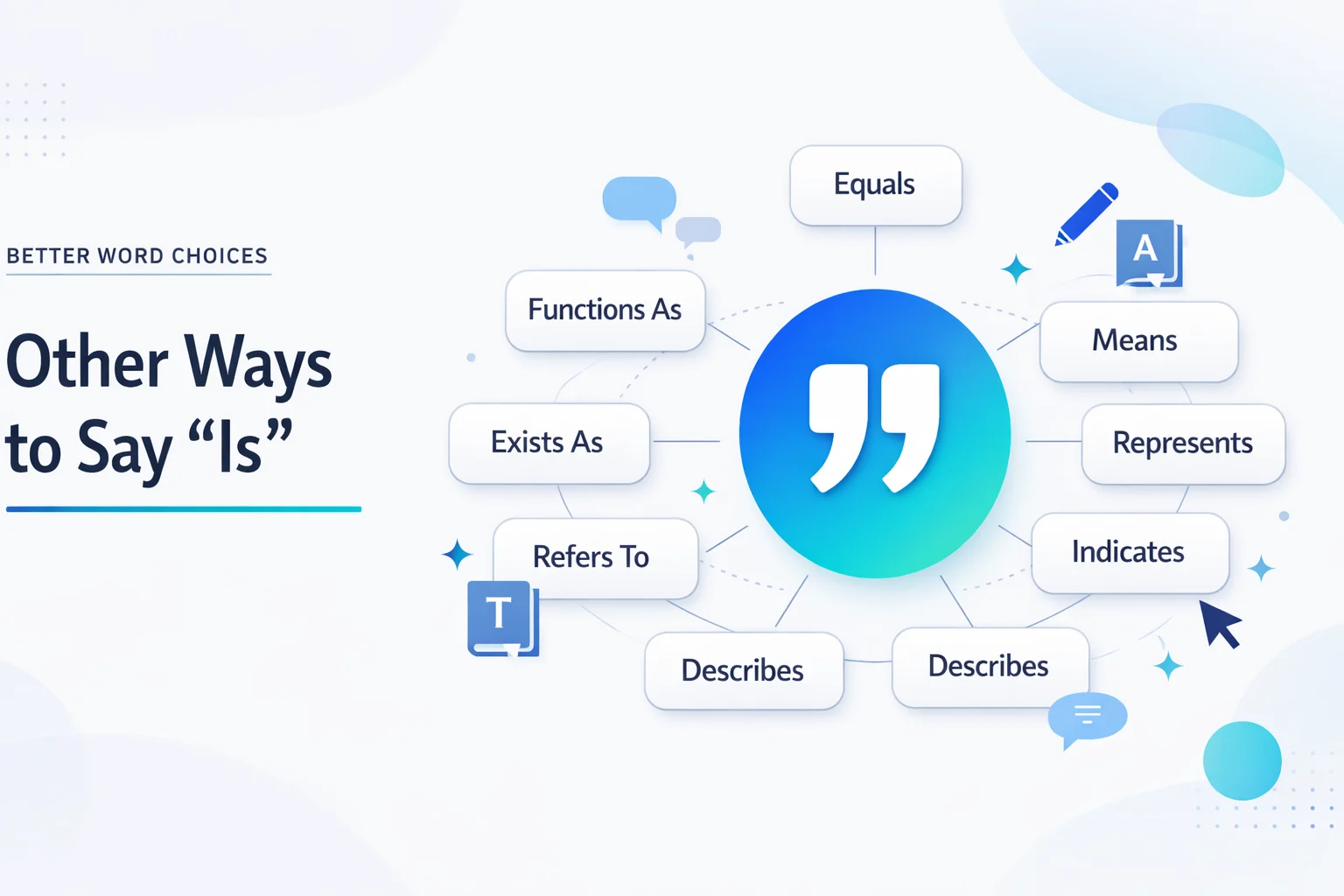
Other Ways to Say “Is”
These alternatives will help you sound more fluent, confident, and natural in different situations. Use them according to tone, context, and audience to express excitement, admiration, or approval.
1. Represents
Meaning: Shows or stands for something.
Explanation: Used to connect an idea, object, or action to a broader meaning or concept.
Example Sentence: This award represents years of hard work.
Best Use: Reports, essays
Worst Use: Casual texting
Tone: Formal, precise
Context Variability: Professional, written
2. Equals
Meaning: Is the same as in value, amount, or meaning.
Explanation: Commonly used in mathematics, logic, and factual comparisons.
Example Sentence: One kilometer equals one thousand meters.
Best Use: Academic, technical writing
Worst Use: Emotional speeches
Tone: Neutral, exact
Context Variability: Professional, spoken
3. Signifies
Meaning: Indicates or symbolizes something important.
Explanation: Often used to express symbolic or deeper meaning.
Example Sentence: This milestone signifies real progress.
Best Use: Speeches, formal writing
Worst Use: Casual chats
Tone: Formal, meaningful
Context Variability: Professional, written
4. Constitutes
Meaning: Forms or officially makes up something.
Explanation: Frequently used in legal, policy, and formal documents.
Example Sentence: This behavior constitutes a violation of company policy.
Best Use: Legal, official writing
Worst Use: Friendly conversations
Tone: Formal, serious
Context Variability: Professional
5. Embodies
Meaning: Perfectly represents an idea or quality.
Explanation: Describes a person or thing that serves as an ideal example.
Example Sentence: The design embodies simplicity and elegance.
Best Use: Reviews, descriptive writing
Worst Use: Technical reports
Tone: Expressive, formal
Context Variability: Written, professional
6. Functions as
Meaning: Acts in the role of something.
Explanation: Highlights the practical purpose or role of a person or object.
Example Sentence: This tool functions as a scheduling assistant.
Best Use: Workplace, technical writing
Worst Use: Casual storytelling
Tone: Neutral, practical
Context Variability: Professional
7. Serves as
Meaning: Fulfills the purpose of something.
Explanation: Common in business, instructional, and professional writing.
Example Sentence: This document serves as an official record.
Best Use: Business writing
Worst Use: Emotional speeches
Tone: Formal, functional
Context Variability: Professional, written
8. Stands for
Meaning: Represents an idea, value, or abbreviation.
Explanation: Often used when explaining symbols, initials, or principles.
Example Sentence: The logo stands for innovation and trust.
Best Use: Branding, education
Worst Use: Legal writing
Tone: Clear, direct
Context Variability: Spoken, written
9. Amounts to
Meaning: Equals a particular total, result, or outcome.
Explanation: Commonly used when summarizing the overall effect of something.
Example Sentence: The damage amounts to a serious concern.
Best Use: Analysis, reports
Worst Use: Casual conversations
Tone: Formal, analytical
Context Variability: Professional
10. Corresponds to
Meaning: Matches or relates directly to something else.
Explanation: Frequently used in comparisons, charts, and data analysis.
Example Sentence: This chart corresponds to last quarter’s sales.
Best Use: Business, academic writing
Worst Use: Casual chats
Tone: Precise, formal
Context Variability: Professional, written
11. Exists as
Meaning: Is present in a particular form or state.
Explanation: Emphasizes the condition or form in which something exists.
Example Sentence: The issue exists as a minor software bug.
Best Use: Technical writing
Worst Use: Friendly conversations
Tone: Neutral, descriptive
Context Variability: Professional
12. Appears to Be
Meaning: Seems to be true based on available evidence.
Explanation: Softens a statement by expressing uncertainty.
Example Sentence: The plan appears to be working.
Best Use: Cautious statements
Worst Use: Confident conclusions
Tone: Neutral, tentative
Context Variability: Spoken, written
13. Turns Out to Be
Meaning: Is revealed to be true after further information.
Explanation: Often used when describing an unexpected outcome.
Example Sentence: The rumor turns out to be false.
Best Use: Storytelling, updates
Worst Use: Formal reports
Tone: Conversational
Context Variability: Spoken
14. Seems to Be
Meaning: Gives the impression of being something.
Explanation: Used when a statement is based on observation rather than certainty.
Example Sentence: He seems to be in a good mood today.
Best Use: Casual observations
Worst Use: Legal statements
Tone: Soft, cautious
Context Variability: Spoken, casual
15. Proves to Be
Meaning: Is shown to be true through evidence or experience.
Explanation: Used after results confirm an expectation.
Example Sentence: The strategy proves to be highly effective.
Best Use: Reviews, analysis
Worst Use: Casual small talk
Tone: Confident, formal
Context Variability: Professional
16. Comes Across as
Meaning: Gives a particular impression to others.
Explanation: Focuses on how someone or something is perceived.
Example Sentence: She comes across as very confident.
Best Use: Feedback, descriptions
Worst Use: Technical writing
Tone: Conversational, descriptive
Context Variability: Spoken
17. Is Regarded as
Meaning: Is widely viewed or recognized in a certain way.
Explanation: Emphasizes public or professional opinion.
Example Sentence: This method is regarded as the industry standard.
Best Use: Professional writing
Worst Use: Casual chats
Tone: Formal, respectful
Context Variability: Professional, written
18. Is Considered
Meaning: Is judged or thought of in a particular way.
Explanation: Frequently used in evaluations and reviews.
Example Sentence: This approach is considered highly effective.
Best Use: Academic, business writing
Worst Use: Casual texting
Tone: Formal, neutral
Context Variability: Professional
19. Is Known as
Meaning: Is commonly recognized by a particular name.
Explanation: Used to introduce names, terms, or labels.
Example Sentence: This process is known as onboarding.
Best Use: Explanations, education
Worst Use: Emotional speeches
Tone: Informative, neutral
Context Variability: Spoken, written
20. Is Deemed
Meaning: Is officially judged or considered.
Explanation: Common in legal, governmental, and official communication.
Example Sentence: The request is deemed acceptable.
Best Use: Legal, official writing
Worst Use: Friendly conversation
Tone: Formal, official
Context Variability: Professional
21. Is Essentially
Meaning: Is basically or fundamentally something.
Explanation: Simplifies a complex concept into its core idea.
Example Sentence: This plan is essentially a backup strategy.
Best Use: Explanations
Worst Use: Legal documents
Tone: Clear, explanatory
Context Variability: Spoken, written
22. Is Basically
Meaning: Is, in simple terms, something.
Explanation: A casual way to explain the main idea.
Example Sentence: This tool is basically a shortcut.
Best Use: Casual explanations
Worst Use: Formal reports
Tone: Casual, relaxed
Context Variability: Casual, spoken
23. Is Fundamentally
Meaning: Is, at its core, something.
Explanation: Highlights the essential nature of a topic.
Example Sentence: The issue is fundamentally about trust.
Best Use: Analysis, discussions
Worst Use: Light conversation
Tone: Formal, thoughtful
Context Variability: Professional, written
24. Is Effectively
Meaning: Is, in practical terms, something.
Explanation: Emphasizes the real-world result or function.
Example Sentence: This update is effectively a new version.
Best Use: Technical explanations
Worst Use: Emotional writing
Tone: Practical, neutral
Context Variability: Professional
25. Is Virtually
Meaning: Is almost entirely or nearly something.
Explanation: Used when something is nearly, but not completely, true.
Example Sentence: The task is virtually complete.
Best Use: Updates, reports
Worst Use: Precise legal claims
Tone: Neutral, approximate
Context Variability: Spoken, written
26. Is Officially
Meaning: Is confirmed through an official announcement.
Explanation: Used when describing verified statuses or decisions.
Example Sentence: The event is officially canceled.
Best Use: Announcements
Worst Use: Casual guesses
Tone: Formal, confirmed
Context Variability: Professional, written
27. Is Technically
Meaning: Is true according to a strict definition.
Explanation: Clarifies that something is accurate in a literal or technical sense.
Example Sentence: This is technically correct, but misleading.
Best Use: Clarifications
Worst Use: Casual compliments
Tone: Precise, analytical
Context Variability: Spoken, written
28. Is by Definition
Meaning: Is true according to the meaning of a term.
Explanation: Explains something based on its accepted definition.
Example Sentence: A square is by definition a four-sided shape.
Best Use: Academic explanations
Worst Use: Emotional speeches
Tone: Formal, factual
Context Variability: Professional, written
29. Denotes
Meaning: Indicates or points to a specific meaning.
Explanation: Frequently used in technical, linguistic, and academic writing.
Example Sentence: This symbol denotes a warning.
Best Use: Technical writing
Worst Use: Casual chats
Tone: Formal, exact
Context Variability: Professional
30. Exemplifies
Meaning: Serves as an excellent example of something.
Explanation: Highlights a person, object, or action that perfectly represents a quality.
Example Sentence: This project exemplifies outstanding teamwork.
Best Use: Reviews, praise
Worst Use: Technical manuals
Tone: Expressive, positive
Context Variability: Written, professional
“Alternatives to ‘is’ let you shift tone instantly, from casual to confident to formal.”
Learning synonym patterns is one of the fastest ways to sound more fluent.
Mini Quiz
1. Which alternative to “is” is most appropriate for a legal document?
A) It’s kind of
B) Constitutes
C) Seems to be
D) Comes across as
2. Which phrase works best in a casual conversation?
A) Is deemed
B) It’s basically
C) Corresponds to
D) Signifies
3. Which option sounds most professional in a business report?
A) Turns out to be
B) It’s like
C) Represents
D) Comes across as
4. Which sentence contains a grammatical error involving the verb “is”?
A) “The team is winning.”
B) “The books is on the table.”
C) “She is a manager.”
D) “It is raining.”
Answers:
- B) “The books is on the table.”
- B) Constitutes
- B) It’s basically
- C) Represents
Comparison Table: Top Alternatives
| Phrase | Tone | Best Use |
|---|---|---|
| Represents | Formal | Reports, essays |
| Equals | Neutral | Academic, technical |
| Signifies | Formal | Speeches, writing |
| Constitutes | Formal | Legal, official |
| Serves as | Formal | Business writing |
| Functions as | Neutral | Workplace, technical |
| Is regarded as | Formal | Professional writing |
| Seems to be | Casual | Spoken, casual talk |
| It’s basically | Casual | Everyday conversation |
| Comes across as | Casual | Feedback, description |
FAQs
What is the most formal alternative to “is”?
“Constitutes” and “represents” are among the most formal alternatives to “is,” commonly used in legal, academic, and official writing.
Can I use “is” in professional emails?
Yes, “is” is grammatically correct and polite, but mixing in alternatives like “represents” or “serves as” makes writing sound more polished.
What is a casual way to say “is”?
Casual alternatives include “it’s basically,” “it’s kind of,” and “it’s like,” which are common in everyday spoken English.
Why should I learn other ways to say “is”?
Learning alternatives to “is” improves fluency, reduces repetition, and helps you express excitement in English or precision depending on context.
Is “is” grammatically different from “are”?
Yes, “is” is used with singular subjects, while “are” is used with plural subjects or “you.”
Conclusion
Mastering alternatives to “is” is a simple but powerful way to elevate your English fluency. From formal words like “constitutes” and “represents” to casual expressions like “it’s basically” or “seems to be,” each option allows you to match your tone precisely to your audience and situation.
Practice using a few new alternatives every day, paying close attention to tone, formality, and context. Over time, this small habit will make your spoken and written English sound noticeably more confident, natural, and professional.
Read More Related Articles:
- Other Ways to Say “First of All” | Make You Sound More Fluent In 2026
- Other Ways to Say That Being Said | Smarter & More Fluent Alternatives In 2026
- Other Ways to Say “In This Article” | That Instantly Elevate Your Writing In 2026

Daniel Murphy is a professional writer and blogger specializing in digital communication and messaging trends. As a contributor to TextsResponse.com, he creates reader-focused content designed to help people find the right words at the right time.