Quick Answer:
I’m in, I’m game, Count me in, That works for me, and I’m up for it are the five most versatile alternatives to I’m down. Use them to express agreement, willingness, or enthusiasm in casual and professional conversations alike.
The phrase I’m down is a staple of modern English. It’s how you tell someone you’re willing, interested, and ready to participate whether it’s grabbing coffee, joining a project, or trying something new. But relying on the same slang expression over and over can make your speech feel repetitive and limit your ability to express excitement in English across different settings.
Learning alternatives to I’m down is one of the fastest ways to sound more fluent, confident, and adaptable. Whether you’re texting friends, writing a professional email, or speaking in a meeting, having a range of other ways to say I’m down at your disposal ensures you always choose the right tone for the right moment. Let’s explore 30 powerful alternatives categorized by formality and context so you can express agreement with precision and style.
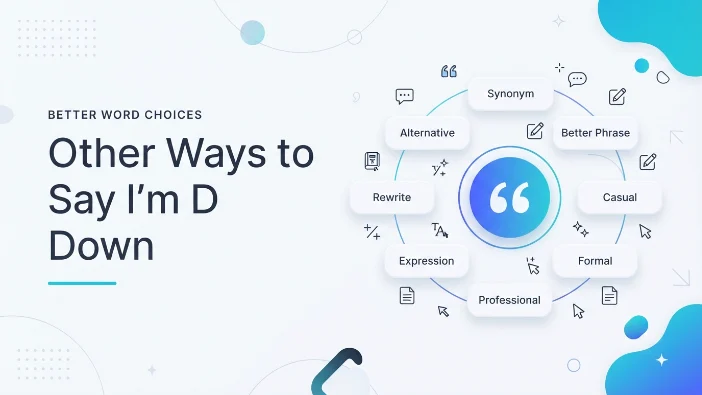
Quick Categories
Formal Alternatives to “I’m Down”
- I agree
- That works for me
- I’m on board
- I support that
- That sounds agreeable
- I’m happy to participate
Casual Alternatives
- I’m in
- I’m game
- Count me in
- Sure thing
- Let’s do it
- Sounds good
Professional Alternatives
- I can do that
- I’d be glad to join
- I’m ready when you are
- That’s acceptable to me
- I’m willing to proceed
- I’m aligned with that
Informal Expressions
- I’m up for it
- Let’s go
- Absolutely
- You can bet on it
- For sure
- I’m all for it
💡 Pro Tip: The key to sounding natural is matching your phrase to the situation. Save casual expressions for friends and peers; use formal and professional alternatives in emails, meetings, and client communication.
Common Mistakes People Make Using “I’m Down”
- Using it in formal business emails.
❌ Dear Client, we have a new proposal, and I’m down to discuss it.
✅ Use I would be happy to discuss or I’m available to discuss instead. - Confusing it with sadness or illness.
❌ I’m down today because I lost my wallet. (Here it means sad correct usage, but easily confused.)
✅ Be clear: I’m feeling down for sadness; I’m down with a cold for illness. - Overusing it in professional meetings.
❌ I’m down with that idea, I’m down for the next step, I’m down to present.
✅ Vary your language: I support that, I’m ready for the next step, I’m happy to present. - Using it with senior leadership or clients.
❌ CEO: “We need to pivot strategy.” You: “I’m down.”
✅ I agree with that direction or That approach works for me. - Forgetting it’s primarily an American slang expression.
❌ Using it in formal British English or with non-native speakers who may not understand.
✅ Opt for universally clear phrases like I agree or That sounds good in international settings.
What Does “I’m Down” Mean?
I’m down is an informal slang expression used to show agreement, willingness, or enthusiasm for a suggestion, plan, or activity. It’s a friendly way of saying “yes” often in response to an invitation or proposal.
Example Sentence:
“We’re ordering pizza for lunch you in?”
“Yeah, I’m down.”
The phrase originated in African American Vernacular English (AAVE) in the mid‑20th century and has since become mainstream in youth culture and digital communication.
When to Use “I’m Down”
- Casual group chats with friends
- Text messages responding to plans
- Social media comments and DMs
- Informal workplace Slack or Teams messages (with peers)
- Spoken conversations among friends or colleagues you know well
- Avoid in formal writing, client proposals, academic papers, or emails to senior leadership
Is It Professional or Polite to Say “I’m Down”?
Polite? ✅ Yes it conveys friendliness and enthusiasm.
Professional? ❌ No in most professional settings, it’s too casual.
Example in a business context:
❌ “I’m down to lead that presentation.”
✅ “I’m available and happy to lead that presentation.”
While it can be acceptable in relaxed workplace cultures, it lacks the formal authority needed for client-facing communication, official documents, or emails to executives.
Pros and Cons of Using “I’m Down”
| Pros | Cons |
|---|---|
| Simple and natural | Too informal for work settings |
| Friendly, approachable tone | Overused and can sound stale |
| Widely understood by English speakers | Lacks emotional depth and nuance |
| Easy to use in fast communication | Not suitable for formal or academic writing |
30 Other Ways to Say “I’m Down” (With Examples)
These alternatives will help you sound more fluent, confident, and natural in different situations. Use them according to tone, context, and audience to express excitement, admiration, or approval.
Formal & Professional Alternatives (1–10)
1. Phrase: I agree
Meaning: A direct, clear statement of alignment.
Explanation: This is the most neutral and professional way to express consent.
Example Sentence: “I agree with the proposed timeline and will adjust my schedule accordingly.”
Best Use: Formal meetings
Worst Use: Texting friends
Tone: Direct, clear, neutral
Context Variability: Professional “I agree with your analysis.” / Casual “I agree, let’s go.”
2. Phrase: That works for me
Meaning: The suggested plan or idea is acceptable to you.
Explanation: A polite and widely used professional alternative.
Example Sentence: “If we move the meeting to 3 PM, that works for me.”
Best Use: Scheduling and planning
Worst Use: Responding to creative ideas
Tone: Practical, accommodating
Context Variability: Professional “That works for my team.” / Casual “Tuesday works for me.”
3. Phrase: I’m on board
Meaning: You fully support and agree with the plan.
Explanation: Conveys commitment and alignment with a group decision.
Example Sentence: “I’m on board with the new marketing strategy let’s move forward.”
Best Use: Team projects
Worst Use: Casual social plans
Tone: Committed, supportive
Context Variability: Professional “I’m on board with this direction.” / Casual “I’m on board for the trip.”
4. Phrase: I support that
Meaning: You give your backing to an idea or proposal.
Explanation: A strong, professional way to show agreement.
Example Sentence: “I support that approach and believe it will yield positive results.”
Best Use: Decision-making
Worst Use: Social invitations
Tone: Formal, supportive
Context Variability: Professional only “I support that initiative.”
5. Phrase: That sounds agreeable
Meaning: The proposal is acceptable to you.
Explanation: A polished, formal phrase suitable for written communication.
Example Sentence: “That sounds agreeable let’s proceed with the revised budget.”
Best Use: Formal emails
Worst Use: Conversations with friends
Tone: Polished, diplomatic
Context Variability: Professional only
6. Phrase: I’m happy to participate
Meaning: You are willing and pleased to join an activity.
Explanation: Expresses enthusiasm in a professional, measured way.
Example Sentence: “I’m happy to participate in the cross-functional workshop next week.”
Best Use: Work events
Worst Use: Casual hangouts
Tone: Enthusiastic, professional
Context Variability: Professional “I’m happy to participate in the panel.”
7. Phrase: I can do that
Meaning: You are able and willing to handle a task or request.
Explanation: A simple, professional way to confirm capability.
Example Sentence: “If you need someone to compile the report by Friday, I can do that.”
Best Use: Task assignments
Worst Use: Social plans
Tone: Capable, reliable
Context Variability: Professional “I can do that analysis.” / Casual “I can do that, sure.”
8. Phrase: I’d be glad to join
Meaning: You are pleased to accept an invitation.
Explanation: Polite and slightly formal, ideal for responding to invitations.
Example Sentence: “Thank you for the invitation I’d be glad to join the strategy session.”
Best Use: Invitations
Worst Use: Texting friends
Tone: Polite, gracious
Context Variability: Professional “I’d be glad to join the committee.”
9. Phrase: I’m willing to proceed
Meaning: You are ready to move forward with a plan.
Explanation: Formal phrasing suitable for decision-making contexts.
Example Sentence: “After reviewing the options, I’m willing to proceed with Option B.”
Best Use: Business decisions
Worst Use: Casual conversation
Tone: Formal, decisive
Context Variability: Professional only
10. Phrase: I’m aligned with that
Meaning: You share the same understanding or agreement.
Explanation: Modern professional language often used in workplace settings.
Example Sentence: “I’m aligned with that vision and ready to contribute.”
Best Use: Strategy discussions
Worst Use: Social settings
Tone: Collaborative, professional
Context Variability: Professional “I’m aligned with the quarterly goals.”
💡 Pro Tip: In professional emails, pair your alternative with a brief reason: “That works for me because it allows us to meet the deadline without compromising quality.” This adds clarity and credibility.
Casual & Neutral Alternatives (11–20)
11. Phrase: I’m in
Meaning: You are participating and fully committed.
Explanation: One of the most common and interchangeable alternatives.
Example Sentence: “You’re organizing a weekend hike? I’m in!”
Best Use: Group activities
Worst Use: Formal work emails
Tone: Enthusiastic, committed
Context Variability: Casual “I’m in for the concert.” / Neutral “I’m in for the project.”
12. Phrase: I’m game
Meaning: You are willing and ready to try something.
Explanation: Carries a sense of playful readiness and adventure.
Example Sentence: “Rock climbing this weekend? I’m game!”
Best Use: New or adventurous activities
Worst Use: Professional settings
Tone: Adventurous, playful
Context Variability: Casual only “I’m game if you are.”
13. Phrase: Count me in
Meaning: Include me in the plan or activity.
Explanation: A friendly, inclusive way to express participation.
Example Sentence: “If you’re organizing a charity run, count me in.”
Best Use: Group events
Worst Use: Formal proposals
Tone: Inclusive, enthusiastic
Context Variability: Casual “Count me in for karaoke.” / Neutral “Count me in for the volunteer day.”
14. Phrase: Sure thing
Meaning: An informal, friendly way to say yes.
Explanation: Light and quick, perfect for fast-paced conversations.
Example Sentence: “Can you grab coffee on the way?” “Sure thing!”
Best Use: Quick confirmations
Worst Use: Written business communication
Tone: Friendly, quick
Context Variability: Casual only
15. Phrase: Let’s do it
Meaning: A direct and energetic expression of agreement.
Explanation: Encourages action and builds momentum.
Example Sentence: “You want to start the project early? Let’s do it!”
Best Use: Motivating a group
Worst Use: Formal settings
Tone: Energetic, motivating
Context Variability: Casual “Let’s do it this weekend.”
16. Phrase: Sounds good
Meaning: The proposal is acceptable and pleasing.
Explanation: One of the most common neutral responses in English.
Example Sentence: “Dinner at 7?” “Sounds good to me.”
Best Use: Everyday conversation
Worst Use: Formal writing
Tone: Easy, agreeable
Context Variability: Casual “Sounds good!” / Neutral That sounds good to me.”
17. Phrase: I’m up for it
Meaning: You are interested and willing to try something.
Explanation: Very similar to I’m down but slightly more neutral.
Example Sentence: “Anyone up for a late-night study session?” “I’m up for it.”
Best Use: Suggesting activities
Worst Use: Professional emails
Tone: Willing, interested
Context Variability: Casual “I’m up for anything.”
18. Phrase: Let’s go
Meaning: An energetic call to action and agreement.
Explanation: Short, punchy, and full of enthusiasm.
Example Sentence: “Ready to hit the road?” “Let’s go!”
Best Use: Starting an activity
Worst Use: Formal writing
Tone: Energetic, motivating
Context Variability: Casual only
19. Phrase: Absolutely
Meaning: A strong, enthusiastic yes.
Explanation: Adds emphasis and conviction to your agreement.
Example Sentence: “Do you think we should apply for the grant?” “Absolutely!”
Best Use: Strong agreement
Worst Use: When you’re only mildly interested
Tone: Enthusiastic, strong
Context Variability: Casual “Absolutely, let’s do it.” / Professional “Absolutely, I support that.”
20. Phrase: For sure
Meaning: A casual, confident confirmation.
Explanation: Very common in spoken American English.
Example Sentence: “Are you coming to the party?” “For sure!”
Best Use: Social plans
Worst Use: Business writing
Tone: Confident, casual
Context Variability: Casual only
💡 Pro Tip: In casual settings, vary your responses to keep conversations dynamic. Instead of saying “I’m down” five times in one group chat, rotate through “I’m in,” “Count me in,” and “Sounds good.”
Informal & Expressive Alternatives (21–30)
21. Phrase: I’m all for it
Meaning: You fully support and endorse the idea.
Explanation: Conveys strong personal approval.
Example Sentence: “A team retreat to build morale? I’m all for it.”
Best Use: Enthusiastic agreement
Worst Use: Formal writing
Tone: Strong, supportive
Context Variability: Casual “I’m all for trying new things.”
22. Phrase: You can bet on it
Meaning: You are absolutely certain and committed.
Explanation: Adds playful confidence to your agreement.
Example Sentence: “Will you be at the game?” “You can bet on it!”
Best Use: Showing certainty
Worst Use: Professional settings
Tone: Confident, playful
Context Variability: Casual only
23. Phrase: I’m ready when you are
Meaning: You are prepared and waiting for the other person.
Explanation: Shows eagerness and patience simultaneously.
Example Sentence: “Whenever you’re ready to start the presentation, I’m ready when you are.”
Best Use: Collaborative activities
Worst Use: Casual texting
Tone: Patient, eager
Context Variability: Professional “I’m ready when you are to begin.” / Casual “Ready when you are!”
24. Phrase: I’m so down
Meaning: An intensified, enthusiastic version of I’m down.
Explanation: Adds extra energy and excitement.
Example Sentence: “Beach trip this weekend?” “I’m so down!”
Best Use: Excited agreement
Worst Use: Any professional context
Tone: Very enthusiastic
Context Variability: Casual only
25. Phrase: That’s a yes from me
Meaning: A playful, modern way to say you agree.
Explanation: Often used in polling or voting contexts.
Example Sentence: “Who’s in favor of ordering Thai food?” “That’s a yes from me.”
Best Use: Group decisions
Worst Use: Professional writing
Tone: Playful, modern
Context Variability: Casual only
26. Phrase: I’d love to
Meaning: You are excited and happy to participate.
Explanation: Expresses genuine enthusiasm and pleasure.
Example Sentence: “Would you like to join our book club?” “I’d love to!”
Best Use: Accepting invitations
Worst Use: When you’re not genuinely excited
Tone: Warm, enthusiastic
Context Variability: Casual “I’d love to come.” / Professional “I’d love to contribute.”
27. Phrase: Sign me up
Meaning: You are volunteering or registering enthusiastically.
Explanation: Often used for events, classes, or activities.
Example Sentence: “We’re offering a free workshop next month.” “Sign me up!”
Best Use: Events and activities
Worst Use: Formal business
Tone: Eager, enthusiastic
Context Variability: Casual “Sign me up for the marathon.”
28. Phrase: Let’s roll
Meaning: A casual way to say you’re ready to start.
Explanation: Often used to transition from planning to action.
Example Sentence: “Everyone ready?” “Let’s roll!”
Best Use: Starting an activity
Worst Use: Professional settings
Tone: Action-oriented, casual
Context Variability: Casual only
29. Phrase: I’m keen
Meaning: You are interested and enthusiastic (more common in British English).
Explanation: A slightly more refined casual alternative.
Example Sentence: “There’s a new exhibit at the gallery are you keen?” “I’m keen!”
Best Use: Expressing interest
Worst Use: American professional settings
Tone: Interested, refined
Context Variability: Casual “I’m keen to try that.”
30. Phrase: That’s fine by me
Meaning: You have no objection and are willing to proceed.
Explanation: A neutral way to show acceptance without over-enthusiasm.
Example Sentence: “If we reschedule to next Tuesday, that’s fine by me.”
Best Use: Accepting changes
Worst Use: Showing strong enthusiasm
Tone: Neutral, accommodating
Context Variability: Casual “That’s fine by me.” / Neutral “That’s fine by me, let’s proceed.”
💡 Pro Tip: The most natural speakers match their phrase to their personality and the situation. Don’t force formal language with friends, and don’t use slang with clients. Authenticity matters more than variety.
Mini Quiz / Self-Check
1. You receive an email from your manager: “We need to finalize the budget by Friday. Can you take the lead?”
Which response is most appropriate?
A) “I’m so down!”
B) “I can do that I’ll have it ready by Friday.”
C) “Sounds good.”
Answer: B Professional and clear.
2. Your friend texts: “Concert tickets go on sale tomorrow wanna go?”
Which response shows enthusiasm in a casual context?
A) “That sounds agreeable.”
B) “I’m willing to proceed.”
C) “I’m game let’s get them!”
Answer: C Casual, enthusiastic, and natural.
3. Your team is voting on a new project direction. You fully support it. Which phrase is best for a professional setting?
A) “I’m down with that.”
B) “I support that approach and believe it’s the right move.”
C) “Let’s do it!”
Answer: B Professional and persuasive.
4. You’re in a group chat and everyone is deciding on dinner. You want to agree casually. What do you say?
A) “I’m aligned with that.”
B) “Count me in for pizza.”
C) “That works for me in principle.”
Answer: B Friendly, casual, and clear.
Comparison Table: Top 10 Alternatives
| Phrase | Tone | Best Use |
|---|---|---|
| I agree | Formal, direct | Business meetings, emails |
| That works for me | Professional, practical | Scheduling, planning |
| I’m on board | Supportive, committed | Team projects, strategy |
| I’m in | Enthusiastic, committed | Group activities, plans |
| I’m game | Playful, adventurous | Trying new things |
| Count me in | Inclusive, friendly | Events, group decisions |
| Sounds good | Easy, agreeable | Everyday conversation |
| I’m up for it | Willing, interested | Suggestions, activities |
| Absolutely | Strong, emphatic | Enthusiastic agreement |
| I’m all for it | Strong, supportive | Endorsing ideas |
FAQs
1. Is “I’m down” grammatically correct?
Yes, it’s grammatically correct as an informal expression. The verb to be is used with the adjective down to indicate willingness or agreement.
2. Can I use “I’m down” in a professional email?
Generally no. It’s too casual for most professional contexts. Use formal alternatives like I agree or That works for me instead.
3. What’s the difference between “I’m down” and “I’m game”?
Both express willingness, but I’m game often implies a sense of playful readiness or adventure, while I’m down is more neutral and widely used.
4. Does “I’m down” mean sad or depressed?
Yes, it can. I’m down can mean feeling sad or unwell depending on the context. Always consider the surrounding conversation to interpret the correct meaning.
5. What is a polite way to say “I’m down” in a business meeting?
Use I support that, I’m on board, or That works for me. These phrases convey agreement while maintaining professionalism.
Conclusion
Learning alternatives to I’m down is one of the simplest yet most effective ways to elevate your English fluency. By expanding your vocabulary, you gain the flexibility to express agreement with the right tone whether you’re texting a friend, collaborating with colleagues, or presenting to clients. The goal isn’t to abandon I’m down entirely; it’s to know when to use it and when to choose a more precise or professional alternative.
Practice incorporating one or two new phrases each day. Pay attention to the tone of the conversation and the people you’re speaking with. Over time, choosing the right expression will become second nature and you’ll sound more confident, polished, and natural in every interaction.
Read More Related Articles:
- Other Ways to Say Never Give Up | Encouraging Messages In 2026
- Other Ways to Say “You’re Proud of Someone” | Sweet and Powerful Ways In 2026
- Other Ways to Say I’m Happy for You | Say It With More Heart and Meaning In 2026

Henry Walker is an American writer and blogger with a keen interest in communication, language and digital content. At TextsResponse.com, he creates informative and reader-focused resources designed to help people communicate with clarity, confidence and authenticity.