Quick Answer:
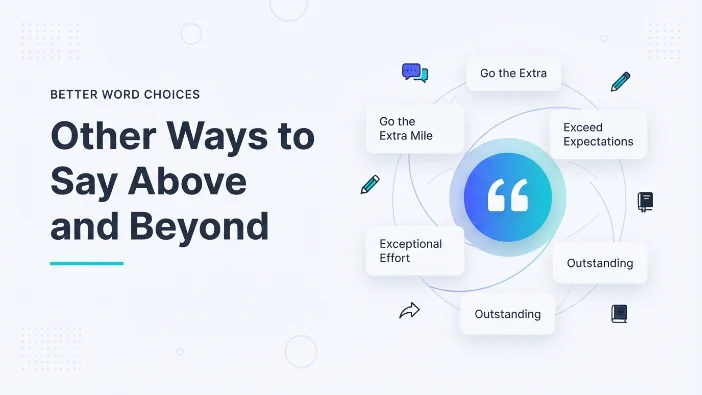
Exceed expectations, go the extra mile, surpass standards, outperform, overdeliver.
The phrase “above and beyond” is one of the most common ways to acknowledge someone who has done more than what was required. It signals dedication, extra effort, and a willingness to go further than the baseline expectation. You’ll hear it in performance reviews, thank-you notes, and everyday conversations.
But using the same phrase repeatedly can make your English sound repetitive and less impactful. Learning alternatives to “above and beyond” helps you express excitement in English with greater precision, whether you are writing a formal report, giving a speech, or simply praising a colleague. Expanding your vocabulary allows you to match your tone to your audience and make your appreciation feel more genuine and thoughtful.
Quick Categories
Formal Alternatives to “Above and Beyond”
- Exceed expectations
- Surpass standards
- Outperform
- Deliver exceptional results
- Go beyond the call of duty
Casual Alternatives
- Go the extra mile
- Outdo yourself
- Give 110%
- Go all out
- Pull out all the stops
Professional Alternatives
- Overdeliver
- Raise the bar
- Set a new standard
- Demonstrate outstanding performance
- Show exceptional dedication
Informal Expressions
- Go above the call
- Take it to the next level
- Go the distance
- Leave no stone unturned
- Put in extra effort
💡 Pro Tip: Match your phrase to your setting. Formal phrases work well in written reports and official recognition. Casual alternatives are better for spoken appreciation among teammates or friends.
Common Mistakes
- Using it too often in one conversation.
Mistake: “She went above and beyond, and he also went above and beyond.”
Better: Vary your language to keep the praise fresh. - Using it in overly formal written documents like legal contracts.
Mistake: “The contractor shall go above and beyond in all deliveries.”
Better: Use precise, measurable language in legal or contractual writing. - Confusing it with simply “doing a good job.”
Mistake: “He did his work on time he went above and beyond.”
Better: Reserve it for truly exceptional effort beyond the expected. - Using it to describe yourself in a resume without evidence.
Mistake: “I always go above and beyond.”
Better: Show specific results: “I exceeded sales targets by 20%.” - Forgetting the preposition “of” in “above and beyond the call of duty.”
Mistake: “He went above and beyond call of duty.”
Better: “He went above and beyond the call of duty.”
What Does “Above and Beyond” Mean?
“Above and beyond” means doing more than what is expected, required, or demanded in a given situation. It describes actions that surpass normal standards, whether at work, in personal relationships, or in service.
Grammar note: It is often used with the verb go: “go above and beyond.” It can also function as a prepositional phrase: “above and beyond what was asked.”
Example: “She went above and beyond to make sure the client was satisfied.”
When to Use “Above and Beyond”
- In performance reviews to recognise outstanding employees
- In thank-you notes or appreciation emails
- In customer service feedback
- In spoken praise during team meetings
- In personal contexts to acknowledge a friend’s extra effort
Spoken vs Written: Common in both, but written use is more frequent in emails and formal recognition.
Formal vs Informal: It works in both, but overuse can make it feel generic.
Is It Professional or Polite to Say “Above and Beyond”?
Polite? ✔️ Yes it is respectful and appreciative.
Professional? ❌ No in most formal business writing, it is considered too informal and overused.
Business-style example:
“We appreciate your commitment, but in future reports, please use more precise language to describe performance.”
Pros and Cons of Using “Above and Beyond”
Pros
- Simple and natural
- Friendly and warm tone
- Common and widely understood
- Easy to use in everyday speech
Cons
- Too informal for formal work documents
- Overused and can lose impact
- Limited emotional range
- Not suitable for academic or legal writing
“The right phrase can turn a simple thank-you into a memorable moment of recognition.”
Other Ways to Say “Above and Beyond” (With Examples)
These alternatives will help you sound more fluent, confident, and natural in different situations. Use them according to tone, context, and audience to express excitement, admiration, or approval.
1. Exceed Expectations
Meaning: Perform better than what was required.
Explanation: A standard professional phrase used in evaluations and feedback.
Example Sentence: “Your presentation exceeded expectations and impressed the entire board.”
Best Use: Performance reviews
Worst Use: Casual chats
Tone: Formal, respectful
Context Variability: Professional
2. Go the Extra Mile
Meaning: Make additional effort beyond what is necessary.
Explanation: A warm and widely used idiom showing dedication.
Example Sentence: “She really went the extra mile to make sure the client felt valued.”
Best Use: Everyday appreciation
Worst Use: Formal contracts
Tone: Warm, encouraging
Context Variability: Casual / Professional
3. Surpass Standards
Meaning: Do better than the established benchmark.
Explanation: Often used in academic or quality control settings.
Example Sentence: “His work ethic keeps surpassing standards every quarter.”
Best Use: Academic evaluations
Worst Use: Friendly texts
Tone: Formal, professional
Context Variability: Professional
4. Outperform
Meaning: Perform better than others or than expected.
Explanation: A concise, powerful word for resumes and reports.
Example Sentence: “Our team outperformed all competitors this quarter.”
Best Use: Resumes, business reports
Worst Use: Personal compliments
Tone: Professional, direct
Context Variability: Professional
5. Overdeliver
Meaning: Provide more than what was promised or expected.
Explanation: Common in customer service and project management.
Example Sentence: “We consistently overdeliver on our client commitments.”
Best Use: Business communication
Worst Use: Formal academic writing
Tone: Professional, confident
Context Variability: Professional
6. Beyond the Call of Duty
Meaning: Do more than what responsibilities require.
Explanation: Often conveys selflessness and service.
Example Sentence: “Her volunteer work was truly beyond the call of duty.”
Best Use: Recognition speeches
Worst Use: Everyday small talk
Tone: Formal, respectful
Context Variability: Formal / Professional
7. Raise the Bar
Meaning: Set a new, higher standard for others to follow.
Explanation: Implies innovation and leadership.
Example Sentence: “She raised the bar for customer service in our department.”
Best Use: Team recognition
Worst Use: Personal favors
Tone: Inspiring, professional
Context Variability: Professional
8. Set a New Standard
Meaning: Establish a higher level of performance.
Explanation: A formal phrase used in strategic discussions.
Example Sentence: “This project sets a new standard for quality in our industry.”
Best Use: Official reports
Worst Use: Casual emails
Tone: Formal, ambitious
Context Variability: Professional
9. Deliver Exceptional Results
Meaning: Produce outcomes that are noticeably better than usual.
Explanation: Focuses on the output rather than the effort.
Example Sentence: “The team delivered exceptional results despite the tight deadline.”
Best Use: Business reviews
Worst Use: Personal notes
Tone: Professional, results oriented
Context Variability: Professional
10. Show Exceptional Dedication
Meaning: Demonstrate a strong and consistent commitment.
Explanation: Highlights loyalty and perseverance.
Example Sentence: “Through exceptional dedication, she completed the project ahead of time.”
Best Use: Employee recognition
Worst Use: Quick text messages
Tone: Warm, professional
Context Variability: Professional
11. Outdo Yourself
Meaning: Achieve more than your own previous best.
Explanation: A personal and uplifting phrase.
Example Sentence: “You really outdid yourself on this presentation.”
Best Use: Praising a friend or colleague
Worst Use: Formal evaluations
Tone: Positive, encouraging
Context Variability: Casual / Professional
12. Give 110%
Meaning: Put in maximum possible effort.
Explanation: An informal but energetic expression.
Example Sentence: “He gives 110% every single day.”
Best Use: Motivational talks
Worst Use: Written reports
Tone: Energetic, informal
Context Variability: Casual
13. Go All Out
Meaning: Use every resource and effort to achieve something.
Explanation: Implies no holding back.
Example Sentence: “We went all out to make the event unforgettable.”
Best Use: Event planning, team projects
Worst Use: Formal business letters
Tone: Enthusiastic, informal
Context Variability: Casual
14. Pull Out All the Stops
Meaning: Make every possible effort to succeed.
Explanation: A vivid idiom originally associated with organ music.
Example Sentence: “They pulled out all the stops for the product launch.”
Best Use: Creative projects
Worst Use: Routine tasks
Tone: Expressive, informal
Context Variability: Casual
15. Go the Distance
Meaning: Persist until the goal is fully achieved.
Explanation: Suggests endurance and reliability.
Example Sentence: “She went the distance to ensure every detail was perfect.”
Best Use: Long term projects
Worst Use: Quick tasks
Tone: Determined, supportive
Context Variability: Casual / Professional
16. Take It to the Next Level
Meaning: Elevate performance or quality significantly.
Explanation: A modern, energetic phrase.
Example Sentence: “His leadership took the team to the next level.”
Best Use: Motivational contexts
Worst Use: Formal documentation
Tone: Ambitious, informal
Context Variability: Casual
17. Leave No Stone Unturned
Meaning: Exhaust all possibilities to achieve a goal.
Explanation: Emphasizes thoroughness and diligence.
Example Sentence: “We left no stone unturned in our market research.”
Best Use: Problem solving, investigations
Worst Use: Routine updates
Tone: Thorough, determined
Context Variability: Professional
18. Surpass the Target
Meaning: Exceed a specific goal or objective.
Explanation: Common in sales and performance metrics.
Example Sentence: “Our sales team surpassed the target by 15%.”
Best Use: Business metrics
Worst Use: Personal compliments
Tone: Professional, data driven
Context Variability: Professional
19. Deliver More Than Promised
Meaning: Provide additional value beyond what was agreed.
Explanation: Builds trust and credibility.
Example Sentence: “The contractor delivered more than promised.”
Best Use: Client relationships
Worst Use: Internal team chats
Tone: Professional, trustworthy
Context Variability: Professional
20. Demonstrate Outstanding Performance
Meaning: Show clearly superior results.
Explanation: A formal, comprehensive phrase.
Example Sentence: “She demonstrated outstanding performance throughout the year.”
Best Use: Annual reviews
Worst Use: Quick verbal praise
Tone: Formal, respectful
Context Variability: Professional
21. Break New Ground
Meaning: Do something innovative that has not been done before.
Explanation: Implies originality and leadership.
Example Sentence: “Our R&D team broke new ground with this technology.”
Best Use: Innovation announcements
Worst Use: Routine tasks
Tone: Inspiring, formal
Context Variability: Professional
22. Make an Exceptional Contribution
Meaning: Add unique and significant value to a project or team.
Explanation: Highlights individual impact.
Example Sentence: “He made an exceptional contribution to the final report.”
Best Use: Team acknowledgments
Worst Use: Casual conversations
Tone: Warm, professional
Context Variability: Professional
23. Show Unwavering Commitment
Meaning: Demonstrate steady and consistent dedication.
Explanation: Emphasizes reliability over time.
Example Sentence: “Her unwavering commitment inspired the whole team.”
Best Use: Leadership recognition
Worst Use: Short term projects
Tone: Respectful, formal
Context Variability: Professional
24. Go Beyond What Is Required
Meaning: Do more than the minimum expectations.
Explanation: A clear and direct alternative.
Example Sentence: “He consistently goes beyond what is required.”
Best Use: General praise
Worst Use: Creative writing
Tone: Neutral, professional
Context Variability: Professional
25. Put in Extra Effort
Meaning: Invest additional time or energy.
Explanation: A simple and clear phrase.
Example Sentence: “She put in extra effort to meet the deadline.”
Best Use: Everyday recognition
Worst Use: Formal reports
Tone: Appreciative, neutral
Context Variability: Casual / Professional
26. Go Well Beyond the Norm
Meaning: Exceed usual or average performance.
Explanation: Emphasizes exceptional performance or dedication.
Example Sentence: “His dedication goes well beyond the norm.”
Best Use: Performance evaluations
Worst Use: Text messages
Tone: Formal, appreciative
Context Variability: Professional
27. Show Remarkable Initiative
Meaning: Take action beyond what is expected without being asked.
Explanation: Highlights proactiveness and independent thinking.
Example Sentence: “She showed remarkable initiative by solving the problem herself.”
Best Use: Leadership feedback
Worst Use: Routine updates
Tone: Professional, encouraging
Context Variability: Professional
28. Elevate Standards
Meaning: Improve the quality or level of performance.
Explanation: Suggests continuous improvement and higher expectations.
Example Sentence: “This initiative will elevate standards across the industry.”
Best Use: Strategic communications
Worst Use: Personal notes
Tone: Formal, aspirational
Context Variability: Professional
29. Go to Great Lengths
Meaning: Make a lot of effort to achieve something.
Explanation: Emphasizes sacrifice, determination, and dedication.
Example Sentence: “He went to great lengths to ensure customer satisfaction.”
Best Use: Customer service stories
Worst Use: Short emails
Tone: Appreciative, narrative
Context Variability: Casual / Professional
30. Give an Outstanding Effort
Meaning: Produce work that reflects a noticeably high level of effort.
Explanation: A straightforward and positive phrase for recognizing dedication and hard work.
Example Sentence: “The whole team gave an outstanding effort this quarter.”
Best Use: Team motivation
Worst Use: Formal legal writing
Tone: Positive, encouraging
Context Variability: Professional
“Variety in your vocabulary shows mastery and builds confidence in any setting.”
Mini Quiz / Self-Check
1. Which phrase is most appropriate for a formal performance review?
A) Go all out
B) Exceed expectations
C) Give 110%
Answer: B
2. You are writing a thank-you note to a friend who helped you move. Which is best?
A) Surpass standards
B) Go the extra mile
C) Outperform
Answer: B
3. Which phrase is too informal for a business proposal?
A) Raise the bar
B) Deliver exceptional results
C) Pull out all the stops
Answer: C
4. You want to highlight innovation in a company report. Which phrase works best?
A) Break new ground
B) Go the distance
C) Put in extra effort
Answer: A
Comparison Table: Top 10 Alternatives
| Phrase | Tone | Best Use |
|---|---|---|
| Exceed expectations | Formal | Performance reviews |
| Go the extra mile | Warm | Everyday appreciation |
| Surpass standards | Formal | Academic evaluations |
| Outperform | Professional | Resumes, business reports |
| Overdeliver | Professional | Client communications |
| Beyond the call of duty | Formal | Recognition speeches |
| Raise the bar | Inspiring | Team motivation |
| Outdo yourself | Positive | Personal praise |
| Give 110% | Energetic | Casual motivation |
| Break new ground | Formal | Innovation announcements |
FAQs
1. Is “above and beyond” grammatically correct?
Yes, it is a correct and commonly used phrase. It functions as a prepositional phrase and is often used with the verb “go.”
2. Can I use “above and beyond” in a resume?
It is not recommended for formal resumes. Instead, use professional alternatives like “exceed expectations” or “outperform” with specific examples.
3. What is the best formal alternative to “above and beyond”?
“Exceed expectations” and “surpass standards” are among the best formal alternatives for professional and academic writing.
4. Is “above and beyond” appropriate for spoken English?
Yes, it is very common in spoken English, especially in workplace conversations and casual praise.
5. How can I avoid overusing “above and beyond”?
Rotate between the 30 alternatives provided in this guide based on your audience, context, and the specific nuance you want to convey.
Conclusion
Learning alternatives to “above and beyond” is one of the simplest ways to elevate your English communication. Whether you are writing a formal report, giving a speech, or praising a colleague, choosing the right phrase shows emotional intelligence and linguistic precision. It helps you express excitement in English with authenticity and impact.
Make it a daily habit to replace common phrases with more specific alternatives. Pay attention to tone, context, and your audience. With practice, you will naturally choose the most effective professional reaction phrases and informal expressions in English for every situation. Start using these alternatives today and watch your communication become more confident, fluent, and memorable.
Read More Related Articles:
- Other Ways to Say “From” in a Letter | For a More Professional Sign-Off In 2026
- Other Ways to Say Be Safe | Upgrade Your Farewells In 2026
- Other Ways to Say Feel Free | Formal Writing and Business Communication In 2026

Henry Walker is an American writer and blogger with a keen interest in communication, language and digital content. At TextsResponse.com, he creates informative and reader-focused resources designed to help people communicate with clarity, confidence and authenticity.