Quick Answer
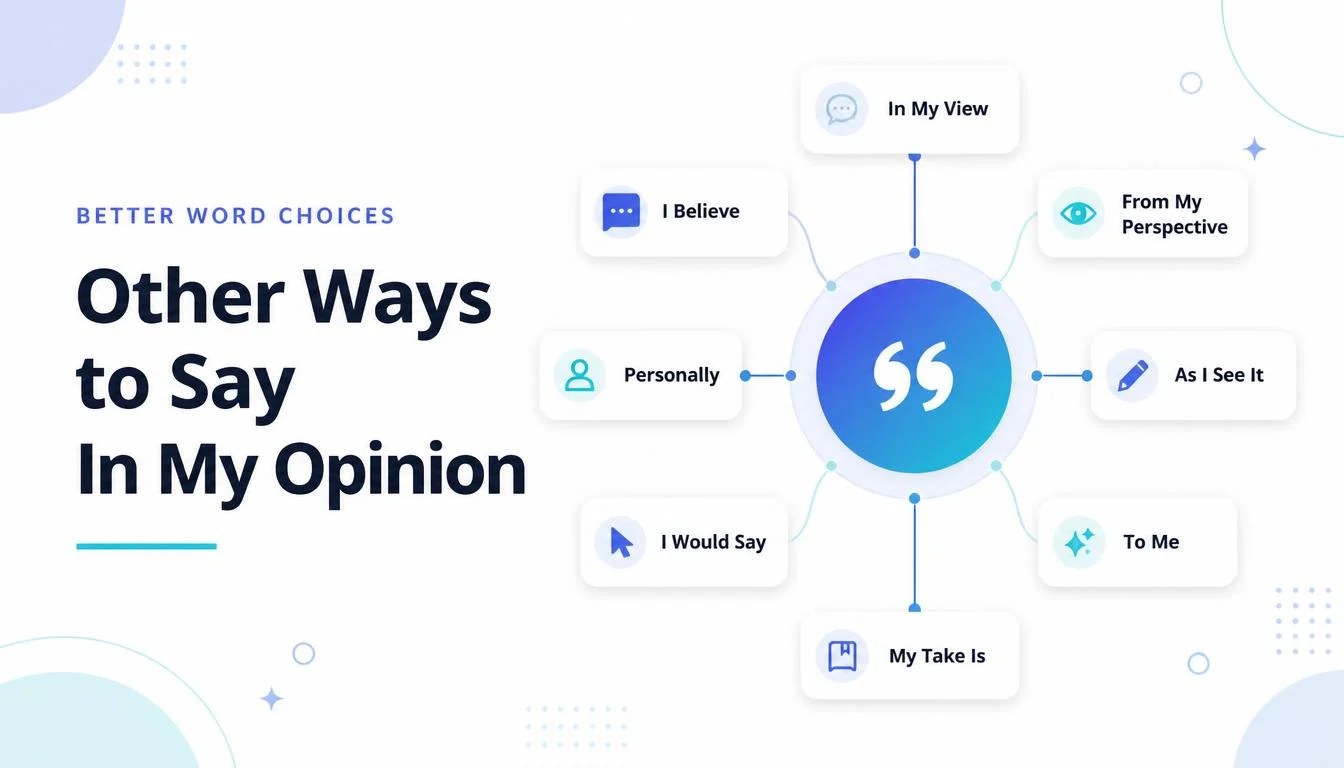
The best alternatives to “in my opinion” include I believe, I think, from my perspective, in my view, and as I see it. These phrases help you share ideas clearly, sound professional, and express your viewpoint without repeating the same words.5 best alternatives: I believe, I think, from my perspective, in my view, as I see it.
Knowing other ways to say in my opinion can make your writing and conversations sound more natural, clear, and engaging. Whether you are writing an essay, sharing an idea at work, or discussing a topic with friends, choosing the right expression helps you communicate your perspective confidently.
In this guide, you’ll discover other ways to say in my opinion for different situations and audiences. From formal alternatives for academic writing to casual expressions for everyday conversations, these phrases will help you share your thoughts without repeating the same words.
What Is “In My Opinion”? (Meaning, Grammar & Real Use)
Imagine you are participating in a team meeting, writing an essay, or discussing a decision with a friend. You have a different perspective and want to share it without sounding rude or overly certain. Saying “in my opinion” helps you introduce your viewpoint while showing that you understand others may think differently.
However, repeating the same expression in every conversation or paragraph can make your English sound less varied. Learning alternatives to in my opinion gives you more flexibility, whether you are contributing to a professional discussion, writing an academic assignment, or having a casual conversation. These expressions also help you communicate your feelings, explain preferences, and express excitement in English when a discussion involves something you genuinely support.
Meaning: “In my opinion” means that something represents your personal belief, judgment, or point of view rather than an established fact.
Grammar: It is a prepositional phrase commonly used at the beginning or within a sentence. It is generally neutral and appropriate in both formal and informal communication.
Example: In my opinion, the new proposal offers a practical solution.
People use this phrase in spoken English to introduce personal views and in written English to distinguish opinions from facts. In professional settings, it can soften disagreement and encourage discussion. In academic writing, however, evidence-based statements are often stronger than repeatedly announcing personal opinions.
When Should You Use “In My Opinion”?
Choose this expression when you want to make your position clear without suggesting that your view is the only possible answer.
- Classroom discussions: Share your interpretation of a topic or text.
- Workplace meetings: Suggest improvements or evaluate possible solutions.
- Academic writing: Introduce a personal interpretation when the assignment permits first-person language.
- Everyday conversations: Discuss preferences, entertainment, food, travel, or personal experiences.
- Respectful disagreements: Explain your position without dismissing someone else’s ideas.
Spoken vs Written
In conversation, “in my opinion” sounds natural when you want to emphasize that a statement reflects your personal view. In writing, it works well in opinion essays, reviews, reports, and reflective assignments.
For concise professional writing, expressions such as “I recommend” or “the evidence suggests” may communicate a point more directly when appropriate.
Formal vs Informal
Formal contexts may call for “from my perspective,” “in my assessment,” or “based on my analysis.” Informal conversations usually sound more natural with “I think,” “I feel,” or “as I see it.”
Is It Professional or Just Polite?
“In my opinion” is both polite and professional in many situations. It signals that you are sharing a personal judgment rather than presenting your interpretation as unquestionable fact.
However, professionalism also depends on what follows the phrase. A well-supported recommendation is more persuasive than an unsupported claim, regardless of the opening words.
Business example: “From my perspective, revising the onboarding process could improve employee retention.”
- Polite? ✔️ Yes
- Professional? ✔️ Yes
Use the expression when your personal judgment is relevant. When presenting measurable findings, lead with the evidence instead.
Pros and Cons of Using “In My Opinion”
Pros
- Clear meaning: Readers and listeners immediately recognize that you are expressing a personal viewpoint.
- Respectful tone: It can make disagreement feel less confrontational.
- Broad usefulness: It works in conversations, essays, reviews, and workplace discussions.
- Easy to understand: English learners can use it confidently without complicated grammar.
Cons
- Repetition: Using it too frequently can make writing monotonous.
- Unnecessary qualification: Established facts do not always need an opinion marker.
- Reduced directness: In some business situations, a clear recommendation is more effective.
- Limited variation: It does not communicate the same degree of confidence, evidence, or formality as every alternative.
Common Mistakes People Make
1. Treating an opinion as a fact
Incorrect: In my opinion, the Earth revolves around the Sun.
Correct: The Earth revolves around the Sun.
Use opinion markers for personal judgments, not established scientific facts.
2. Repeating the phrase in every paragraph
Incorrect: In my opinion, the plan is useful. In my opinion, it is affordable.
Correct: In my opinion, the plan is useful. It is also affordable.
Introduce your viewpoint once when the context remains clear.
3. Using a personal opinion marker before every recommendation
Incorrect: In my opinion, we should submit the report today.
Correct: I recommend submitting the report today.
Choose direct recommendation language when your purpose is to suggest an action.
4. Confusing personal feelings with evidence
Incorrect: In my opinion, the survey proves every customer is satisfied.
Correct: In my opinion, the survey results are encouraging, although they do not represent every customer.
Distinguish your interpretation from what the available evidence actually establishes.
5. Assuming every alternative sounds equally formal
Incorrect: My two cents is that we should revise the contract. (In a formal client report.)
Correct: From my perspective, the contract needs revision.
Match your expression to the audience, setting, and purpose.
“Small tone mistakes can make confident English sound careless.”
Alternatives by Category
These selected expressions are a preview of the full list below. Each serves a slightly different purpose, from presenting a careful assessment to sharing a relaxed personal view.
Formal alternatives to “In My Opinion”
- From my perspective
- In my assessment
- In my considered view
Pro Tip: Use formal alternatives when presenting a reasoned position in reports, presentations, or academic discussions.
Casual alternatives
- I think
- I feel
- As I see it
Pro Tip: Choose the expression you can say naturally without interrupting the flow of conversation.
Professional alternatives
- I believe
- I would argue
- Based on my analysis
Pro Tip: Follow your viewpoint with a reason, example, or relevant evidence to make your contribution more persuasive.
Informal expressions
- If you ask me
- My two cents
- The way I see it
Pro Tip: Reserve conversational expressions for relaxed discussions unless you know your professional audience welcomes an informal tone.
“Formal and informal English aren’t about correctness. They’re about context.”
Other Ways to Say “In My Opinion” (Full List with Examples)
These 30 alternatives help you communicate viewpoints with greater variety and confidence. Choose each phrase according to the situation, the strength of your belief, and the level of formality you need.
1. Phrase: I Think
Meaning: A personal belief or judgment.
Explanation: A versatile, natural alternative for everyday communication.
Example Sentence: I think we should update the schedule.
Best Use: Everyday conversation
Worst Use: Formal declarations
Tone: Neutral conversational
Context Variability: casual / professional / spoken
2. Phrase: I Believe
Meaning: A considered personal conviction.
Explanation: Sounds slightly more confident than “I think” in many contexts.
Example Sentence: I believe this strategy will improve customer satisfaction.
Best Use: Workplace discussions
Worst Use: Proven facts
Tone: Confident neutral
Context Variability: casual / professional / spoken
3. Phrase: From My Perspective
Meaning: Based on your particular viewpoint or experience.
Explanation: Recognizes that other people may see the situation differently.
Example Sentence: From my perspective, the timeline is realistic.
Best Use: Team discussions
Worst Use: Simple facts
Tone: Thoughtful professional
Context Variability: casual / professional / spoken
4. Phrase: In My View
Meaning: According to your personal judgment.
Explanation: A concise, polished option for discussions and writing.
Example Sentence: In my view, the proposal needs more detail.
Best Use: Essays and meetings
Worst Use: Casual banter
Tone: Neutral formal
Context Variability: casual / professional / spoken
5. Phrase: As I See It
Meaning: According to your understanding of a situation.
Explanation: Expresses a personal interpretation without claiming universal agreement.
Example Sentence: As I see it, both options have advantages.
Best Use: Group discussions
Worst Use: Formal research
Tone: Reflective conversational
Context Variability: casual / professional / spoken
6. Phrase: I Feel
Meaning: A personal impression or emotional judgment.
Explanation: Useful when a viewpoint is influenced by feelings or intuition.
Example Sentence: I feel we need more time to prepare.
Best Use: Personal discussions
Worst Use: Technical reporting
Tone: Personal gentle
Context Variability: casual / professional / spoken
7. Phrase: I Would Say
Meaning: A qualified personal judgment.
Explanation: Softens a statement when the answer is not completely straightforward.
Example Sentence: I would say the second option is more practical.
Best Use: Careful evaluations
Worst Use: Urgent instructions
Tone: Cautious conversational
Context Variability: casual / professional / spoken
8. Phrase: To Me
Meaning: From your personal point of view.
Explanation: Works especially well when explaining how something appears or feels to you.
Example Sentence: To me, the ending feels unfinished.
Best Use: Personal reactions
Worst Use: Formal reports
Tone: Casual subjective
Context Variability: casual / professional / spoken
9. Phrase: The Way I See It
Meaning: According to your interpretation.
Explanation: A conversational way to explain your reasoning.
Example Sentence: The way I see it, we have two realistic choices.
Best Use: Friendly debates
Worst Use: Formal correspondence
Tone: Relaxed thoughtful
Context Variability: casual / professional / spoken
10. Phrase: If You Ask Me
Meaning: A direct invitation to consider your opinion.
Explanation: Often introduces a personal preference or strong judgment.
Example Sentence: If you ask me, the simpler design works better.
Best Use: Casual discussions
Worst Use: Formal presentations
Tone: Informal assertive
Context Variability: casual / professional / spoken
11. Phrase: From Where I Stand
Meaning: Based on your position or circumstances.
Explanation: Can emphasize your experience, responsibilities, or personal standpoint.
Example Sentence: From where I stand, the team needs clearer priorities.
Best Use: Workplace conversations
Worst Use: Neutral data summaries
Tone: Firm personal
Context Variability: casual / professional / spoken
12. Phrase: In My Estimation
Meaning: According to your judgment or calculation.
Explanation: Suggests an assessment based on the information available.
Example Sentence: In my estimation, the project needs another week.
Best Use: Practical assessments
Worst Use: Friendly small talk
Tone: Measured formal
Context Variability: casual / professional / spoken
13. Phrase: In My Assessment
Meaning: Based on your evaluation.
Explanation: Appropriate when you have considered relevant details before reaching a conclusion.
Example Sentence: In my assessment, the proposal meets our main requirements.
Best Use: Formal evaluations
Worst Use: Casual chatting
Tone: Analytical professional
Context Variability: casual / professional / spoken
14. Phrase: In My Considered View
Meaning: A viewpoint reached after careful thought.
Explanation: Emphasizes reflection rather than an immediate reaction.
Example Sentence: In my considered view, the policy needs revision.
Best Use: Formal arguments
Worst Use: Quick replies
Tone: Deliberate formal
Context Variability: casual / professional / spoken
15. Phrase: I Would Argue
Meaning: You would support a particular position with reasons.
Explanation: Particularly effective in analytical writing and structured debate.
Example Sentence: I would argue that prevention deserves more investment.
Best Use: Academic arguments
Worst Use: Friendly greetings
Tone: Assertive analytical
Context Variability: casual / professional / spoken
16. Phrase: I Would Suggest
Meaning: You recommend or propose an option.
Explanation: Shifts the emphasis from personal belief to a practical recommendation.
Example Sentence: I would suggest reviewing the figures first.
Best Use: Professional advice
Worst Use: Unrelated opinions
Tone: Polite constructive
Context Variability: casual / professional / spoken
17. Phrase: I Am Convinced That
Meaning: You hold a strong belief.
Explanation: Communicates considerable confidence and should suit the strength of your supporting reasons.
Example Sentence: I am convinced that regular practice improves fluency.
Best Use: Strong arguments
Worst Use: Uncertain guesses
Tone: Strong confident
Context Variability: casual / professional / spoken
18. Phrase: My Impression Is That
Meaning: Your initial understanding or perception.
Explanation: Useful when you have an informed impression but not complete certainty.
Example Sentence: My impression is that the client prefers a shorter proposal.
Best Use: Preliminary feedback
Worst Use: Finalized facts
Tone: Cautious professional
Context Variability: casual / professional / spoken
19. Phrase: I Tend to Think
Meaning: Your usual or developing belief.
Explanation: Leaves room for exceptions or alternative interpretations.
Example Sentence: I tend to think that shorter meetings are more productive.
Best Use: Nuanced discussions
Worst Use: Firm commitments
Tone: Tentative thoughtful
Context Variability: casual / professional / spoken
20. Phrase: My View Is That
Meaning: A clearly stated personal position.
Explanation: Introduces an opinion directly, particularly in discussion or writing.
Example Sentence: My view is that the deadline should remain unchanged.
Best Use: Structured discussions
Worst Use: Casual greetings
Tone: Direct professional
Context Variability: casual / professional / spoken
21. Phrase: I Would Maintain That
Meaning: You continue to support a particular argument.
Explanation: Useful when defending a position against disagreement.
Example Sentence: I would maintain that quality should come before speed.
Best Use: Formal debate
Worst Use: Light conversation
Tone: Firm formal
Context Variability: casual / professional / spoken
22. Phrase: As Far as I Am Concerned
Meaning: According to your personal position or judgment.
Explanation: Can communicate a firm stance, and sometimes sounds final or dismissive.
Example Sentence: As far as I am concerned, the issue is resolved.
Best Use: Firm personal positions
Worst Use: Sensitive negotiations
Tone: Decisive emphatic
Context Variability: casual / professional / spoken
23. Phrase: To My Mind
Meaning: In your personal judgment.
Explanation: A somewhat traditional expression, often found in reflective or formal British English.
Example Sentence: To my mind, the explanation is incomplete.
Best Use: Reflective writing
Worst Use: Casual texting
Tone: Thoughtful traditional
Context Variability: casual / professional / spoken
24. Phrase: I Am of the View That
Meaning: You hold a particular position.
Explanation: A formal construction used in some professional and institutional settings.
Example Sentence: I am of the view that further consultation is necessary.
Best Use: Formal correspondence
Worst Use: Everyday chatting
Tone: Formal measured
Context Variability: casual / professional / spoken
25. Phrase: My Two Cents
Meaning: Your personal contribution or opinion.
Explanation: An informal idiom that often introduces a modest suggestion.
Example Sentence: My two cents is that we should keep the design simple.
Best Use: Casual discussions
Worst Use: Official reports
Tone: Informal friendly
Context Variability: casual / professional / spoken
26. Phrase: I Personally Think
Meaning: Your own individual belief.
Explanation: Adds emphasis that the statement reflects your personal view.
Example Sentence: I personally think the blue version looks better.
Best Use: Personal preferences
Worst Use: Repetitive essays
Tone: Emphatic conversational
Context Variability: casual / professional / spoken
27. Phrase: From My Experience
Meaning: Based on what you have personally experienced.
Explanation: Best when your experience genuinely provides relevant context.
Example Sentence: From my experience, clear instructions reduce mistakes.
Best Use: Practical advice
Worst Use: Unsupported generalizations
Tone: Experienced helpful
Context Variability: casual / professional / spoken
28. Phrase: Based on My Analysis
Meaning: A conclusion drawn from your examination of information.
Explanation: Signals reasoning and is strongest when you can explain the method or evidence.
Example Sentence: Based on my analysis, the revised budget is achievable.
Best Use: Business reports
Worst Use: Unsupported guesses
Tone: Analytical professional
Context Variability: casual / professional / spoken
29. Phrase: My Understanding Is That
Meaning: Your current interpretation of the available information.
Explanation: Useful when confirming your understanding without claiming absolute certainty.
Example Sentence: My understanding is that the meeting starts at noon.
Best Use: Clarifying details
Worst Use: Established certainties
Tone: Cautious diplomatic
Context Variability: casual / professional / spoken
30. Phrase: I Am Inclined to Believe
Meaning: You lean toward a particular belief.
Explanation: Expresses a reasoned but not entirely certain conclusion.
Example Sentence: I am inclined to believe that the earlier option is safer.
Best Use: Qualified judgments
Worst Use: Simple preferences
Tone: Reserved analytical
Context Variability: casual / professional / spoken
Comparison Table: Top 10 Alternatives at a Glance
| Phrase | Tone | Best Use |
|---|---|---|
| I think | Neutral | Everyday conversation |
| I believe | Confident | Workplace discussions |
| From my perspective | Thoughtful | Team discussions |
| In my view | Polished | Essays and meetings |
| As I see it | Reflective | Group discussions |
| I feel | Personal | Emotional reactions |
| I would suggest | Constructive | Professional advice |
| In my assessment | Analytical | Formal evaluations |
| If you ask me | Informal | Friendly debates |
| Based on my analysis | Evidence-focused | Business reports |
Quick Self-Check (Mini Quiz)
1. You are writing a formal project evaluation. Which phrase is most suitable?
A. My two cents
B. In my assessment
C. If you ask me
Answer: B. “In my assessment” suits a structured, professional evaluation.
2. You are sharing a preference with a friend. Which sounds most natural?
A. I think
B. I am of the view that
C. I would maintain that
Answer: A. “I think” is simple and natural in everyday conversation.
3. You have reviewed the budget figures and want to explain your conclusion. Which phrase is strongest?
A. To me
B. Based on my analysis
C. My two cents
Answer: B. It signals that your conclusion follows an examination of information.
4. You want to disagree politely during a meeting. Which option is most constructive?
A. I would suggest considering another approach.
B. If you ask me, this is a terrible idea.
C. As far as I am concerned, you are wrong.
Answer: A. It introduces an alternative without unnecessarily criticizing another person.
FAQs
What is the most professional alternative to “in my opinion”?
“From my perspective,” “in my assessment,” and “based on my analysis” are professional choices. Select the phrase that accurately reflects whether you are sharing a viewpoint, evaluation, or evidence-based conclusion.
What is a more formal way to say “in my opinion”?
“In my considered view” and “I am of the view that” are formal alternatives. They work best in serious discussions, reports, and formal correspondence.
What can I say instead of “in my opinion” in an essay?
Try “I would argue,” “in my view,” or “my interpretation is that.” Follow your claim with relevant reasoning or evidence, and follow your assignment’s rules about first-person writing.
Is “I think” less professional than “in my opinion”?
Not necessarily. “I think” is common in professional conversations and often sounds natural. “In my opinion” is slightly more explicit, but neither phrase automatically makes an argument more convincing.
How can I avoid repeating “in my opinion”?
Vary your wording with expressions such as “I believe,” “from my perspective,” and “in my assessment.” You can also state your argument directly or introduce the evidence supporting it.
Conclusion
Learning different ways to introduce your viewpoint helps you communicate more naturally in conversations, essays, and professional settings. The strongest expression is not always the most formal one. It is the phrase that matches your purpose, confidence, and audience.
Practice using two or three alternatives each day. Pay attention to how they sound in meetings, discussions, and writing, and choose evidence-based language whenever accuracy matters.
Read More Related Articles:
- Other Ways to Say You’re Beautiful | Beyond the Ordinary Compliment In 2026
- Other Ways to Say I Love You in Spanish | Beyond the Usual Phrase In 2026
- Other Ways to Say I Love You in Other Languages | Beyond the Classic Three Words In 2026

Henry Walker is an American writer and blogger with a keen interest in communication, language and digital content. At TextsResponse.com, he creates informative and reader-focused resources designed to help people communicate with clarity, confidence and authenticity.