Quick Answer
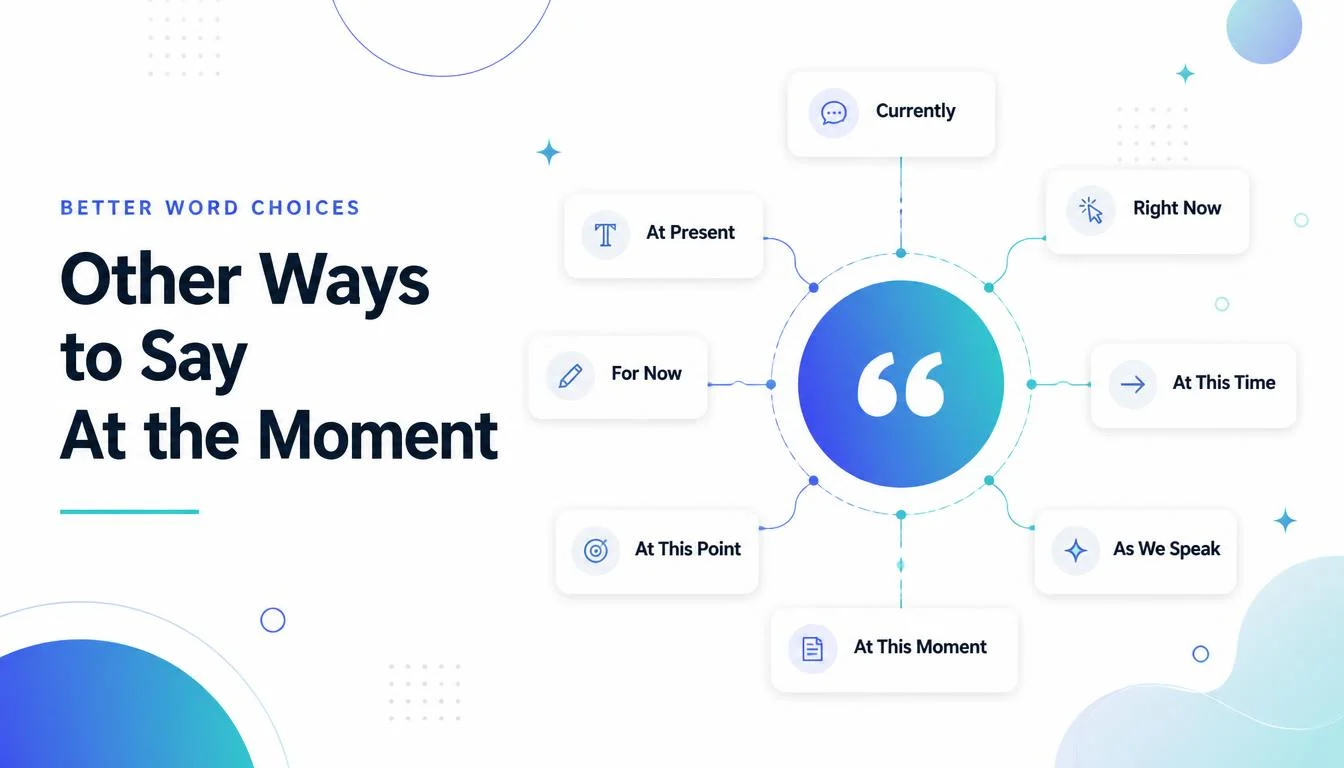
Other ways to say “at the moment” include currently, right now, at present, for now, and as of now.
At the moment is a common phrase used to describe something happening or being true now. It works well in both everyday conversations and professional communication.
Learning different alternatives to at the moment can help you avoid repetition and express time more naturally. Depending on the context, you can choose a formal phrase like “at present” or a conversational option like “right now.”
What Is “At the Moment”? Meaning, Grammar & Real Use
Imagine a colleague asking whether you can join a meeting, a friend asking what you are doing, or a customer asking about the status of an order. Saying “I’m busy at the moment” communicates that the situation is true now, without necessarily suggesting that it will remain true for long.
The phrase at the moment refers to the current time or a situation happening now. Learning alternatives to at the moment helps English learners vary their vocabulary instead of repeatedly using the same time expression.
It is also useful to understand that time expressions can change the tone of a sentence. For example, “right now” sounds more immediate, while “currently” is often more suitable for professional writing. These distinctions matter just as much when learning how to express excitement in English or choosing professional reaction phrases.
Grammatically, at the moment is a prepositional phrase functioning as an adverbial time expression. It is neutral and works naturally in both spoken and written English.
Example: “I’m working on the report at the moment.”
People commonly use it when describing a temporary situation, current activity, availability, or status. It is particularly natural in everyday conversation and can also appear in professional communication.
When Should You Use “At the Moment”?
Use at the moment when you want to show that something is happening or true now.
Common contexts
- Describing what you are doing now: “I’m studying at the moment.”
- Explaining temporary availability: “I’m not available at the moment.”
- Describing a current situation: “The service is unavailable at the moment.”
- Giving a current status update: “We are reviewing the proposal at the moment.”
- Talking about a temporary condition: “She is staying with relatives at the moment.”
Spoken vs Written
In spoken English, “at the moment” sounds natural, clear, and conversational.
In written English, it is also acceptable, although currently and at present may sound more concise in formal documents.
Formal vs Informal
The phrase is relatively neutral rather than strongly formal or informal. For casual conversation, right now is often more direct. For professional writing, currently or at present can provide a polished alternative.
Is It Professional or Just Polite?
At the moment is both polite and professionally acceptable. It does not sound overly formal, but it can fit emails, meetings, reports, customer communication, and everyday conversations.
For example:
“The team is currently reviewing your request and will provide an update shortly.”
This type of wording is especially useful when communicating a temporary status without sounding abrupt.
Polite? ✔️ Yes
Professional? ✔️ Yes
The key distinction is that professionalism depends on the complete sentence and situation, not simply on the phrase itself.
Pros and Cons of Using “At the Moment”
Pros
- Clear meaning: It immediately communicates that something is happening now.
- Neutral tone: It works in casual and professional settings.
- Natural usage: Native speakers commonly use it in everyday conversation.
- Flexible placement: It can appear at the beginning or end of a sentence.
Cons
- Can become repetitive: Frequent use may make your writing sound less varied.
- Less immediate than “right now”: It does not always emphasize urgency.
- May be less concise: “Currently” can be shorter in some professional sentences.
- Not always interchangeable: Some alternatives describe a slightly different time relationship.
Common Mistakes People Make
Mistake 1: Using “currently” for a completed action
Incorrect: “I currently finished the report.”
Correct: “I have just finished the report.”
“Currently” normally describes something that is happening or remains true now, not an action that has already been completed.
Mistake 2: Confusing “just now” with “at the moment”
Incorrect: “I am working on it just now” when you mean generally today.
Correct: “I am working on it at the moment.”
“Just now” often refers to something that happened very recently.
Mistake 3: Using “for now” when you mean exactly now
Incorrect: “I am unavailable for now” when you only mean this instant.
Correct: “I am unavailable at the moment.”
“For now” often suggests a temporary arrangement that may continue for a period.
Mistake 4: Treating “at present” as strongly casual
Incorrect: “Hey, what are you doing at present?” in a relaxed conversation.
Correct: “What are you doing right now?”
“At present” is grammatically correct but can sound more formal or deliberate.
Mistake 5: Using “these days” for a single moment
Incorrect: “I’m in a meeting these days.”
Correct: “I’m in a meeting at the moment.”
“These days” generally refers to a broader period rather than one specific moment.
Pull Quote: “Small tone mistakes can make confident English sound careless.”
Alternatives by Category
Formal alternatives to “At the Moment”
- At present
- Currently
- At this time
These expressions are useful in reports, formal correspondence, presentations, and official updates.
Pro Tip: Use currently when you want a concise, professional description of an ongoing situation.
Casual alternatives
- Right now
- Now
- This minute
These are useful when talking naturally with friends, family, classmates, or colleagues in relaxed situations.
Pro Tip: Choose right now when you want to emphasize immediacy.
Professional alternatives
- Currently
- At present
- At this point
These work well in workplace conversations, emails, status updates, and business documents.
Pro Tip: In professional writing, select the phrase that accurately reflects whether you mean an immediate moment or an ongoing situation.
Informal expressions
- For now
- As we speak
- Just now
These expressions can work in informal conversations, but their meanings are not identical.
Pro Tip: Check the time meaning before replacing the original phrase. Some alternatives describe recent events or temporary arrangements rather than the exact present.
Pull Quote: “Formal and informal English aren’t about correctness. They’re about context.”
Other Ways to Say “At the Moment” (Full List with Examples)
These 30 alternatives build fluency and give you more precise ways to describe the present, a temporary situation, or an ongoing activity.
1. Phrase: Right Now
Meaning: At this exact time.
Explanation: Stronger and more immediate than “at the moment.”
Example Sentence: “I can’t talk right now.”
Best Use: Immediate situations
Worst Use: Formal reports
Tone: Direct, casual
Context Variability: casual / professional / spoken
2. Phrase: Currently
Meaning: At the present time.
Explanation: A concise choice for ongoing situations, especially in professional communication.
Example Sentence: “She is currently reviewing the contract.”
Best Use: Work updates
Worst Use: Casual banter
Tone: Neutral, professional
Context Variability: casual / professional / written
3. Phrase: At Present
Meaning: At this time.
Explanation: A polished alternative often used in formal or written English.
Example Sentence: “No further changes are required at present.”
Best Use: Formal writing
Worst Use: Relaxed chats
Tone: Formal, neutral
Context Variability: casual / professional / written
4. Phrase: For Now
Meaning: During the current temporary period.
Explanation: Suggests that a situation may change later.
Example Sentence: “We’ll use this office for now.”
Best Use: Temporary plans
Worst Use: Exact timing
Tone: Casual, neutral
Context Variability: casual / professional / spoken
5. Phrase: At This Time
Meaning: At the current time.
Explanation: Useful for clear, neutral status statements.
Example Sentence: “We have no additional information at this time.”
Best Use: Status updates
Worst Use: Friendly chats
Tone: Neutral, formal
Context Variability: casual / professional / written
6. Phrase: At This Point
Meaning: At the current stage or time.
Explanation: Often refers to a situation or stage rather than a precise instant.
Example Sentence: “At this point, we need more information.”
Best Use: Decision stages
Worst Use: Exact moments
Tone: Neutral, professional
Context Variability: casual / professional / spoken
7. Phrase: Now
Meaning: At the present time.
Explanation: The simplest and most versatile alternative.
Example Sentence: “I’m busy now.”
Best Use: Everyday speech
Worst Use: Formal emphasis
Tone: Simple, direct
Context Variability: casual / professional / spoken
8. Phrase: At This Very Moment
Meaning: Exactly now.
Explanation: Adds strong emphasis to the present moment.
Example Sentence: “She is speaking with the client at this very moment.”
Best Use: Strong emphasis
Worst Use: Routine updates
Tone: Emphatic, neutral
Context Variability: casual / professional / spoken
9. Phrase: As We Speak
Meaning: While we are talking.
Explanation: Highlights that something is happening simultaneously with the conversation.
Example Sentence: “The team is preparing the documents as we speak.”
Best Use: Live situations
Worst Use: Formal reports
Tone: Conversational, vivid
Context Variability: casual / professional / spoken
10. Phrase: At the Present Time
Meaning: At the current time.
Explanation: A longer, formal version suitable for official communication.
Example Sentence: “The facility is closed at the present time.”
Best Use: Official statements
Worst Use: Casual speech
Tone: Formal, neutral
Context Variability: casual / professional / written
11. Phrase: For the Time Being
Meaning: During the current temporary period.
Explanation: Indicates that an arrangement is temporary.
Example Sentence: “Please use the temporary entrance for the time being.”
Best Use: Temporary arrangements
Worst Use: Exact moments
Tone: Neutral, formal
Context Variability: casual / professional / written
12. Phrase: At This Juncture
Meaning: At this stage or point in a situation.
Explanation: A formal expression usually associated with discussions, decisions, or developments.
Example Sentence: “At this juncture, further evidence is needed.”
Best Use: Formal discussions
Worst Use: Casual conversations
Tone: Formal, serious
Context Variability: casual / professional / written
13. Phrase: In the Current Situation
Meaning: Under the circumstances that exist now.
Explanation: Focuses on present circumstances rather than a precise moment.
Example Sentence: “In the current situation, we should postpone the launch.”
Best Use: Situation analysis
Worst Use: Quick replies
Tone: Neutral, professional
Context Variability: casual / professional / written
14. Phrase: At the Present Moment
Meaning: At the current moment.
Explanation: A direct but somewhat formal alternative emphasizing the present.
Example Sentence: “The system is unavailable at the present moment.”
Best Use: Formal notices
Worst Use: Casual speech
Tone: Formal, neutral
Context Variability: casual / professional / written
15. Phrase: For the Current Period
Meaning: During the period happening now.
Explanation: More appropriate for schedules, policies, and planned periods than everyday conversation.
Example Sentence: “This rate applies for the current period.”
Best Use: Business documents
Worst Use: Casual speech
Tone: Formal, technical
Context Variability: casual / professional / written
16. Phrase: As of Now
Meaning: Up to the current time.
Explanation: Often introduces the latest known status or information.
Example Sentence: “As of now, no changes have been announced.”
Best Use: Status reports
Worst Use: Past events
Tone: Neutral, direct
Context Variability: casual / professional / spoken
17. Phrase: At This Instant
Meaning: At this exact instant.
Explanation: Emphasizes a very specific present moment.
Example Sentence: “At this instant, every second matters.”
Best Use: Dramatic emphasis
Worst Use: Routine emails
Tone: Emphatic, formal
Context Variability: casual / professional / spoken
18. Phrase: In the Here and Now
Meaning: In the present moment.
Explanation: Often focuses attention on present experience rather than past or future.
Example Sentence: “Try to focus on the here and now.”
Best Use: Reflective contexts
Worst Use: Business reports
Tone: Reflective, conversational
Context Variability: casual / professional / spoken
19. Phrase: These Days
Meaning: During the current period of time.
Explanation: Refers to a broader period, not necessarily this exact moment.
Example Sentence: “These days, many meetings are held online.”
Best Use: Current trends
Worst Use: Exact moments
Tone: Casual, neutral
Context Variability: casual / professional / spoken
20. Phrase: Nowadays
Meaning: In the present era or period.
Explanation: Useful for discussing general modern conditions rather than a temporary action.
Example Sentence: “Nowadays, customers expect faster responses.”
Best Use: General trends
Worst Use: Immediate actions
Tone: Neutral, conversational
Context Variability: casual / professional / written
21. Phrase: At the Current Time
Meaning: At the time now being discussed.
Explanation: A literal and formal option for status information.
Example Sentence: “The application is unavailable at the current time.”
Best Use: Formal notices
Worst Use: Friendly chats
Tone: Formal, neutral
Context Variability: casual / professional / written
22. Phrase: At the Present Stage
Meaning: At the current stage of development.
Explanation: Best when discussing progress rather than an exact moment.
Example Sentence: “At the present stage, testing is still underway.”
Best Use: Project updates
Worst Use: Casual speech
Tone: Professional, formal
Context Variability: casual / professional / written
23. Phrase: At This Stage
Meaning: At the current point in a process.
Explanation: Common when discussing projects, decisions, or developments.
Example Sentence: “At this stage, we need additional feedback.”
Best Use: Project discussions
Worst Use: Exact timing
Tone: Neutral, professional
Context Variability: casual / professional / spoken
24. Phrase: For the Time Being
Meaning: Temporarily, until circumstances change.
Explanation: Useful when something is expected to remain true for an unspecified period.
Example Sentence: “For the time being, the office will remain closed.”
Best Use: Temporary decisions
Worst Use: Exact moments
Tone: Formal, neutral
Context Variability: casual / professional / written
25. Phrase: In the Meantime
Meaning: During the period before another event occurs.
Explanation: This is not an exact synonym, but it works when describing what happens while waiting.
Example Sentence: “The report is being prepared. In the meantime, review the data.”
Best Use: Waiting periods
Worst Use: Exact timing
Tone: Neutral, professional
Context Variability: casual / professional / written
26. Phrase: Just Now
Meaning: Very recently or a moment ago.
Explanation: Usually refers to something that happened shortly before speaking.
Example Sentence: “He called me just now.”
Best Use: Recent events
Worst Use: Ongoing actions
Tone: Casual, direct
Context Variability: casual / professional / spoken
27. Phrase: This Minute
Meaning: At this exact time.
Explanation: Adds immediacy and is more conversational than formal.
Example Sentence: “I’m finishing the task this minute.”
Best Use: Immediate action
Worst Use: Formal writing
Tone: Casual, emphatic
Context Variability: casual / professional / spoken
28. Phrase: At the Current Moment
Meaning: At the moment happening now.
Explanation: A literal alternative, though “currently” is usually more natural in professional writing.
Example Sentence: “The service is unavailable at the current moment.”
Best Use: Status descriptions
Worst Use: Natural conversation
Tone: Formal, neutral
Context Variability: casual / professional / written
29. Phrase: At This Exact Moment
Meaning: At precisely this time.
Explanation: Adds emphasis when the exact present moment matters.
Example Sentence: “The manager is meeting the client at this exact moment.”
Best Use: Precise timing
Worst Use: Routine updates
Tone: Emphatic, neutral
Context Variability: casual / professional / spoken
30. Phrase: At the Time of Writing
Meaning: At the time when something is being written.
Explanation: Useful for articles, reports, research, and formal documents when information may change later.
Example Sentence: “At the time of writing, the policy remains unchanged.”
Best Use: Written reports
Worst Use: Casual speech
Tone: Formal, professional
Context Variability: casual / professional / written
Comparison Table: Top 10 Alternatives at a Glance
| Phrase | Tone | Best Use |
|---|---|---|
| Right now | Casual, direct | Immediate conversation |
| Currently | Professional, neutral | Workplace writing |
| At present | Formal, neutral | Formal communication |
| For now | Casual, neutral | Temporary situations |
| At this time | Neutral, formal | Status updates |
| At this point | Professional, neutral | Decisions and stages |
| Now | Simple, direct | Everyday speech |
| As we speak | Conversational, vivid | Live situations |
| For the time being | Formal, neutral | Temporary arrangements |
| As of now | Neutral, direct | Current status |
Quick Self-Check
1. You are writing a formal business update. Which sounds most suitable?
A. This minute
B. Currently
C. Right now
D. These days
Answer: B. Currently
2. Your friend asks why you cannot talk. Which response sounds natural?
A. I cannot talk at this juncture.
B. I cannot talk at the present stage.
C. I cannot talk right now.
D. I cannot talk at the time of writing.
Answer: C. I cannot talk right now.
3. You want to describe a temporary arrangement that may change later.
A. For now
B. Just now
C. At this instant
D. At the time of writing
Answer: A. For now
4. A report describes information that is true when the document is prepared. Which phrase fits best?
A. Right now
B. This minute
C. At the time of writing
D. Just now
Answer: C. At the time of writing
FAQs
What are the best other ways to say at the moment?
Common alternatives include right now, currently, at present, for now, at this time, and now. The best choice depends on whether you need casual, professional, or formal language.
Is “currently” the same as “at the moment”?
They are often interchangeable when describing an ongoing situation. However, currently is especially common in professional and written English, while at the moment sounds more conversational.
Is “right now” more informal than “at the moment”?
Generally, yes. “Right now” emphasizes immediacy and is particularly natural in conversation. “At the moment” is neutral and works across a wider range of situations.
Can I use “at the moment” in professional emails?
Yes. The phrase is polite, clear, and professionally acceptable. However, currently or at present may be preferable when you want a more formal written style.
What is a formal alternative to “at the moment”?
Currently and at present are two common formal alternatives. “At this time” can also work well in official updates and customer communication.
conclusion
Knowing different ways to express the present helps you sound more flexible and precise in English. Instead of repeating one phrase, you can choose right now for immediacy, currently for professional communication, or at present for a more formal style.
Daily practice is one of the easiest ways to build this flexibility. Pay attention to whether you are speaking, writing an email, giving a status update, or discussing a temporary situation, then select the expression that fits the context.
Read More Related Articles:
- Other Ways to Say Thanks in Spanish | Native-Sounding Options In 2026
- Other Ways to Say God Is Good | Uplifting Words for Every Occasion In 2026
- Other Ways to Say This Matters Because | When Making a Strong Point In 2026

Daniel Murphy is a professional writer and blogger specializing in digital communication and messaging trends. As a contributor to TextsResponse.com, he creates reader-focused content designed to help people find the right words at the right time.