Quick Answer
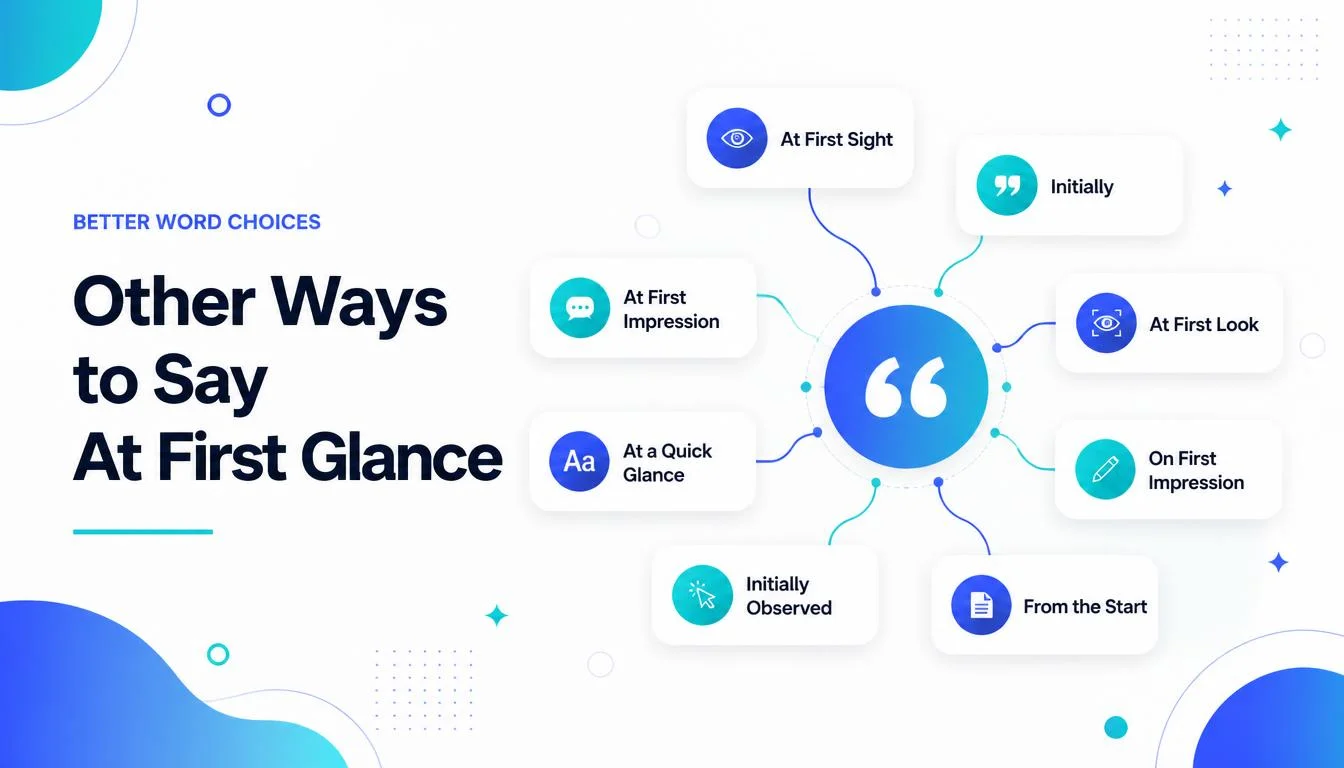
Use at first sight, initially, on first impression, at first look, or upon first seeing as alternatives to “at first glance.”
Finding the right other ways to say at first glance can make your English sound more natural and precise. Whether you are writing an essay, describing a person, or sharing a first impression, different expressions can add variety and clarity.
Learning other ways to say at first glance also helps you choose the right phrase for formal, casual, and professional situations. These alternatives can make your writing more engaging while helping you express first impressions with confidence.
What Is “At First Glance”? Meaning, Grammar & Real Use
Imagine meeting someone for the first time, opening a new book, or reviewing a report for only a few seconds. You may form an immediate impression before examining every detail. In that situation, you might say, “At first glance, the proposal looks promising.”
The phrase at first glance describes an initial impression based on a quick or limited observation. It does not necessarily mean that the first impression is completely accurate. Learning alternatives to at first glance helps you describe first impressions with greater precision and avoid repeating the same expression.
The phrase is particularly useful when you want to contrast an initial observation with what you discover after closer examination. This makes it valuable in essays, reviews, professional discussions, and everyday conversations. Knowing these distinctions can also improve your ability to express excitement in English when describing an immediately impressive result.
Grammatically, at first glance is a prepositional phrase functioning as an adverbial expression. It is neutral and can be used in both formal and informal English.
Example: “At first glance, the design appears simple.”
People use it when making an initial visual, intellectual, or general assessment before taking a closer look. It is especially useful when the first impression may later be confirmed, changed, or challenged.
When Should You Use “At First Glance”?
Use at first glance when you want to describe an impression formed quickly, usually before detailed examination.
Common contexts
- Describing an immediate impression of a person.
- Discussing the appearance of a product or design.
- Introducing an initial opinion in an essay.
- Reviewing a document before detailed analysis.
- Describing something that seems different after closer inspection.
- Comparing an initial impression with a later discovery.
- Discussing visual details noticed quickly.
- Introducing a preliminary assessment.
Spoken vs Written
In spoken English, the phrase sounds natural when describing a quick reaction or first impression.
In written English, it is particularly useful in essays, reviews, reports, critiques, and analytical writing because it allows you to introduce an observation before presenting deeper analysis.
Formal vs Informal
“At first glance” is neutral rather than strongly formal or informal. It works comfortably in everyday conversation, academic writing, workplace communication, and professional analysis.
For casual speech, at first look or at first sight may sometimes sound more conversational. For formal writing, upon initial examination or initially can provide a more analytical tone.
Is It Professional or Just Polite?
“At first glance” is both polite and professional. It is especially useful when you want to present an observation without claiming that it represents the complete truth.
For example:
“At first glance, the proposed schedule appears to meet the project requirements.”
This wording is professional because it leaves room for further review rather than presenting an initial impression as a final conclusion.
Polite? ✔️ Yes
Professional? ✔️ Yes
Politeness concerns how respectfully you communicate. Professionalism concerns whether your wording fits the workplace or formal context. “At first glance” can satisfy both.
Pros and Cons of Using “At First Glance”
Pros
- Clear meaning: It immediately signals that an observation is preliminary.
- Useful for analysis: It helps distinguish first impressions from deeper examination.
- Flexible tone: It works in conversations, essays, reviews, and workplace discussions.
- Naturally cautious: It avoids presenting a quick observation as a final judgment.
Cons
- Can become repetitive: Frequent use may make analytical writing sound predictable.
- May imply visual observation: Some contexts are better served by “initially” or “on first impression.”
- Not always exact: It does not necessarily explain how the first impression was formed.
- Some alternatives are more precise: Formal contexts may benefit from expressions such as “upon initial examination.”
Common Mistakes People Make
Mistake 1: Confusing “at first glance” with “at first”
Incorrect: “At first glance, I used to live in Boston.”
Correct: “At first, I lived in Boston.”
“At first” usually describes an earlier stage in a sequence, while “at first glance” describes an initial observation.
Mistake 2: Using it for a final judgment
Incorrect: “At first glance, this proves the theory is correct.”
Correct: “At first glance, this appears to support the theory.”
The phrase signals an initial impression, so avoid using it to introduce an unnecessarily absolute conclusion.
Mistake 3: Confusing “at first sight” with every context
Incorrect: “At first sight of the spreadsheet, the figures were analyzed for three hours.”
Correct: “Upon initial examination, the figures were analyzed in detail.”
“At first sight” often describes an immediate perception, while “upon initial examination” better fits detailed review.
Mistake 4: Using “initially” when describing only appearance
Incorrect: “Initially, the building is painted blue.”
Correct: “At first glance, the building appears blue.”
“Initially” often describes the first stage of a situation, not simply what something looks like.
Mistake 5: Treating “on first impression” as a synonym for visual inspection
Incorrect: “On first impression, the spreadsheet contains twelve columns.”
Correct: “At first glance, the spreadsheet appears to contain twelve columns.”
“On first impression” usually focuses on an overall opinion rather than a specific visual observation.
Pull Quote: “Small tone mistakes can make confident English sound careless.”
Alternatives by Category
Formal alternatives to “At First Glance”
- Upon initial examination
- Upon preliminary inspection
- On initial observation
These expressions work well in analytical reports, academic writing, evaluations, and formal reviews.
Pro Tip: Use a formal alternative when your sentence focuses on a deliberate preliminary assessment rather than a casual impression.
Casual alternatives
- At first look
- At first sight
- On first look
These expressions work naturally in everyday descriptions and conversations.
Pro Tip: Choose at first sight for an immediate impression and at first look for a quick visual observation.
Professional alternatives
- Initially
- On initial review
- Upon review
These are useful in workplace emails, reports, meetings, evaluations, and project discussions.
Pro Tip: Use on initial review when you want to emphasize that the material has been examined before a more detailed assessment.
Informal expressions
- At first look
- At first sight
- On first impression
These can make everyday descriptions sound more natural while preserving the idea of an initial reaction.
Pro Tip: Match the phrase to your meaning. “On first impression” focuses on opinion, while “at first look” focuses more on immediate observation.
Pull Quote: “Formal and informal English aren’t about correctness. They’re about context.”
Other Ways to Say “At First Glance” (Full List with Examples)
These alternatives help build fluency and let you describe first impressions, quick observations, and preliminary assessments with greater precision.
1. Phrase: Initially
Meaning: At the beginning.
Explanation: Describes an early impression, stage, or response.
Example Sentence: “Initially, the plan seemed practical.”
Best Use: Early assessments
Worst Use: Exact observation
Tone: Neutral, professional
Context Variability: casual / professional / written
2. Phrase: At First Sight
Meaning: When first seen.
Explanation: Describes an immediate visual or emotional impression.
Example Sentence: “At first sight, the building looks enormous.”
Best Use: First impressions
Worst Use: Detailed analysis
Tone: Natural, neutral
Context Variability: casual / professional / spoken
3. Phrase: On First Impression
Meaning: Based on an initial impression.
Explanation: Focuses on an early overall judgment.
Example Sentence: “On first impression, the candidate seemed confident.”
Best Use: Personal impressions
Worst Use: Precise measurements
Tone: Neutral, analytical
Context Variability: casual / professional / spoken
4. Phrase: At First Look
Meaning: When first observed.
Explanation: A straightforward expression for a quick visual assessment.
Example Sentence: “At first look, the design appears simple.”
Best Use: Visual observations
Worst Use: Formal analysis
Tone: Casual, direct
Context Variability: casual / professional / spoken
5. Phrase: Upon Initial Examination
Meaning: When first examined.
Explanation: Emphasizes an initial but deliberate assessment.
Example Sentence: “Upon initial examination, the document appeared complete.”
Best Use: Formal analysis
Worst Use: Casual conversation
Tone: Formal, analytical
Context Variability: casual / professional / written
6. Phrase: Upon Preliminary Inspection
Meaning: During an initial inspection.
Explanation: Suitable when something is checked before a deeper review.
Example Sentence: “Upon preliminary inspection, no major errors were found.”
Best Use: Technical reviews
Worst Use: Casual impressions
Tone: Formal, technical
Context Variability: casual / professional / written
7. Phrase: On Initial Observation
Meaning: From the first observation.
Explanation: Highlights what was noticed before further analysis.
Example Sentence: “On initial observation, the results appeared consistent.”
Best Use: Analytical writing
Worst Use: Friendly chats
Tone: Formal, analytical
Context Variability: casual / professional / written
8. Phrase: On Initial Review
Meaning: During the first review.
Explanation: Useful for documents, proposals, reports, and other professional materials.
Example Sentence: “On initial review, the proposal meets our requirements.”
Best Use: Workplace reviews
Worst Use: Personal reactions
Tone: Professional, neutral
Context Variability: casual / professional / written
9. Phrase: Upon Review
Meaning: After an initial review.
Explanation: Works when reporting an observation resulting from examining something.
Example Sentence: “Upon review, several details required clarification.”
Best Use: Professional analysis
Worst Use: Casual reactions
Tone: Formal, professional
Context Variability: casual / professional / written
10. Phrase: At First Observation
Meaning: When first observed.
Explanation: Signals that an observation is preliminary rather than final.
Example Sentence: “At first observation, the difference was difficult to notice.”
Best Use: Initial findings
Worst Use: Casual speech
Tone: Formal, neutral
Context Variability: casual / professional / written
11. Phrase: At First Encounter
Meaning: When first experienced or encountered.
Explanation: Useful for describing an initial experience with a person, place, or idea.
Example Sentence: “At first encounter, the system seemed complicated.”
Best Use: Initial experiences
Worst Use: Precise data
Tone: Formal, neutral
Context Variability: casual / professional / written
12. Phrase: On First Viewing
Meaning: When something is viewed for the first time.
Explanation: Particularly suitable for visual media, designs, presentations, and artworks.
Example Sentence: “On first viewing, the painting seems unusually dark.”
Best Use: Visual reviews
Worst Use: Everyday dialogue
Tone: Neutral, analytical
Context Variability: casual / professional / written
13. Phrase: On First Inspection
Meaning: During an initial inspection.
Explanation: Suggests a quick but purposeful check.
Example Sentence: “On first inspection, the equipment appeared functional.”
Best Use: Initial checks
Worst Use: Personal opinions
Tone: Professional, formal
Context Variability: casual / professional / written
14. Phrase: At First Observation
Meaning: Based on an initial observation.
Explanation: Useful when the first impression may change after further study.
Example Sentence: “At first observation, the results seemed unusual.”
Best Use: Preliminary findings
Worst Use: Casual conversation
Tone: Analytical, formal
Context Variability: casual / professional / written
15. Phrase: At First Impression
Meaning: Based on the first impression formed.
Explanation: Emphasizes an immediate overall opinion.
Example Sentence: “At first impression, the proposal seemed ambitious.”
Best Use: Initial opinions
Worst Use: Exact facts
Tone: Neutral, analytical
Context Variability: casual / professional / spoken
16. Phrase: From the First Look
Meaning: Based on an initial look.
Explanation: A natural phrase for describing immediate visual impressions.
Example Sentence: “From the first look, the interface seems easy to use.”
Best Use: Visual reactions
Worst Use: Formal reports
Tone: Casual, direct
Context Variability: casual / professional / spoken
17. Phrase: On Initial Assessment
Meaning: Based on an early assessment.
Explanation: Appropriate when evaluating something before a complete analysis.
Example Sentence: “On initial assessment, the project appears feasible.”
Best Use: Professional evaluations
Worst Use: Friendly conversation
Tone: Professional, formal
Context Variability: casual / professional / written
18. Phrase: Upon Initial Review
Meaning: During an initial review.
Explanation: Clearly indicates that a more detailed review may follow.
Example Sentence: “Upon initial review, the application appears complete.”
Best Use: Document reviews
Worst Use: Casual impressions
Tone: Formal, professional
Context Variability: casual / professional / written
19. Phrase: At First Consideration
Meaning: When first considered.
Explanation: Focuses on an initial thought about an idea or proposal.
Example Sentence: “At first consideration, the offer seemed reasonable.”
Best Use: Initial decisions
Worst Use: Visual details
Tone: Formal, analytical
Context Variability: casual / professional / written
20. Phrase: On First Examination
Meaning: During the first examination.
Explanation: Signals an initial examination that may lead to further investigation.
Example Sentence: “On first examination, the figures appeared accurate.”
Best Use: Analytical reviews
Worst Use: Casual speech
Tone: Formal, professional
Context Variability: casual / professional / written
21. Phrase: Initially Observed
Meaning: Noticed at the beginning.
Explanation: A concise option for describing an early observation in formal writing.
Example Sentence: “The pattern was initially observed in three samples.”
Best Use: Research writing
Worst Use: Casual conversation
Tone: Technical, formal
Context Variability: casual / professional / written
22. Phrase: At the Outset
Meaning: At the beginning.
Explanation: Refers to the beginning of a process rather than necessarily a visual first impression.
Example Sentence: “At the outset, the project appeared straightforward.”
Best Use: Process descriptions
Worst Use: Visual details
Tone: Formal, polished
Context Variability: casual / professional / written
23. Phrase: In the Initial Assessment
Meaning: During the first assessment.
Explanation: Clearly identifies an observation as preliminary.
Example Sentence: “In the initial assessment, several risks were identified.”
Best Use: Risk reviews
Worst Use: Casual speech
Tone: Professional, formal
Context Variability: casual / professional / written
24. Phrase: Based on an Initial Look
Meaning: Based on what was first observed.
Explanation: Makes the preliminary nature of the impression explicit.
Example Sentence: “Based on an initial look, the design needs revision.”
Best Use: Early feedback
Worst Use: Final conclusions
Tone: Neutral, professional
Context Variability: casual / professional / spoken
25. Phrase: From an Initial Perspective
Meaning: From an early point of view.
Explanation: Useful when presenting a preliminary interpretation of an issue.
Example Sentence: “From an initial perspective, the strategy seems effective.”
Best Use: Preliminary opinions
Worst Use: Simple descriptions
Tone: Professional, analytical
Context Variability: casual / professional / written
26. Phrase: At the Initial Stage
Meaning: During the beginning stage.
Explanation: Refers to the early phase of a process rather than an instant.
Example Sentence: “At the initial stage, the differences were unclear.”
Best Use: Process analysis
Worst Use: First impressions
Tone: Formal, neutral
Context Variability: casual / professional / written
27. Phrase: On Preliminary Review
Meaning: Based on a first review.
Explanation: A concise professional expression for an early assessment.
Example Sentence: “On preliminary review, the report requires revisions.”
Best Use: Document feedback
Worst Use: Casual conversation
Tone: Formal, professional
Context Variability: casual / professional / written
28. Phrase: At First Perception
Meaning: From the first perception.
Explanation: Emphasizes an immediate impression, though it is less common than “at first glance.”
Example Sentence: “At first perception, the difference is subtle.”
Best Use: Analytical writing
Worst Use: Everyday speech
Tone: Formal, unusual
Context Variability: casual / professional / written
29. Phrase: From an Initial View
Meaning: Based on an early view.
Explanation: Introduces a preliminary interpretation before closer analysis.
Example Sentence: “From an initial view, the approach seems effective.”
Best Use: Preliminary analysis
Worst Use: Casual dialogue
Tone: Neutral, analytical
Context Variability: casual / professional / written
30. Phrase: Upon First Examination
Meaning: During the first examination.
Explanation: A formal way to introduce an early finding or impression.
Example Sentence: “Upon first examination, the document appeared complete.”
Best Use: Formal evaluation
Worst Use: Casual conversation
Tone: Formal, analytical
Context Variability: casual / professional / written
Comparison Table: Top 10 Alternatives at a Glance
| Phrase | Tone | Best Use |
|---|---|---|
| Initially | Neutral, professional | Early assessments |
| At first sight | Natural, neutral | First impressions |
| On first impression | Neutral, analytical | Personal opinions |
| At first look | Casual, direct | Visual observations |
| Upon initial examination | Formal, analytical | Formal analysis |
| On initial review | Professional, neutral | Workplace reviews |
| Upon review | Formal, professional | Business analysis |
| On first inspection | Professional, formal | Initial checks |
| On initial assessment | Professional, formal | Evaluations |
| At the outset | Formal, polished | Process descriptions |
Quick Self-Check
1. You are writing a professional report about a proposal after an initial review. Which option fits best?
A. This minute
B. At first look
C. On initial review
D. Just now
Answer: C. On initial review
2. You are describing your immediate impression of a person you just met.
A. On first impression
B. At the outset
C. Upon preliminary inspection
D. At the initial stage
Answer: A. On first impression
3. You want to describe the beginning of a project rather than a visual first impression.
A. At first sight
B. At the outset
C. At first look
D. On first viewing
Answer: B. At the outset
4. Which phrase most strongly suggests a formal examination?
A. At first look
B. Right away
C. Upon initial examination
D. On first impression
Answer: C. Upon initial examination
FAQs
What are the best other ways to say at first glance?
Useful alternatives include initially, at first sight, on first impression, at first look, on initial review, and upon initial examination. The best choice depends on whether you mean an impression, observation, or formal assessment.
Is “initially” the same as “at first glance”?
They can overlap, but they are not always interchangeable. Initially means at the beginning, while at first glance specifically suggests an impression formed from a quick or limited observation.
What is a formal alternative to “at first glance”?
Upon initial examination, upon preliminary inspection, and on initial assessment are formal alternatives. They work particularly well in reports, academic writing, and professional evaluations.
Is “at first sight” the same as “at first glance”?
They can describe similar first impressions, especially visual ones. However, at first sight can also have a stronger association with immediate emotional or visual reactions.
Can I use “at first glance” in professional writing?
Yes. It is a clear and professional expression. It is especially useful when you want to signal that an observation is preliminary and may change after closer examination.
conclusion
Learning different ways to describe a first impression gives your English more flexibility and precision. You can use initially for an early stage, on first impression for an opinion, or upon initial examination when describing a formal assessment.
The most important skill is matching your expression to the context. Daily practice with formal, professional, and conversational alternatives will help you communicate observations more naturally and accurately.
Read More Related Articles:
- Other Ways to Say You’re Beautiful | Beyond the Ordinary Compliment In 2026
- Other Ways to Say I Love You in Spanish | Beyond the Usual Phrase In 2026
- Other Ways to Say I Love You in Other Languages | Beyond the Classic Three Words In 2026

Victoria Hughes is a content writer dedicated to making communication clearer and more effective. Through TextsResponse.com, she shares practical insights and thoughtfully crafted response ideas that help readers express themselves with confidence.